


Quick answer: The most commonly used ICD-10 codes for UTI is N39.0, Urinary tract infection, site not specified. Use it when the provider diagnoses a urinary tract infection but does not say where the infection is (bladder, urethra or kidney). If the provider documents a specific site, such as cystitis or pyelonephritis, use that more specific code instead of N39.0.
Urinary tract infections are among the most frequent reasons patients see primary care physicians, urgent care clinics, OB/GYNs, urologists and emergency departments. Because UTIs are so routine, many practices assume they are easy to code. In practice, UTI claims are a frequent source of avoidable errors. Coders reach for N39.0 by default, mix up cystitis with an unspecified UTI, turn a positive culture into an infection diagnosis, or attach a UTI code to services it does not support.
The right ICD-10-CM code depends on four things in the record: the documented site of infection, its type or acuity, the causative organism (when the record supports one), and related findings such as hematuria. A diagnosis code also has to support every service on the claim, including the office visit, urinalysis, urine culture and follow-up care.
This guide covers:
- What N39.0 means and when it applies (and when it does not)
- Cystitis codes with and without hematuria
- How to handle recurrent UTI and a history of UTI
- Organism-specific coding, including Pseudomonas and E. coli
- How UTI differs from pyuria, bacteriuria, urethritis and pyelonephritis
- Documentation requirements, billing rules, common errors and denial prevention
Accurate UTI coding protects revenue. When the diagnosis matches the documentation and each service on the claim, practices see fewer medical necessity denials, fewer rejected claims and less rework. Stream RCM’s medical coding services are built to catch these issues before a claim goes out.
Code set note: The FY2027 ICD-10-CM code set took effect on October 1, 2026, and applies to dates of service through September 30, 2027. Always confirm current descriptors, Excludes notes and instructional notes in the official Tabular List published by CDC/NCHS and CMS before final code assignment.
What Is the ICD-10 Codes for UTI?
N39.0 – Urinary Tract Infection, Site Not Specified
N39.0 sits in Chapter 14 of ICD-10-CM (Diseases of the Genitourinary System, N00–N99), under category N39, Other disorders of the urinary system. It is a billable code that can be reported on a claim.
Clinically, N39.0 means the provider has determined that the patient has an infection somewhere in the urinary tract but has not documented the exact location. That is common in outpatient settings. For example, a patient presents with dysuria and frequency, the urine dipstick is positive for leukocyte esterase and nitrites, and the provider assesses the patient, establishes a diagnosis of “UTI” and starts empiric antibiotics without further localization. In that case N39.0 is the correct and complete diagnosis. What supports the code is the provider’s diagnosis, not the positive dipstick on its own.
Key instructional notes attached to N39.0 include:
- Use additional code (B95–B97) to identify the infectious agent, when it is supported by the medical record.
- Excludes1 notes, which mean these conditions generally should not be coded together with N39.0 for the same condition:
- Candidiasis of the urinary tract (B37.4-)
- Neonatal urinary tract infection (P39.3)
- Pyuria (R82.81)
- UTI of a specified site, such as cystitis (N30.-), pyonephrosis (N13.6) and urethritis (N34.-)
The last Excludes1 item matters a lot. Once the provider names the site, N39.0 is no longer correct for that infection. You should not report N39.0 alongside N30.- for the same infection. The Official ICD-10-CM Guidelines do allow an exception when two conditions are clearly unrelated, but that exception rarely applies to two urinary infection codes on one encounter.
Quick Reference: Most Common UTI-Related Codes
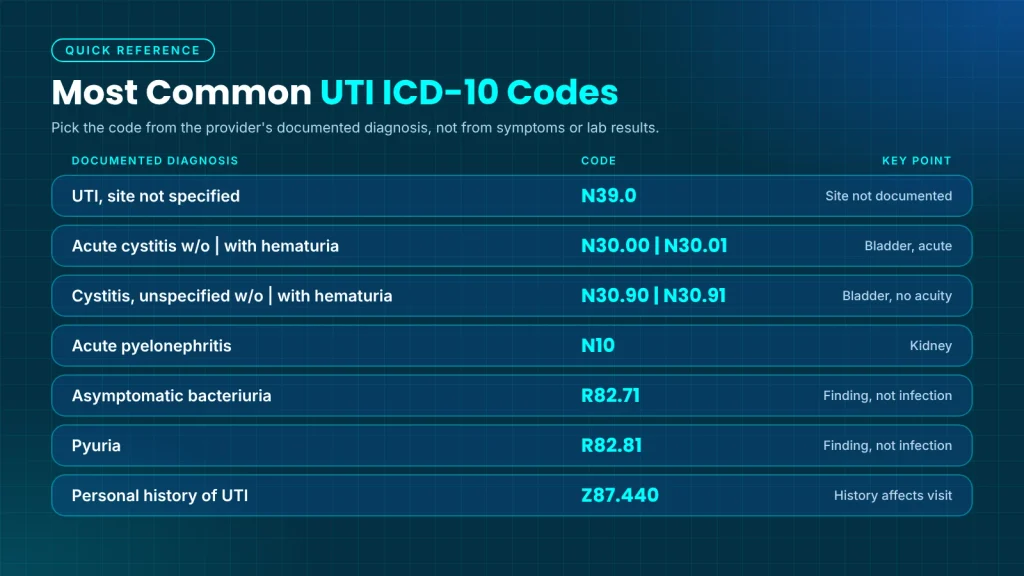
| Documented diagnosis | Code |
| UTI, site not specified | N39.0 |
| Acute cystitis without / with hematuria | N30.00 / N30.01 |
| Cystitis, unspecified without / with hematuria | N30.90 / N30.91 |
| Acute pyelonephritis | N10 |
| Asymptomatic bacteriuria | R82.71 |
| Pyuria | R82.81 |
| Personal history of UTI | Z87.440 |
Why Coders Should Not Assume the Site
ICD-10-CM guidelines require coders to code from provider documentation, not from their own clinical interpretation. Suprapubic pain may suggest bladder involvement, and fever with flank pain may suggest kidney involvement, but a coder cannot turn “UTI” into “acute cystitis” or “pyelonephritis” from those clues alone.
If the record contains signs that point to a more specific diagnosis, the right step is a provider query, not an assumption. The provider either clarifies the site or confirms that “UTI, site not specified” is the most accurate diagnosis.
When Should N39.0 Not Be Used?
N39.0 is a default code, not a catch-all. Do not use it when documentation supports something more specific or something different:
| Documented condition | Use instead of N39.0 |
| Cystitis (any type) | N30.- category |
| Acute cystitis | N30.00 or N30.01 |
| Acute pyelonephritis | N10 |
| Pyonephrosis | N13.6 |
| Urethritis | N34.- category |
| Asymptomatic bacteriuria | R82.71 |
| Pyuria without diagnosed infection | R82.81 |
| Candidal cystitis/urethritis | B37.41 |
| Neonatal UTI | P39.3 |
| UTI in pregnancy | O23.- category |
| Urinary symptoms only, no diagnosis | Symptom codes (R30–R39) |
ICD-10 Codes for Different Types of Urinary Tract Infections
This is where most of the real coding decisions happen. “UTI” covers several distinct conditions in ICD-10-CM, each with its own code logic.
ICD-10 Code for Unspecified UTI
Code: N39.0
Documentation requirements:
- The provider establishes “urinary tract infection,” “UTI” or equivalent wording as a diagnosis, not as a “rule-out” or “possible” diagnosis in the outpatient setting.
- No specific site is documented.
- The infectious agent is supported by the medical record, if an organism code is to be added.
Common scenarios:
- Primary care visit: A 34-year-old woman reports burning on urination for two days. UA is positive for nitrites. Assessment: “Uncomplicated UTI, start nitrofurantoin.” → N39.0
- Urgent care: A patient with urinary frequency and cloudy urine. Assessment: “UTI, culture sent.” → N39.0. If culture results come back on a later encounter and support the organism, a B-code can be added then.
- Telehealth follow-up: “UTI resolving on antibiotics.” → N39.0 remains appropriate while the provider is still treating an active infection.
ICD-10 Codes for Cystitis
Cystitis means inflammation of the bladder, usually from infection. ICD-10-CM places it in category N30, where the fifth character tells you whether hematuria is present:
- 0 = without hematuria
- 1 = with hematuria
The most commonly used cystitis codes:
| Code | Description |
| N30.00 | Acute cystitis without hematuria |
| N30.01 | Acute cystitis with hematuria |
| N30.90 | Cystitis, unspecified without hematuria |
| N30.91 | Cystitis, unspecified with hematuria |
Other N30 subcategories used in specialty settings, especially urology:
| Code range | Description |
| N30.10 / N30.11 | Interstitial cystitis (chronic), without / with hematuria |
| N30.20 / N30.21 | Other chronic cystitis, without / with hematuria |
| N30.30 / N30.31 | Trigonitis, without / with hematuria |
| N30.40 / N30.41 | Irradiation cystitis, without / with hematuria |
| N30.80 / N30.81 | Other cystitis, without / with hematuria |
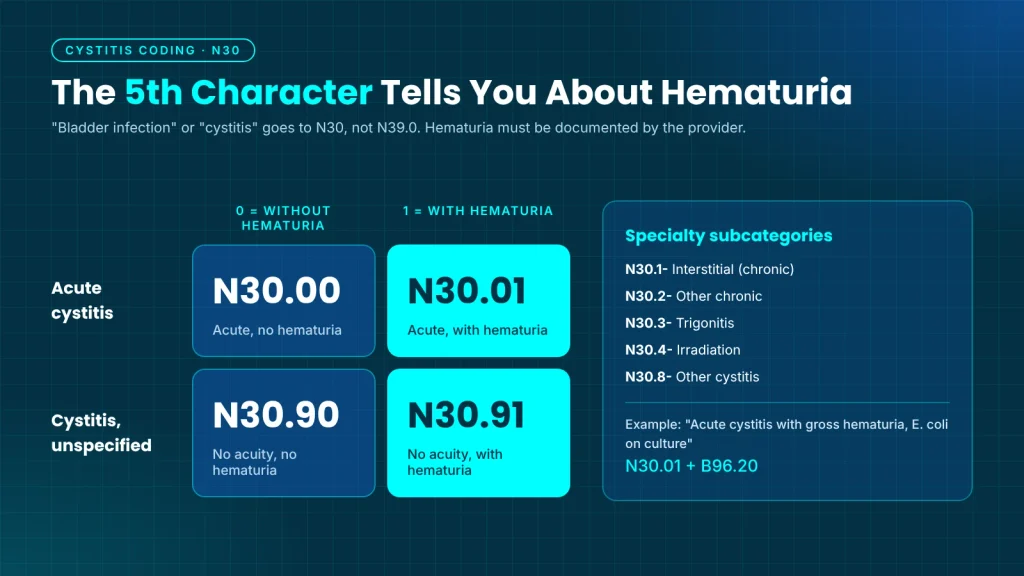
How to choose between them:
- Is cystitis documented? If the provider writes “bladder infection” or “cystitis,” you are in N30, not N39.0. ICD-10-CM indexes “bladder infection” to cystitis.
- Is acuity documented? “Acute cystitis” goes to N30.0-. “Cystitis” with no acuity goes to N30.9-.
- Is hematuria documented? If the provider documents hematuria as part of the cystitis, use the “with hematuria” code (N30.01 or N30.91). A positive blood result on a dipstick that the provider never mentions in the assessment is not enough.
Hematuria is built into these combination codes, so you generally do not add a separate R31.- hematuria code when you report N30.01 or N30.91.
Example: “Acute cystitis with gross hematuria, E. coli on culture.” → N30.01 + B96.20
ICD-10 Code for Recurrent UTI
Clinically, recurrent UTI usually means two or more infections in six months or three or more in a year. Recurrence is a pattern over time, not a separate infection type. That has direct consequences for coding.
There is no single dedicated “recurrent UTI” code in ICD-10-CM. Code selection depends on what is happening at the current encounter.
Scenario A: Active infection in a patient with recurrent UTIs
The patient has a current, documented UTI or cystitis. Code the active infection by its documented site and type (N39.0, N30.00, N30.01 and so on). The recurrent pattern does not change the code for the active infection.
Scenario B: No active infection; the visit concerns the history
A patient returns for a prophylaxis discussion, a urology consult on prevention, or post-treatment follow-up, and the infection has resolved. Do not use N39.0, because there is no current infection.
About Z87.440: Z87.440 describes a personal history of urinary tract infections. Report it when the provider documents a relevant history of previous infections and that history affects the current encounter, for example by guiding prophylaxis, imaging or a referral. Do not assign it automatically just because the provider uses the term “recurrent UTI.” When an active infection is present, code the current infection according to its documented site and type. If the visit is follow-up after completed treatment, a Z09 follow-up code with Z87.440 may apply according to the guidelines.
Scenario C: Workup for an underlying cause
If the provider evaluates recurrent infections and identifies a cause, such as vesicoureteral reflux, urinary retention, a stone or a structural abnormality, code that condition too, because it supports the medical necessity of imaging or cystoscopy.
What coders must avoid:
- Inferring “recurrent” from several unrelated encounters in the chart. Only the provider can establish recurrence.
- Assuming that a recurrent UTI is cystitis or that it involves the same organism as before.
- Reporting an active infection code at a visit where the provider documents that the infection has resolved.
ICD-10 Code for UTI Caused by a Specific Organism
The organism matters because it affects treatment, antimicrobial stewardship, quality data and sometimes risk adjustment. N39.0 and the N30 codes carry a “use additional code” instruction to report the bacterial agent with a code from B95–B97.
Common organism codes in UTI coding:
| Organism | ICD-10-CM code |
| Escherichia coli, unspecified | B96.20 |
| Pseudomonas (aeruginosa) | B96.5 |
| Klebsiella pneumoniae | B96.1 |
| Proteus (mirabilis) (morganii) | B96.4 |
| Enterococcus | B95.2 |
| Staphylococcus aureus, methicillin susceptible | B95.61 |
| Staphylococcus aureus, methicillin resistant | B95.62 |
| Streptococcus, group B | B95.1 |
Pseudomonas UTI example
A patient presents with dysuria and fever. Culture grows Pseudomonas aeruginosa. Provider assessment: “UTI due to Pseudomonas, start ciprofloxacin.”
→ N39.0 + B96.5
If the provider documents a specific site, for example “acute cystitis due to Pseudomonas without hematuria,” the codes become N30.00 + B96.5.
Drug resistance: When resistance is documented, such as an ESBL-producing organism, add the matching Z16. code (for example, Z16.12 for extended spectrum beta lactamase resistance). Check the applicable sequencing notes.
How to use culture results correctly:
When a UTI is established, assign an additional B95–B97 code when the infectious agent is supported by the medical record and applicable coding guidance. Do not independently diagnose a UTI or assume that a positive culture represents an active infection. If the relationship between the organism and the documented infection is unclear, follow your organization’s coding policy or query the provider.
Do not assume E. coli. E. coli is the most common cause of UTIs, but “most common” is not documented. If the record does not support an organism, report only the infection code.
Special UTI Situations Coders Should Know
Catheter-associated UTI (CAUTI): When the provider documents that the infection is due to an indwelling urethral catheter, report T83.511- (Infection and inflammatory reaction due to indwelling urethral catheter) with the correct seventh character: A for the initial encounter, D for a subsequent encounter or S for sequela. The T83.511- code carries an instruction to use an additional code to identify the infection, such as N39.0 or a more specific site code, plus the organism code when supported. Confirm the causal relationship first. A UTI in a patient who happens to have a catheter is not automatically catheter-associated. Other catheter types, such as cystostomy or nephrostomy catheters, have their own T83.51- codes.
UTI in pregnancy: Chapter 15 codes take priority. Use O23.4- (unspecified infection of urinary tract in pregnancy) or a more specific O23.- code for the trimester and site, rather than N39.0 as the primary code. Postpartum UTI goes to O86.2.
Neonatal UTI: P39.3 is used for infections specific to the perinatal period. N39.0 carries an Excludes1 note for it.
UTI with sepsis: If the provider documents sepsis due to a UTI, the systemic infection code (for example, A41.51 for sepsis due to E. coli) is generally sequenced first, followed by the localized infection code. Severe sepsis adds R65.2-. Sequencing depends on the sepsis section of the Official Guidelines and on the complication guidelines, especially when the infection is device-related, such as a catheter-associated infection. In those cases, the complication code may need to be sequenced first. These cases carry high audit risk in hospital billing, so review them carefully.
Fungal UTI: Candidal infections go to B37.4- (for example, B37.41, candidal cystitis and urethritis), not N39.0.
ICD-10 Codes for Other Related Urinary Conditions
These conditions are often confused with UTI on claims. They are clinically and code-wise distinct.
Pyuria – R82.81
Pyuria means white blood cells in the urine. It is a lab finding, not an infection diagnosis. It can occur with sterile inflammation, stones, interstitial cystitis or recent antibiotics. Code R82.81 when the provider documents pyuria as the finding without diagnosing a UTI. N39.0 and R82.81 generally should not be reported together for the same urinary condition because of the Excludes1 note. An exception may apply when the conditions are clearly unrelated, consistent with the Official ICD-10-CM Guidelines.
Asymptomatic bacteriuria – R82.71
Bacteria in the urine without urinary symptoms attributable to infection. Major clinical guidelines, including those from the Infectious Diseases Society of America, generally recommend against screening for or treating it in most nonpregnant adults. Coding R82.71 as N39.0 misstates the patient’s condition and can distort quality reporting on antibiotic use. In pregnancy, asymptomatic bacteriuria is coded in Chapter 15 (O23.- category) per the index instructions.
Bladder infection
“Bladder infection” indexes to cystitis (N30.-). It is not an unspecified UTI.
Urethritis – N34.-
Inflammation of the urethra. N34.1 covers nonspecific urethritis, and N34.2 covers other urethritis. Sexually transmitted urethritis (gonococcal, chlamydial) is classified in Chapter 1 infectious disease codes instead.
Pyelonephritis – N10, N11.-, N12
Kidney infection. N10 is acute pyelonephritis (acute tubulo-interstitial nephritis). Chronic forms go to N11.-. N12 is used for tubulo-interstitial nephritis not specified as acute or chronic. Pyelonephritis is a more serious diagnosis with different treatment intensity, so documentation has to be clear.
None of these conditions is interchangeable with a general UTI diagnosis. Code what the provider documents.
UTI ICD-10 Code Comparison Table
| Condition | ICD-10-CM code | Coding consideration |
| UTI, site not specified | N39.0 | Use when the infection site is not documented |
| Acute cystitis without hematuria | N30.00 | Acute cystitis documented, no hematuria |
| Acute cystitis with hematuria | N30.01 | Hematuria must be documented by the provider |
| Cystitis, unspecified without hematuria | N30.90 | Cystitis documented, no acuity, no hematuria |
| Cystitis, unspecified with hematuria | N30.91 | Cystitis with documented hematuria |
| Acute pyelonephritis | N10 | Kidney infection specifically documented |
| Nonspecific urethritis | N34.1 | Urethral site documented |
| Asymptomatic bacteriuria | R82.71 | Do not automatically classify as symptomatic UTI |
| Pyuria | R82.81 | Finding only; Excludes1 with N39.0 for the same condition |
| Personal history of UTI | Z87.440 | Relevant history documented and affecting the current encounter |
| Infection due to indwelling urethral catheter | T83.511A, T83.511D or T83.511S, as applicable, plus an additional code identifying the infection | Confirm the causal relationship and select the appropriate encounter character |
| UTI in pregnancy, unspecified | O23.4- | Chapter 15 codes take priority |
| Neonatal UTI | P39.3 | Perinatal period infection |
| E. coli (as cause) | B96.20 | Additional code; organism must be supported by the record |
| Pseudomonas (as cause) | B96.5 | Additional code; organism must be supported by the record |
Verify each code’s current-year descriptor, inclusion and exclusion notes and applicable guidelines in the official FY2027 ICD-10-CM files before final assignment.
How to Choose the Correct ICD-10 Code for UTI
A consistent decision process keeps code selection accurate across coders and providers. Use these steps for every UTI-related encounter.
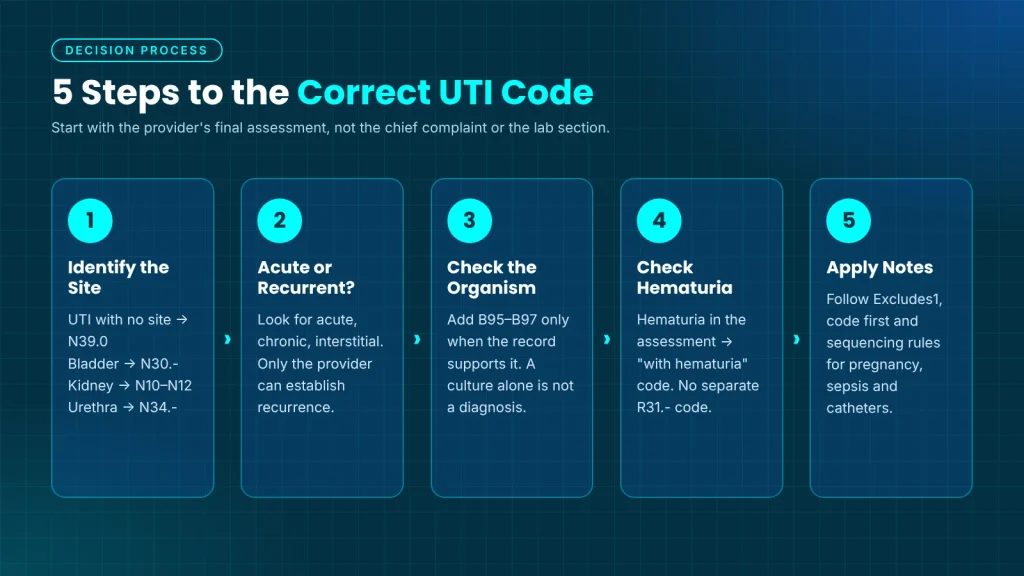
Step 1: Identify the Documented Infection Site
Start with the provider’s final assessment, not the chief complaint or the lab section.
- Does the provider document “UTI” without a location? → N39.0
- Is it cystitis or bladder infection? → N30.-
- Is it pyelonephritis or kidney infection? → N10 / N11.- / N12
- Is it urethritis? → N34.-
- Is the patient pregnant, a neonate or catheterized? → Check the special rules first.
Avoid coding from symptoms. “Dysuria, frequency, suprapubic pain” in the HPI is not a diagnosis.
Also watch for uncertain diagnoses. In the outpatient setting (Section IV.H of the Official Guidelines), do not code diagnoses documented as “probable,” “suspected,” “likely” or “rule out.” Code the symptoms or findings instead. In the inpatient setting (Section II.H), uncertain diagnoses documented at discharge may be coded as if confirmed. This difference is a common source of outpatient UTI errors.
Step 2: Determine Whether the Infection Is Acute or Recurrent
- Look for acuity terms: “acute,” “chronic,” “interstitial.”
- Separate an active infection from a history of infections.
- Do not infer recurrence from several separate visits. Only the provider establishes that a patient has recurrent UTIs.
Step 3: Review Culture and Organism Documentation
- Check whether a urine culture was ordered and whether results are available for the date of service.
- Once the provider has established the UTI, confirm that the organism is supported by the medical record and applicable coding guidance.
- If the relationship between the organism and the infection is unclear, follow your coding policy or query the provider.
- Never use a positive culture alone to create a UTI diagnosis.
- Check for documented drug resistance (Z16.- codes).
Step 4: Check for Hematuria and Other Associated Findings
- For cystitis, decide between “with” and “without” hematuria from what the provider documents.
- Keep the three urine findings separate: hematuria (blood, R31.-), pyuria (white cells, R82.81) and bacteriuria (bacteria, R82.71).
- Do not add findings as separate diagnoses when they are part of an established diagnosis. Signs and symptoms routinely associated with a confirmed diagnosis are generally not coded separately (Section I.B.5 of the guidelines).
Step 5: Apply Sequencing and Instructional Notes
- Follow “code first” and “use additional code” instructions.
- Respect Excludes1 notes (for example, N39.0 with N30.- or with R82.81 for the same condition), and apply the unrelated-conditions exception only when it is supported by the guidelines.
- Sequence complication, pregnancy and sepsis codes according to the chapter-specific guidelines.
UTI Symptoms vs. Confirmed Diagnosis: What Coders Should Know
A large share of UTI coding errors comes from mixing up three separate things: symptoms, lab findings and the provider’s diagnosis.

Common UTI-related symptoms and their typical codes:
| Symptom | Typical code |
| Dysuria (painful urination) | R30.0 |
| Urinary frequency | R35.0 |
| Urinary urgency | R39.15 |
| Hematuria, unspecified | R31.9 |
| Fever, unspecified | R50.9 |
| Pelvic and perineal pain | R10.2 |
Suprapubic discomfort and flank pain should be coded from the exact wording in the record, using the ICD-10-CM Alphabetic Index, because the terms index to different abdominal pain codes.
How the three levels differ:
- Symptoms are what the patient reports, such as burning, urgency or pain.
- Lab findings are what the tests show, such as positive nitrites, leukocytes, bacteria or blood.
- Diagnosis is the provider’s clinical conclusion after weighing symptoms and findings.
Only the provider-established diagnosis drives the infection code.
Example 1: Symptoms without a diagnosis
A patient reports painful urination and frequency. The provider orders a culture and writes, “Dysuria and frequency, await culture before diagnosis.” No UTI is established.
→ Code R30.0 + R35.0, not N39.0.
Example 2: Suspected UTI in the outpatient setting
Assessment: “Probable UTI, empiric treatment started.”
→ In an outpatient setting, “probable” cannot be coded as confirmed. Code the symptoms. Many providers will clarify the diagnosis when queried, because they are treating it as an infection.
Example 3: Confirmed diagnosis
Assessment: “Acute cystitis without hematuria.”
→ N30.00. Dysuria and frequency are integral to cystitis, so do not code them separately.
Example 4: Abnormal UA without symptoms
A routine pre-op UA shows bacteria, and the patient has no symptoms. Provider: “Asymptomatic bacteriuria, no treatment indicated.”
→ R82.71, not N39.0.
A Quick Note on “U/A ICD-10 Code”
Many people search for a “u/a ICD-10 code,” but a urinalysis (U/A) is a test, not a diagnosis. There is no ICD-10-CM code for “urinalysis” as such. The procedure is billed with CPT codes (for example, 81000–81003 depending on method and automation, or 87086/87088 for urine culture). The ICD-10-CM code on the claim is the reason the test was ordered: a symptom (R30.0), a diagnosis (N39.0, N30.00) or, for a screening context, the appropriate Z code. Abnormal results without a diagnosis use the R82.- category.
Documentation Requirements for UTI ICD-10 Coding
Essential Clinical Documentation
For accurate and defensible UTI coding, the record should include:
- The provider’s final diagnosis, stated clearly in the assessment.
- Infection site, if known (bladder, urethra, kidney or unspecified).
- Type or acuity, such as acute, chronic or interstitial.
- Relevant symptoms and clinical findings that support the diagnosis.
- Urine test results, including UA and culture, when performed.
- Organism identification, when supported by the record.
- Associated findings, such as hematuria, and whether they are part of the diagnosis.
- Complicating factors, such as pregnancy, catheter use and its relationship to the infection, immunosuppression, structural abnormality or sepsis.
- Treatment and follow-up plan, including antibiotics, culture follow-up and return precautions.
Common UTI Documentation Gaps
These gaps lead to vague codes, queries and denials:
- UTI is documented with no site when clinical findings point to a specific location (for example, CVA tenderness and fever but only “UTI” in the assessment).
- Cystitis documented without acuity or hematuria status, which forces the less specific N30.9- code.
- Organisms in the lab report with an unclear link to the documented infection, which may need a query before a B-code is added.
- Symptoms documented with no diagnosis, especially when the provider is clearly treating an infection.
- “Recurrent UTI” in the problem list without saying whether there is an active infection today or how the history affects the visit.
- Catheter present but no documented link between the catheter and the infection, which is needed for the T83.511- complication code.
- Copy-forward problem lists that carry “UTI” into later visits after it has resolved.
A periodic medical billing audit is one of the most effective ways to find these patterns across providers, because single claims rarely show them.
Medical Billing Guidelines for UTI Diagnosis Codes
Correct ICD-10 selection is only half the work. The diagnosis also has to support each service on the claim.
Linking UTI Diagnosis Codes to Services
A typical UTI encounter may include:
- Office or outpatient E/M visit (99202–99215), based on medical decision making or time
- Urinalysis (81000–81003), often CLIA-waived dipstick testing in the office
- Urine culture (87086, 87088) and susceptibility testing (87186 and related codes)
- Medication management for antibiotic treatment
- Follow-up visits to confirm resolution or review culture results
On the CMS-1500 claim, each service line uses diagnosis pointers to show which diagnosis supports it. Common rules:
- The pointer for each service should point to the diagnosis that explains why that service was done.
- If a UA was ordered because of dysuria and the provider then diagnosed a UTI, the UA can point to the UTI diagnosis (or the symptom, depending on payer policy and the order).
- Do not attach a UTI code to unrelated services at the same visit, such as a vaccine, a diabetic foot exam or a wellness component. Those need their own supporting diagnoses.
- When a preventive visit and a problem-oriented UTI visit happen on the same day, the problem visit may need modifier 25 and its own diagnosis linkage.
UTI Coding and Medical Necessity
Payers decide whether a service was reasonable and necessary based on the diagnosis codes submitted and the supporting documentation. For UTI-related testing:
- Medicare’s National Coverage Determination for urine culture (NCD 190.12) lists covered indications and ICD-10-CM codes. Cultures billed with diagnoses outside that list may be denied unless additional documentation supports them. Reflex cultures and repeat cultures are frequent targets.
- Screening urinalysis: Routine screening urinalysis in asymptomatic patients is generally not covered by Medicare unless a specific covered indication applies. Although screening for asymptomatic bacteriuria may be clinically recommended during pregnancy, CMS NCD 190.12 treats this testing as screening and states that it is not covered under Medicare. Commercial and other government payers may apply different coverage rules. Verify the applicable payer policy before billing.
- Commercial payers follow their own medical policies, which may limit repeat cultures, test-of-cure cultures or certain molecular urine panels.
Coverage depends on the payer, the plan, the place of service and the clinical documentation. A diagnosis code alone never guarantees payment for a test. Checking benefits up front with insurance eligibility verification helps avoid surprises, especially for higher-cost urine pathogen panels.
Common UTI Billing and Coding Errors
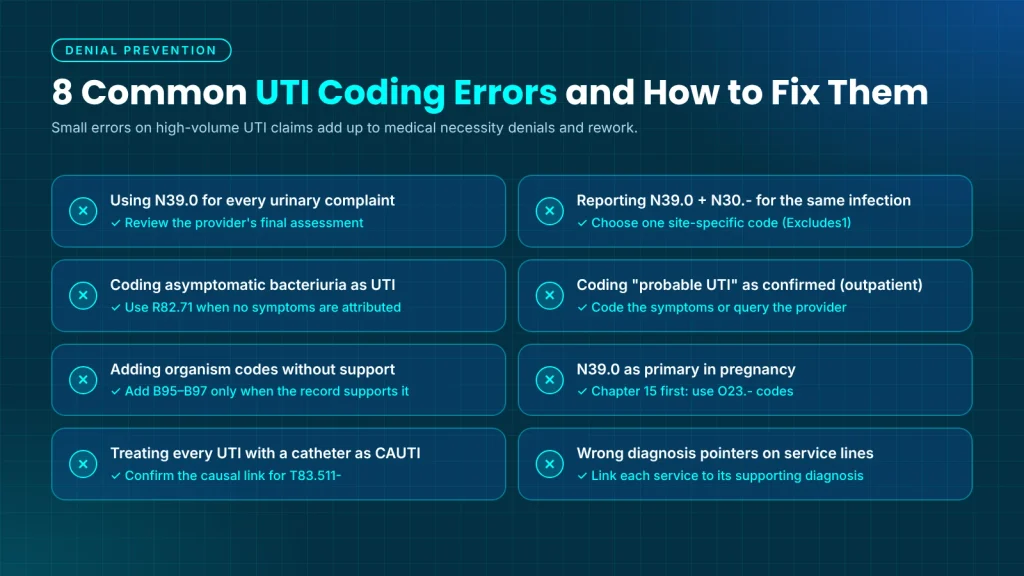
| Common error | Why it creates a problem | Prevention |
| Using N39.0 for every urinary complaint | Diagnosis may not support an actual UTI | Review the provider’s final assessment |
| Confusing cystitis with unspecified UTI | Code does not reflect the documented infection | Use the most specific supported diagnosis |
| Reporting N39.0 and N30.- for the same infection | Excludes1 conflict; triggers claim edits | Choose one site-appropriate code |
| Coding asymptomatic bacteriuria as UTI | Different clinical conditions; distorts quality data | Check symptoms and provider documentation |
| Assigning organism codes without support | Organism may not be related to the documented infection | Code organisms supported by the record; query when unclear |
| Missing hematuria details | Wrong cystitis code (with vs. without) | Confirm hematuria in the assessment |
| Coding “probable UTI” as confirmed (outpatient) | Violates the outpatient uncertain diagnosis rule | Code symptoms or query the provider |
| Incorrect diagnosis pointers | Services lack medical necessity support | Link each service to its supporting diagnosis |
| N39.0 as primary in pregnancy | Chapter 15 codes take sequencing priority | Use O23.- codes |
| Assuming every UTI with a catheter is a CAUTI | Overstates a complication without documentation | Confirm the causal link and the 7th character |
How to Prevent UTI Coding Denials
UTI claims are high-volume and usually low-dollar, so small error rates add up quickly. A few controls stop most avoidable denials.
Verify the Diagnosis Before Claim Submission
Before coding, confirm that the assessment contains a definitive diagnosis, not just symptoms or “rule-out” wording. If the documentation is unclear, query the provider before the claim goes out. Fixing a claim after a denial costs far more than a quick pre-bill query.
Confirm Code Specificity and Current ICD-10-CM Guidelines
Update encoders, EHR pick lists and superbills every October when the new ICD-10-CM fiscal-year code set takes effect. Before you make those updates, check code descriptors and Excludes notes against the official ICD-10-CM files published by CDC/NCHS. Remove outdated favorites lists that push providers toward N39.0 by default. Train providers to document site, acuity, organism and hematuria when known.
Review Laboratory Findings and Provider Documentation
Compare culture results and UA findings against the provider’s assessment. Mismatches cause errors in both directions: an organism coded without a clear relationship to the documented infection, or a well-supported organism that never made it onto the claim.
Check Medical Necessity and Payer Policies
For each urine test billed, check that the linked diagnosis meets the payer’s coverage rules, particularly Medicare’s urine culture NCD and any commercial policy on molecular testing. Obtain an Advance Beneficiary Notice (ABN) when Medicare coverage is uncertain. Automated claim scrubbing catches many Excludes1 conflicts, pointer errors and NCD mismatches before submission.
Audit Rejected and Denied UTI Claims
Track UTI-related denials by reason code. Common denial situations include:
- The diagnosis does not support the service (often urine cultures or panels)
- Missing or unclear documentation
- Incorrect diagnosis selection, such as Excludes1 conflicts
- Medical necessity not established
- Duplicate or inconsistent claim information, such as repeated cultures on the same date
Correct and resubmit or appeal denied claims quickly. The longer a claim ages, the harder it is to collect. Stream RCM’s guide on how to prioritize unpaid medical claims before they reach 90 days explains how to sort and work these accounts.
How Medical Billing Services Help Improve UTI Claim Accuracy
Most practices do not lose UTI revenue through one big mistake. They lose it through many small, repeated ones: the wrong default code, a missed pointer, a culture that does not meet policy. A dedicated billing and coding partner tackles those patterns systematically.
Accurate Medical Coding
Certified coders review the assessment, labs and orders together, then:
- Select the most specific supported ICD-10-CM code
- Apply instructional notes, Excludes1 rules and sequencing guidelines
- Add organism, resistance and complication codes when the record supports them
- Send compliant provider queries when the documentation is unclear
Stream RCM’s medical coding services cover primary care, urology-related services, OB/GYN and other specialties that see UTIs often. For family medicine practices, where UTIs are among the most common acute visits, see Stream RCM’s family practice billing services.
Clean Claim Submission
Before a claim is sent, it should pass checks for:
- Accurate diagnosis pointers on each service line
- Payer-specific edits and NCD/LCD requirements
- Modifier use (for example, modifier 25 on same-day preventive and problem visits)
- Patient demographic and eligibility accuracy
A clean claim is paid on first submission without rework. Stream RCM’s medical claim submission services focus on getting claims out accurately and on time.
Denial Management and A/R Follow-Up
When UTI claims are denied, a structured process:
- Groups denials by root cause (coding, documentation, medical necessity, eligibility)
- Corrects and resubmits claims, or files appeals with supporting documentation
- Gives providers feedback so the same issues do not keep coming back
- Follows up on unpaid and rejected claims before they reach timely filing limits
Stream RCM provides denial management services and accounts receivable follow-up to recover revenue and shorten the payment cycle.
Why Healthcare Practices Outsource Medical Billing
Practices outsource billing to:
- Reduce administrative workload, so clinical staff are not chasing claims
- Improve coding consistency across providers and locations
- Submit and follow up on claims on time, keeping A/R days under control
- Get visibility into performance through reporting on denial rate, clean claim rate and collections
If you are evaluating options, Stream RCM’s articles on how to choose the right medical billing company and questions to ask before choosing a medical billing company are a practical place to start. You can also review the medical billing KPIs every practice should track to measure where your current process stands.

Final Thoughts on ICD-10 Codes for UTI
Choosing the right ICD-10 code for UTI takes more than memorizing N39.0. The main points:
- N39.0 is the correct code for a UTI when the provider does not document the site.
- More specific conditions have their own codes: cystitis (N30.-), pyelonephritis (N10–N12), urethritis (N34.-), pregnancy-related UTI (O23.-), neonatal UTI (P39.3) and documented catheter-associated infection (T83.511- with the correct seventh character).
- Recurrent UTI, cystitis, asymptomatic bacteriuria and pyuria are not interchangeable. Each represents a different clinical picture.
- Organism codes (B95–B97) belong on the claim when a UTI is established and the organism is supported by the record.
- Provider documentation decides code selection. Coders should query rather than assume.
- Accurate diagnosis linkage and pre-submission claim review prevent most avoidable UTI denials.
Small coding decisions on high-volume diagnoses like UTI have an outsized effect on a practice’s clean claim rate, denial rate and cash flow. A structured coding and billing process keeps every UTI claim accurate, compliant and paid on time.
Stream RCM helps physician practices, primary care groups and specialty providers strengthen their entire revenue cycle management process, from coding and claim submission to denial management and A/R recovery. Contact Stream RCM or request a free billing audit to find out where your UTI claims, and the rest of your revenue cycle, can improve.
Frequently Asked Questions About UTI ICD-10 Codes
What is the ICD-10 code for UTI?
The ICD-10-CM code most commonly used for UTI is N39.0, Urinary tract infection, site not specified. Use it when the provider diagnoses a urinary tract infection but does not document whether the bladder, urethra or kidney is involved. If a specific site is documented, use that site’s code instead.
What is the ICD-10 code for an unspecified UTI?
An unspecified UTI is coded as N39.0. “Unspecified” here refers to the site of infection, not to the certainty of the diagnosis. The provider must still clearly establish a UTI. In outpatient settings, “possible” or “probable” UTI should not be coded as N39.0.
What does N39.0 mean?
N39.0 stands for “Urinary tract infection, site not specified.” It is a billable code in Chapter 14 (Genitourinary System). It carries an instruction to add a B95–B97 code for the infectious agent when supported, and Excludes1 notes for cystitis, urethritis, pyonephrosis, pyuria, neonatal UTI and candidal infections.
What is the ICD-10 code for recurrent UTI?
ICD-10-CM has no single code for recurrent UTI. If the patient has an active infection, code it by its documented site (for example, N39.0 or N30.00). Z87.440, Personal history of urinary (tract) infections, applies when a documented history affects the current encounter. It is not assigned automatically just because “recurrent” is mentioned.
What is the ICD-10 code for cystitis?
Cystitis codes are in category N30. Acute cystitis is N30.00 (without hematuria) or N30.01 (with hematuria). Cystitis without stated acuity is N30.90 or N30.91. Chronic, interstitial, irradiation and other types have their own subcategories. The choice depends on documented type and hematuria status.
What is the ICD-10 code for cystitis with hematuria?
Use N30.01 for acute cystitis with hematuria, or N30.91 for cystitis, unspecified, with hematuria. Hematuria must be documented by the provider as part of the diagnosis. These combination codes include the hematuria, so a separate R31.- code is generally not needed.
What is the ICD-10 code for a Pseudomonas UTI?
Code the infection first, using N39.0 for an unspecified site or a site-specific code such as N30.00, then add B96.5 for Pseudomonas when the organism is supported by the medical record. Add a Z16.- code if drug resistance is documented, following the applicable sequencing notes.
Is asymptomatic bacteriuria the same as a UTI?
No. Asymptomatic bacteriuria means bacteria in the urine without symptoms attributable to infection. Outside of pregnancy it is coded as R82.71, not N39.0. Most clinical guidelines advise against treating it in nonpregnant adults, so coding it as a UTI misrepresents the patient’s condition.
Can N39.0 be used for a positive urine culture?
Not automatically. A positive culture is a lab result, not a diagnosis. N39.0 needs the provider to establish a UTI. If the provider documents bacteria without infection, use R82.71 or another R82.- finding code. If the documentation is unclear, query the provider.
What diagnosis code is used for pyuria?
Pyuria is coded as R82.81 when white blood cells in the urine are documented as a finding without a diagnosed infection. Because of an Excludes1 note, R82.81 generally should not be reported with N39.0 for the same condition, unless the conditions are clearly unrelated under the Official Guidelines.