


Picture a three-provider family practice. The doctors are great, the schedule is full, and yet the bank account never quite reflects how busy everyone is. Claims sit in limbo. Denials pile up in a folder nobody has time to open. The office manager spends Friday afternoons on hold with insurance companies instead of helping patients.
Sound familiar? That’s usually the moment a practice starts looking into medical billing outsourcing. It’s also the moment many make their most expensive mistake: picking a billing company based on a polished website and a low quote.
The smarter move is to ask the right questions before you sign anything. This guide covers the 10 questions to ask before hiring a medical billing company, what a strong answer sounds like, and which answers should send you looking elsewhere. It’s written with medical billing for small practices in mind, but the questions work for any group that wants to know how to choose a medical billing company without regrets.
Why the Right Questions Matter More Than the Sales Pitch
All medical billing companies promise the same thing. Better collection rates. Fewer claim denials. Prompt payment. Dedicated support team. The same pitch on a sales call.
It’s in the little things that they differ like who codes your claims, how a denial is handled at 3 PM on a busy Thursday, what will happen to your information should you ever decide to switch, and what your bill will look like three months from now. Those answers can only be found through direct questioning.
And there is a lot riding on this decision. Reimbursement is the very breath of life in any practice, especially in smaller ones where there is no margin for error. Three months’ worth of bad bills could spell delays in hiring, equipment purchases, or even paying your bills. Switching over to another billing company down the line is always an option, but it is a mess to do.
So consider the next ten questions a matter of basic due diligence. Don’t hesitate to ask them out loud and in writing. And see how they’re answered.
Before You Start Interviewing: Know Your Own Numbers
Without knowing where you stand, you can’t evaluate a billing company’s claims. Get a quick assessment of your practice before you make that call:
Collections per month from both insurance companies and patients
- A/R days – the time it takes for you to get paid on average. A goal to remain below 40 is quite common.
- Denial rate – the percentage of rejected claims
- Clean claims rate – the percentage of the claims which are accepted at the first submission. A goal to reach 95% or higher is quite common.
- Aged A/R – the total of money pending payment for over 90 days
- Payer mix – your top five payers and approximate percentage of contributions from them
- The tools you use – EHR, practice management software, clearinghouse
- What is actually going wrong – payment delays, frequent denials, coding issues, high employee turnover or all of the above
After that, decide which tasks you intend to delegate. Some practices outsource everything starting from eligibility checks and ending with patient statements. Others need help only with coding or denials. That will allow you to get consistent quotes as you’ll ask the same questions to everyone.
If you feel stuck on any of this, a medical billing consultant or an outside audit can give you an unbiased baseline before you commit to a long-term partner. More on that shortly. For now, keep your snapshot handy. It’s the yardstick for every answer you’re about to hear.
The 10 Questions to Ask Before Hiring a Medical Billing Company
1. What exactly is included in your services, and what costs extra?
Start here, because everything else hangs on it. “Full-service” means different things at different companies. For one, it covers everything from eligibility checks to patient statements. For another, it’s claim submission and not much more.
Request that they take you through the full revenue cycle process from start to finish: insurance eligibility, preauthorization, charge capture, coding, submission of claims, payment posting, denial management, collections, patient billing, credentialing, and reporting. Then ask one question for each part: is this your responsibility or ours?
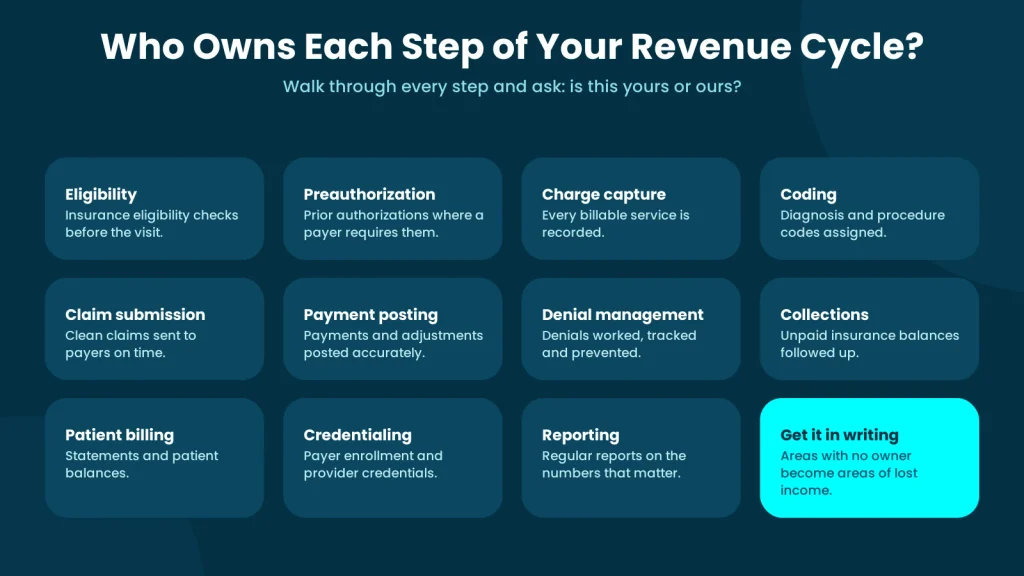
Why it matters: areas of responsibility become areas of lost income if there is no accountability.
Ideal response: an outlined scope of work detailing responsibilities and services billed separately, like credentialing, appeals, patient billing, or clearinghouse fees.
Red flag response: “We do it all,” but without anything in writing.
If you’re comparing options, it also helps to see how a provider structures its medical billing outsourcing services end to end, since the best ones are specific about what happens at each step.
2. Have you worked with practices like mine, in my specialty and at my size?
Experience with medical billing companies is not just about how many years they have been in business; it is about how many years they have done business in your specialty, with your payers, and in your practice size range. A firm that has excellent records with a major hospital group might consider a three-doctor practice as an afterthought.
Inquire about their experience with practices of your size and specialty and the types of payers they work with most. Inquire about who works for the firm and what their credentials are. The real key issue here, though, is whether the firm will give you names of several other clients in your specialty.
When you call these references, don’t simply ask whether they are satisfied with the service. Instead, inquire about how quickly any problems were corrected, how clear reporting was, whether results were as promised, and if they would rehire the company.
Positive response: specific details on their client experience with your specialty, your payers, and their client references.
Negative sign: unwillingness to provide client references or a pitch that never mentions your specialty.
3. How do you price your services, and what will I really pay?
Medical billing service cost is the question everyone asks first, and it’s the one most likely to produce a misleading answer. Companies typically price in one of four ways:
- Percentage of collections. The most common model. You pay a percentage of what’s actually collected, so the company earns more when you do.
- Flat monthly fee. Predictable, but make sure it still rewards performance.
- Per-claim fee. Works for some low-volume practices, though costs can climb quickly.
- Hybrid. A mix of the above, often a lower percentage plus a monthly minimum.
Medical billing company pricing varies with your specialty, claim volume and the services included, and percentages commonly run from the low single digits up to around 8 or 9 percent. Here’s a quick example. If your practice collects $80,000 a month, a 4% fee comes to $3,200, while a 6% fee comes to $4,800. That $1,600 gap matters, but only if the two companies deliver the same results.
That’s the part price comparisons miss. Compare medical billing outsourcing cost against your true cost of billing in-house: salary, benefits, training, software, turnover, and the hours you or your office manager spend supervising. Then look at what a stronger collection rate or fewer denials are worth.
Ask these questions to get the real number:
- What is the percentage based on: collections or charges?
- Are there setup, onboarding or minimum monthly fees?
- Do patient statements, credentialing, appeals or clearinghouse fees cost extra?
- Does the percentage apply to old A/R they recover?
- How and when can rates change?
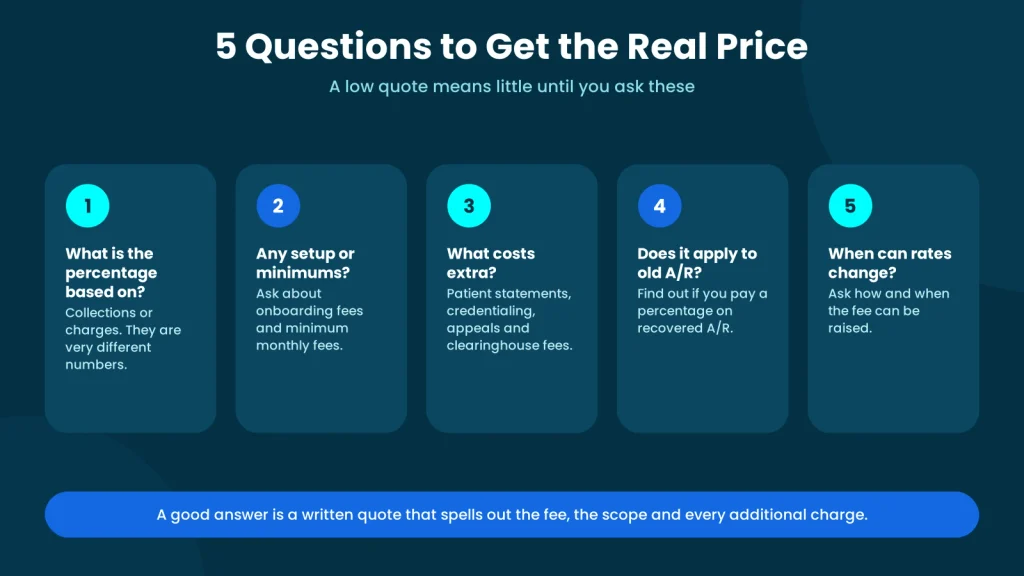
A red flag: a rock-bottom price with no scope attached, or an unwillingness to put anything in writing.
4. Will you audit my current billing before I sign?
A medical billing audit is perhaps one of the best things you can do before picking a business partner, but is one of the most overlooked. An audit will look at a sampling of your claims, coding, denials, aged A/R and payments to pinpoint the areas in which you are losing money. It may even uncover things like undercoding and underpayment issues you were unaware of.
It also gives you a baseline. Without one, you can’t tell later whether a billing company actually improved things or just kept the status quo.
Ask whether they offer an audit, whether it’s free or paid, how many claims and months it covers, and what you’ll receive at the end. Ask, too, whether there’s any obligation attached. If you’d rather have a neutral opinion first, an independent medical billing consultant can do the same job without a stake in your decision.
A good answer: a review of your real claims, delivered as written findings, with no pressure to sign.
A red flag: an “audit” that’s really a sales presentation, or a flat refusal to look at your actual data.
A dedicated medical billing audit is a good way to see how a company thinks before you hand over your revenue cycle.
5. Who does the coding, and how do you keep it accurate?
Coding is where billing accuracy starts. An incorrect code, lack of a modifier or diagnosis which does not justify the procedure will cause an outright denial, underpayment or compliance violation.
Asking if you are thinking of outsourcing medical billing coding to know what kind of people code your claims. Are they certified coders like AAPC or AHIMA coders? Can they code based on your provider documentation? In case of documentation ambiguity, do they send a query to your provider or guess?
Ask about the process through which the company updates their codes. The ICD-10-CM codes get updated every October, the CPT codes are revised every January and your payers keep changing their rules during the year. Asking about the process of coding audit is important too.
A good answer: credentialed coders, a documentation query process, and regular internal accuracy audits.
A red flag: “Our software handles the coding,” with no human review.
Practices that want to see what this looks like in practice can read how medical coding services are structured when certified coders review documentation before a claim is submitted.
6. How do you protect patient data and keep us compliant?
Medical billing compliance has two sides: protecting patient information, and billing correctly. You need answers on both.
Data protection. Under HIPAA, a billing company that handles protected health information is a business associate, which means you need a signed Business Associate Agreement. HHS publishes sample business associate agreement provisions that show what a solid contract should cover. Beyond the paperwork, ask about access controls, encryption, employee training, breach notification procedures and where the work is physically done. If staff outside the United States will see your patient data, you should know about it before you sign.
Billing compliance. Your practice is ultimately responsible for claims submitted in its name, so compliance can’t be fully outsourced. Ask whether the company runs an internal compliance program and regular audits, and how it handles situations where documentation doesn’t support a code. The OIG publishes voluntary compliance guidance for third-party medical billing companies, and a reputable company should be able to explain how its practices line up with it.
A good answer: an immediate yes on the BAA, plus a clear description of training, security controls and audits.
A red flag: hesitation around a BAA, or a vague “we’re HIPAA compliant” with nothing behind it.
7. What’s your process for denials and unpaid claims?
This is the make-or-break area of the process. All practices have denials. The distinction comes in what happens after the fact.
Find out how promptly they handle denials once received and categorize them according to reason – for instance, whether denials are based on eligibility, authorization, coding, documentation or timely filing. Find out if they not only correct individual claims but conduct an analysis by payor and procedure to fix the underlying problem. Ask how frequently and on what schedule they track unpaid claims – 30, 60 and 90 days? Also ask about underpayments – they are often overlooked. Are the payments compared to your contractual rates?
Prevention is equally important. Verifying eligibility ahead of time and obtaining prior authorization when necessary prevents many denials in the first place.
Lastly, ask about their average clean claim rate and days in A/R, as well as how they calculate them.
A good answer: a defined workflow, regular denial reports, and examples of root-cause fixes.
A red flag: impressive percentages that they can’t explain or document.
To see what a structured process looks like, review how denial management services and A/R follow-up are handled in an outsourced model.
8. Which systems do you work in, and who owns my data?
This question gets skipped surprisingly often, and it can cause the biggest headaches later.
First, the practical side. Will the company work inside your current EHR and practice management system, or will they ask you to switch to theirs? Which clearinghouse do they use? Is there a cost for integration? A company that adapts to your setup saves you a painful migration.
Second, ownership. If you part ways, do you get your data back, including claim history, patient ledgers, payer correspondence and reports? In what format, how fast, and at what cost? You should also be able to log in and see your billing data whenever you want, not just when someone sends a report.
A good answer: flexibility on systems, clear data ownership, and an export on request.
A red flag: proprietary lock-in, or any suggestion that your data is “theirs” once it’s in their system.
9. How will I see what’s happening, and who will I talk to?
Handing over your billing doesn’t mean losing sight of it. In fact, the best partners make your revenue cycle easier to see than it was before.
Ask which reports you’ll receive and how often. At a minimum, you want collections, A/R aging, denial rate by payer, clean claim rate, days in A/R and net collection rate. Ask whether you’ll get a dashboard or only a monthly PDF, and ask for a sample report on the call. If they can’t show you one, that’s informative.
Then ask about people. Will you have a named contact who knows your practice, or a shared inbox? How quickly are questions answered? What’s the escalation path when something goes wrong? Are there regular review meetings where someone walks you through the numbers and what they plan to do about them?
A good answer: a sample report, a named contact, and a regular review schedule.
A red flag: a generic support line and reports that arrive without explanation.
10. What does onboarding look like, and how do we leave if it isn’t working?
It may not be fun to start divorce proceedings even before the wedding day, but this particular question helps in that regard.
The first step is onboarding, which usually takes some weeks at best. What do you require in terms of credentialing information, payer portal information, fee schedule, EHR access? What is the procedure for pending claims? Whom will handle your current A/R?
The second step is the actual contract, where you should inquire about the term, auto renewal, the notice period, and the termination fees. Many practices would feel comfortable with having to enter into a contract whose term will be long enough to see tangible results, but not too long so they feel trapped. You also need to inquire if they can commit themselves to certain performance targets, and if not what your remedies would be.
A good answer: a clear onboarding timeline, reasonable contract terms, and a documented transition process in both directions.
A red flag: long lock-ins, automatic renewals, steep exit fees, or pressure to sign this week.
Red Flags That Should Make You Walk Away
Across all ten questions, a few warning signs show up again and again:
- Guaranteed results, like a promised percentage increase in revenue, with no knowledge of your practice
- A quote that can’t be explained line by line
- Reluctance to share references, sample reports or a Business Associate Agreement
- No clear answer on who does the coding or how denials are handled
- Your data held hostage, or vague terms about exiting the contract
- High-pressure tactics and artificial deadlines
- A team that’s hard to reach before you’ve even signed
Trust your instincts. If communication is slow and vague during the sales process, it rarely improves afterward.
A Simple Medical Billing Company Checklist
Use this as a scorecard when you’re comparing providers. Rate each item from 1 to 5, then total the scores. It keeps the decision objective when several sales calls start to blur together.
- Services and scope are documented in writing
- Experience with your specialty and practice size, backed by references
- Pricing is transparent, with all fees listed
- A real audit of your current billing is offered
- Certified coders with a documented accuracy process
- Signed BAA, strong security and a compliance program
- A defined denial and A/R follow-up workflow
- Works in your systems, and you own your data
- Clear reporting and a named point of contact
- Fair onboarding and exit terms
A company that scores well across the board is far more likely to be a good long-term fit than one that wins on price alone.
Outsourcing, In-House or a Medical Billing Consultant: Which Fits?
It helps to step back and compare your options.
Your personal involvement is ensured by in-house billing. The drawbacks are money, turn-over, training, and risk. In the case when your only experienced biller is on vacation or gone, the billing process will become incredibly slow.
The outsourcing process offers you not just an individual, but a whole team, along with expertise in coding, denials, and follow-ups. For smaller practices, this is the most sensible way, as it means replacing a salary with an amount paid based on collections. And yet, it demands a great deal of trust and communication, and this is precisely why these ten questions matter.
A medical billing consultant is typically a project-based advisor. They’re helpful for audits, workflow fixes and training, or for reviewing a vendor’s proposal. But they usually don’t submit your claims or work your A/R every day.
Many practices combine approaches: an audit or consultant to establish a baseline, then an outsourced partner for ongoing work. If you’re running a smaller clinic, resources like this guide to medical billing for small practices can help you see how outsourcing scales to a practice your size.
How Stream RCM Answers These Questions
We’d rather you ask hard questions than sign blindly, so here’s how Stream RCM approaches them.
Stream RCM is a medical billing company that supports practices across the United States, with more than 15 years of experience and AAPC-certified billers and coders covering 50+ medical specialties. Services span revenue cycle management, medical billing, coding, denial management, A/R follow-up, provider credentialing and insurance eligibility verification, so you can see a full scope in one place.
On pricing, fees start as low as 2.99% of monthly collections, which ties our results to yours. On compliance, our processes are built around HIPAA, with data security as a baseline rather than an add-on. And on the audit question, we offer a free billing audit, so you can see where your revenue is leaking before you decide anything.
You can review our specialties, learn more about Stream RCM, or request your audit below.
Ready to see what your billing is really doing? Claim your free billing audit or schedule a free consultation with our team.
Frequently Asked Questions
What questions should I ask before hiring a medical billing company?
Ask about what’s included in their services, experience in your specialty, pricing and extra fees, whether they’ll audit your current billing, who does the coding, how they protect data and stay compliant, how they handle denials and unpaid claims, which systems they use, how they report, and what the contract and exit terms look like.
How much do medical billing services cost?
The most common types of charges that you will see include percentages of collections, fixed monthly fees, claims-based fees or combinations thereof. The percentages typically range from low-single digits up to about 8% or 9%. Make sure that you always have a written quote which lists all fees.
How do I choose a medical billing company for a small practice?
Look for a company that has experience with practices your size, offers transparent pricing, works inside your existing systems and gives you clear reporting and a named contact. Ask for references from similar practices and compare providers using the same checklist.
Is medical billing outsourcing worth it for a small practice?
That may be true for many small practices. With outsourcing, there is no need to incur costs and risks associated with hiring employees. However, you need to select a partner with good denial management and accurate coding. Consider how much it will cost you to outsource compared to the cost of doing it in-house.
What is a medical billing audit, and do I need one?
A medical billing audit reviews a sample of your claims, coding, denials and payments to find errors, missed revenue and compliance risks. It’s useful before hiring a billing company because it gives you a baseline and shows where improvement is most likely.
What’s the difference between a medical billing company and a medical billing consultant?
A billing company handles your day-to-day billing, from claims to payment posting and follow-up. A consultant usually works on a project basis, such as an audit, workflow improvement or vendor review, and doesn’t typically run your daily billing.
How long does it take to switch to a new medical billing company?
It depends on your systems, payer enrollments and the amount of open A/R, but many transitions take a matter of weeks. A good partner will give you a clear onboarding timeline and a plan for claims already in progress.
Final Thoughts
Selection of billing partners is among the most critical financial considerations a practice will have to make, and this requires far more than a demonstration and cost analysis. The above questions need to be posed, and you should seek written answers in addition to the help of the checklist.
This will ensure that you select not only a partner who is able to process claims but who also understands your specialty, secures your data, and treats your revenue as his/her own.