


Medicare defines a clean claim in one sentence: a claim that does not contain a defect requiring the Medicare contractor to investigate or develop it prior to adjudication, filed within the timely filing period, as CMS states. Everything else about clean claims is what that sentence means for your team on a Tuesday afternoon with 200 claims in the queue.
In plain terms, a clean claim is a claim that goes out right the first time. The patient and coverage details match the payer’s records, the codes are valid and supported, the required fields and authorizations are there and it arrives on time. The payer can decide it without asking you for anything.
Why it matters: in Experian Health’s 2025 State of Claims survey, 41% of providers said at least 10% of their claims were denied, and Premier found that working a single denied claim cost an average of $57.23, according to its claims cost analysis. Every claim that goes out clean is one you never pay to fix.
Clean Claims at a Glance
| Question | Short Answer |
|---|---|
| What is a clean claim? | A claim with no defect that would force the payer to investigate, request information or return it |
| How is it measured? | Clean claim rate: claims accepted on first submission without edits ÷ total claims submitted x 100 |
| What rate should you aim for? | There is no single official benchmark; most practices aim for 95% or higher |
| How fast does Medicare pay one? | No earlier than day 14 for electronic claims and day 29 for paper, and within 30 days before interest applies |
| What usually breaks it? | Patient or insurance data errors, missing authorizations, coding errors and late filing |

What Is a Clean Claim?
A clean claim is a complete, accurate claim that a payer can process without investigating it, asking for more information or sending it back. Medicare calls any claim that does need that work an “other than clean claim,” and as recently as August 2026 CMS updated its claims manual codes for tracking them, in Change Request 14574.
Other payers and states use their own definitions, but they share the same idea. In Texas, for example, a clean claim is one that contains all the required data elements, and state-regulated insurers cannot require attachments as a condition of making a claim clean, according to the Texas Department of Insurance. Check each major payer’s definition in its provider manual, because it decides when the payer’s payment clock starts.
What Makes a Claim “Clean”?
A claim is clean when every one of these pieces is right:
| Component | What “Right” Looks Like |
|---|---|
| Patient information | Name, date of birth and member ID exactly as the payer has them |
| Coverage | Active on the date of service, with the correct primary and secondary payer |
| Provider information | Billing and rendering NPIs, taxonomy and tax ID that match the payer’s enrollment record |
| Codes | Current ICD-10-CM, CPT and HCPCS codes that are valid on the date of service and support each other |
| Modifiers and units | The modifiers the service needs and units that match the code descriptor |
| Authorization | A valid authorization or referral number when the payer requires one |
| Claim details | Correct place of service, dates, charges and diagnosis pointers |
| Timing | Filed within the payer’s timely filing limit |
Stream tip: Most claims that fail one of these checks fail at the front desk, not in coding. A two-minute eligibility check at check-in prevents more rework than any scrubber rule.
What Is the Difference Between a Clean, Rejected and Denied Claim?
| Clean Claim | Rejected Claim | Denied Claim | |
|---|---|---|---|
| What happened | Accepted and adjudicated without questions | Stopped before adjudication by the clearinghouse or payer front-end edits | Adjudicated, then not paid in full |
| How you find out | An 835 remittance with payment | A 999 or 277CA acknowledgment, or a clearinghouse report | An 835 remittance with adjustment reason codes |
| What you do | Post the payment | Fix the error and resubmit | Correct and resubmit, or appeal |
| Counts against clean claim rate | No | Yes | Yes |
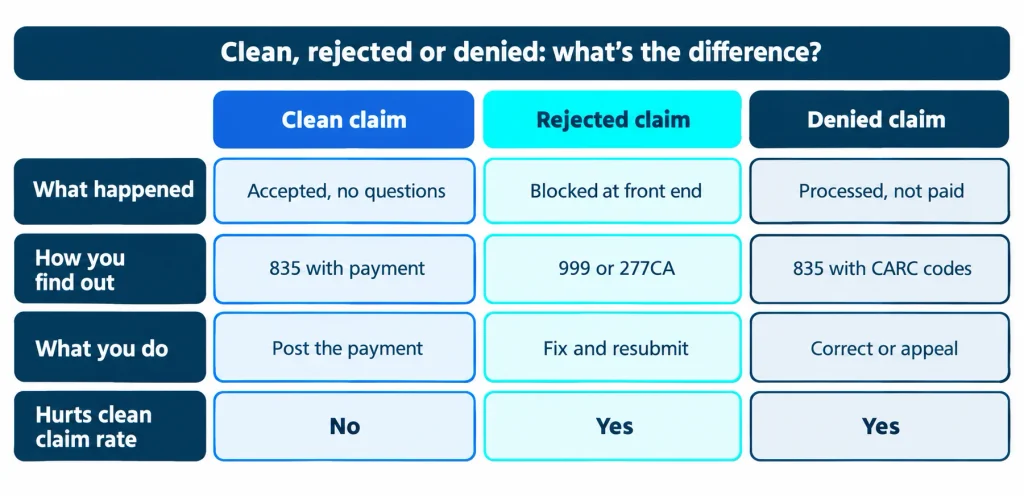
Rejections are the cheaper problem because the claim never entered the payer’s system, so nothing has been decided against you. Denials take longer, and many need an appeal. Our guide to denial management covers how to work with them.
What Is a Clearinghouse in Medical Billing?
A clearinghouse is the company that sits between your practice management system and the payers. It receives your claims, checks them against format and payer edits, converts them into the HIPAA standard 837 format when needed and routes each one to the right payer. It then sends back acknowledgments and remittances. Under HIPAA, a health care clearinghouse is itself a covered entity.
| Clearinghouse Function | Why It Matters for Clean Claims |
|---|---|
| Front-end edits | Catches missing fields, invalid codes and format errors before the payer sees them |
| Payer routing | Sends each claim to the correct payer ID |
| Acknowledgments (999 and 277CA) | Tells you within hours whether a claim was accepted or rejected |
| Remittance (835) and status (276/277) | Returns payment details and lets you check claim status |
Your clean claim rate depends on your clearinghouse more than most practices realize. When Change Healthcare, one of the largest clearinghouses, was hit by a ransomware attack in February 2024, claims stopped moving for weeks for practices across the country, and the breach eventually affected 192.7 million people, as Healthcare IT News reported. Knowing how you would switch clearinghouses is part of a clean claims plan.
What Does the Claim Process Flow Look Like?
Here is how a claim moves from the visit to payment, and where it can stop being clean:
| Step | What Happens | Where It Can Break |
|---|---|---|
| 1. Registration and eligibility | Patient and coverage details captured and verified | Wrong member ID or inactive coverage |
| 2. Documentation and coding | The visit is documented and coded | Unsupported codes or missing modifiers |
| 3. Charge entry and scrubbing | Charges are entered and checked against edits | Scrubber rules missing a payer’s requirement |
| 4. Clearinghouse | Claim is formatted, edited and routed | Format or payer ID errors |
| 5. Payer front end | Payer accepts or rejects the claim | Eligibility or provider enrollment mismatch |
| 6. Adjudication | Payer decides to pay, deny or adjust | Medical necessity, authorization or bundling |
| 7. Payment and posting | Payment arrives with an 835 and is posted | Underpayments missed at posting |

How Fast Are Clean Claims Paid?
For Medicare, a clean electronic claim cannot be paid before day 14 after receipt and a clean paper claim before day 29, which is the payment floor, as First Coast explains. Medicare contractors then have up to 30 days to process a clean claim before they owe interest, according to CGS. Claims that are not clean lose that protection.
Commercial plans follow state prompt pay laws and their contracts. In Texas, state-regulated plans must pay clean claims within 30 days when filed electronically and 45 days on paper. Other states set their own windows, so filing electronically and cleanly is the fastest route almost everywhere.
What Is a Clean Claim Rate and How Do You Calculate It?
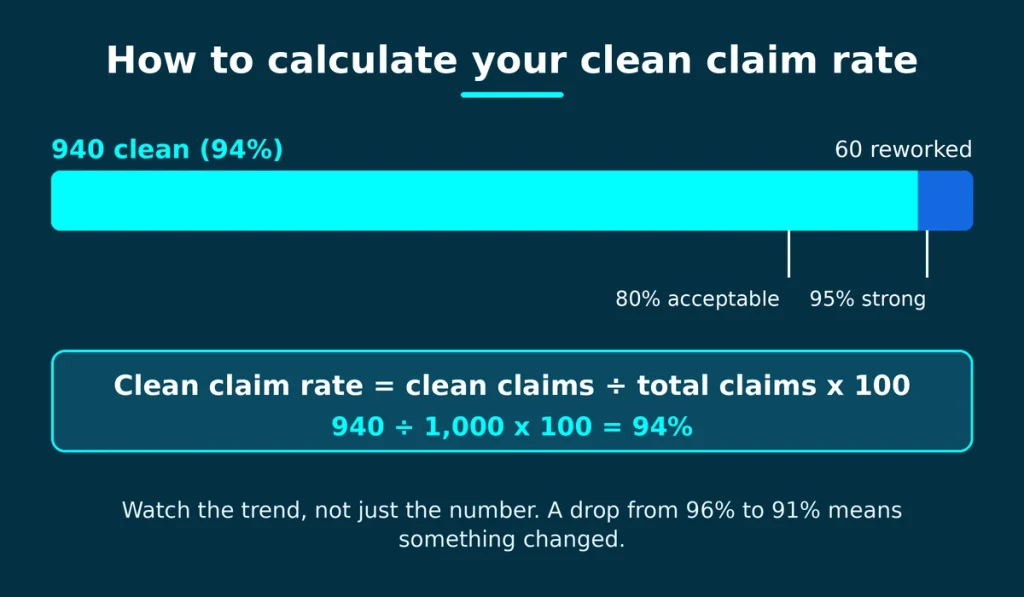
Clean claim rate = (claims accepted on first submission without edits or corrections ÷ total claims submitted) x 100.
If you send 1,000 claims in a month and 940 go through without rejection or correction, your clean claim rate is 94%. Track it by payer and by provider, because one payer or one template often drags the whole number down.
What is a good clean claim rate?
There is no single official benchmark. Published targets range from 80% as acceptable to 95% or higher as strong, and most well-run practices aim for 95% or more. Watch the trend more than the number: a rate falling from 96% to 91% says something changed, such as a new payer rule or a new hire.
Clean claim rate vs first-pass resolution vs zero-touch rate
| Metric | What It Measures |
|---|---|
| Clean claim rate | Claims that pass all edits on the first submission |
| First-pass resolution rate | Claims paid on the first submission without follow-up |
| Zero-touch rate | Claims that went out clean without any human intervention before submission |
A high clean claim rate can hide a lot of manual fixing before claims go out. The zero-touch rate shows how much work it took to get there.
What Are the Most Common Reasons Claims Are Not Clean?
In Experian’s survey, providers named missing or inaccurate claim data at 50% and authorization problems at 35% among the top causes of denials, as Becker’s reported. These are the errors behind most unclean claims:
| Error | Typical Result | Fix |
|---|---|---|
| Name, date of birth or member ID mismatch | Rejection or CARC 16 | Scan cards and verify at every visit |
| Coverage inactive or wrong primary payer | CARC 27, 109 or 22 | Real-time eligibility verification |
| Missing or expired authorization | CARC 197 or 15 | Track requests through prior authorization workflows |
| Invalid, deleted or unsupported codes | Rejection or CARC 11, 16 or 50 | Current code sets and medical coding review |
| Missing or wrong modifier | CARC 4 or 97 | Payer-specific scrubber rules |
| Provider not enrolled or linked | CARC B7 | Keep provider credentialing current |
| Late filing | CARC 29 | Submit daily and track filing limits by payer |
How Do You Submit Clean Claims Every Time?
Use this checklist on every claim, or build it into your scrubber so the system checks it for you:
| Done | Before You Submit | What It Prevents |
|---|---|---|
| ☐ | Patient name, date of birth and member ID match the payer record | Front-end rejections |
| ☐ | Coverage verified as active for the date of service | Eligibility denials |
| ☐ | Primary and secondary payers confirmed | Coordination of benefits denials |
| ☐ | Authorization or referral number on file and valid for the dates and units | Authorization denials |
| ☐ | Billing and rendering providers enrolled with the payer | Enrollment denials |
| ☐ | Codes valid for the date of service and supported by the note | Coding and medical necessity denials |
| ☐ | Modifiers, units and diagnosis pointers checked | Bundling and unit denials |
| ☐ | Place of service and dates of service correct | Place of service denials |
| ☐ | Claim scrubbed against payer-specific edits | Payer rejections |
| ☐ | Submitted within the timely filing limit | Timely filing denials |
Stream tip: Review every rejection within 24 hours and fix the rule that caused it, not just the claim. Ten fixed rules are worth more than a thousand fixed claims.
Is a Clean Claim the Same as a Clean Bill of Health?
No. A “clean bill of health” is a phrase for a statement that someone is healthy, or more broadly that something has passed an inspection. It comes from the bill of health ships once carried to show that no infectious disease was present at their last port. In clinical settings, “clean” can also mean free of dirt and most germs but not sterile. In medical billing, “clean” is about the paperwork: a clean claim is free of errors, not a statement about the patient’s health.
How Does Stream RCM Get Claims Clean on the First Pass?
Stream RCM builds the checks in this guide into its claim submission process: eligibility and authorization before the visit, coding review before charge entry, payer-specific scrubbing before the clearinghouse and same-day work on every rejection. Stream RCM reports a 98% clean claim rate for its clients, with pricing from 2.99% of monthly collections. It works as part of full revenue cycle management services or as a single service.

Frequently Asked Questions
What is the definition of a clean claim?
A clean claim is a complete and accurate claim that a payer can process without investigating it, requesting more information or returning it. Medicare defines it as a claim without a defect requiring the contractor to investigate or develop it before adjudication, filed on time.
What is a clean claim rate?
The percentage of claims accepted on first submission without edits or corrections. Most practices aim for 95% or higher.
What is a clearinghouse in medical billing?
A company that receives claims from your practice management system, checks and formats them, routes them to payers and returns acknowledgments and remittances.
Is a rejected claim the same as a denied claim?
No. A rejected claim never entered adjudication and can be corrected and resubmitted. A denied claim was processed and not paid, and may need correction or an appeal.
How long does it take to get paid on a clean claim?
For Medicare, from day 14 after receipt for electronic claims and day 29 for paper, and within 30 days before interest applies. Commercial timelines depend on state prompt pay laws and contracts.
What does “medically clean” mean?
In clinical settings, clean means free of dirt and most germs but not sterile. In billing, a clean claim means a claim free of errors.