


Most unpaid claims are not lost at 120 days. They are lost much earlier, on the day nobody notices that a claim was never received, or that a denial is sitting unread. Medicare, for example, must pay a clean claim within 30 days of receipt or owe interest, as CGS explains. If one of your Medicare claims is still unpaid on day 31, it is not “pending.” Something is wrong, and you have already lost a month.
That is why the best time to prioritize unpaid claims is before they reach 90 days, not after. By day 90, many commercial filing windows have closed, appeal clocks are running out and every week makes the claim harder to collect. This guide shows you when to follow up, how to sort unpaid claims by status and deadline and how to work them so very few ever reach the 90-day bucket.
Quick answer: To prioritize unpaid medical claims before 90 days, sort them by status first (not received, denied, underpaid, pending or no response), then move any claim within 14 days of a filing or appeal deadline to the top. Rank the rest by expected payment and how easy they are to fix. Start follow-up as soon as the payer’s payment deadline passes, usually around day 30, instead of waiting for the aging report to show 60 or 90 days.
Why Does the 90-Day Mark Matter So Much?
Day 90 is where unpaid claims start turning into lost claims, for three reasons:
Filing windows close. Many commercial contracts give you 90 to 120 days from the date of service to file. Texas state-regulated plans allow 95 days under the Texas Prompt Pay Act, and Texas Medicaid claims must reach TMHP within 95 days. A claim that was never received is often unrecoverable by day 90.
Appeal clocks run. Aetna allows 180 days from its decision to request a reconsideration and 60 days after that to appeal, according to its disputes and appeals overview, and Medicare allows 120 days for a redetermination. A denial left unread for 60 days has already used up much of that time.
Collection gets harder. Older claims need more calls, more research and more appeals per dollar. Practice guidance based on MGMA data recommends keeping 10% or less of A/R over 120 days, as the ACAAI practice guide notes.
When Should You Follow Up on Unpaid Medical Claims?
Follow up when the payer’s payment deadline has passed, not when the claim lands in a 60-day or 90-day bucket. Payment deadlines are set by law or contract, so you can build them into your follow-up schedule:
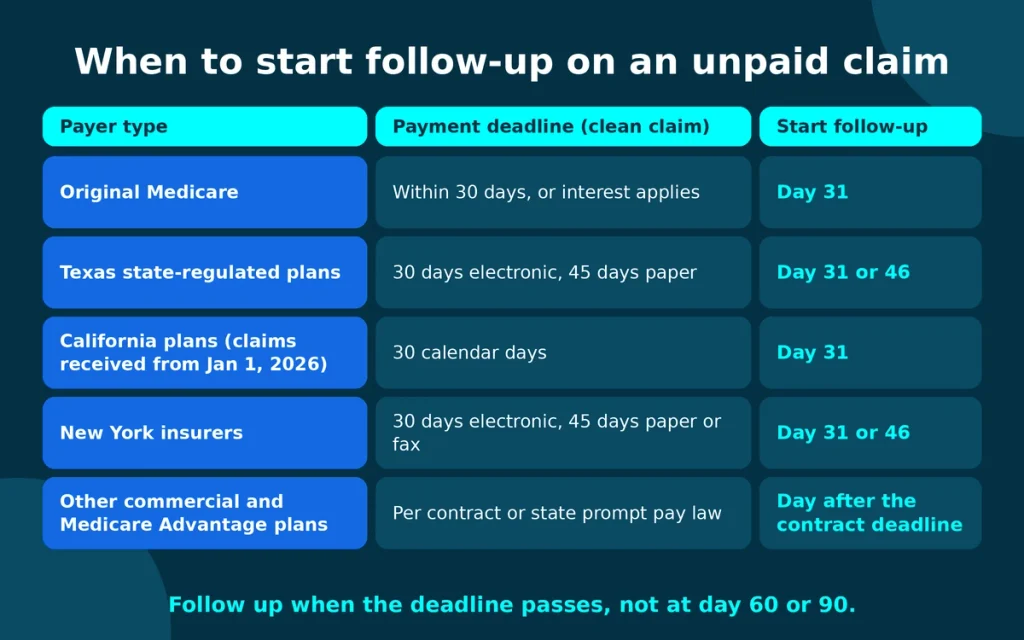
| Payer Type | Payment Deadline for a Clean Claim | Start Follow-Up |
|---|---|---|
| Original Medicare | Paid no earlier than day 14 (electronic) and within 30 days, or interest applies | Day 31 |
| Texas state-regulated plans | 30 days electronic, 45 days paper | Day 31 or 46 |
| California plans (claims received from January 1, 2026) | 30 calendar days | Day 31 |
| New York insurers | 30 days electronic, 45 days paper or fax | Day 31 or 46 |
| Other commercial and Medicare Advantage plans | Per contract or state prompt pay law | The day after the contract deadline |
Sources: CGS and First Coast (Medicare); TDI (Texas); California Medical Association (California); New York DFS (New York).
| Stream tip: Late payment from a state-regulated plan can carry interest: 15% a year in California and generally 12% in New York, for example. When a claim passes its payment deadline, it is both a follow-up task and a possible interest claim. |
What Does a 0 to 90 Day Follow-Up Calendar Look Like?
Use checkpoints instead of waiting for the aging report. Every claim should hit these points:
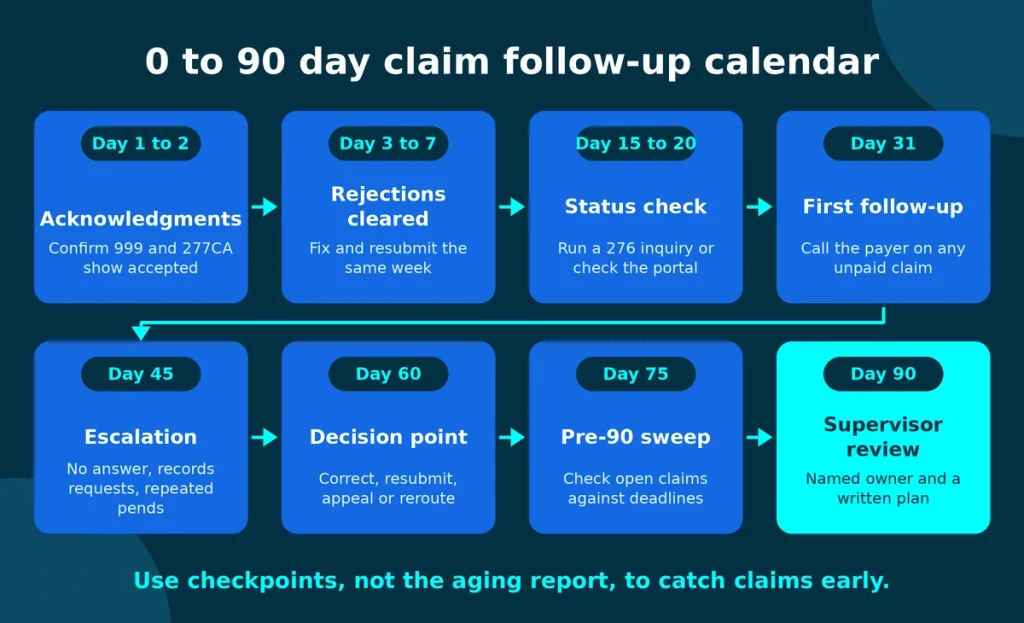
| Day | Checkpoint | What You Do |
|---|---|---|
| Day 1 to 2 | Acknowledgments | Confirm the 999 and 277CA reports show the claim was accepted, not rejected |
| Day 3 to 7 | Rejections cleared | Fix and resubmit every rejection the same week |
| Day 15 to 20 | Electronic status check | Run a 276 claim status inquiry or check the payer portal |
| Day 31 (or the day after the payment deadline) | First follow-up | Call or message the payer for any claim not paid or denied |
| Day 45 | Escalation | Escalate claims with no answer, missing records requests or repeated pends |
| Day 60 | Decision point | Correct, resubmit, appeal or send to the right payer; nothing stays “pending” without a reason |
| Day 75 | Pre-90 sweep | Review every claim still open and check it against its filing and appeal deadlines |
| Day 90 | Supervisor review | Any claim still open gets a named owner and a written plan |
Electronic claim status uses the X12 276 request and 277 response, as CMS describes.
How Should You Triage Unpaid Claims by Status?
Before you look at age or dollar amount, sort every unpaid claim by what is actually happening to it. Each status needs a different action:
| Status | What It Means | First Action |
|---|---|---|
| Not received or rejected | The payer has no record of the claim, or it failed front-end edits | Fix and resubmit now; this is the most urgent group because the filing clock is still running |
| Denied | The payer processed and refused the claim | Correct or appeal through denial management before the appeal deadline |
| Underpaid | Paid, but below the contracted amount | Compare with the contract and dispute the difference, starting at payment posting |
| Pending or in process | Received and being reviewed | Check what the payer is waiting for and send it |
| No response | Past the payment deadline with no decision | Call, document a reference number and escalate |
| Patient responsibility | Insurance has paid its share | Send a statement and offer a payment plan |
How Do You Decide Which Unpaid Claims to Work First?
Once claims are sorted by status, rank them with three questions, in this order:
1. Is the deadline close? Any claim within 14 days of a filing, correction or appeal deadline goes to the top, whatever its size.
2. How much is actually collectible? Use the expected allowed amount minus anything already paid, not the billed charge. A $3,000 charge with a $900 allowed amount is a $900 claim.
3. How easy is it to fix? A claim that needs one missing record or a corrected modifier usually beats a larger claim that needs a full medical necessity appeal.
A Simple Medical Claims Priority Tier System
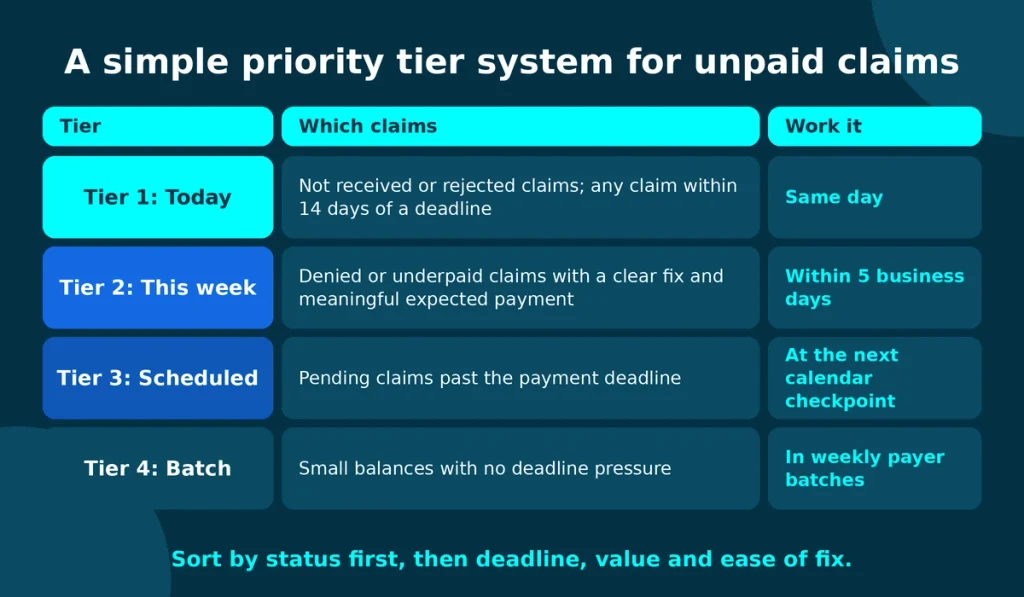
| Tier | Which Claims | Work It |
|---|---|---|
| Tier 1: Today | Not received or rejected claims; any claim within 14 days of a deadline | Same day |
| Tier 2: This week | Denied or underpaid claims with a clear fix and meaningful expected payment | Within 5 business days |
| Tier 3: Scheduled | Pending claims past the payment deadline | At the next calendar checkpoint |
| Tier 4: Batch | Small balances with no deadline pressure | In weekly payer batches |
Example: four unpaid claims, one morning
| Claim | Age | Expected Payment | Situation | Tier |
|---|---|---|---|---|
| A | 38 days | $420 | Never received by the payer; 95-day filing limit | Tier 1: resubmit today |
| B | 52 days | $1,850 | Denied for a missing modifier; appeal window open | Tier 2: correct this week |
| C | 41 days | $2,300 | Pending; payer asked for records on day 20 and nobody sent them | Tier 1: send records today |
| D | 33 days | $95 | No response, just past the payment deadline | Tier 4: next payer batch |
Illustrative example.
Claim C is a good example of why status comes first: it looks like a routine pending claim, but it is actually waiting on you.
Should You Work Unpaid Claims One at a Time or by Payer?
By payer, whenever you can. Group open claims by payer and work them together: one portal session or one phone call can resolve ten claims instead of one. Use electronic 276 status checks before calling, since they are faster and free up staff for the claims that need a conversation. Track each payer’s typical turnaround, too. A payer that routinely takes 40 days is different from one that pays in 15, and your follow-up calendar should reflect that.
What Should You Ask on a Payer Follow-Up Call?
- Was the claim received, and on what date?
- What is the claim number and current status?
- If it is pending, what exactly is needed and where should it be sent?
- If it was denied, what is the reason code and the deadline to appeal?
- If it was paid, what was the amount, the date and the check or EFT number?
- What is the expected payment date?
- What is your name and the call reference number?
Record every answer in the claim notes with the next follow-up date. A note that says “called payer, pending” is not a follow-up; it is a delay.
Why Do Claims Stall Before 90 Days?
| Reason | How to Prevent It |
|---|---|
| Rejection nobody saw | Review 999 and 277CA reports every day |
| Wrong payer or inactive coverage | Verify coverage before the visit with insurance eligibility verification |
| Records request ignored | Route payer letters and portal requests to a named person |
| Provider not credentialed | Finish provider credentialing before new providers see patients |
| Coding or modifier error | Scrub claims before submission |
| Coordination of benefits question | Confirm primary and secondary coverage at check-in |
Most of these start before the claim is sent, which is why claim submission done right is the cheapest A/R follow-up there is.
Which Numbers Show Your Follow-Up Is Working?
| Metric | What to Watch |
|---|---|
| A/R over 60 and over 90 days | Both should shrink month over month |
| Claims past the payment deadline with no follow-up | Should be close to zero |
| Average days to first follow-up | Should sit just after each payer’s payment deadline |
| Rejections open more than 3 days | Should be zero |
| A/R over 120 days | 10% or less of total A/R |
| Net days in A/R | Track it with a standard definition such as HFMA’s MAP Keys |
How Does Stream RCM Keep Claims From Reaching 90 Days?
Stream RCM works every open claim on a calendar, not a pile. We clear rejections daily, check status electronically, follow up as soon as each payer’s payment deadline passes and escalate anything still open at day 45. Denials, underpayments and records requests each have an owner, and every claim is checked against its filing and appeal deadlines before day 90. It is all part of our revenue cycle management services, with pricing from 2.99% of monthly collections.
Frequently Asked Questions
How long should you wait before following up on an unpaid claim?
Until the payer’s payment deadline passes, which is about 30 days for clean electronic claims under Medicare and many state prompt pay laws. Check acknowledgments and rejections much earlier, within the first week.
Which unpaid claims should be worked first?
Claims the payer never received or rejected, and any claim within 14 days of a filing or appeal deadline. After that, denied and underpaid claims with a clear fix and meaningful expected payment.
What happens to claims over 90 days old?
Many are still collectible, but filing and appeal windows may be closing, so each one needs a review of its deadlines and a written plan. Some will need appeals and some may be written off.
Is it better to call payers or use portals for claim status?
Use electronic status checks or portals first because they are faster, then call for claims that need an explanation, a reference number or escalation.
How do you prevent claims from aging past 90 days?
Verify eligibility before the visit, scrub claims before submission, clear rejections daily, follow up as soon as payment deadlines pass and escalate any claim still open at day 45.
What is the difference between a pending claim and a no-response claim?
A pending claim has been received and is being reviewed, often waiting for information. A no-response claim is past the payment deadline with no decision and needs a call and escalation.