


Prior authorization is a health plan’s approval, obtained before a service is provided, that confirms the plan considers the service medically necessary and covered. In 2026 it is changing faster than at any point in the last decade: federal rules now set decision deadlines for Medicare Advantage and Medicaid plans, Original Medicare has started requiring prior authorization in six states and the largest insurers have pledged to cut their requirements.
For practices, the workload has not shrunk yet. In the 2025 AMA Prior Authorization Physician Survey, released in May 2026, physicians reported completing an average of 40 prior authorizations a week, using 13 hours of physician and staff time, and 95% said prior authorization delays patient care. This guide explains how the process works, what changed in 2026, how long approvals take and the checklist that keeps requests from coming back denied.
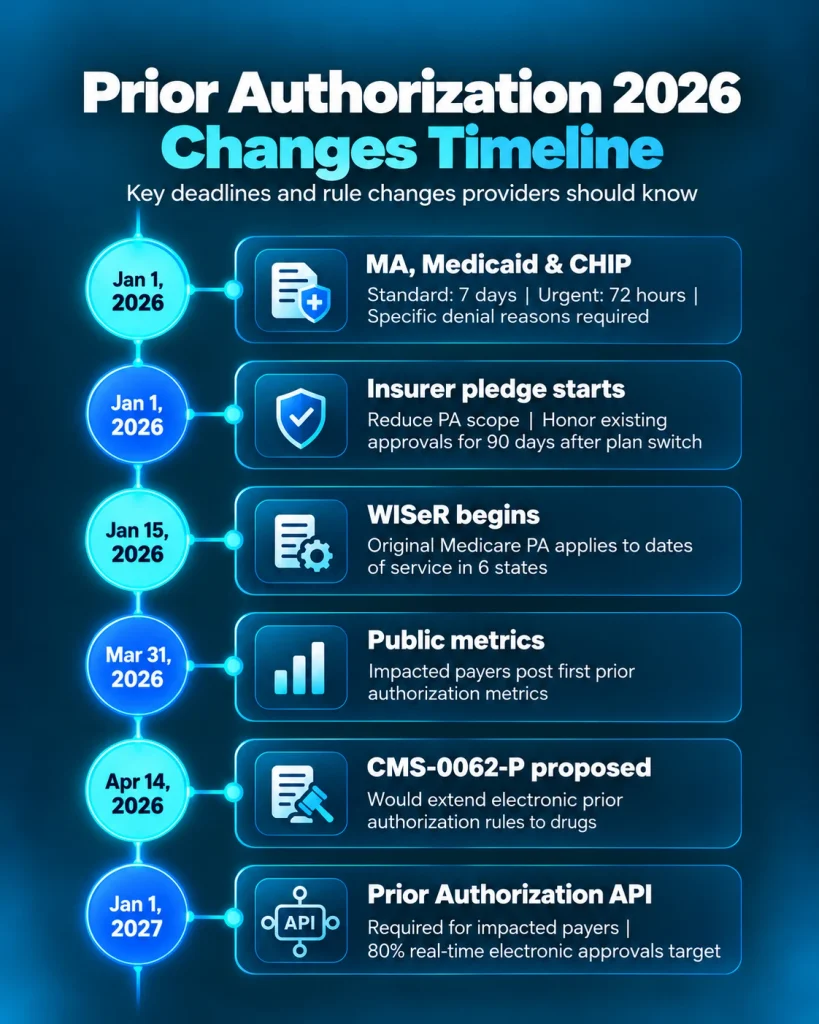
Prior Authorization in 2026
| Date | Change |
|---|---|
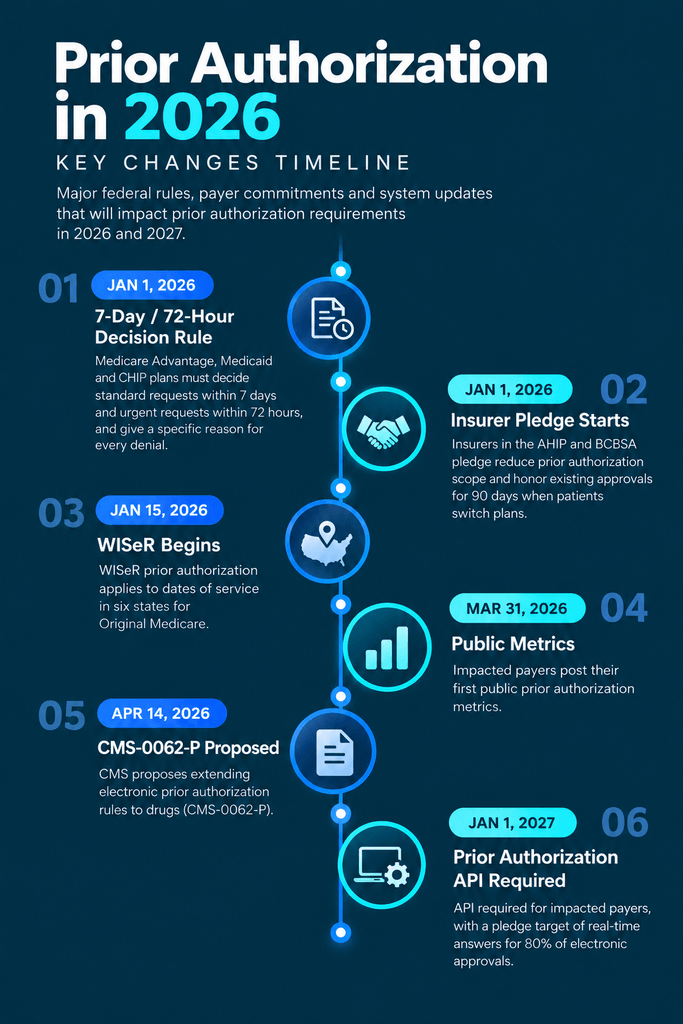
| January 1, 2026 | Medicare Advantage, Medicaid and CHIP plans must decide standard requests within 7 days and urgent requests within 72 hours, and give a specific reason for every denial |
| January 1, 2026 | Insurers in the AHIP and BCBSA pledge reduce prior authorization scope and honor existing approvals for 90 days when patients switch plans |
| January 15, 2026 | WISeR prior authorization applies to dates of service in six states for Original Medicare |
| March 31, 2026 | Impacted payers post their first public prior authorization metrics |
| April 14, 2026 | CMS proposes extending electronic prior authorization rules to drugs (CMS-0062-P) |
| January 1, 2027 | Prior Authorization API required for impacted payers; pledge target of real-time answers for 80% of electronic approvals |
What Is Prior Authorization?
Prior authorization, also called preauthorization, precertification or prior approval, is the process of getting a health plan’s approval before providing a service, procedure, test, device or drug. The plan reviews whether the service meets its coverage and medical necessity criteria. If it does not approve in advance, the plan may refuse to pay the claim, even when the care was appropriate.
Prior authorization in medical billing
In medical billing, prior authorization is a front-end step that protects payment. The authorization number goes on the claim, and a missing or mismatched authorization is one of the most common reasons claims deny. An approval does not guarantee payment, though; the patient still has to be eligible on the date of service and the claim must match what was approved.
Prior authorization vs referral
A referral is a primary care provider’s permission for a patient to see a specialist, usually required by HMO plans. Prior authorization is the health plan’s approval of a specific service. A patient may need both: a referral to see a cardiologist and prior authorization for the cardiac imaging the cardiologist orders.
How Prior Authorization Works: The Process Step by Step
The prior authorization workflow is the same in principle for every payer, even though forms and portals differ.
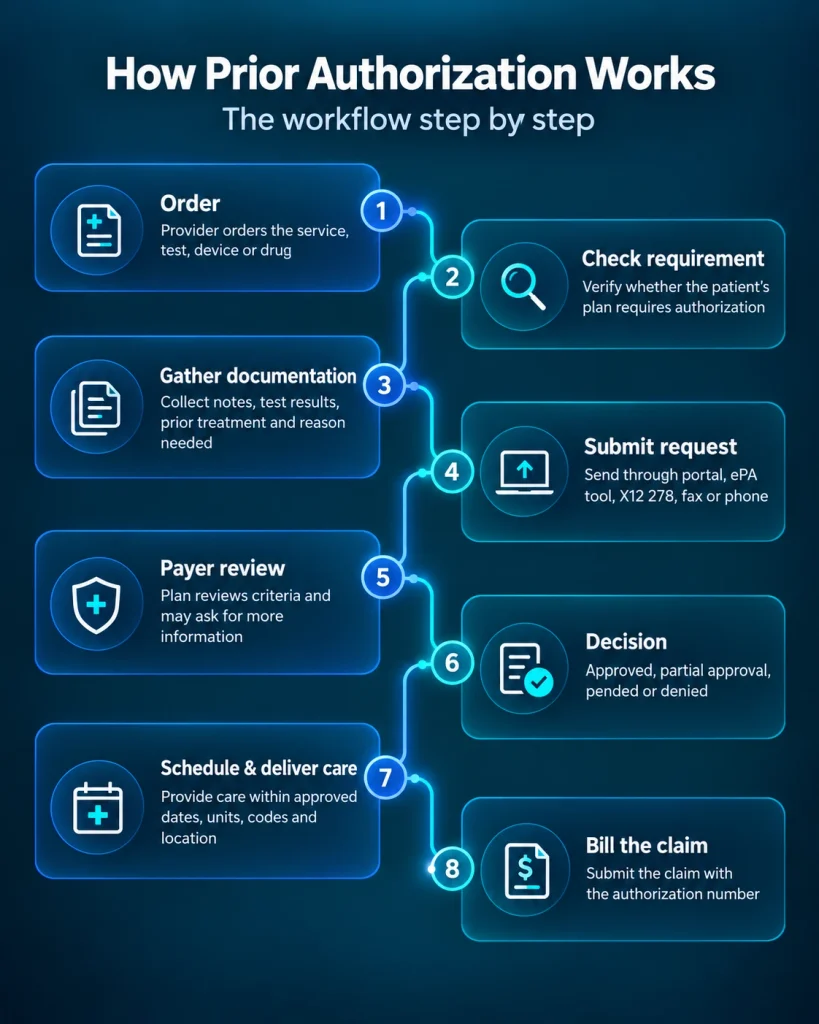
| Step | What Happens |
|---|---|
| 1. Order | The provider orders a service, test, device or drug |
| 2. Check the requirement | Staff check whether the patient’s plan requires authorization for that code, setting and diagnosis |
| 3. Gather documentation | Clinical notes, test results, prior treatments and the reason the service is needed |
| 4. Submit the request | Through the payer portal, an electronic prior authorization tool, the X12 278 transaction, fax or phone |
| 5. Payer review | The plan applies its criteria and may ask for more information or a peer-to-peer call |
| 6. Decision | Approved, partially approved, pended for more information or denied with a reason |
| 7. Schedule and deliver care | Within the approved dates, units, codes and location |
| 8. Bill the claim | With the authorization number, matching the approved service |
Standard vs urgent prior authorization requests
A standard request follows the normal timeline. An urgent (expedited) request is for situations where waiting could seriously jeopardize the patient’s life, health or ability to regain maximum function. The provider should state why the request is urgent, since plans can treat an unsupported urgent request as standard.

What Are the Changes in CMS Prior Authorization for 2026?
Four developments define prior authorization in 2026: new federal deadlines for Medicare Advantage and Medicaid plans, a proposed rule for drugs, Original Medicare’s first broad prior authorization model and a voluntary insurer pledge.
CMS-0057-F: decision deadlines and denial reasons
The CMS Interoperability and Prior Authorization final rule (CMS-0057-F) applies to Medicare Advantage organizations, state Medicaid and CHIP fee-for-service programs, Medicaid managed care plans and CHIP managed care entities. Since January 1, 2026, these payers must decide expedited requests within 72 hours and standard requests within 7 calendar days, give a specific reason for every denial and, starting March 31, 2026, publish prior authorization metrics on their websites. By January 1, 2027, they must offer a Prior Authorization API. The rule covers medical items and services, not drugs, as the CMS page on the drug proposal explains.
CMS-0062-P: prior authorization for drugs (proposed)
On April 14, 2026, CMS proposed extending these requirements to prior authorization for drugs, including electronic prior authorization, shorter decision timeframes and more transparency. HHS also proposed adopting HL7 FHIR standards for prior authorization transactions under HIPAA, which would apply to all covered entities that exchange prior authorization requests electronically. The comment period closed on June 15, 2026, and the rule is not yet final.
WISeR: prior authorization in Original Medicare
Original Medicare began testing prior authorization for a list of outpatient services in six states on January 1, 2026, through the WISeR model, explained in the next section.
The insurer pledge
In June 2025, AHIP, the Blue Cross Blue Shield Association and plans serving nearly 270 million people committed to simplify prior authorization. As of January 1, 2026, participating plans have reduced the scope of services requiring authorization, honor existing approvals for 90 days when patients change plans and provide clearer explanations of decisions. For 2027, they have committed to answering at least 80% of electronic approvals in real time, as Blue Cross Blue Shield summarized. The pledge is voluntary, and only 33% of physicians in the AMA survey believed it would make a meaningful difference.
What Six States Will Have Prior Authorization Through Medicare in 2026?
Arizona, New Jersey, Ohio, Oklahoma, Texas and Washington. These are the six states in CMS’s Wasteful and Inappropriate Service Reduction (WISeR) Model, which runs from January 1, 2026 through December 31, 2031 and applies to Original Medicare, not Medicare Advantage, as Baker Tilly explained. Prior authorization requests began January 5, 2026, for dates of service on or after January 15, 2026.
WISeR uses technology vendors working with CMS to review a selected list of outpatient services, such as skin substitutes, electrical nerve stimulator implants and knee arthroscopy for knee osteoarthritis. Providers can either request prior authorization before the service or deliver the service and have the claim go through pre-payment medical review. The model has drawn bipartisan criticism, and Congress has considered repealing it, but it remains in effect unless that happens. CMS is also running a separate prior authorization demonstration for certain ambulatory surgical center services in ten states, as the American Bar Association noted.
Medicare Prior Authorization Requirements in 2026
Original Medicare
Original Medicare still requires prior authorization only for specific programs, not most services:
| Program | What It Covers |
|---|---|
| Hospital outpatient department services | Blepharoplasty, botulinum toxin injections, panniculectomy, rhinoplasty, vein ablation, cervical fusion with disc removal, implanted spinal neurostimulators and facet joint interventions |
| DMEPOS Required Prior Authorization List | Selected power mobility devices, pressure reducing support surfaces, lower limb prostheses and orthoses |
| Repetitive scheduled non-emergent ambulance | Recurring non-emergency ambulance transport |
| WISeR Model | Selected outpatient services in six states |
| ASC demonstration | Selected ambulatory surgical center services in ten states, phased in from 2026 |
Medicare Advantage prior authorization rules
Medicare Advantage plans can require prior authorization for many services, but CMS rules limit how they use it. Plans must follow Original Medicare’s coverage criteria, including national and local coverage determinations, keep an approval valid for the full course of treatment and give new enrollees in active treatment a transition period of at least 90 days. Under CMS-0057-F, they must also meet the 7-day and 72-hour decision deadlines.
The volume is large. Medicare Advantage insurers made nearly 53 million prior authorization determinations in 2024, according to KFF. Only 11.5% of denials were appealed, but 80.7% of those appeals were overturned in full or in part.
Medicaid Prior Authorization Rules
Medicaid prior authorization is set by each state and each Medicaid managed care plan, so the services that require approval, the forms and the portals differ widely. Under CMS-0057-F, state Medicaid fee-for-service programs and Medicaid managed care plans must now meet the same 7-day standard and 72-hour expedited deadlines, unless state law sets a shorter timeframe, and must give specific denial reasons. Practices that see patients from several Medicaid plans need a separate prior authorization list for each one.
How Long Until Prior Authorization Is Approved?
It depends on the payer and whether the request is standard or urgent. These are the maximum decision timeframes; many requests are answered faster, and some are approved instantly through electronic prior authorization.
| Payer or Program | Standard Request | Urgent Request |
|---|---|---|
| Medicare Advantage (medical services) | 7 calendar days | 72 hours |
| Medicaid and CHIP (fee-for-service and managed care) | 7 calendar days, or shorter under state law | 72 hours |
| Medicare Part D drugs | 72 hours | 24 hours |
| Original Medicare hospital outpatient services | 10 business days | 2 business days |
| Commercial plans | Set by state law and contract | Set by state law and contract |
The clock starts when the payer has a complete request. Missing documentation is the most common reason approvals take longer than these limits, because the payer pends the request and asks for more.
Prior Authorization by Service Type
| Service | Who Usually Requires It | What to Have Ready |
|---|---|---|
| MRI, CT and other advanced imaging | Medicare Advantage and commercial plans, often through a radiology benefit manager; Original Medicare does not | Symptoms, duration, exam findings, prior imaging and conservative treatment tried |
| Surgery | Most Medicare Advantage and commercial plans for elective procedures; Original Medicare for listed outpatient and WISeR services | Diagnosis, failed conservative treatment, imaging and the planned procedure codes and setting |
| Physical therapy | Many commercial and Medicare Advantage plans after an initial number of visits; WISeR does not add a requirement for outpatient PT | Evaluation, plan of care, functional goals and progress notes |
| Durable medical equipment | Most plans for high-cost items; Original Medicare for items on the DMEPOS list | Order, face-to-face encounter, medical necessity and product codes |
| Medications | Part D and commercial pharmacy benefits for specialty and high-cost drugs | Diagnosis, prior drugs tried, dose and duration |
Behavioral health has its own authorization patterns, such as session blocks and annual visit limits, which we cover in our guide to mental health billing challenges.
Prior Authorization Checklist for Providers
Use this checklist for every request. Most denials and delays come from one of these items being missing.
| Item | Why It Matters |
|---|---|
| Patient eligibility and plan confirmed for the date of service | An approval is useless if the patient is not covered |
| Current payer prior authorization list checked for the CPT or HCPCS code | Requirements change, sometimes quarterly |
| Correct ordering and rendering provider, NPI and location | Approvals are tied to the provider and setting |
| Diagnosis codes that support medical necessity | The reviewer matches diagnoses to the plan’s criteria |
| Clinical notes showing symptoms, findings and history | The core evidence for the request |
| Results of prior tests and treatments tried | Many criteria require conservative treatment first |
| Exact codes, units, dates and site of service requested | The claim must match what was approved |
| Urgency justified in writing if submitting an urgent request | Unsupported urgent requests are processed as standard |
| Authorization number, approved dates and units recorded in the practice management system | Needed on the claim and for scheduling |
| Follow-up date set for pending requests | Pended requests stall without a follow-up |
An approval only helps if the rendering provider is enrolled with the plan, so make sure credentialing delays have not left the provider out of network before you submit the request.
Electronic Prior Authorization and the Prior Authorization API
Electronic prior authorization (ePA) replaces fax and phone requests with structured data exchanged between the provider’s systems and the payer. The payoff is speed: when a request includes all the clinical data the plan needs, many approvals can be returned in real time. That shift is still early. Nearly half of prior authorization requests are submitted by fax or phone, according to Blue Cross Blue Shield.
The Prior Authorization API that impacted payers must offer by January 1, 2027 uses HL7 FHIR standards to let providers check whether authorization is required, see the documentation the plan needs and submit the request from inside their own systems. For practices, the practical steps are asking their EHR and practice management vendors when they will support FHIR-based prior authorization and moving the highest-volume requests off fax first.
Common Prior Authorization Denial Reasons and Mistakes
| Denial Reason or Mistake | How to Prevent It |
|---|---|
| Authorization not obtained | Check the payer list for every scheduled service, not only the ones staff remember |
| Incomplete clinical documentation | Submit notes, test results and prior treatments with the first request |
| Criteria not met, such as no conservative treatment documented | Read the plan’s criteria before submitting and address each one |
| Codes on the claim differ from the approved codes | Update the authorization before the service if the plan changes |
| Service done outside the approved dates or units | Track expiration dates and request extensions early |
| Wrong provider, NPI or location on the request | Match the request to who will perform the service and where |
| Urgent request without justification | State the clinical reason waiting would harm the patient |
Authorization denials that still get through belong in your denial management workflow, where each one is traced to the step that failed and fixed before the next request.
Prior Authorization Appeal Process
Many prior authorization denials can be overturned. The KFF data on Medicare Advantage shows most appealed denials are reversed, yet few are appealed at all. A practical appeal process looks like this:
1. Read the denial reason. Since 2026, Medicare Advantage and Medicaid plans must give a specific reason, which tells you exactly what to fix.
2. Request a peer-to-peer review. A conversation between the ordering physician and the plan’s reviewer often resolves clinical denials quickly.
3. Submit additional documentation. Address the criteria the plan said were not met, with notes and test results.
4. File a formal appeal on time. Each plan sets a deadline for reconsideration; track it from the date of the denial notice.
5. Escalate if needed. Medicare Advantage denials can move to independent review, and many commercial plans allow external review under state law.
How to Reduce Prior Authorization Delays
| Best Practice | What It Changes |
|---|---|
| Check requirements at scheduling, not the day before | Gives time for standard review |
| Build payer-specific templates for high-volume services | Captures the documentation each plan asks for |
| Submit electronically wherever possible | Faster responses and fewer lost faxes |
| Track every request in one queue with due dates | Nothing sits pended without follow-up |
| Measure approval rates and turnaround by payer | Shows where to push for gold carding or contract changes |
| Use gold-carding programs where available | Some states and plans exempt providers with high approval rates |
| Assign trained staff or outsource the work | Frees clinical staff from paperwork |
Are Prior Authorizations Going Away?
No. Prior authorization is shrinking in some places and growing in others. Insurers have cut some requirements under their pledge, and federal rules are making decisions faster and more transparent. At the same time, Original Medicare added prior authorization in six states through WISeR, and CMS has proposed extending electronic prior authorization rules to drugs.
For the next several years, practices should expect fewer requests for some routine services, faster and more electronic processes and continued requirements for high-cost care.

Frequently Asked Questions
What does prior authorization mean?
Prior authorization means getting a health plan’s approval before a service, test, device or drug is provided. The plan checks whether it is medically necessary and covered; without the approval, the plan may refuse to pay.
Does prior authorization guarantee payment?
No. The patient must still be eligible on the date of service, and the claim must match the approved codes, dates, units, provider and location. Plans can still deny claims that do not match the authorization.
Who is responsible for getting prior authorization?
Usually the provider ordering or performing the service, depending on the plan’s rules. In practice, the practice’s staff or billing partner submits the request, but the patient may be billed if a required authorization was never obtained and the plan allows it.
Does Original Medicare require prior authorization for an MRI?
No. Original Medicare does not require prior authorization for MRI or CT, and its imaging appropriate use criteria program was rescinded in 2024. Many Medicare Advantage and commercial plans do require it.
Do I need prior authorization for physical therapy?
It depends on the plan. Many commercial and Medicare Advantage plans require it after an initial number of visits. Original Medicare does not require prior authorization for outpatient therapy, and WISeR does not add one.
What is the Prior Authorization API?
It is a FHIR based connection that Medicare Advantage, Medicaid and CHIP payers must offer by January 1, 2027. It lets providers check requirements, see what documentation is needed and submit requests from their own systems.
What is the difference between a standard and an urgent prior authorization request?
A standard request follows the normal timeline, 7 calendar days for Medicare Advantage and Medicaid. An urgent request is for cases where waiting could seriously harm the patient and must be decided within 72 hours.