


Credentialing delays cost a medical practice revenue in five ways: visits the new provider cannot bill in network, claims that deny after the visit, Medicare’s limit on billing back before the effective date, lapsed recredentialing that stops payment for established providers and the rework and turnover that follow. Each day a provider waits for approval is a day of appointments that either do not happen or may not get paid.
The losses are measurable. In Medallion’s 2026 survey of more than 550 healthcare leaders, more than half of hospitals and provider groups reported measurable revenue loss tied to credentialing delays. This guide explains where that money goes, how to calculate the cost for your own practice, why credentialing takes so long and how to keep delays from turning into denials. Healthcare organizations looking to simplify provider enrollment and billing can also explore Stream RCM for revenue cycle and credentialing support.
What Is Credentialing in Medical Billing?
In medical billing, credentialing is the work of getting a provider approved by each insurance payer and loaded into its system with an effective date, so claims under that provider’s NPI can be paid in network. It combines two steps: the payer verifying the provider’s qualifications, and payer enrollment linking the provider to the practice, its tax ID and its locations.
Credentialing is not a one-time event. CAQH profiles need re-attestation every 120 days, payers recredential on a cycle and Medicare revalidates enrollment every five years. CAQH profiles need re-attestation every 120 days, payers recredential on a cycle and Medicare revalidates enrollment every five years. For the documents and steps involved, see our [physician credentialing checklist]. Practices can also explore our provider credentialing services to streamline payer enrollment and reduce credentialing-related billing delays. Managing credentialing alongside billing can help practices prevent enrollment-related denials and maintain a more consistent revenue flow. Stream RCM offers provider credentialing services to help streamline payer enrollment, while its revenue cycle management (RCM) services support efficient claims processing, denial management and reimbursement tracking.
Five Ways Credentialing Delays Hit Revenue
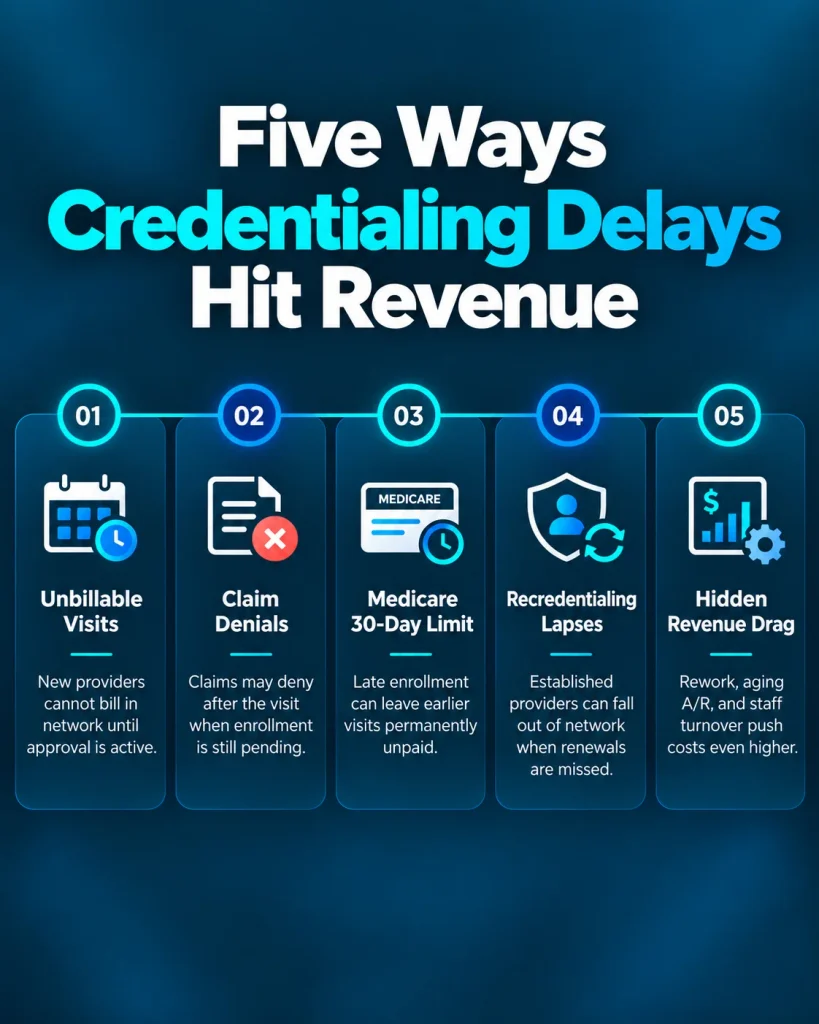
1. Visits the provider cannot bill in network
Until a payer approves a provider and confirms an effective date, the practice faces a bad set of choices for that payer’s patients. It can keep them off the new provider’s schedule. It can see them and risk an out-of-network payment or a denial. Or it can move them to other providers who may already be fully booked. Each option means lost or delayed revenue, and patients who wait too long often book with another practice.
2. Claims that deny after the visit
When a practice bills before the payer finishes enrollment, the claim may be denied with claim adjustment reason code (CARC) B7, provider not certified or eligible to be paid for this service on this date, or processed as out of network. These credentialing denials age in accounts receivable while staff chase approval letters, and some never become payable at all.
3. Medicare’s 30-day limit on billing back
Medicare sets a physician’s effective date at the later of the date the Medicare contractor receives an application it approves or the date the provider started seeing patients at the location. It then allows billing back only 30 days before that effective date, as First Coast Service Options explains. A physician who starts on March 1 but files on May 1 can bill Medicare back to April 1 at best, and every March visit is lost for good.
4. Lapsed recredentialing and revalidation
Delays are not limited to new hires. An established provider can fall out of network when a CAQH attestation lapses, a recredentialing deadline passes or a Medicare revalidation is missed. Blue Cross Blue Shield of Michigan, for example, warns that a missed CAQH re-attestation removes providers from its directory and ends their credentialing status until they reapply.
5. Hidden costs: rework, aging A/R and turnover
Denied and held claims take staff time to rework and push days in A/R up. Delays also wear on the people involved: Medallion found that 38% of organizations report high turnover or burnout in administrative and clinical roles, and a new physician who cannot see a full schedule for months is more likely to leave.
How to Calculate What a Credentialing Delay Costs Your Practice
Industry articles often quote a single “cost per day” for credentialing delays, usually borrowed from hospital revenue surveys. Merritt Hawkins’ widely cited figure, an average of $2,378,727 a year per physician, measures net revenue a physician generates for an affiliated hospital, including admissions, tests and procedures, as AMN Healthcare reported. It is not what an independent practice collects, so a practice should calculate its own number.
| Input | How to Find It |
|---|---|
| Expected daily collections for the provider | Projected monthly collections divided by working days per month |
| Share of the payer mix not yet approved | Percentage of the provider’s expected patients covered by payers still pending |
| Days of delay | Days between the provider’s start date and each payer’s effective date |
| Revenue at risk | Daily collections x share of payer mix pending x days of delay |
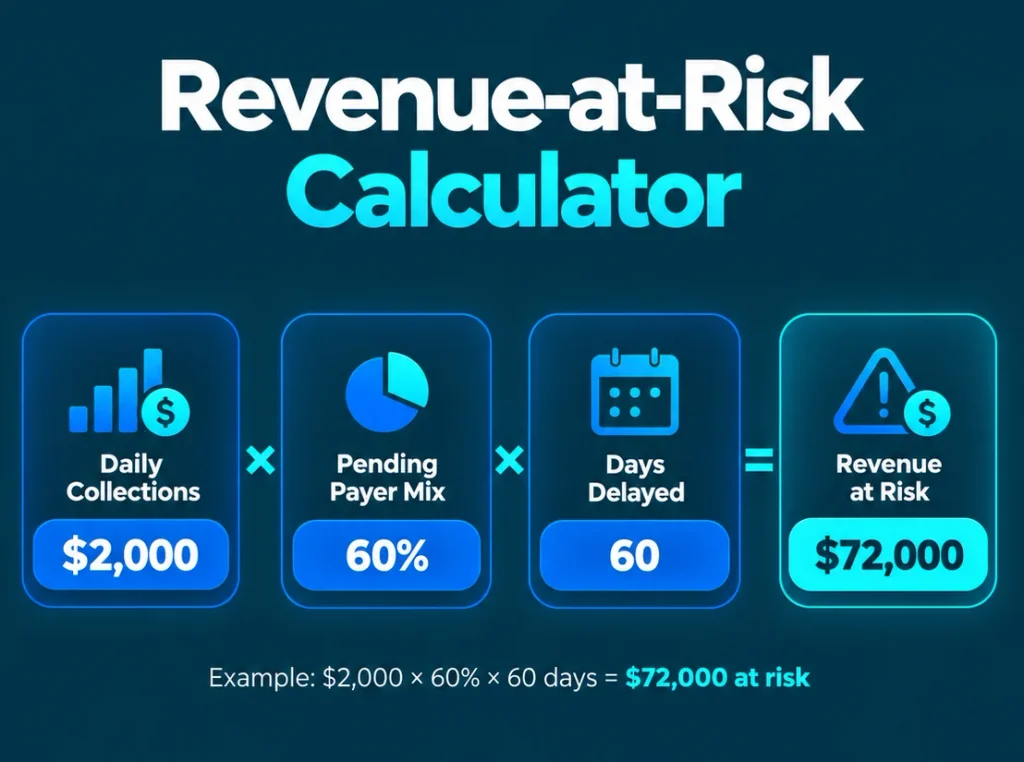
Illustrative example: a new physician expected to collect $2,000 a day starts work while payers covering 60% of her expected patients are still pending. If those approvals take 60 days, about $72,000 in revenue is delayed or at risk ($2,000 x 60% x 60 days). The numbers here are hypothetical; plug in your own.
Why Does Credentialing Take So Long?
Credentialing takes so long because it depends on several outside parties working in sequence, and a gap at any step restarts the clock.
| Cause | What Happens |
|---|---|
| Incomplete or inconsistent applications | Payers send the file back; Medallion found 40% of enrollment denials tied to application errors |
| Credentialing committee schedules | Medallion’s 2026 data names committee review as the most unpredictable step |
| Primary source verification | Schools, boards and prior employers respond on their own timelines |
| Verification time limits | Under 2025 NCQA standards, verifications can be no older than 120 days at the decision, so slow files may need to be re-verified |
| CAQH problems | Unattested profiles, expired documents or missing payer authorization stall commercial applications |
| Closed panels | Some payers are not adding providers in certain specialties or areas |
| State and payer variation | Timelines differ widely by state and payer |
The NCQA change is documented in Provider Trust’s summary of the 2025 NCQA credentialing updates.
How long does medical credentialing take?
Once a complete application is submitted, payer enrollment takes a median of about 60 days nationally, based on Medallion’s analysis of more than 64,000 enrollments, ranging from under 40 days in Hawaii and Maine to as long as 196 days in the slowest states. Gathering documents, building the CAQH profile and any licensing work come before that, which is why most practices plan for three to four months.
CAQH Credentialing Delays
Most commercial payers pull credentialing data from CAQH ProView, so problems there delay every commercial application at once. The most common causes are a profile that is not attested, payers that have not been authorized to view the profile, expired licenses or malpractice certificates still on file, missing work history explanations and practice locations that do not match what the payer has on record. Re-attesting every 120 days and uploading renewals as soon as they arrive prevents most of them.
Credentialing Denials in Medical Billing
A credentialing denial happens when a payer refuses a claim because the rendering provider was not credentialed, enrolled or linked to the billing group on the date of service. On the remittance it usually shows as CARC B7 or as out-of-network processing.
How to fix a credentialing denial
| Situation | Next Step |
|---|---|
| Provider approved, but claim dated before the effective date | Ask the payer whether it allows a retroactive effective date; for Medicare, check the 30-day retrospective billing rule |
| Provider approved, but not linked to the group or location | Ask the payer to update the roster or enrollment record, then send a corrected claim |
| Approval letter shows an earlier effective date than the payer applied | Appeal with the approval letter attached |
| Provider never enrolled with the payer | Start enrollment now; the claims are usually not recoverable from that payer |
What not to do while credentialing is pending
Do not bill a new provider’s services under another provider’s NPI to get around a delay. Unless a payer’s written policy allows it, that misrepresents who performed the service and creates compliance and overpayment risk. Medicare’s locum tenens rule (modifier Q6) is narrow: it covers a substitute physician filling in for an absent physician, generally for up to 60 continuous days, and it is not a workaround for a new hire waiting on enrollment.

How to Prevent Credentialing Delays From Costing You Revenue
The provider credentialing process cannot be made instant, but most of the revenue loss comes from steps a practice controls.
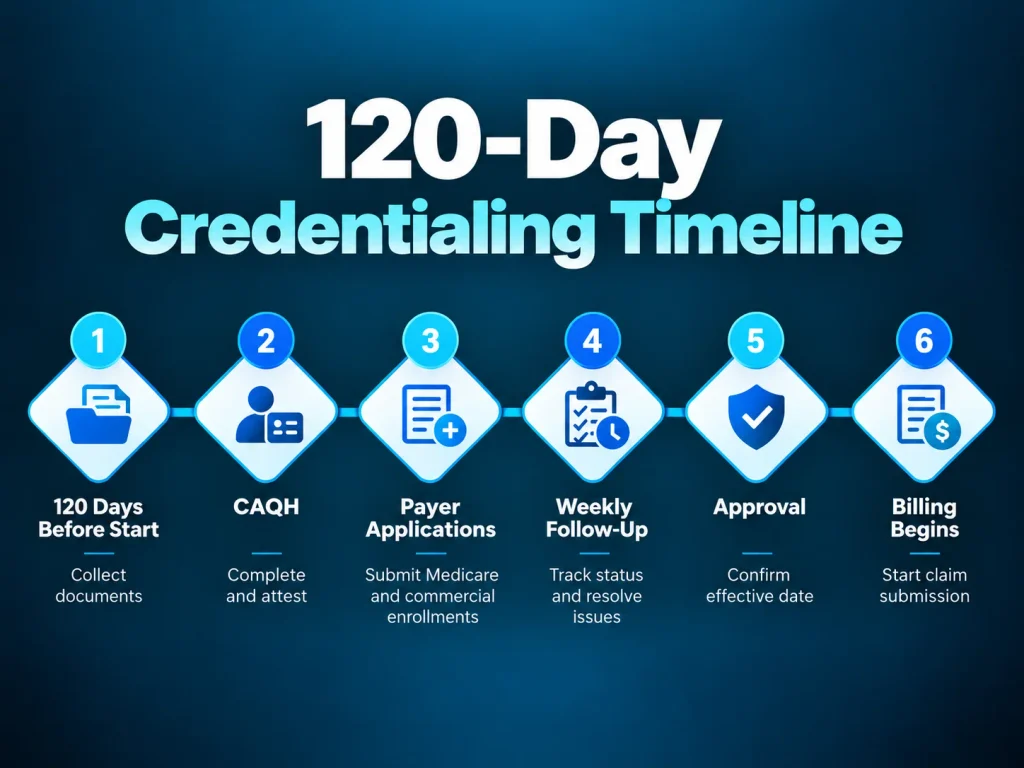
| Step | What to Do |
|---|---|
| Start early | Begin collecting documents 120 days before the provider’s start date |
| Complete CAQH first | Finish, attest and authorize the profile before any commercial application |
| File Medicare before the start date | Submit through PECOS before the first patient visit to protect the effective date |
| Prioritize by payer mix | Apply first to the payers covering most of the provider’s expected patients |
| Follow up on a schedule | Check every pending application weekly and answer requests within days |
| Confirm before billing | Get each effective date in writing and confirm the provider is linked to the right group and locations |
| Track every renewal | Keep CAQH, recredentialing, revalidation, license and DEA dates on one calendar |
Provider panel management and credentialing compliance
As practices grow, the challenge shifts from enrolling one provider to managing the whole panel: which providers are in network with which payers, at which locations and until when. Panel management means keeping a single record of each provider’s status by payer, updating rosters when providers join, leave or move and checking that directories and payer records match. Gaps here create the same denials as a new-hire delay, only spread across established providers.
How Credentialing Services Reduce Denials and Protect Revenue
A credentialing service reduces denials by keeping applications complete, following up with payers on a fixed schedule and catching renewal dates before they lapse. When credentialing sits with the same team that handles billing, an enrollment gap shows up before claims are sent rather than weeks later as a denial. For practices adding providers, opening locations or billing many payers, that coordination is usually where the revenue is protected.
FAQs
How do credentialing delays affect revenue?
Credentialing delays stop a provider from billing in network, cause claims to deny after the visit, limit how far back Medicare will pay and can take established providers out of network when renewals lapse. They also add rework, slow cash flow and contribute to provider turnover.
Why does credentialing take so long?
Credentialing depends on payers, primary sources and credentialing committees, each with its own timeline. Incomplete applications, CAQH problems, committee schedules and verification time limits restart the clock, and timelines vary widely by state and payer.
How long does insurance credentialing take?
Payer enrollment takes a median of about 60 days after a complete application, according to Medallion’s analysis of more than 64,000 enrollments, and up to 196 days in the slowest states. Most practices plan for three to four months including document gathering.
What is a credentialing denial in medical billing?
A credentialing denial is a claim denied because the provider was not credentialed, enrolled or linked to the billing group on the date of service. It usually shows as CARC B7 or as out-of-network processing on the remittance.
Can a provider see patients while credentialing is pending?
A provider can treat patients, but payment depends on each payer’s effective date. Medicare allows billing back up to 30 days before the effective date when circumstances justify it. Commercial payers set their own rules, so confirm before scheduling their patients.
Can a new provider bill under another provider’s NPI while waiting?
Generally no. Billing a new provider’s services under another provider’s NPI misrepresents who performed the service unless the payer’s written policy allows it. Medicare’s locum tenens rule applies only to substitutes for an absent physician.
What causes CAQH credentialing delays?
The most common causes are an unattested profile, payers not authorized to view it, expired documents, missing work history explanations and practice locations that do not match payer records. Re-attesting every 120 days prevents most of them.