


Half of all claim denials start with the same problem: missing or inaccurate claim data. That was the top denial cause providers reported in Experian Health’s 2025 survey, at 50%, as Becker’s reported. It is also exactly what a claim scrubber is built to catch before your claim ever reaches a payer.
Claim scrubbing is the automated review of a medical claim against coding, payer and format rules before submission, so errors are fixed while they are still cheap. A claim scrubber is the software that runs those checks, flags anything that would cause a rejection or denial and sends the claim back to your team for correction. Claims that pass go out clean.
This guide explains how claim scrubbing works, what a scrubber actually checks, what it cannot catch and how to use it to raise your clean claim rate, with the checklist and metrics to prove it is working.
Quick answer: Claim scrubbing improves clean claim rates by catching data, coding, modifier, bundling, unit and payer-rule errors before submission. Every error fixed before the claim leaves is a rejection or denial that never happens, which means faster payment, less rework and fewer claims aging past their filing limits.

What Is Claim Scrubbing in Medical Billing?
Claim scrubbing in medical billing is a pre-submission quality check. Before a claim is sent to a clearinghouse or payer, a scrubber compares every field against a library of rules: is the patient data complete, are the codes valid for the date of service, do the procedure and diagnosis codes support each other, are the modifiers and units allowed and does the claim meet this payer’s specific requirements?
What does it mean to scrub a claim?
To scrub a claim means to run it through those edits and fix whatever fails. In practice, your billing system holds the claim in a work queue with a message such as “modifier 25 required” or “units exceed MUE,” a biller or coder corrects it and the claim is scrubbed again before it is released.
Claim scrubber definition
A claim scrubber, also called a claims editor or medical coding scrubber, is software that applies coding, billing and payer edits to claims before submission. It can sit inside your practice management system, inside your clearinghouse or both.
What Is the Purpose of Claim Scrubbers?
The purpose of a claim scrubber is to make every claim clean on its first submission. Medicare defines a clean claim as one with no defect that would require the contractor to investigate or develop it before adjudication, as CMS explains. A scrubber enforces that standard automatically, so:
- Rejections are caught in minutes instead of weeks.
- Denials caused by fixable errors never happen.
- Clean claims qualify for prompt payment timelines, such as Medicare’s 30-day window.
- Billers spend time on exceptions instead of checking every claim by hand.
- Patterns in scrubber edits show which templates, providers or front-desk steps need fixing.
How Does the Claims Scrubbing Process Work?
Scrubbing usually happens in layers, and each layer catches a different kind of error:
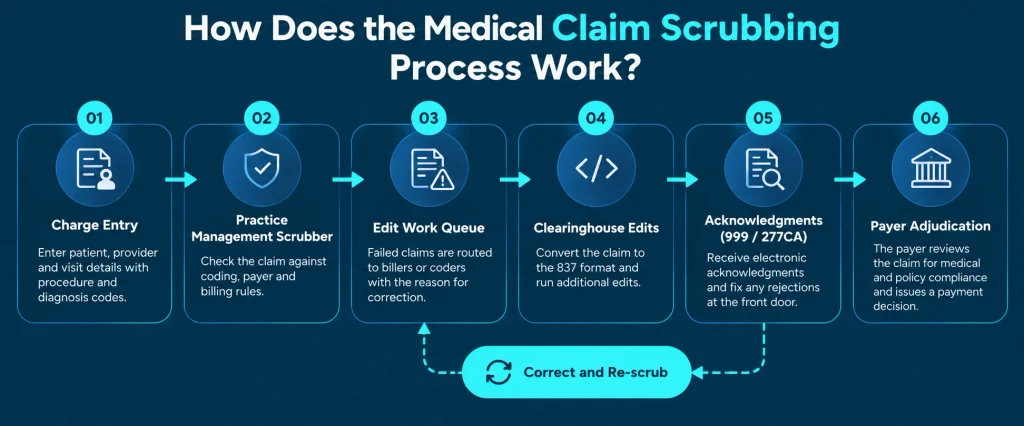
| Stage | What Happens | What It Catches |
|---|---|---|
| 1. Charge entry | Charges and codes are entered from the visit | Missing charges and obvious data gaps |
| 2. Practice management scrubber | Claims are checked against coding and payer rules | Coding, modifier, bundling, unit and payer-specific errors |
| 3. Edit work queue | Failed claims are routed to billers or coders with the reason | Errors that need a human decision |
| 4. Clearinghouse edits | The claim is converted to the 837 format and checked again | Format, payer ID and required-field errors |
| 5. Acknowledgments | The clearinghouse and payer return 999 and 277CA reports | Rejections at the front door |
| 6. Payer adjudication | The payer applies its own edits and policies | Coverage, medical necessity and contract issues |
The earlier an error is caught, the cheaper it is. A practice management edit costs a few minutes; a denial costs about $57.23 to work, according to Premier.
What Does a Claim Scrubber Check?
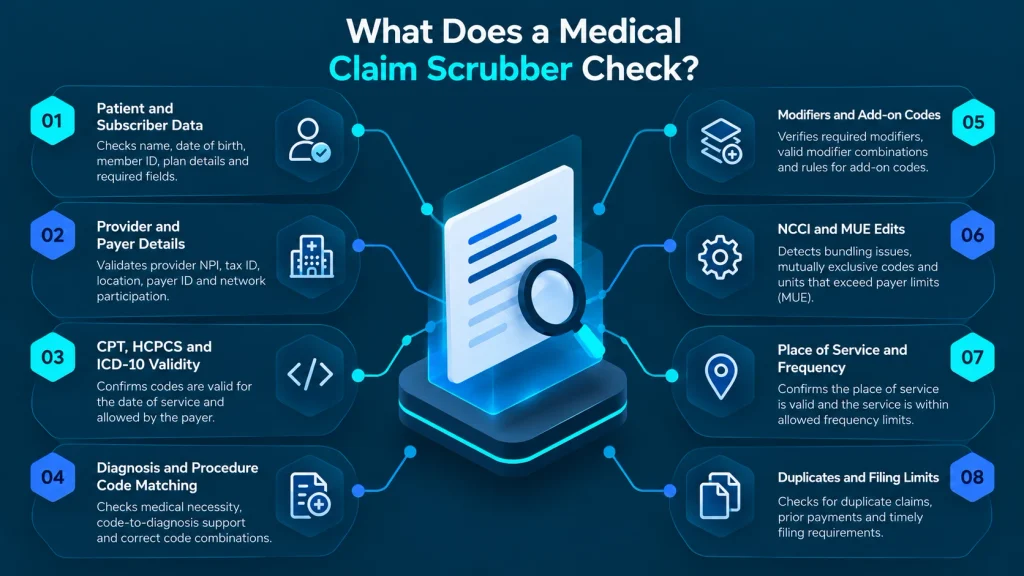
A good scrubber runs hundreds of edits. They fall into these categories:
| Edit Type | What It Checks | Example of an Error It Stops |
|---|---|---|
| Format and required fields | Every required 837 field is present and valid | Missing billing provider NPI |
| Patient and subscriber data | Name, date of birth, member ID and relationship | Member ID with a missing prefix |
| Payer and enrollment | Payer ID, rendering provider and taxonomy | Claim sent with a provider not linked to the group |
| Code validity | CPT, HCPCS and ICD-10-CM codes valid on the date of service | A code deleted in the latest annual update |
| Diagnosis to procedure | Diagnosis supports the procedure and coverage policy | Test billed without a covered diagnosis |
| NCCI procedure-to-procedure edits | Code pairs that should not be billed together | Component billed with its comprehensive code |
| Medically Unlikely Edits (MUEs) | Maximum units per code per day | Units above the MUE limit |
| Add-on codes | Add-on codes have a primary code | Add-on billed alone |
| Modifiers | Required and invalid modifiers | E/M with a procedure and no modifier 25 |
| Age, sex and frequency | Service fits the patient and frequency limits | Screening billed before the allowed interval |
| Place of service | POS matches the service and provider | Telehealth visit with an office POS |
| Duplicates and timely filing | Claim is not a duplicate and is within the filing limit | Resubmission of a claim still in process |
| Payer-specific rules | Custom rules for each contract and plan | A plan that requires a specific modifier or attachment |
| Pro tip: Ask how often your scrubber’s rule library is updated. CMS updates NCCI edits every quarter, code sets change every October and January and payers change policies all year. A scrubber on last year’s rules lets this year’s errors through. |
What Is a Scrubbing Error on a Claim?
A scrubbing error, or scrubber edit, is a flag the scrubber raises when a claim breaks a rule. It is not a denial; the claim has not been sent yet. Each error tells your team what failed and usually how to fix it, such as “diagnosis does not support procedure,” “missing referring provider” or “units exceed daily limit.” Some edits are hard stops that must be fixed; others are warnings a coder can override when documentation supports it.
How Does Claim Scrubbing Improve Clean Claim Rates?
Your clean claim rate is the share of claims accepted on first submission without edits or corrections. Scrubbing raises it by stopping the errors that would have caused a rejection or denial and fixing them first. Our guide to clean claims in medical billing explains the metric in detail.
Clean claim rate = claims accepted on first submission ÷ total claims submitted x 100
The payoff shows up in cash flow. Medicare pays a clean electronic claim no earlier than day 14 and within 30 days before interest applies, as First Coast explains, while a claim that is rejected or denied starts over. Every error the scrubber catches is time and money you keep.
| Without Scrubbing | With Scrubbing |
|---|---|
| Errors found by the payer weeks later | Errors found before submission, in minutes |
| Rework on denied claims | Fixes on unsent claims |
| Claims aging toward filing limits | Claims submitted clean and on time |
| No pattern data | Edit reports that show where errors start |
What Claim Rejection Reasons and Submission Errors Can a Scrubber Catch?
| Claim Error | Typical Result Without Scrubbing | Scrubber Edit |
|---|---|---|
| Wrong member ID or date of birth | Rejection or CARC 16 | Patient data validation |
| Inactive coverage | CARC 27 | Real-time eligibility check, when integrated |
| Invalid or deleted code | Rejection or CARC 16 | Code validity by date of service |
| Diagnosis does not support the service | CARC 11 or 50 | Diagnosis-to-procedure and LCD edits |
| Missing or wrong modifier | CARC 4 | Modifier logic |
| Bundled services billed separately | CARC 97 or 236 | NCCI procedure-to-procedure edits |
| Too many units | CARC 151 or MUE denial | MUE edits |
| Provider not enrolled | CARC B7 | Payer enrollment edits |
| Duplicate claim | OA-18 | Duplicate check |
| Late submission | CARC 29 | Filing limit alert |
What Can a Claim Scrubber Not Catch?
A scrubber checks rules. It cannot judge everything, and treating it as a guarantee is how denials slip through:
- Weak documentation: a scrubber sees the codes, not whether the note supports them.
- Medical necessity judgment beyond the rules it holds.
- Missing prior authorizations, unless authorization status is integrated, which is why prior authorization tracking still matters.
- Payer policy changes that have not been loaded into the rules.
- Underpayments, which show up only after payment posting.
Scrubbing works best as one layer in a process that also verifies eligibility, codes from complete documentation and works denials back to their root cause.
Manual vs. Automated Claim Scrubbing
| Manual Review | Automated Scrubbing | |
|---|---|---|
| Speed | Minutes per claim | Seconds per claim |
| Consistency | Depends on the reviewer | The same rules every time |
| Rule coverage | What staff remember | Thousands of coding and payer rules |
| Updates | Training and memos | Rule library updates |
| Best use | Complex claims and edit overrides | Every claim, every day |
The strongest setup combines both: automated scrubbing on every claim and experienced coders and billers working the edits the scrubber flags.
How Do You Choose Claim Scrubbing Software?
- Rule library: NCCI, MUE, LCD and NCD edits plus payer-specific rules.
- Update frequency: quarterly NCCI updates and annual code set changes loaded on time.
- Custom rules: the ability to add your own payer and template rules.
- Integration: works with your EHR, practice management system and clearinghouse.
- Eligibility: real-time eligibility checks before claims are built.
- Reporting: edit hit rates by rule, provider and payer.
- Override control: clear rules for when a coder can override an edit.
Medical Billing Audit Checklist: What to Check Before Every Claim
Use this as a pre-submission audit checklist, or turn each line into a scrubber rule:
| Done | Check |
|---|---|
| ✔️ | Patient name, date of birth and member ID match the payer record |
| ✔️ | Coverage is active for the date of service and the primary payer is correct |
| ✔️ | Authorization or referral is on file and matches the service |
| ✔️ | Rendering and billing providers are enrolled and linked |
| ✔️ | Codes are valid for the date of service and supported by documentation |
| ✔️ | Diagnosis codes support each procedure |
| ✔️ | Modifiers, units and place of service are correct |
| ✔️ | No NCCI or MUE conflicts remain |
| ✔️ | The claim is not a duplicate and is within the filing limit |
How Do You Reduce Claim Denials Beyond Scrubbing?
Scrubbing stops errors on the claim. To reduce claim denials further, fix the steps that create those errors: verify eligibility before the visit with insurance eligibility verification, code from complete notes through medical coding review and work every denial to its root cause through denial management. In Experian Health’s 2026 State of Claims survey, 89% of providers said reducing denials is a priority this year.
How Does Stream RCM Use Claim Scrubbing?
Stream RCM runs every claim through payer-specific scrubbing before it leaves, works scrubber edits the same day and clears clearinghouse rejections within 24 hours through its claim submission workflow. Repeat edits are traced back to the template or front-desk step that caused them, so the same error does not come back next week. Stream RCM reports a 99% first-pass claim acceptance rate for its clients (company reported), with pricing from 2.99% of monthly collections.

Frequently Asked Questions
What does “clean claims have been processed by a scrubber” mean?
It means the claims passed all of the scrubber’s edits without errors, so they are ready to submit. Passing the scrubber makes a clean claim far more likely, but the payer can still deny it for reasons the scrubber cannot see, such as documentation or coverage.
What is a medical coding scrubber?
A medical coding scrubber is a claim scrubber focused on coding rules, such as code validity, diagnosis-to-procedure links, NCCI bundling edits, MUE unit limits and modifiers.
Is insurance claim scrubbing the same as claim scrubbing?
Yes. Insurance claim scrubbing, claims scrubbing and scrubbing in medical billing all describe the same pre-submission review of claims against coding and payer rules.
Does a claim scrubber guarantee payment?
No. It prevents errors the rules can detect. Documentation, medical necessity, authorization and contract issues can still lead to denials.
How often should claim scrubber rules be updated?
At least quarterly for NCCI edits, every October and January for code set changes and whenever a payer changes its policies.
What is the difference between a scrubber and a clearinghouse?
A scrubber checks claims against rules. A clearinghouse formats, routes and tracks claims between you and payers, and many clearinghouses include their own scrubbing edits.