

Almost half of the entire adult population in the US suffers from hypertension and it ranks among the most frequently encountered conditions in both ambulatory and in-patient settings. Given the fact that hypertension can either exist on its own as a primary condition or occur as a complication due to heart diseases, kidneys or pregnancy, coding will involve not only memorizing a single code, but also remembering many others. While code I10 corresponds to essential/primary hypertension, the things get complicated when it comes to complications such as diabetes, chronic kidney disease, heart disease, secondary or hypertensive crisis.
Based on the National Center for Health Statistics, the rate of hypertension among adults above 18 years old was 47.7% between August 2021 and August 2023, which is increasing according to age from 23.4% among adults between 18 to 39 years old to 71.6% among those above 60 years old. The number of office visits because of essential hypertension reached 56.8 million and the death rate of essential hypertension was 42,343.
The clinical documentation plays an important role in each coding process. It was exposed that only 59.2% of the hypertensive patients knew about their condition, whereas 20.7% managed to have their blood pressure maintained below 130/80 mm Hg. Such results highlight the fact that this condition is not always recognized or properly documented. It is the clinician’s note, not blood pressure results, which defines whether the patient’s claim will be paid on time and accurately. This guide discusses all hypertension-related ICD-10-CM codes and documentation requirements associated with them, as well as logic behind combined codes, thus making sure that all claims created by any medical billing company in USA reflect correct diagnoses.
What Is the ICD-10 Code for Hypertension?
The ICD-10 code for hypertension will vary depending on the nature of hypertension. For example, the code used for essential hypertension or primary hypertension is I10. There are other codes that apply to specific types of hypertension.
I10, Essential (Primary) Hypertension
The I10 diagnosis represents a form of hypertension where there is no other related condition affecting the heart or kidney and therefore requires a combination code. The diagnosis is often used to represent essential hypertension, primary hypertension, or high blood pressure. The diagnosis can be applied when there is a proven diagnosis of hypertension by the provider and not just a single reading of blood pressure. Documentation of the diagnosis will be based on the fact that the diagnosis has been diagnosed, treated or managed.
A coder looking for hypertension ICD-10 diagnosis code, hypertension diagnosis code, ICD-10 code for essential hypertension, primary hypertension ICD-10 code, or ICD-10 code for high blood pressure will find I10 as the focal point of these searches, although the documentation will determine whether the code will be used. Medical coding services support healthcare providers precisely translating clinical documentation into standardized codes, supporting compliant billing, timely reimbursements, and minimized claim denials.
Hypertension ICD-10 Codes List at a Glance
| Condition | ICD-10-CM Code/Category | Key Coding Consideration |
| Essential/primary hypertension | I10 | Used when documented as primary/essential hypertension |
| Hypertensive heart disease | I11.- | Requires appropriate heart disease documentation |
| Hypertensive CKD | I12.- | CKD stage should also be coded |
| Hypertensive heart and CKD | I13.- | Used when both conditions are documented |
| Secondary hypertension | I15.- | Code based on documented secondary cause |
| Hypertensive crisis | I16.- | Includes hypertensive urgency/emergency |
I10 covers isolated primary hypertension without complication. I11 applies once heart disease is documented alongside hypertension and generally requires additional codes for the specific cardiac condition. I12 applies to hypertension with chronic kidney disease and depends on the CKD stage being separately reported. I13 combines both heart and kidney involvement. I15 applies when a secondary, identifiable cause drives the elevated pressure. I16 addresses hypertensive crises, including both urgency and emergency presentations.
Understanding the Main ICD-10 Hypertension Categories
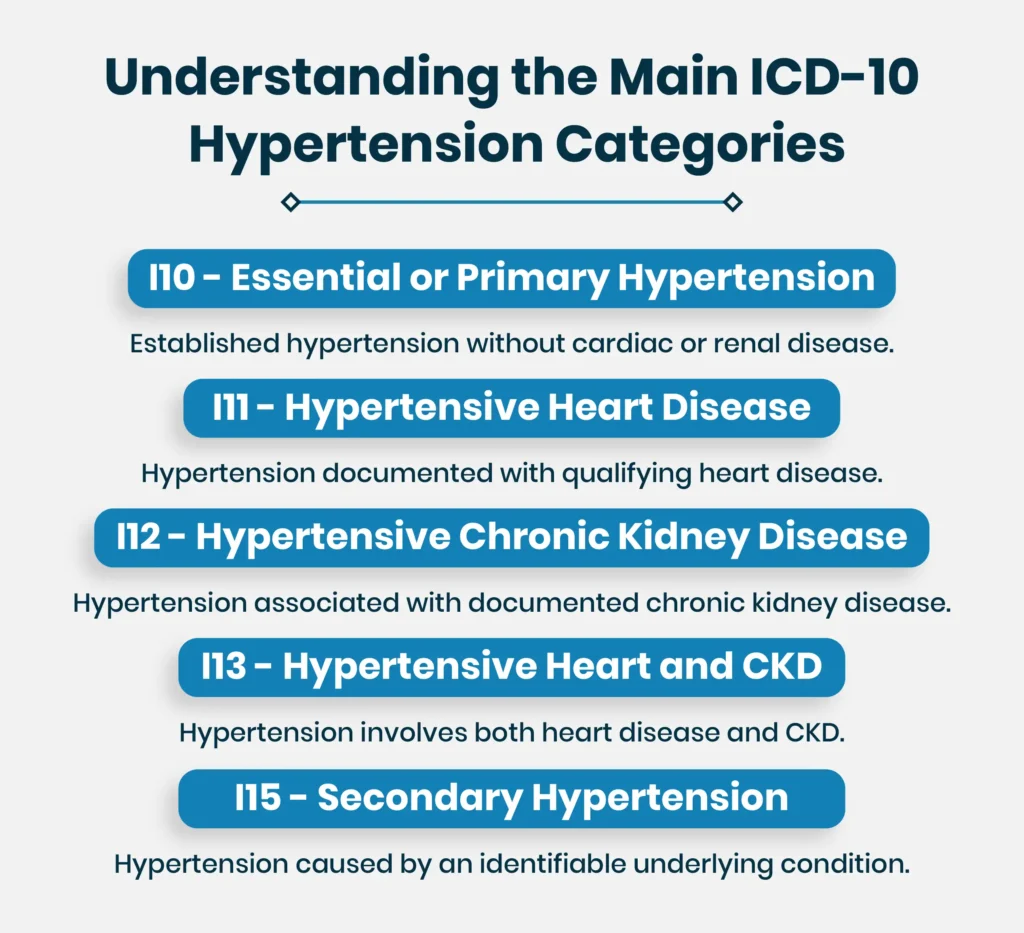
Hypertension coding in ICD-10 can be divided into various groups according to the nature of hypertension and accompanying disorders. The knowledge of the groups assists healthcare practitioners, coders, and billers in determining the appropriate codes for hypertension, hypertensive heart disease, hypertension with CKD, secondary hypertension, and hypertensive crisis.
I10, Essential or Primary Hypertension
I10 can be used for a situation where the diagnosis of hypertension has been clearly established without any associated cardiac or renal disease. Documentation in this regard usually involves a history of hypertension, current treatment of hypertension, or a plan for treatment. It is important to understand that a diagnosis is different from one instance of high blood pressure found during an encounter as the former requires documentation of a chronic condition. Coders need to resist the temptation to use I10 as a matter of course whenever hypertension is mentioned in the record.
I11. – Hypertensive Heart Disease
This category will be used when both the high blood pressure and a qualifying heart condition, for instance, heart failure, are recorded together, and there is an existing relationship between the two diseases which can be specified or inferred using the existing coding practices. Most institutions that offer coding services to their clients usually train their personnel to consider this presumed relationship because, in most cases, the ICD-10-CM coding rules indicate that the relationship between high blood pressure and a heart condition exists unless the healthcare provider clarifies otherwise. A second code needs to be included so as to specify the qualifying heart condition like systolic and diastolic heart failure.
I12. – Hypertensive Chronic Kidney Disease
I12 can be used when the link between hypertension and chronic kidney disease has been made clear in the medical record. Since there is a presumption of the relationship under the ICD-10-CM rules in the vast majority of cases, it is enough for hypertension along with chronic kidney disease to be mentioned in the medical record in order to use the combined code; however, a code for the stage of CKD is required separately.
I13. – Hypertensive Heart and Chronic Kidney Disease
When both a qualifying heart condition and CKD are documented alongside hypertension, I13 replaces the separate I11 and I12 categories. Additional codes are still required for the specific heart condition and the CKD stage. Accurate documentation of both conditions matters because omitting either one can result in an incomplete code selection that understates the clinical picture and affects downstream reimbursement.
I15. – Secondary Hypertension
Secondary hypertension develops as a result of another identifiable medical condition rather than existing independently. Code selection depends on the documented underlying cause, which may include renal artery stenosis, endocrine disorders, or other identifiable conditions. Common examples include renovascular disease and certain adrenal conditions. Coders working through secondary hypertension ICD-10 code or ICD-10 code for secondary hypertension queries should trace the documentation back to the specific cause before assigning a code from this category, since I15 is never used generically.
Expert Review: Make sure to review all of the clinical records for each patient before coding. Always look for any connection that is recorded between hypertension and heart disease, CKD, or secondary causes. Proper use of combination codes and additional secondary codes will help in improving coding.
Hypertension With Diabetes: ICD-10 Coding Considerations
ICD-10-CM does not automatically assume the presence of causality between the two diseases like in some heart and kidney conditions. In this case, coders are expected to not bundle the two diagnoses in one presumption code unless there is proof that they are directly related clinically. Instead, the two conditions are usually separately coded in their own codes in accordance with the documentation from the physician.
When looking for hypertension associated with the ICD-10 code for diabetes or vice versa, there is always an assumption that there is only one code available for the two conditions together, but current guidelines recommend that both conditions should be documented separately unless there is some complication associated with both of them, like nephropathy due to diabetes with hypertensive CKD.
The coder is expected to go through all the documentation, including the assessment and plans, rather than coding based on the problem list only because sometimes, the problem list may not be updated or up to date in relation to the current encounter. The latest ICD-10-CM guidelines for the current coding year have to be referred because there are periodic updates related to diabetes/hypertension combination coding.
Hypertension With CKD: What Coders Need to Know
It is common for chronic kidney disease to be associated with hypertension; according to the ICD-10-CM coding system, there is an assumed relationship unless otherwise documented. This presumption places hypertensive CKD cases into category I12 or, when heart disease is also present, category I13. Both categories depend on accurate reporting of the CKD stage, which is captured through an additional code from category N18, ranging from stage 1 through end stage renal disease.
The CKD stage holds significant clinical and administrative relevance, as it indicates the severity of the disease and influences care coordination decisions far beyond the biller’s office. The documentation should indicate the CKD stage in terms of glomerular filtration rate measurements or the use of appropriate staging terminology in the nephrology or primary care documentation. If heart failure is mentioned as well, it must have its separate code assigned.
Another common but critical error is the coding of only I10 even though the documentation shows hypertensive CKD. This usually happens because of the diagnosis of CKD which is found in other places like the nephrology consult report or laboratory summary and not in the problem list itself, thus the coder did not see it through the entire medical record. Facilities that use specialized AR Management Services usually spot such errors during their claims audit process because of the under-coding of CKD stages.
Hypertensive Urgency vs. Hypertensive Emergency: ICD-10 Codes
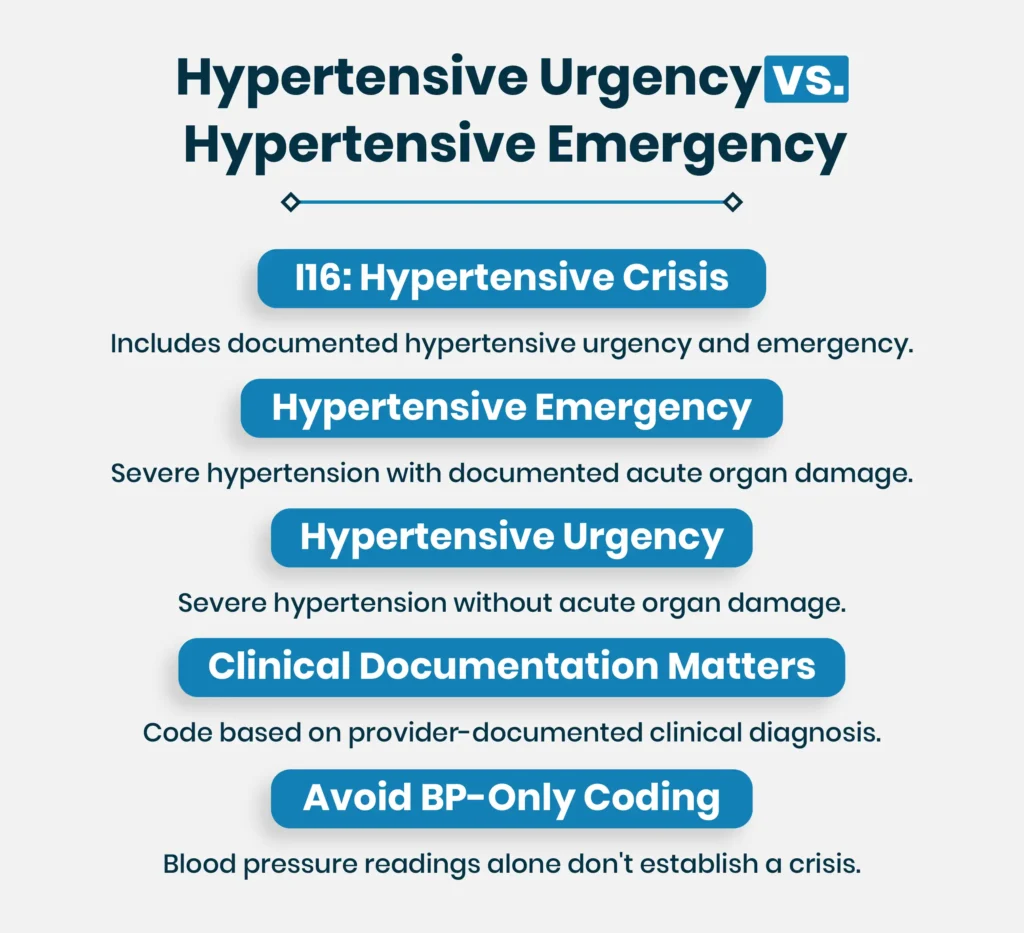
Hypertensive urgency and hypertensive emergency are separate medical conditions and need to be coded carefully using the ICD-10-CM system. While both come under the I16.- category of hypertensive crisis, proper coding can only be done based on the diagnosis provided by the health care provider and the patient’s situation.
Hypertensive Crisis and I16
Category I16 generally deals with hypertensive crisis, with hypertensive urgency and hypertensive emergency being two sub-categories of the same. The reason for having this particular category is to distinguish between a significantly high BP measurement and a true clinical emergency.
Hypertensive Emergency ICD-10 Code
A hypertensive emergency consists of very high blood pressure readings along with evidence of organ damage. This would include organs such as the heart, kidneys, brain, and eyes. The provider must document and clearly identify a hypertensive emergency through his documentation and clinical presentation. Very high blood pressure alone without any organ involvement and an emergency being declared should not be considered a hypertensive emergency.
Hypertensive Urgency ICD-10 Code
Hypertensive urgency is a condition wherein there is a high blood pressure reading but the patient does not have the organ damage related to emergencies. Documentation must be based on what the provider sees during his clinical assessment, together with the treatment plan that he has prepared for the patient outside the clinic. The ICD-10 hypertensive urgency code can be used only if the provider specifies urgency in his documentation.
Why Clinical Documentation Matters
The code cannot be decided on just based on a blood pressure reading noted in the vital signs portion. The diagnosis noted, along with the treatment, assessment, and comments made by the practitioner concerning the degree of severity, will determine the code to be assigned. In case there are conflicting readings, a physician query will be the right course to take.
Malignant and Uncontrolled Hypertension: How Should They Be Coded?
Malignant and uncontrolled hypertension must be carefully evaluated with regard to the provider’s documentation and current ICD-10-CM coding guidelines. Codes should not be assigned based on the actual blood pressure level or terminology used. Instead, it is necessary to consider the diagnoses, any comorbidities, and coding guidance.
Malignant Hypertension ICD-10 Code
The condition malignant hypertension is one that was used in the past and could possibly show up in some patient records but, there does not seem to be an ICD-10-CM code designation reserved specifically for this disease. The best thing to do when encountering this term during the coding process would be to know how it is currently coded to avoid the use of outdated nomenclature before checking the current code set. In most instances, this would pertain to the correct hypertensive codes according to the presentation.
Uncontrolled Hypertension ICD-10 Code
The term uncontrolled hypertension should be reviewed by the coder carefully without immediately assigning a code to the statement. The coder should identify whether the physician is noting the presence of a continuous diagnosis of hypertension that is uncontrolled or if a different disease entity like hypertensive urgency is being documented. It is not the case in present ICD-10-CM coding practice that uncontrolled hypertension is considered a different code from I10, so the coder should code based on the diagnosis being noted.
Resistant Hypertension ICD-10 Coding
Resistant hypertension is defined as a state where high blood pressure persists in spite of the application of multiple drugs. In clinical practice, this term refers to the treatment of this medical condition but not to the disease itself, hence, no specific code is assigned to it in ICD-10-CM. Usually, coding is performed according to the hypertension type code, I10 being the most common one. In case other diseases are involved, like hypertensive CKD, coders have to consider them as well.
Medications and treatment history may serve as an additional information source while coding, but it is not allowed to independently code resistant hypertension based on medication only. This disease has to be diagnosed by the physician explicitly or described as such for the sake of coding. Any researcher interested in the resistant hypertension ICD-10 code should remember that the classification of hypertension is what actually counts.
Gestational Hypertension ICD-10 Coding
In the case of hypertension experienced during pregnancy, the categorization is different from that of plain essential hypertension as pregnancy creates new classes depending on time of onset, degree of severity, and complications such as preeclampsia. Instead of using code I10, there is a need to use the codes in series O that deal specifically with hypertension disorders in pregnancy, which include codes for gestational hypertension, preexisting hypertension during pregnancy, and preeclampsia with varying severities.
Searches for gestational hypertension ICD-10 code or hypertension in pregnancy usually lead coders to this special group of codes, and trimester-specific coding may be necessary based on when the disorder occurs in the gestational period. In order to choose the appropriate code, the trimester, the gestational age, and type of the disorder will have to be considered as preeclampsia and gestational hypertension have different codes, despite having similar signs. Checking insurance eligibility of a patient prior to the visit can also help one ensure that maternity codes are used where relevant. Provider credentialing delays can postpone patient appointments, insurance participation, and reimbursements, creating unnecessary revenue loss for healthcare practices.
I10 code should not be automatically applied in all cases of hypertension arising in pregnancy since this would ignore the specific coding system for pregnancy altogether. Where appropriate, other codes relating to the specific complication of pregnancy, the gestational period, or delivery are supposed to be added as well.
Hypertension Coding Guidelines: Documentation Requirements
Proper coding of hypertension requires proper documentation of the provider. The provider’s chart should specify what kind of hypertension the patient has and any other underlying conditions such as cardiac or renal diseases, diabetes, pregnancy, or hypertensive crisis where necessary.
What Documentation Should Include
Documentation that will provide strong support for a diagnosis of hypertension should include information about the type of hypertension whether it is primary or secondary; heart disease, chronic kidney disease with the stage; any accompanying diabetes; the patient’s pregnancy state, if applicable; hypertensive urgency and emergency, if there is such a condition; and any underlying cause that makes it a secondary condition. With all the documentation, it would be possible to choose the most precise code for a diagnosis.
Do Not Code From Blood Pressure Values Alone
A blood pressure reading documented in the vitals area of a medical chart cannot be equated with a diagnosis. Higher readings that do not have a known history of a hypertension diagnosis need an evaluation of the entire visit and not just coding the higher reading. In situations where there is uncertainty regarding the presence of a diagnosis of hypertension, then the best way forward would be to ask the physician for clarification.
Review the Entire Clinical Record
It may be important to get information from sections other than the main progress note, including the assessment and plan, active problem list, history and physical, consult notes of specialists, discharge summaries, as well as diagnoses, such as echocardiograms or renal panels. Limiting the review to one section raises the probability that an appropriate combination diagnosis would be overlooked, which could have made the difference for coding. Some outsourcing facilities that use outsource medical billing services for their patients design the coding review process in order to review multiple sections of the record.
Follow the Current ICD-10-CM Official Guidelines
The coding instructions, guidance notes, and code definitions may be different in each yearly revision of the ICD-10-CM coding system. The coders need to review the full code definition, relevant inclusion and exclusion notes, and the appropriate guidelines, which apply to the actual date of service, and not depend on past-year memorization.
Common Hypertension Coding and Billing Mistakes
Several recurring errors affect hypertension claims across many practices. Defaulting to I10 for every hypertension diagnosis, regardless of associated conditions, remains one of the most frequent issues. Coding directly from an elevated blood pressure measurement without a documented diagnosis is a closely related problem. Without the codes for both hypertension and chronic kidney disease, or missing the chronic kidney disease staging after the combination code is found, an incomplete claim occurs.
Other common errors include forgetting to enter a necessary heart disease code in case of hypertensive heart disease, considering hypertension in pregnancy to be just as uncomplicated as primary hypertension, and thinking that a severely high blood pressure will always be considered a hypertensive emergency regardless of the actual situation. Using the old terminology for diseases like malignant hypertension without checking the code equivalency can be inconsistent.
Failing to query a provider when documentation is genuinely ambiguous, and selecting a code based on medication use rather than an actual documented diagnosis, round out the most common errors. Most of these problems become visible during a proper medical billing audit services evaluation, which is why regular internal or external audits are still a good insurance policy against frequent denial claims. When such denial claims do happen due to these issues, denial management services will be able to reveal the root cause of the problem and rectify the code submission procedure.
Professional Insight: Do not make assumptions that all hypertension diagnoses should be coded to I10. Review the entire record and look for any co-existing heart disease, CKD, diabetes, pregnancy, or secondary factors. If there is uncertainty, contact the provider rather than making assumptions that can lead to improper coding and claim rejections.
Quick Reference: ICD-10 Codes for Hypertension
I10 covers essential or primary hypertension without complication. I11 applies to hypertensive heart disease and requires an additional heart condition code. I12 covers hypertensive chronic kidney disease and requires a CKD stage code. I13 combines hypertensive heart disease and CKD, requiring both additional codes. I15 covers secondary hypertension based on a documented underlying cause. I16 addresses hypertensive crises, including both urgency and emergency presentations.
Prior to filing a claim, it is vital for coders to check the entire code, instructional notes if needed, and ensure that the coding criteria of ICD-10-CM for the year in question apply to the documented diagnosis. After coding the diagnosis is done, Claim Submission Services will enable timely submission of the claim, while correct Payment Posting Services will allow reconciliation of payment made according to the original code of the diagnosis at a later stage. In cases where planned procedures or advanced diagnostic imaging associated with cardiac and renal workups are involved, prior authorization requirements of Prior Authorization Services must be established before the visit.
How Stream RCM Helps with Hypertension Coding and Billing
Stream RCM provides solutions to support physicians in coding for accurate hypertension codes by making sure that thorough clinical documentation is translated into appropriate hypertension codes, thus decreasing the possibility of under-coding for combination diagnosis and denials. Stream RCM ensures coding accuracy for high volume of hypertension claims through its structured chart review, Revenue Cycle Management support, and consideration of documentation issues of CKD, heart disease, and pregnancy-related hypertension.
FAQs
What is the ICD-10 code for essential hypertension?
I10 code signifies primary or essential hypertension without any evidence of heart or kidney disease. This is when a physician has made a diagnosis based on history or treatment, and not a high blood pressure reading recorded during a single encounter.
Does hypertension always get coded with chronic kidney disease?
Both being documented, there is a presumption of causation according to ICD-10-CM. Thus, the claim is classified as I12 or I13. However, the stage of CKD is to be coded additionally, otherwise the diagnosis is not fully formed.
Is uncontrolled hypertension a separate ICD-10 code?
There is no unique code that represents uncontrolled hypertension. The coders should review the medical record to see whether the disease is still coded as I10 or another condition, for example, hypertensive urgency.
How is hypertension coded during pregnancy?
Hypertension in pregnancy requires separate O-codes as opposed to I10 because hypertensive disorder of pregnancy, preeclampsia, and hypertension as a complication of pregnancy all have different coding methods based on trimester and severity.
What is the difference between hypertensive urgency and emergency codes?
Both belong to category I16, but “emergency” entails the presence of documentation for organ damage, whereas “urgency” pertains to a markedly high blood pressure value without the organ involvement. Both categories cannot be assigned merely based on the blood pressure value.
Can medication use alone justify a resistant hypertension diagnosis code?
There is no separate coding for resistant hypertension, and just based on medication history, it does not influence code assignment. The documented category of hypertension will apply unless otherwise stated by the physician.