


A newly hired physician can see patients on day one and still generate zero reimbursable revenue for three to six months. That gap has nothing to do with clinical readiness. It is the direct result of how long payer enrollment and credentialing now take across Medicare, Medicaid, and commercial networks. At Stream RCM, credentialing delays are the single most common revenue leak we are asked to diagnose, because they hide inside a practice’s operations rather than showing up as an obvious billing error.
This piece is a data-driven look at why credentialing delays happen, what they actually cost, how 2025–2026 regulatory changes have reshaped the math, and what separates practices that stay on schedule from practices carrying a permanent backlog. A structured approach to provider credentialing services is what separates practices that stay on schedule from those carrying a permanent backlog.
Why A Single Delayed Day Adds Up Fast
The most cited figure in credentialing research comes from Merritt Hawkins physician revenue data, which places the cost of a single day’s onboarding delay at roughly $10,122 per provider. That number is not theoretical. It is built from average annual physician-generated revenue divided across a working year, and it is the reason MGMA and multiple revenue cycle researchers continue to reference it when quantifying credentialing risk. For practices, partnering with reliable medical billing services can help reduce the financial impact of these delays by keeping enrollment, claims, and revenue cycle processes organized while credentialing is completed.
Multiply that figure across a realistic enrollment window and the exposure becomes clear. A physician stuck in a 45-day commercial payer queue represents roughly $455,000 in delayed or lost billing capacity. Stretch that to the 90-to-180-day range now common for several major commercial plans, and the exposure moves into seven figures for a single provider. According to Medallion’s 2026 State of Payer Enrollment and Medical Credentialing report, hospital organizations are now commonly reporting more than $1 million in annual revenue risk tied directly to enrollment and credentialing delays.
This is not an isolated finding. A 2025 industry report on payer enrollment inefficiencies found that 60% of healthcare executives said credentialing and enrollment workflow problems were negatively affecting their organization’s bottom line. That statistic matters because it comes from finance and operations leadership, not just credentialing staff; meaning the cost is visible at the level where budget decisions get made. A clean credentialing file reduces downstream rework, but denial management services are still essential for catching the errors that slip through.
What’s Actually Driving Longer Enrollment Timelines
Credentialing issues rarely stem from a single cause. They come from the layering of several independent timelines that all have to complete before a provider can bill in-network. Coordinating prior authorization services alongside credentialing prevents a newly enrolled provider from hitting a second administrative bottleneck immediately after approval.
Medicare Enrollment
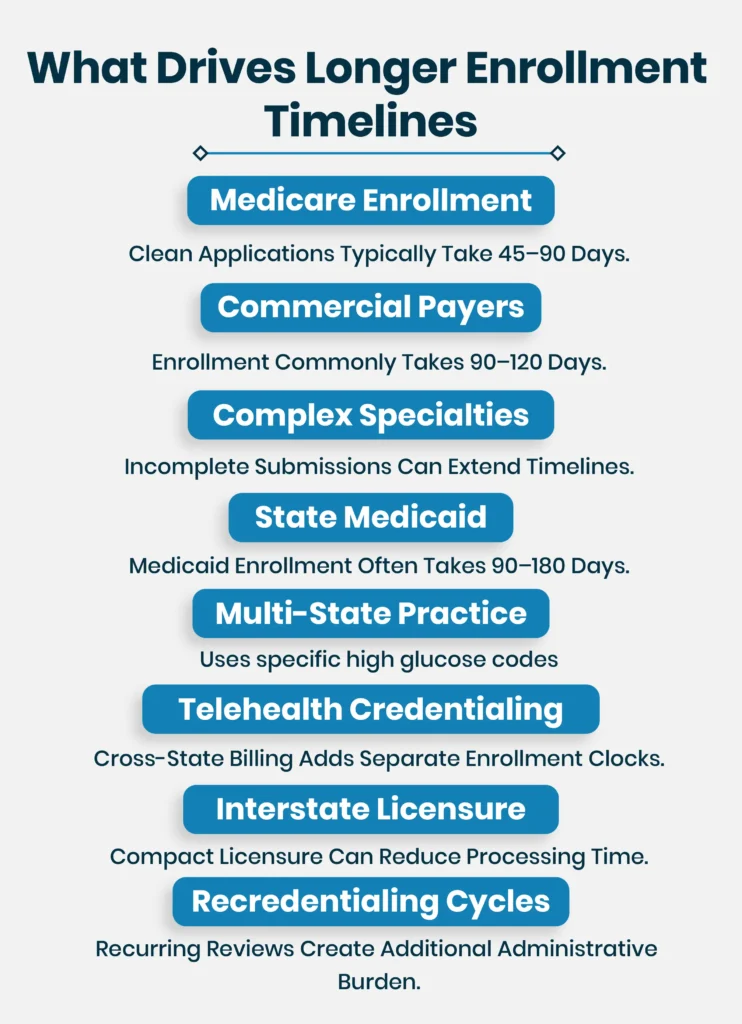
PECOS enrollment for individual providers typically runs 45 to 90 days, assuming a clean, complete application. Backlogs at Medicare Administrative Contractors during high-volume periods can extend that window further.
Commercial Payer Credentialing
This is where most of the pain concentrates. Commercial payer enrollment now averages 90 to 120 days, with several national plans running 120 to 180 days for complex specialties or incomplete submissions. Some payers have adapted well to updated verification requirements and maintain 60-to-75-day turnarounds, while others are running 120 to 150 days for the same process; meaning payer selection and sequencing now directly affects how fast a provider starts generating revenue. Once credentialing clears, claim submission services determine how quickly that newly billable revenue actually reaches the practice.
State Medicaid Programs
Managed care Medicaid enrollment frequently runs 90 to 180 days depending on the state and the volume of applications the program is processing.
Telehealth And Multi-State Practice
Providers billing across state lines faces compounded timelines, since each state may require separate licensure and separate payer enrollment. Telehealth credentialing timelines in 2026 commonly run 90 to 150 days for this reason. The Interstate Medical Licensure Compact, which now includes 42 states plus Washington D.C. and Guam, has shortened the licensure portion of this process to 14–21 days for providers already licensed in a member state a meaningful improvement, but only for the license itself. Payer enrollment in each new state still runs on its own separate clock.
Recredentialing adds a second layer most practices underestimate. Even though it recurs every two to three years rather than being a one-time event, re-credentialing still typically takes two to four months once preparation and payer review phases are combined and a missed re-credentialing deadline can result in a fully active provider being retroactively dropped from a network.
The Administrative Layer Nobody Budgets For
Every credentialing timeline is built on top of a data-verification process that has to happen before any payer will even begin reviewing an application. This is where a large share of credentialing delays actually originate not with the payer, but with the completeness of the file submitted to them. Insurance eligibility verification and credentialing rely on the same underlying provider and payer data, so errors in one often surface in the other.
Research into in-house credentialing operations has found that a striking share of self-managed applications contain missing data, expired documentation, or formatting errors serious enough to trigger a payer rejection and restart the clock. Every rejected application does not just cost the days it takes to fix it moves the provider to the back of that payer’s review queue.
CAQH ProView sits at the center of this problem for most commercial credentialing. A profile with outdated malpractice history, an unattested data set, or missing supporting documents will stall every payer application tied to that profile simultaneously, since most commercial plans pull directly from it. The 2025 CAQH Index built on data from more than 600 provider organizations and health plans representing 63% of insured lives found that the healthcare industry avoided an estimated $258 billion in administrative costs in 2024 through electronic transactions, yet still identified a further $21 billion savings opportunity tied to manual, error-prone administrative workflows including credentialing-adjacent data exchange. That gap is a direct measure of how much friction remains in provider data management even after two decades of industry-wide automation investment.
How Timelines Compare Across Payer Types
Not all delays are created equal, and knowing where the slowest points sit helps a practice decide where to focus credentialing specialists’ time first.
- Medicare (PECOS) – 45–90 days for individual providers, among the more predictable timelines because the process is standardized nationally.
- State Medicaid / managed care Medicaid – 90–180 days, with wide variation by state and by how many managed care organizations operate in that market.
- Commercial payers, responsive plans – 60–75 days for payers that have adapted well to updated verification requirements.
- Commercial payers, high-complexity plans – 120–180 days, often the largest single driver of a practice’s total time-to-bill.
- Telehealth / multi-state enrollment – 90–150 days, compounded by separate licensure and separate payer files in each state.
- Recredentialing – Two to four months per cycle, recurring every two to three years, with preparation (four to six weeks) and payer review (30–90 days) as the two components.
The gap between the fastest and slowest categories above; roughly 45 days versus 180 days is itself the strongest argument for parallel processing. A provider only bills once every required payer has approved the file, which means the slowest payer in the group effectively sets the revenue start date for all of them.
Compliance Rules Just Got Stricter, Not Looser
Anyone assuming regulatory pressure on credentialing timelines is easing should look closely at what changed in 2025. NCQA’s updated credentialing standards, effective July 1, 2025, shortened the primary source verification window from 180 days to 120 days for Credentialing Accreditation and to 90 days for Credentialing Certification. Under the previous 180-day window, teams had enough runway to manage a backlog quietly. That cushion is gone.
Organizations undergoing 2026 review cycles are already failing audits because their internal processes were never rebuilt around the shorter deadline. NCQA now also requires monthly exclusion checks against OIG, SAM, and NPDB databases, monthly license-expiration tracking with documented escalation, and credentialing committee meetings held at least monthly with retained minutes. Documentation gaps not missing verifications themselves are cited as the most common cause of audit failure, because if the method, source, and date of a verification step is not recorded, NCQA treats it as if the verification never happened.
For practices using delegated credentialing arrangements, these same standards apply to any delegate. As of 2024, NCQA allows more than 50% of primary source verification to be delegated to NCQA-accredited or certified partners, but credentialing decision-making authority itself cannot be delegated past that threshold; meaning oversight responsibility never fully transfers, even when the verification workload does.
Where Credentialing Backlogs Quietly Take Root
A late-2025 MGMA Stat poll found that while 65% of medical groups reported their provider files covering new-hire credentialing, re-credentialing, and reappointments were on schedule, the remaining 32% reported some form of backlog, credentialing verification organization delay, or a slip that would push completion into the following quarter. Groups that stayed on time shared three traits: adequate staffing, a documented checklist-driven process, and written turnaround commitments held against their verification partners.
That finding matters because it draws a clean line between practices with structured credentialing management services and practices running the process ad hoc. The gap is not caused by payer behavior alone; internal process maturity is just as strong a predictor of whether a provider bills on time.
Separately, MGMA polling found that 48% of medical groups now cite denials and appeals, many traced back to credentialing and enrollment errors as their single biggest source of revenue cycle leakage. That places credentialing failures in the same tier of financial risk as coding errors and eligibility mistakes, categories most practices already staff and monitor closely.
Sequential Versus Parallel: Where Time Actually Gets Lost
The most common structural mistake in self-managed credentialing is running steps sequentially that could run in parallel. A typical unoptimized sequence looks like this: collect provider documents, complete the CAQH profile, wait for attestation, submit to Medicare, wait for PECOS approval, then begin submitting commercial payer applications one at a time as staff capacity allows.
Each sequential handoff adds calendar days without adding verification value. Running primary source verification, CAQH data entry, and priority commercial payer submissions concurrently rather than waiting for one approval before starting the next has been shown to save 45 to 60 days per provider in practices that restructure around parallel processing. At $10,122 per day, that range alone represents $455,000 to $607,000 in protected or accelerated revenue per provider.
This is precisely the operational shift that dedicated credentialing specialists are built around. A provider enrollment company working multiple applications at once, holding payers to documented service-level turnaround targets, and maintaining a continuously attested CAQH profile is solving a scheduling problem as much as a compliance one.
In-House Credentialing Versus Outsourced Support: What the Data Shows
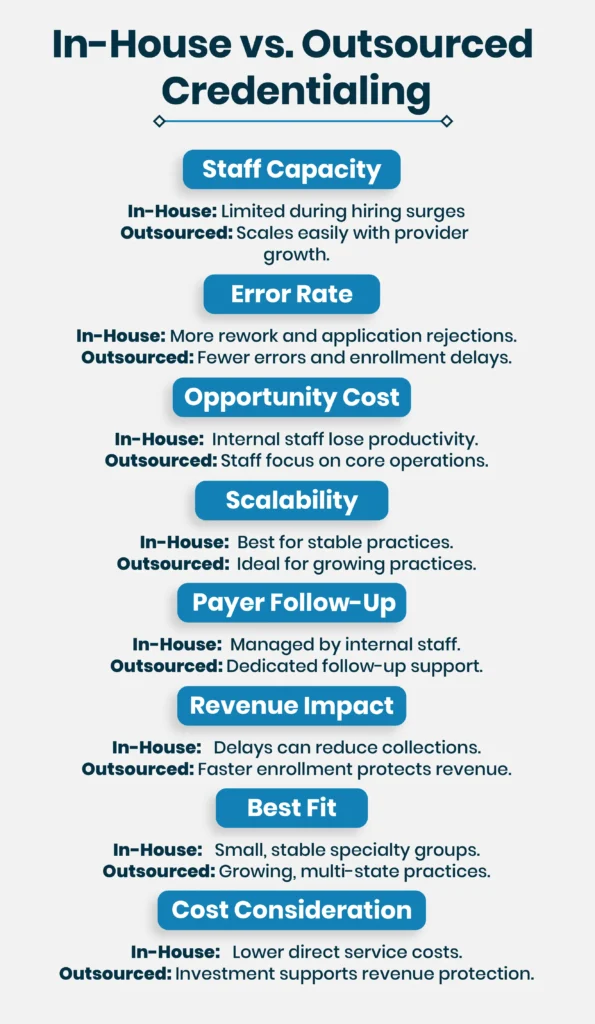
Practices weighing whether to outsource provider credentialing are really weighing three variables; staff capacity, error rate, and opportunity cost.
Staff Capacity
Credentialing is not a task that scales evenly. A practice adding two providers a year can often manage credentialing internally. A practice adding six to ten providers, or expanding into new states, typically cannot without dedicated headcount and that headcount sits idle between hiring waves, which is why many groups instead look at outsourced credentialing services that flex with volume.
Error Rate
In-house teams juggling credentialing alongside other administrative duties show meaningfully higher rejection and rework rates than teams whose entire function is credentialing and enrollment services. Every rejected application restarts a payer’s internal clock, compounding the delay described earlier in this piece.
Opportunity Cost
Even when an in-house team is technically capable, the $10,122-per-day figure means slow, understaffed credentialing is rarely the cheaper option once lost billing capacity is counted against the cost of support.
None of this means every practice needs outsourced credentialing. A stable, low-growth single-specialty group with dedicated administrative staff and a documented process may run in-house credentialing perfectly well; the MGMA data on the 65% of groups staying on schedule confirms that internal models can work when properly resourced. The deciding factor is whether the practice can sustain adequate staffing, a written checklist process, and enforced payer turnaround targets the same three traits MGMA identified as separating on-time groups from backlogged ones; without the credentialing function starving other operational priorities of attention.
Calculating Your Own Delay Exposure
Practices evaluating whether credentialing support services are worth the investment can build a reasonably accurate estimate using publicly available benchmarks rather than guesswork:
- Take the provider’s expected monthly collections (commonly $30,000–$50,000 for primary care, higher for procedural specialties).
- Divide by roughly 21 billing days per month to estimate daily revenue capacity.
- Multiply by the number of days between hire date and expected in-network effective date across your slowest-moving payer.
- Compare that figure against the cost of dedicated credentialing support, including CAQH maintenance, payer follow-up, and sanction monitoring.
For most groups, this calculation reframes credentialing consultant fees from a line-item expense into a revenue-protection decision; because the comparison is rarely “pay for help versus pay nothing.” It is “pay for help versus absorb $10,122 per unbilled day per provider.
What Structured Credentialing and Enrollment Support Actually Involves
Effective provider credentialing solutions are built around a handful of specific, measurable practices rather than a single fix:
- Pre-hire initiation – Starting CAQH data entry and primary source verification up to 90 days before a provider’s official start date, rather than after onboarding paperwork is complete.
- Simultaneous payer submission – Filing priority payer applications in parallel instead of sequentially, which is where the 45-to-60-day savings referenced earlier comes from.
- Continuous sanction and exclusion monitoring – Monthly checks against OIG and state exclusion databases, matching the tightened NCQA credentialing standard rather than the older annual-review habit many practices still follow.
- Documented turnaround accountability – Holding payers and verification partners to written service-level targets, the same practice MGMA identified among on-time groups.
- Recredentialing calendar management – Tracking two-to-three-year re-credentialing cycles proactively, since a missed deadline risks retroactive network removal; turning already-collected revenue into a repayment liability.
- Electronic funds transfer setup – Completing EFT enrollment alongside credentialing, since practices still receiving paper checks lose processing time on every payment cycle after approval.
This is the practical difference between generic administrative help and dedicated credentialing management services: the second category is structured entirely around compressing calendar time between hire date and first billable claim, using the specific timelines and compliance windows outlined above.
Specialty Revenue Makes the Delay Math Worse for Some Providers
The $10,122-per-day figure is an average, and averages hide meaningful variation by specialty. Merritt Hawkins’ physician revenue surveys have shown interventional cardiologists generating as much as $3.48 million in annual hospital revenue, with several procedural specialties; orthopedic surgery, neurosurgery, and general surgery among them, generating well above $2.5 million annually. Translated into daily terms, a delayed credentialing file for a high-revenue procedural specialist can represent $12,000 to $14,000 per unbilled day, meaningfully above the blended average used in most industry calculators.
This is one reason credentialing prioritization matters as much as credentialing speed. A practice bringing on multiple providers at once gets more value from sequencing its highest-revenue specialties through the fastest available payers first, rather than processing applications in the order they were received.
The backdrop driving this urgency is a widening supply gap. The Association of American Medical Colleges has projected a shortage of up to 124,000 physicians by 2034, meaning replacement providers are harder to recruit and slower to onboard clinically before credentialing timelines are even added to the equation. A vacancy that already took months to fill through recruiting cannot afford another 90 to 180 days sitting in a payer queue once a replacement provider is found. Understanding the full provider credentialing timeline is the first step toward identifying exactly where a practice’s delays are originating.
How Stream RCM Supports Provider Credentialing
Stream RCM works as an extension of a practice’s credentialing function rather than a replacement for it, which is the distinction that tends to matter most once a group has been burned by a slow enrollment cycle. The team begins credentialing and payer enrollment work as early as possible in a provider’s onboarding pulling CAQH data entry, primary source verification, and priority payer submissions into the same window instead of waiting for one approval before starting the next, which is where the 45-to-60-day savings referenced earlier in this piece comes from. Every payer file is tracked against a written turnaround expectation, and every provider’s re-credentialing date is monitored well ahead of the two-to-three-year deadline so a lapse never puts an already-active provider at risk of retroactive network removal. Sanction and exclusion checks run on a monthly cycle in line with NCQA’s tightened standards, and CAQH profiles are kept continuously attested so a single outdated document doesn’t stall several commercial applications at once. Because this work sits inside the same team handling billing and revenue cycle management, a credentialing delay never becomes a blind spot between departments; it’s visible, tracked, and treated as a revenue question from the first day of onboarding rather than an administrative afterthought.
FAQs
How long does provider credentialing take in 2026?
Credentialing usually takes 90-120 days for a full and error-free submission, although a more realistic timeframe would be 60-180 days. Credentialing through Medicare’s Physician Enrollment Center Online System (PECOS) process is much quicker and usually takes only 45-90 days.
What causes most credentialing delays?
Incomplete or outdated CAQH profiles cause the majority of delays, since most commercial payers pull directly from that data. Expired malpractice history, missing documentation, or an unattested profile can simultaneously stall multiple payer applications, forcing practices to restart verification steps that already consumed weeks of processing time.
How much does a credentialing delay actually cost?
Physician income figures from Merritt Hawkins, according to MGMA, suggest that the cost of each onboarding delay day is about $10,122 per doctor. This means that for a 90-day commercial payor wait list, the lost or unclaimed billing capacity could amount to about $911,000.
Did NCQA’s 2025 update make credentialing stricter?
Yes. As of July 1, 2025, the NCQA reduced primary source verification timelines to 120 days for Accreditation and 90 days for Certification. There were new monthly exclusion-monitoring requirements introduced and many organizations are already failing 2026 audits due to their lack of documentation of these verification procedures.
Is outsourcing credentialing worth it for smaller practices?
It depends on the hiring volume. Practices adding one or two providers a year can often manage credentialing internally with a documented checklist process. Groups expanding faster, entering new states, or lacking dedicated staff typically lose more in delayed revenue than outsourced support costs.
Can a practice recover revenue lost to a credentialing delay?
Partially, through retroactive billing where a payer permits it, but retroactive effective dates vary by payer and are never guaranteed. Prevention outperforms recovery starting credentialing 90 to 180 days before a provider’s start date consistently protects more revenue than appealing after the fact.