

Anxiety disorders are some of the frequently diagnosed disorders in mental illnesses around the globe and have an impact on people independent of their ages in any setting of healthcare provision. Proper coding and categorization of these disorders have now become crucial to ensure proper treatment, communication, and integrity of healthcare information.
The importance of ICD-10 coding for anxiety disorders is no longer limited to documentation requirements; it is closely linked to reimbursement accuracy, regulatory compliance, and the quality of patient records. For healthcare providers and every medical billing company in the USA, accurate coding plays a critical role in reducing claim denials, supporting medical necessity, and ensuring proper reimbursement. This blog helps healthcare professionals strengthen coding practices, improve documentation standards, and maintain compliance while optimizing revenue cycle performance.
Understanding Anxiety Disorders in ICD-10
Anxiety disorders in ICD-10 categorize conditions involving excessive fear, worry, and panic, which guide accurate diagnosis, documentation, and treatment coding.
What Are Anxiety Disorders?
Anxiety Disorders are mental illnesses whose main features are the feeling of fear, worry or nervousness, which persist in individuals beyond the usual experience during stressful situations. The ICD-10 code for anxiety is used to correctly identify an anxiety disorder to aid diagnosis, treatment and proper documentation in the healthcare setting.
The symptoms associated with anxiety include persistent worry, being restless, easily irritated, difficulty focusing on things, poor sleep patterns, as well as physiological symptoms, like an increased heart rate. Even though some people experience symptoms of anxiety at times, having a diagnosed anxiety disorder unspecified ICD-10 code or another diagnosis indicates a problem.
Why Accurate ICD-10 Coding Matters
The accurate coding of ICD-10 code for anxiety will ensure the demonstration of the medical necessity for the provision of any anxiety disorder services. The proper use of the anxiety diagnosis code will aid the explanation of why the service is clinically necessary which makes the documentation more relevant to the patient’s condition and level of functionality.
From the financial aspect, the selection of the appropriate anxiety disorder medical billing code will be critical. Payers use coding to identify whether patients qualify for coverage and how much money is owed. Any wrong coding can affect payers’ decisions on payments and even lead to denied claims.
Coding can also play a significant role in quality measurement, compliance, and health care information. The use of proper anxiety ICD-10 coding guidelines will assist providers in avoiding coding mistakes and ensure readiness for audits and denials prevention.
Expert Insight: Always document specific anxiety symptoms, duration, severity, and functional impairment clearly before selecting an ICD-10 code. Accurate clinical detail ensures correct anxiety diagnosis code assignment, reduces claim denials, and improves reimbursement consistency and compliance outcomes.
Common ICD-10 Codes for Anxiety Disorders
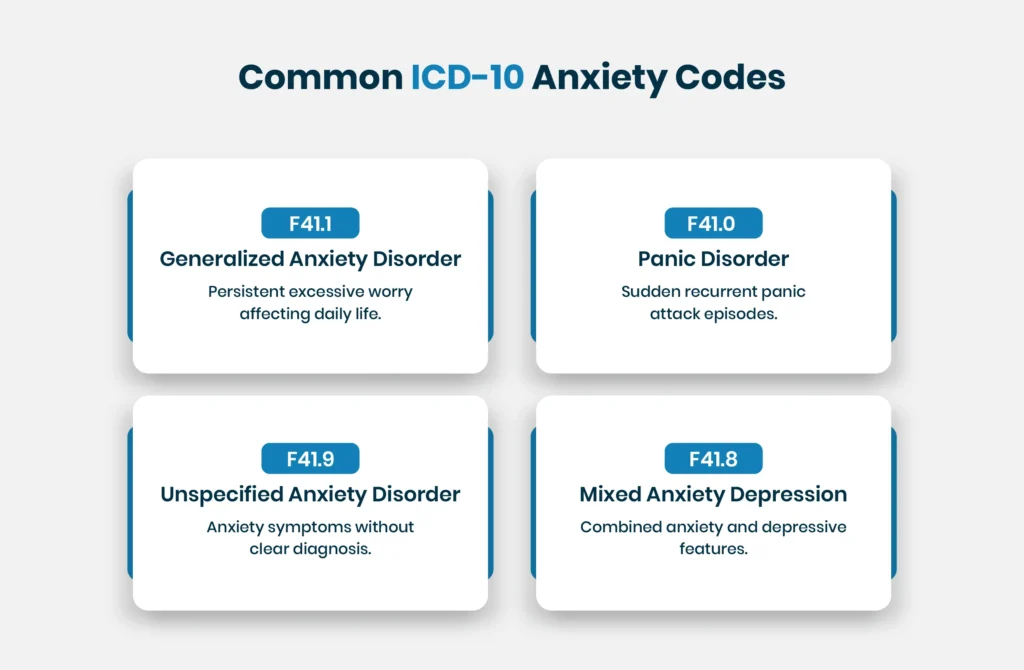
Proper diagnosis of anxiety disorders relies upon selecting the appropriate diagnosis codes corresponding to the symptoms shown by the patient. The knowledge about the codes which are normally used for diagnosing anxiety may help in proper coding of claims and their reimbursement, especially when supported by professional medical coding services which ensure accuracy, compliance, and well-organized healthcare revenue cycle management.
Generalized Anxiety Disorder (GAD)
The code F41.1 is the ICD-10 code for generalized anxiety disorder which is applied when patients are affected by persistent and intense anxiety that limits an individual’s ability to perform daily tasks. Reports should clarify the timeframe of symptoms, severity, impairments that accompany the condition, and clinical results or findings that support a substantial diagnosis rather than associated functional limitations.
Panic Disorder
ICD-10 code F41.0 is employed to classify for panic disorder, which is additionally categorized as episodic paroxysmal anxiety. Panic disorder is considered episodic paroxysmal anxiety. The notes for the patient should contain information on panic attacks, accompanying symptoms both physiological and psychological, number of such attacks, and their effect on functionality. Thorough records support justifies treatment plans and cares for precise reimbursement decisions.
Anxiety Disorder, Unspecified
F41.9 is for the ICD-10 code for anxiety disorder unspecified and is commonly applied when documented clinical information does not justify a more comprehensive diagnosis. While suitable under certain conditions, payers normally prefer greater diagnostic specificity which make complete documentation essential to support medical certainty and claim approval.
Mixed Anxiety and Depressive Disorder
Providers may use F41.8, categorized under other specified anxiety disorders, when clinical documentation supports features of both anxiety and depression. Appropriate coding requires a strong description of symptoms, diagnostic evaluation findings, and the rationale for choosing this code instead of separate anxiety or depressive disorder diagnoses.
Social Anxiety Disorder
Social anxiety disorder encompasses significant fear of social or performance conditions that may lead to escaping behaviors and useful impairment. Correct coding depends on documentation which demonstrates persistent symptoms, clinical evaluation findings, and the degree to which social anxiety impacts occupational, educational, or interpersonal or interactive functioning.
Anxiety Symptoms vs. Anxiety Disorders
Not all anxiety-related complaints qualify for a formal anxiety disorder diagnosis. ICD-10 code for anxiety symptoms may be suitable when symptoms are present but diagnostic criteria have not been met. Providers should differentiate temporary symptom presentations from clinically diagnosed disorders through inclusive assessment and supportive documentation.
Anxiety-Related ICD-10 Codes
| Condition | ICD-10 Code | Brief Explanation |
| Generalized Anxiety Disorder (GAD) | F41.1 | Persistent, excessive worry about multiple areas of life (work, health, family, etc.) that are difficult to control. |
| Panic Disorder | F41.0 | Recurrent, unexpected panic attacks with intense fear and physical symptoms such as rapid heartbeat, sweating, or shortness of breath. |
| Anxiety Disorder, Unspecified | F41.9 | Anxiety symptoms are present, but there is not enough information to identify a specific anxiety disorder. |
| Other Specified Anxiety Disorders | F41.8 | Anxiety symptoms that cause distress or impairment but do not fully meet the criteria for a specific anxiety disorder. |
| Phobic Anxiety Disorders | F40 Series | Anxiety triggered by specific fears or situations, such as social situations, open spaces, or particular objects (e.g., spiders, heights). The F40 category includes several more specific codes. |
ICD-10 Documentation Requirements for Anxiety Disorders
Accurate ICD-10 anxiety documentation needs detailed symptom records, severity evaluation, functional impact, clinical findings, and treatment planning provision.
Essential Documentation Elements
Precise documentation is fundamental to anxiety diagnosis, coding compliance, reimbursement, and treatment arrangement. Strong clinical records care diagnostic precision, demonstrate medical necessity, minimize claim denials, and align with ICD 10 documentation requirements for anxiety across healthcare settings.
Chief Complaint
The chief complaint should obviously state the patient’s principal reason for looking for care, preferably using direct patient language. In-depth documentation strengthens diagnostic trustworthiness and supports the choice of the suitable ICD 10 anxiety diagnosis code whereas establishing the foundation for clinical assessment and treatment planning.
Symptom Description
A complete symptom explanation should document anxiety appearances, frequency, causes, emotional responses or retorts, and physical symptoms. Research-based records advance diagnostic specificity and coding accurateness. Thorough symptom analysis supports suitable assignment of the ICD 10 code for anxiety symptoms and assists to distinguish anxiety from related mental health conditions.
Duration and Severity
Clinicians should record symptom commencement, duration, progression, and concentration using assessable clinical observations. Documenting severity levels offers objective evidence for diagnosis and treatment choices. This information is predominantly important when defining the ICD 10 code for chronic anxiety and assessing the long-standing impact of symptoms.
Functional Impairment
Functional impairment documentation should explain how anxiety disturbs work performance, education, social connections or interactions, relationships, and everyday responsibilities. Evidence-based assessments authenticate clinical implication and support medical necessity. Strong documentation reinforces the anxiety diagnosis code for billing by connecting symptoms to meaningful restrictions in everyday functioning.
Mental Status Examination Findings
Mental status examination findings should accurately describe mood, affect, behavior, cognition, judgment, insight, and thought processes. Analytical documentation increases diagnostic dependability and supports clinical decision-making. These findings are essential when conveying an ICD 10 mental health diagnosis code for anxiety and monitoring treatment results.
Treatment Plan
The treatment plan should include therapeutic interventions, medication management, patient education, follow-up schedules, and assessable goals. Research dependably demonstrates that organized care plans advance outcomes and endurance of care. Complete planning also supports the appropriate practice of an anxiety disorder medical billing code during reimbursement procedures.
Supporting Medical Necessity
All documents must be able to provide information proving that anxiety is medically necessary using a full and complete evaluation, assessment, and results. It is obvious that one must show the effects of anxiety on daily activities, which include work, social interactions, and personal obligations. In addition, documentation must prove the ongoing need for treatment, taking into account persistent symptoms, treatment objectives, and progress.
Documentation Best Practices
Anxiety diagnosis requires accurate language usage, reliable tracking of patient condition, and application of scientific thinking in order to facilitate accurate coding and therapy. It is essential to emphasize specific diagnoses rather than vague terms that reduce diagnostic precision, while carefully documenting symptom progression over time. This approach supports adherence to ICD 10 coding guidelines and is further strengthened through professional outsource medical billing services to ensure enhanced accuracy, compliance, and efficient reimbursement processes.
Anxiety Disorder Billing Tips for Healthcare Providers
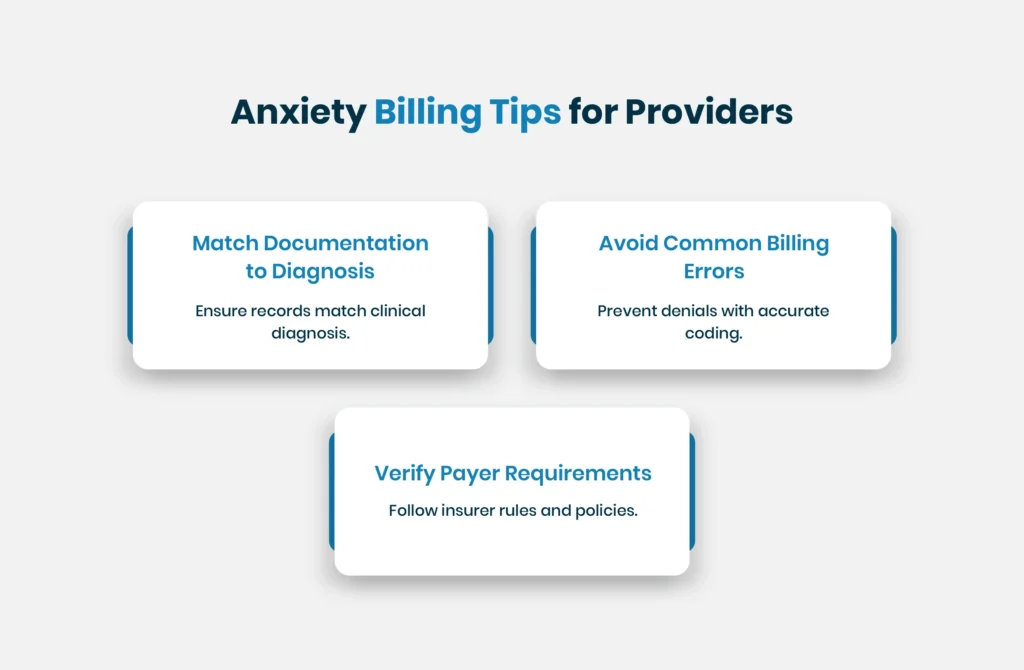
Effective anxiety billing needs precise documentation, correct ICD-10 coding, and adherence to payer-specific rules. Strong clinical records guarantee compliance, minimize claim denials, and advance reimbursement efficiency. Appropriate alignment of diagnosis, treatment evidence, and coding standards strengthens inclusive healthcare billing integrity and cares for sustainable mental health service delivery.
Match Documentation to Diagnosis
Correct billing depends on aligning clinical documentation with the long-established diagnosis, to ensure coding accuracy and uniformity. Providers should evidently link symptoms, assessment findings, and diagnostic decisions. This strengthens claim legitimacy and supports suitable use of the ICD 10 code for generalized anxiety disorder while refining reimbursement outcomes and minimizing administrative errors.
Avoid Common Billing Errors
Common billing errors include overuse of unspecified codes, inadequate documentation, and coding symptoms instead of established diagnoses. These mistakes often lead to claim denials or delays. Clear diagnostic justification is essential when choosing the ICD 10 code for anxiety disorder unspecified to ensure accurate classification and improved payer acceptance rates. Effective denial management services further help identify, analyze, and prevent recurring billing errors that support better revenue cycle performance and compliance.
Verify Payer Requirements
Healthcare providers must confirm or authenticate payer-specific requirements that include pre-authorization guidelines, behavioral health coverage restrictions, and documentation standards. Compliance minimizes audit risks and advances reimbursement effectiveness. The knowledge about the insurance policies certifies proper use of the anxiety diagnosis code for billing which supports precise claims submission and minimizing financial inconsistencies in mental health services.
Professional Advice: Strengthen anxiety billing accuracy by consistently matching clinical documentation with ICD-10 coding guidelines, verifying payer-specific rules, and using detailed symptom evidence. This reduces claim denials, improves reimbursement speed, and ensures reliable compliance in behavioral health billing workflows.
Difference Between Anxiety Disorder and Panic Disorder in ICD-10
Anxiety disorders and panic disorders vary in symptom pattern, duration, and clinical presentation. Anxiety disorders usually involve persistent worry, whereas panic disorder is characterized by sudden and intense episodes of anxiety. Precise differentiation is essential for correct ICD 10 mental health diagnosis code for anxiety collection, treatment planning, and billing accuracy. Furthermore, you need to understand about ICD-10 Codes for migraine headaches which classify headache types, severity, and support accurate diagnosis, treatment, and billing.
Anxiety Disorder Overview
Anxiety disorders comprise persistent, unnecessary worry, tension, and physical symptoms such as restlessness, exhaustion, and sleep disturbance. These symptoms normally develop gradually and persevere over time which affect day-to-day functioning. Appropriate recognition supports correct identification of the ICD 10 code for generalized anxiety disorder and guarantees appropriate longstanding management strategies.
Panic Disorder Overview
Panic disorder is well-defined by sudden, regular panic attacks linking intense fear and physical symptoms such as chest pain, dizziness, palpitations, and shortness of breath. Episodes are unpredictable and inadequate of time. This episodic nature differentiates it clinically and supports precise practice of the ICD 10 code for panic disorder in diagnosis.
Coding Comparison
The key coding difference lies in F41.1 for generalized anxiety disorder versus F41.0 for panic disorder. Documentation must evidently reflect symptom patterns and diagnostic criteria. Accurate differentiation improves billing precision, minimizes claim errors to certify correct application of the difference between anxiety and panic disorder ICD 10 guidelines.
Common ICD-10 Coding Challenges
ICD-10 coding for anxiety disorders is normally complicated by overlapping symptoms which evolve presentations, and comorbid conditions. Correct classification entails cautious clinical judgment, comprehensive documentation, and adherence to coding standards. Suitable application of the ICD 10 anxiety diagnosis code guarantees diagnostic clarity, minimizes billing errors, and advances reimbursement accuracy.
Acute vs. Chronic Anxiety
Acute anxiety presents unexpectedly with short-term symptoms, whereas chronic anxiety includes persistent, long-lasting worry and physiological distress. Clinicians must sensibly understand duration and severity to confirm correct classification. Precise difference supports proper application of the ICD 10 code for acute anxiety versus chronic presentations that improve diagnostic precision and treatment alignment.
Anxiety and Depression Together
When anxiety and depression happen instantaneously, clinicians must regulate the primary condition or use combined diagnostic coding when suitable. Clear documentation of symptom overlaps and severity is indispensable. Proper evaluation supports accurate selection of the ICD 10 code for anxiety and depression which ensure clinical clarity and minimize coding uncertainty in billing.
Unspecified Anxiety Diagnoses
Unspecified anxiety diagnoses should only be used when clinical information is inadequate for a more precise diagnosis. Overuse may indicate poor documentation and raise compliance concerns during audits. Cautious assessment supports justify the ICD 10 code for anxiety disorder unspecified to ensure coding accuracy whereas maintain regulatory and billing standards.
Expert Tip: Always prioritize detailed clinical documentation, symptom specificity, and duration assessment before selecting anxiety ICD-10 codes. Accurate differentiation between acute, chronic, comorbid, and unspecified conditions significantly improves coding precision, reduces audit risks, and enhances reimbursement efficiency.
How Stream RCM support with CD-10 Code Anxiety Disorder
Stream RCM supports ICD-10 anxiety disorder coding by ensuring precise documentation review, accurate code selection, and compliance with payer procedures. It minimizes claim denials through accurate authentication of clinical data and advances reimbursement effectiveness. Stream RCM enhances revenue cycle management, minimizes errors, and supports healthcare providers to maintain coding accuracy and regulatory compliance by regulating the anxiety disorder medical billing code procedure.
FAQs
What is the ICD-10 code for anxiety?
Anxiety codes in ICD-10 depend on the type of condition. In most cases, the code for unspecified anxiety disorders is F41.9 when there are signs of anxiety disorders without proper description. An ICD 10 code for mental health diagnosis for anxiety disorders should be selected accurately.
What is the ICD-10 code for generalized anxiety disorder?
Generalized anxiety disorder is classified under the ICD-10 coding as F41.1. This occurs where an individual shows symptoms of chronic anxiety over various aspects of their life. Proper use of the ICD-10 for Generalized Anxiety Disorder includes proof of duration and severity.
What is the ICD-10 code for panic disorder?
ICD-10 code for panic disorder is F41.0, where the individual suffers from repeated episodes of panic attacks characterized by an overwhelming sense of fear along with physical manifestations. It is important to correctly document ICD-10 codes for panic disorder in order to avoid mistakes.
Can anxiety and depression be coded together?
Yes, it is appropriate to code anxiety and depression together provided that both are diagnosed and confirmed clinically. It is very important to separate symptoms from each other. Appropriate coding of ICD 10 anxiety and depression code will ensure proper billing and treatment planning.
When should F41.9 be used?
Use F41.9 if there are anxiety symptoms but it cannot be classified as a particular kind of disorder. This diagnosis can be applied only if there is inadequate documentation regarding this situation. Too much use of this ICD 10 code for anxiety disorder not otherwise specified means inadequate information.
What documentation is required for anxiety diagnosis coding?
Coding of anxiety disorder diagnosis necessitates thorough documentation of symptoms, duration, severity, impairment, mental status evaluation, and course of treatment. This is necessary for proper coding and billing. Well-kept notes ensure that the coding criteria as per ICD 10 for anxiety disorder will be met.