


Annually, millions of individuals present to healthcare clinics, emergency rooms, and specialty offices. Migraine is considered one of the most disabling neurological conditions in medicine. Although it remains highly prevalent and one of the most persistent challenges in healthcare management remains precise and consistent coding. Choosing the right ICD-10 migraine codes for headache is not merely a clerical task for medical coders, billers, and clinicians alike.
It is also a medical and financial responsibility that has immediate consequences for patient treatment, insurance reimbursement, and practice revenue. Claims move cleanly through the billing cycle, when codes are assigned appropriately, if not then the consequences range from outright claim denials to compliance risks, delayed patient care, and significant revenue loss.
This blog is intended to cover all resources whether you are looking for a specific migraine diagnosis code, trying to understand the difference between intractable and non-intractable migraine, or searching documentation best practices that a medical billing company in USA can support under payer scrutiny and that hold up under review.
Understanding Migraine as a Medical Diagnosis
Before discussing the codes, it is essential to understand from a clinical perspective what is migraine essentially, because coding precision begins with diagnostic clearness. Migraine is a complex neurological condition rather than a bad or simple headache. It is a complicated, chronic neurological disorder which is characterized by regular episodes of moderate to severe head pain. This is normally accompanied by vomiting, nausea, phonophobia and photophobia.
In many patients, attacks are accompanied or led by neurological symptoms known as aura that include sensory changes, visual disturbances, or speech difficulties. The World Health Organization ranks migraine among the leading causes of disability globally which is affecting approximately one in seven people worldwide.
From a coding viewpoint, the difference between a headache and a migraine conveys enormous weight. A general headache is captured under code R51, whereas migraine falls under the completely separate G43 category which reflects its neurological nature. Assigning R51 to a patient with a documented migraine diagnosis is not just a coding error.
It is also a clinical misrepresentation that can affect treatment authorization, specialist referrals, and enduring disease tracking. Appropriate migraine headache documentation in the medical record is therefore the foundation upon which all correct coding is built.
Expert Advice: The type, frequency, intensity of migraines, as well as related symptoms such as aura or nausea, should be documented meticulously because proper documentation allows for accurate coding using ICD-10 codes, avoids denials, and facilitates reimbursement.
ICD-10 Code Structure for Migraines
The ICD-10-CM classifies all migraine diagnoses within the parent category G43. Migraine is a part of the broader chapter on diseases of the nervous system and includes G00–G99. This procedure further strengthens the neurological classification of migraine rather than treating it as a pain or symptom-based condition. The G43 category applies an organized alphanumeric system that communicates numerous layers of clinical information within a single code.
The initial character “G” is used to designate the chapter, whereas the digits “43” are assigned in case of a particular type of condition. The digit or letter that appears next represents a category of a migraine headache, where the ICD-10 code “G43.0” is used for migraine without aura, the ICD-10 code “G43.1” represent a migraine with aura, the ICD-10 code “G43.7” is applied for chronic migraine, and so on.
Many codes also bring a fifth character which distinguishes the presence or absence of status migrainosus. This is a condition of a debilitating migraine attack lasting more than 72 hours which is considered a medical emergency in many situations. Understanding this architecture allows coders to move through the G43 category systematically rather than defaulting to vague and unspecified codes.
Complete List of ICD-10 Migraine Codes
ICD-10 migraine codes categorize different migraine types that include with aura, without aura, chronic, and other specified neurological headache disorders conditions, where medical coding services ensure accurate classification and compliance.
Migraine Without Aura — G43.0
The most commonly diagnosed migraine type used in neurology and primary care settings is migraine without aura or also known as common migraine. Patients present with repeated unilateral or one side head pain, moderate to severe in intensity which is normally worsened by physical activity and accompanied by nausea or light sensitivity, but without previous neurological aura symptoms.
- G43.001 — Not intractable, without status migrainosus.
- G43.009 — Not intractable, with status migrainosus.
- G43.011 — Intractable, with status migrainosus.
- G43.019 — Intractable, without status migrainosus.
Migraine with Aura — G43.1
Migraines with aura occur in about 25–30% of patients with migraines. The aura manifests itself through reversible neurologic symptoms, mainly consisting of visual symptoms like seeing jagged lines, scotoma, or flashing lights, that precede the headache phase and occur over the course of five to twenty minutes. The code for migraine with aura under ICD-10 should document aura symptoms in order to be sure of assigning G43.1 since the absence of this information means the coder does not have the clinical rationale for assigning this code.
- G43.101 — Not intractable, without status migrainosus.
- G43.109 — Not intractable, with status migrainosus.
- G43.111 — Intractable, with status migrainosus.
- G43.119 — Intractable, without status migrainosus.
Considering the health risks from a medical perspective, it has been established that migraine with aura has a greater predisposition to ischemic stroke, especially for smoking women using combined oral contraceptives. This means that proper classification of code G43.1 is vital.
Hemiplegic Migraine — G43.4
This migraine condition is a very rare and severe form of migraine where the aura involves a temporary weakness or paralysis of one side of the body, simulating symptoms of a stroke. This kind of migraine needs meticulous reporting and at times calls for specialists to be consulted.
- G43.40 — Not intractable
- G43.41 — Intractable
Persistent Migraine Aura — G43.5 and G43.6
Persistent migraine aura is a neurological condition whereby auras manifest and continue for more than one week after the migraine occurs. This difference in coding is significant for numerous reasons.
- G43.5 — Persistent migraine aura without cerebral infarction.
- G43.6 — Persistent migraine aura with cerebral infarction.
If there is indication through neuroimaging for a cerebrovascular infarct from a migrainous aura, commonly referred to as migrainous infarction, then the code to use is G43.6. This affects both treatment strategies and insurance approval for further treatment.
Chronic Migraine — G43.7
Chronic migraines are categorized by headaches which occur on 15 or more days a month and last more than three months, eight or more of which achieve all diagnostic criteria of migraines. Chronic migraines are far more debilitating than episodic migraines and have fluctuating implications regarding management and cost coverage. The ICD-10 classification for chronic migraines is infrequently used since the providers fail to document headache frequencies.
- G43.701 — Not intractable, without status migrainosus.
- G43.709 — Not intractable, with status migrainosus.
- G43.711 — Intractable, with status migrainosus.
- G43.719 — Intractable, without status migrainosus.
Migraine Variants — G43.A, G43.B, G43.C
These codes encompass migraine spectrum disorders with unique manifestations, especially pertinent to pediatric neurology and gastroenterology.
- G43.A0 or G43.A1 — Cyclical vomiting, not intractable or intractable.
- G43.B0 or G43.B1 — Ophthalmoplegic migraine, not intractable or intractable.
- G43.C0 or G43.C1 — Periodic headache syndromes in children or adults, not intractable or intractable.
Vestibular Migraine — G43.D
The ICD-10 coding for vestibular migraine – G43.D – was included to account for the increasing awareness of this type of migraine disorder that manifests itself with episodes of vertigo, imbalance, and dizziness caused by a past history of migraines. G43.D can easily be mistaken for either benign paroxysmal positional vertigo (H81.1) or Ménière’s disease (H81.0).
- G43.D0 — Not intractable
- G43.D1 — Intractable
Unspecified Migraine — G43.9
ICD-10 code for unspecified types of migraines is applied only when there is no clinical evidence for a particular type of migraine subtype.
• G43.909 – Not intractable and not with status migrainosus.
• G43.919 – Intractable and not with status migrainosus.
The over-reliance on this particular ICD-10 code for unspecified migraines indicates that the documentation provided is inadequate for the payer and makes patients’ longitudinal medical record substandard.
Professional Insight: Remember to always identify migraine type, migraine intractability, presence or absence of aura, number of attacks, and accompanying symptoms, since this helps in making sure that you choose the correct ICD-10 code.
Quick Reference — ICD-10 Migraine Code
| Code | Description |
| G43.001 | Migraine without aura, not intractable, without status migrainosus |
| G43.011 | Migraine without aura, intractable, with status migrainosus |
| G43.101 | Migraine with aura, not intractable, without status migrainosus |
| G43.111 | Migraine with aura, intractable, with status migrainosus |
| G43.40 | Hemiplegic migraine, not intractable |
| G43.41 | Hemiplegic migraine, intractable |
| G43.5 | Persistent migraine aura without cerebral infarction |
| G43.6 | Persistent migraine aura with cerebral infarction |
| G43.701 | Chronic migraine without aura, not intractable, without status migrainosus |
| G43.711 | Chronic migraine without aura, intractable, with status migrainosus |
| G43.A0 | Cyclical vomiting, not intractable |
| G43.B0 | Ophthalmoplegic migraine, not intractable |
| G43.C0 | Periodic headache syndromes, not intractable |
| G43.D0 | Vestibular migraine, not intractable |
| sG43.D1 | Vestibular migraine, intractable |
| G43.909 | Migraine, unspecified, not intractable, without status migrainosus |
Intractable vs. Non-Intractable Migraine: A Critical Coding Distinction
Among the most important, yet often misinterpreted, migraine differentiations is that of intractable vs. non-intractable migraine. All subtypes of migraine under the G43 classification require such differentiation, and there are far-reaching ramifications for both patients and healthcare providers.
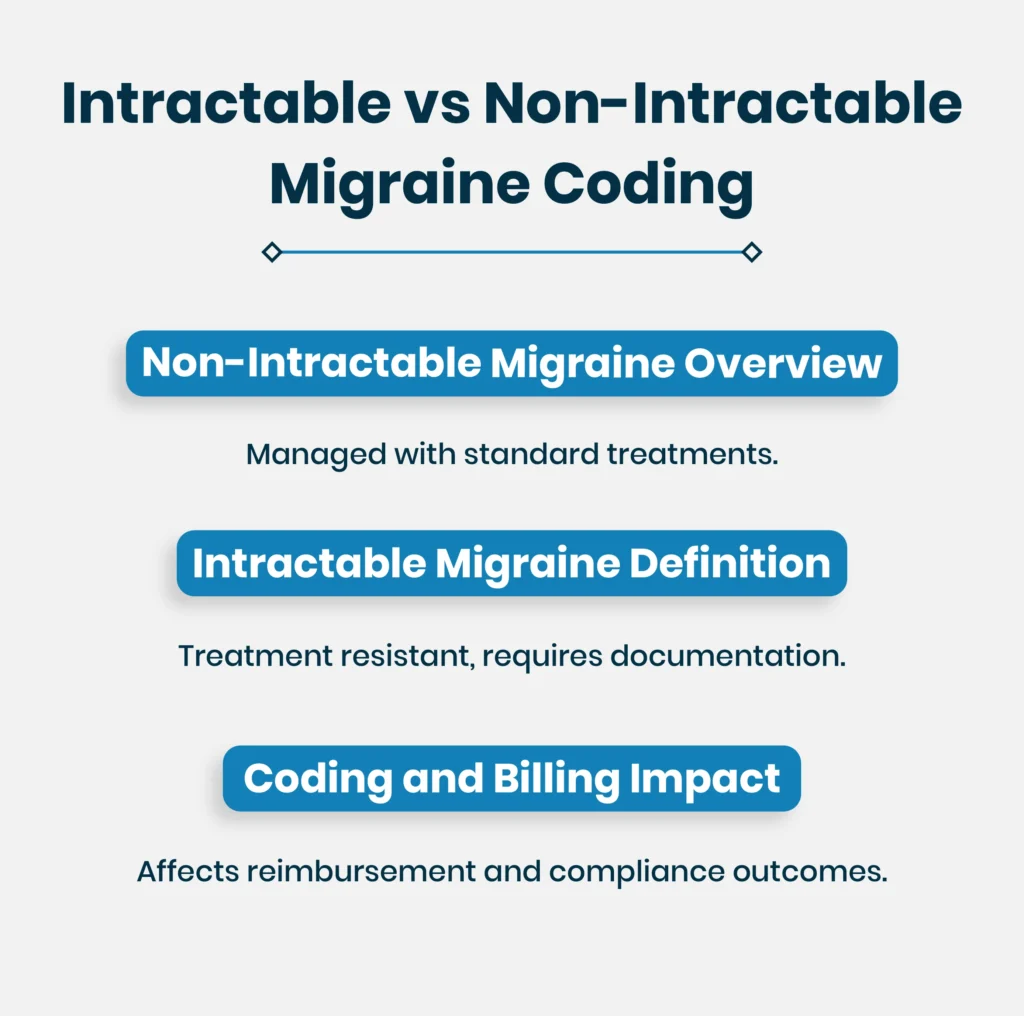
Non-intractable migraine is a type of migraine that can be treated using conventional treatment methods. Even though the patient might have to deal with considerable pain, the problem can be managed through the use of triptans, NSAIDs, or antiemetics. Most of the normal migraine cases that you encounter will fall under non-intractable migraines. Intractable migraines are those that cannot be handled by conventional treatment methods.
Pharmacoresistance, pharmacointractability, treatment resistance, and refractory migraine can all be used as clinically appropriate terms, and are supported by the ICD-10 intractable migraine code. Documentation of treatment failure or refractoriness is required for intractable migraine. Coding intractable migraine based on intensity of pain is not possible. Neither is coding intractable migraine based on the administration of intravenous medicines in the ER.
The difference has direct implications for reimbursement, as intractable migraines will frequently require more complex evaluation and management service billing, procedure coding, and lengthier hospitalizations. Inappropriately neglecting intractability in a coding scenario where it is applicable translates into undercoding and missed revenue opportunities.
Migraine with Aura vs. Without Aura: Clinical and Coding Differences
The distinction between migraines with and without aura involves more than just the difference in name. This distinction is vital in terms of therapy, risk assessment, and medical billing. These are entirely distinct classes of codes, and G43.0 refers to migraines with aura while G43.1 refers to migraines without aura. Simply put, there is no room for error regardless of how similar the two may seem.
The term aura is used to refer to various neurological manifestations that occur approximately 20 to 60 minutes before the appearance of headache pain. The most frequent form of aura occurs visually in almost 90% of patients experiencing any form of aura at all. If the presence of aura is noted, the coding for the diagnosis is simply G43.1.
Otherwise, the diagnosis is G43.0. As far as the question of uncertainty goes, it should be clarified by a physician in order not to make mistakes. In addition, this distinction is very important clinically speaking because it is associated with a higher risk of developing a stroke.
Chronic Migraine Coding Guidelines
Chronic migraine represents one of the most challenging coding scenarios in neurology because the transition from episodic to chronic migraine is often gradual and inconsistently documented. Many patients who clinically meet the threshold for chronic migraine continue to be coded as episodic simply because the provider has not updated the diagnosis in the record.
Documentation must explicitly support the frequency criterion, 15 or more headache days per month for more than three months, with at least eight days meeting full migraine criteria, to assign the ICD-10 code for chronic migraine (G43.7). This must appear in the clinical note as a physician statement, a reviewed headache frequency log, or a patient-reported diary. Chronic migraine also has direct implications for treatment authorization. Most insurers require a specific chronic migraine diagnosis with ICD-10 specificity before approving CGRP antagonist therapies such as erenumab (Aimovig), fremanezumab (Ajovy), or galcanezumab (Emgality), as well as OnabotulinumtoxinA (Botox) injections. Vague or episodic migraine coding in these cases results in prior authorization denials that delay patient care and frustrate both providers and patients.
Another critical issue is differentiation from medication overuse headache (MOH), coded under G44.40–G44.41. When both conditions coexist, both may be coded — but the primary reason for the encounter must be sequenced first. Coders working in neurology practices should be alert to this complication, particularly in patients who present with escalating headache frequency alongside heavy analgesic use.
Vestibular Migraine — Special Focus
Vestibular migraine needs a special focus due to its status between neurology and otolaryngology, frequent misdiagnosis, and its significance as a recently added yet vital entry in the classification of ICD-10.
A patient experiences repeated attacks of vertigo or disequilibrium in relation to migraine but does not necessarily have headache at that time.
According to the classification criteria proposed by the International Headache Society and the Barany Society, one must have a confirmed case of current or previous history of migraine; recurrent (at least five times) attacks of moderate-to-severe vertigo/disequilibrium lasting for at least five minutes but not more than 72 hours; presence of characteristics of migraine in at least 50% of attacks of vertigo/disequilibrium.
The most typical miscode is using H81.x (disorders of vestibular function). It brings to mind an inappropriate treatment strategy, failure to provide proper medication, and wrong statistical information about the disease. In coders working in ENT clinics and neurologists, one should check for vestibular-migraine association before choosing codes from either G43.D or H81 categories.
ICD-10 Coding Guidelines for Different Migraine Visit Types
ICD-10 coding guidelines for migraine visit types ensure accurate classification, while outsource medical billing services help maintain compliance, reduce errors, and improve reimbursement efficiency.
Initial Diagnosis Visit
In the case where a patient has been seen for the first instance of migraine, the attending physician should state which kind of migraine it is, whether intractable, and other complicating factors in his medical record. A diagnosis of G43 should not be coded simply because of the signs exhibited by the patient. If there is a mention of severe headaches with nausea and photophobia without mentioning migraines, then it is better to use R51, R11.x, and H53.13 symptom codes.
Follow-Up and Treatment Visits
In terms of recurrences of migraines, coders need to update the code for the diagnosis of recurrence of migraines based on the latest condition of the patient during each episode, not just copying the same information from the last visit. In cases where a patient had been diagnosed with recurrent migraines, code G43.001, but now meets all the diagnostic criteria for chronic migraine, his/her record must be updated with code G43.701 or G43.711.
Emergency Department Visits
Migraine coding in emergencies is usually related to intractable migraine codes and status migrainosus. The encoder should find out if the doctor mentioned that the migraine was an intractable migraine and for what period of time, if any treatment was effective or not. Migraine should be coded as the primary diagnosis if it was the reason for visiting a hospital, and other codes related to symptoms of migraine should be used as secondary.
Migraine Medical Billing: Coding for Reimbursement
Coding for accurate migraine diagnosis and coding is intrinsically linked with successful billing practices. Migraine diagnosis codes, which are determined by the physician’s diagnosis, determine what procedure codes can be billed, what authorizations will be covered, and the level of reimbursements obtained by the practice. Mismatched codes for procedures and diagnoses continue to cause many billing denials even now, where denial management services help identify errors, correct claims, and improve reimbursement outcomes.
For visits for the routine management of migraine, E/M codes (99202-99215) are based on the diagnosis code for migraine. The higher the level of medical complexity, as defined by higher-complexity conditions like chronic intractable migraines with several comorbidities, the higher the level of E/M code used. However, documentation must justify the increase in complexity of medical decision-making.
When there are procedure codes such as occipital nerve blocks (64405), trigger point injections (20552-20553), and Botox injections (64615), the diagnosis codes for the migraine must satisfy payer requirements for medical necessity of those procedures. For example, most insurers require that the G43.701 and G43.711 codes be submitted along with the claims for Botox injections for migraine; else, denial is inevitable.
When it comes to targeted preventive treatments, there are more stringent prior authorization requirements. Insurers usually demand documented history of chronic migraine, including the use of at least two to three classes of preventive medication which failed, and qualifying data regarding the headache frequency among others. Coding specialists with knowledge of these prior authorization requirements will help ensure correct use of codes in prior authorization request submissions, streamlining the process.
Documentation Best Practices for Migraine Coding
The first, most important thing that influences migraine coding accuracy is the quality of clinical documentation. No matter how proficient the coder is, he/she will be unable to code correctly using poor notes. In particular, the physician documenting the patient’s visit in relation to the case of migraines must always document the exact type of the disease and mention if there is an aura, intractability and clear description of the treatment, headache frequency (when there are signs of chronic migraine), presence of accompanying symptoms like nausea, photophobia, and phonophobia, and the treatment history indicating what medications the patient has tried and refused.
Using electronic health record software designed specifically to provide migraine documentation templates, doctors can document all these aspects each time they see their patients. Clinical documentation specialists working on migraine documentation prior to coding can contribute immensely to coding success by detecting gaps in documentation that could lead to coding errors or denials. The guidelines published by AHA Coding Clinic and AAPC emphasize the need to do one thing in this situation – query the physician when there are doubts about the type of code to use due to vague documentation.
Common Coding Mistakes to Avoid
There are some coding mistakes that always happen and should be avoided at all costs. Defaulting to G43.9 (migraine unspecified) happens most commonly; it demonstrates lack of good documentation practice to the payer and could be a cause for an audit. Using R51 (headache) instead of G43 (migraine) happens whenever physicians interchange these terms in their progress notes; thus, coders have no choice but to code the symptom instead of a diagnosis.
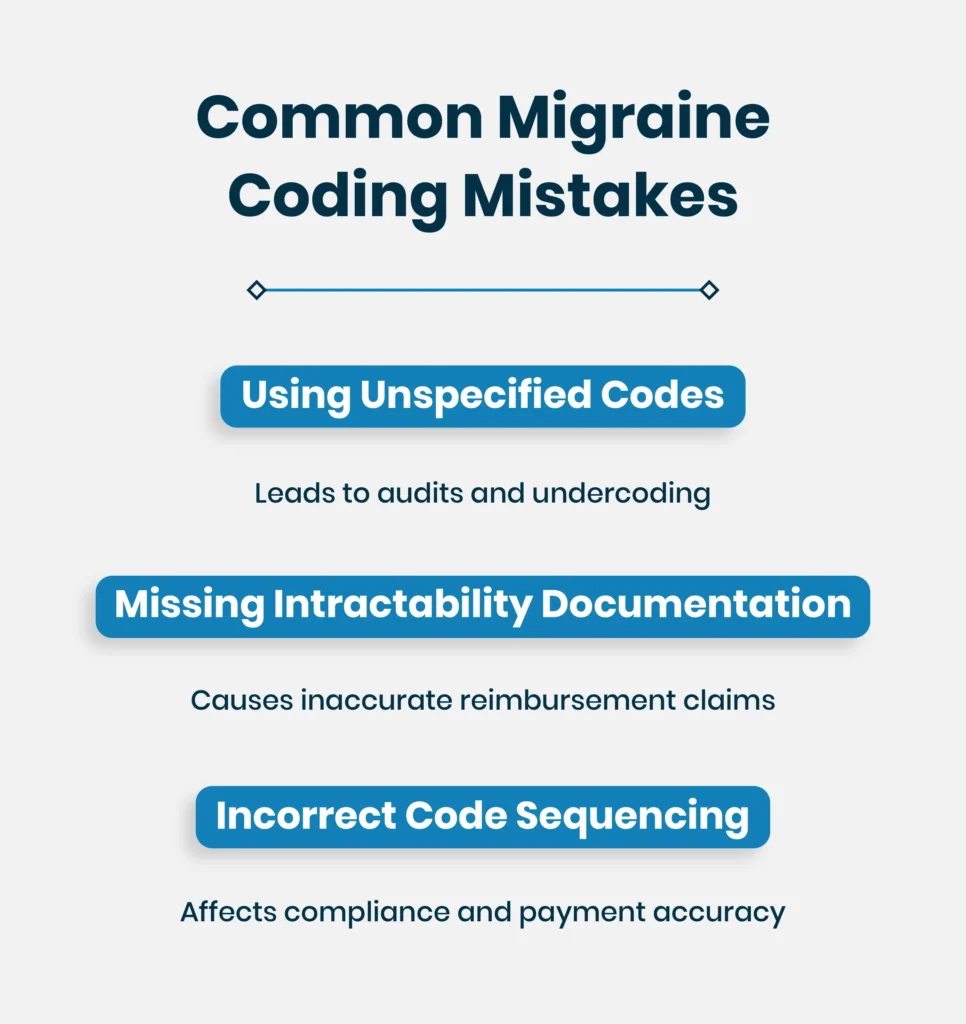
Not documenting intractability is a costly error in many ways. Whenever a patient has tried various home remedies without success, there might have been an intractability; however, this code will only apply if it is mentioned explicitly in the medical record. Mistakenly assigning a code for vestibular migraine (G43.D) with any other vestibular condition (H81.x) creates problems because of different pathways and inaccurate data.
Coding comorbidity codes out of order is another common mistake. If the patient experienced nausea or anxiety as a result of a migraine attack and these were not the reason why they visited the physician, nausea and anxiety should come first; otherwise, payment and compliance problems arise.
Pro Tip: Do not get into the habit of automatically using unspecified codes; always make sure that the migraine is identified properly as well as its intractability and symptoms, and proper sequencing of diagnoses to avoid coding errors.
How Stream RCM Supports Your Practice with ICD-10 Migraine Coding
Stream RCM enables healthcare services to adopt ICD-10 migraine codes effectively through provision of expert coders, documentation improvement, denial management, prior authorization support, and compliance services. The company’s expertly trained professionals guarantee proper code choice, reduced claim denials, and optimized reimbursement performance while remaining audit-ready. The service is helpful to various facilities including neurology clinics.
FAQs
What is the most common ICD-10 code for migraine?
G43.909, the code for migraine unspecified, not intractable, not having status migrainosus, is the one most commonly used to document care. But this code doesn’t represent good coding practice, as it should be reflective of the clinical reality at hand.
Can I use G43.9 for all migraines?
Feasible technologically, yet strongly discouraged. G43.9 serves as a last-resort code. Utilizing it regularly invites payer review and does not reflect the actual condition of the patient.
What is the difference between G43.0 and G43.1?
Migraine without aura is identified by G43.0 while G43.1 stands for migraine with aura. This differentiation is made based on aura symptoms alone.
How do I code a migraine not responding to treatment?
In cases when the notes indicate that the migraine is refractory, pharmacoresistant, or treatment resistant, use the intractable type of coding, which involves ending the code with the digit “1” (G43.01, G43.11, G43.71).
Is vestibular migraine the same as vertigo in ICD-10?
No. A vertigo not associated with any known migraine is categorized as H81.x. On the other hand, vestibular migraine is classified under G43.D and needs some clinically documented criteria relating vestibular symptoms to migraine.
Can migraine codes be used for pediatric patients?
Yes, the classification G43 will cover individuals regardless of age. There is a difference with pediatric migraine as this tends to be bilateral, lasts for a shorter period of time, and manifests more GI-related features, yet the ICD-10 classification remains the same