


A practice can see every patient, code every visit correctly and still lose money. In Experian Health’s 2025 State of Claims survey, 41% of providers said at least 10% of their claims were denied. Premier found that fighting a single denied claim cost an average of $57.23, even though about 70% of denials were eventually overturned and paid, according to its analysis of claims adjudication costs.
That gap between care delivered and money collected is what revenue cycle management exists to close. Revenue cycle management (RCM) in medical billing is the process of managing every financial step of a patient encounter, from scheduling and insurance verification through coding, claim submission, payment posting, denial management and patient collections, so that each service is paid correctly and on time.
This guide explains what RCM is, how the revenue cycle works step by step, how it differs from medical billing, which metrics show whether it is working and what changes in 2027. It answers the questions practices ask most, in the order they usually ask them.
RCM at a Glance
| Part of the Cycle | Main Steps | Goal |
|---|---|---|
| Front end (patient access) | Scheduling, registration, eligibility, prior authorization, cost estimates | Start every claim with correct patient and coverage data |
| Middle (charge and code) | Documentation, charge capture, medical coding, charge review | Turn care into accurate, supported charges |
| Back end (claims and cash) | Claim submission, payment posting, denials, A/R follow-up, patient billing | Collect what is owed and learn from every denial |
| Across the cycle | Reporting, compliance, credentialing | Measure performance and stay payable |
What Is RCM in Simple Terms?
In simple terms, RCM is how a healthcare provider gets paid. It covers everything that happens to the money side of a visit: checking the patient’s insurance before they arrive, recording what was done, turning it into codes, sending the bill to the insurer, posting the payment, fixing any denial and collecting what the patient owes. When any step is skipped or done wrong, payment is delayed or lost.
What Is RCM in Healthcare?
In healthcare, revenue cycle management is the financial process that connects three parties: the provider who delivers care, the payer that reimburses it and the patient who owes any remaining balance. It applies to physician practices, hospitals, labs, therapy clinics, dialysis centers and every other organization that bills for care. The AAPC overview of revenue cycle management describes it as the process used to track revenue from the first patient contact to the final payment.
RCM looks slightly different by setting. A physician practice bills professional claims on the CMS-1500, while a hospital also bills institutional claims on the UB-04 with revenue codes. Fee-for-service payment rewards accurate coding and timely claims, while value-based contracts add quality reporting, risk adjustment and shared savings to the cycle. The core steps stay the same.
Is RCM the Same as Medical Billing?
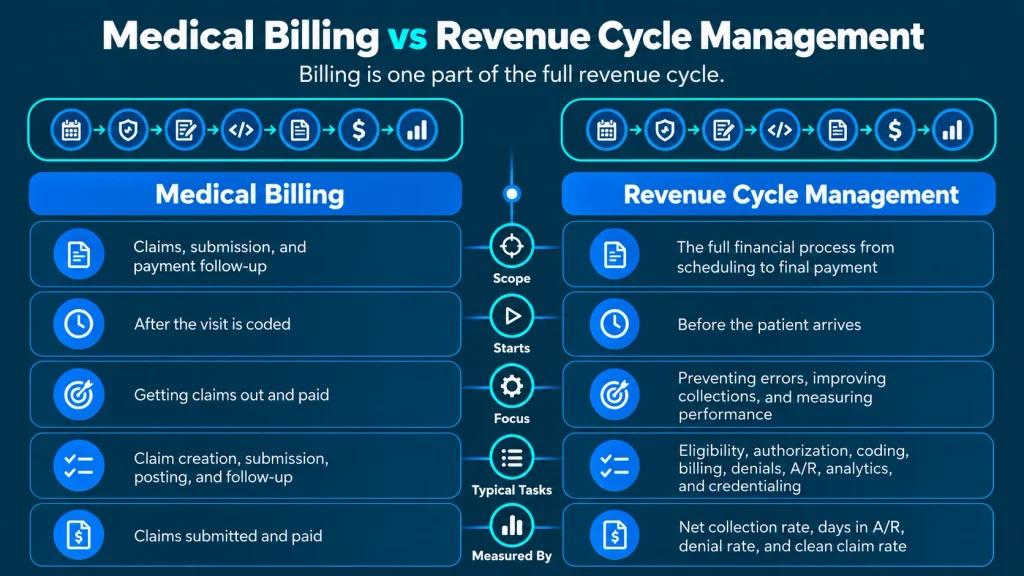
No. Medical billing is one part of RCM. Billing focuses on creating claims, sending them to payers and following up on payment. RCM covers the whole financial lifecycle, including the steps before billing (eligibility, authorization, documentation and coding) and after it (denial analysis, patient collections and reporting), as ADS explains in its comparison of billing and RCM.
| Medical Billing | Revenue Cycle Management | |
|---|---|---|
| Scope | Claims, submission and payment follow-up | The full financial process from scheduling to final payment |
| Starts | After the visit is coded | Before the patient arrives |
| Focus | Getting claims out and paid | Preventing errors, measuring performance and improving collections |
| Typical tasks | Claim creation, submission, posting, follow-up | Eligibility, authorization, coding, billing, denials, A/R, analytics, credentialing |
| Measured by | Claims submitted and paid | Net collection rate, days in A/R, denial rate, clean claim rate |
What Is the Role of Revenue Cycle Management in Medical Billing?
RCM gives medical billing a clean start and a feedback loop. Before billing, it makes sure the patient’s coverage, authorization and documentation are in place so the claim can be paid. After billing, it tracks payments, works denials, collects patient balances and turns every denial into a fix upstream. Without RCM, billing becomes a cycle of resubmitting the same errors; with it, the same team spends its time preventing them.
What Are the Steps in the RCM Cycle?
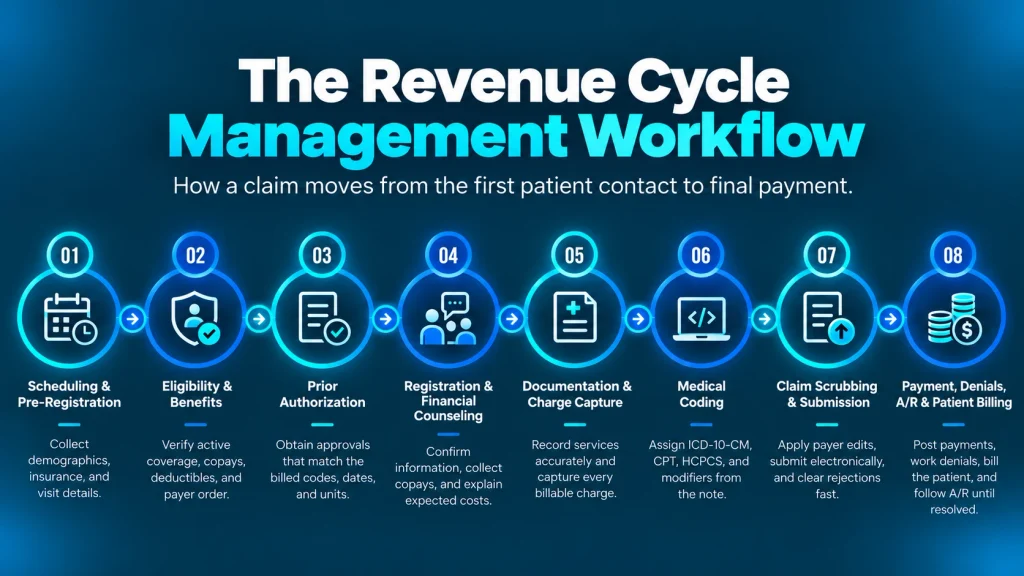
The revenue cycle can be described in different numbers of steps, and organizations such as TruBridge use a 12-step model. The 12 steps below follow a claim from the first phone call to the final payment, with where each step usually breaks and how to get it right.
1. Scheduling and pre-registration
The cycle starts when the patient books. Staff collect demographics and insurance details and confirm the reason for the visit.
Where it breaks: Typos in names, dates of birth or member IDs that reject claims weeks later.
How to get it right: Use scripted intake questions and capture insurance card images at scheduling.
2. Insurance eligibility and benefits verification
The practice confirms that coverage is active and checks copays, deductibles, visit limits and whether another payer is primary.
Where it breaks: Expired coverage, the wrong primary payer or a carved-out benefit, such as behavioral health.
How to get it right: Verify eligibility before every visit, not just the first one, through insurance eligibility verification.
3. Prior authorization
For services the payer requires, the practice obtains approval before care is delivered.
Where it breaks: Services performed without approval, or approvals that do not match the codes, dates or units billed. Physicians complete an average of 40 prior authorizations a week, according to the 2025 AMA survey.
How to get it right: Check requirements at scheduling and track every request through prior authorization services.
4. Patient registration and financial counseling
At check-in, staff confirm the information, collect copays and explain expected costs. Uninsured and self-pay patients must receive a Good Faith Estimate under the No Surprises Act.
Where it breaks: Copays not collected, missing estimates and unclear payment responsibility.
How to get it right: Collect at the time of service and offer clear estimates and payment plans.
5. Clinical documentation and charge capture
The provider documents the visit, and every billable service, supply and drug is captured as a charge.
Where it breaks: Missed charges, unsigned notes and documentation that does not support the service.
How to get it right: Reconcile scheduled visits against charges every day and close charts promptly.
6. Medical coding
Coders translate the documentation into ICD-10-CM diagnosis codes, CPT and HCPCS procedure codes and the right modifiers.
Where it breaks: Outdated codes, unsupported E/M levels, missing modifiers and unbundled services.
How to get it right: Code from the note, not the template, with certified medical coding review for high-risk services.
7. Claim scrubbing and submission
The claim is checked against payer edits and sent electronically through a clearinghouse.
Where it breaks: Rejections for missing data or payer-specific rules, and late submissions that miss filing limits.
How to get it right: Scrub claims before they leave, submit daily and clear rejections within 24 hours through claim submission workflows.
8. Payer adjudication
The payer reviews the claim and decides to pay, deny or adjust it, then sends an electronic remittance advice (ERA).
Where it breaks: Claims that sit unanswered and payers that underpay against contracted rates.
How to get it right: Monitor claim status and compare each payment with the contracted rate.
9. Payment posting
Payments, adjustments and denials from the remittance are posted to each patient account.
Where it breaks: Posting errors that hide underpayments or leave balances on the wrong party.
How to get it right: Post ERA and EFT payments the same day through payment posting.
10. Denial management and appeals
Denied claims are reviewed, corrected or appealed, and each denial is traced to its cause.
Where it breaks: Denials left unworked until appeal deadlines pass.
How to get it right: Sort denials by reason code and payer and fix the upstream cause through denial management.
11. Patient statements and collections
Once the payer has paid, the remaining balance is billed to the patient.
Where it breaks: Unclear statements, late bills and no easy way to pay.
How to get it right: Send clear statements quickly, offer online payment and set up payment plans.
12. A/R follow-up and reporting
Open claims and balances are followed up until resolved, and performance is measured across the cycle.
Where it breaks: Claims that age past filing and appeal deadlines because no one owns them.
How to get it right: Work A/R by age and payer every week through A/R follow-up and review KPIs every month.
What Are the 9 Steps in RCM?
Many sources describe the revenue cycle in nine steps by combining a few of the twelve above. A common version maps like this:
| 9-Step Version | Matches 12-Step Model |
|---|---|
| 1. Pre-registration | Steps 1 and 2 |
| 2. Registration | Step 4 |
| 3. Prior authorization | Step 3 |
| 4. Charge capture | Step 5 |
| 5. Medical coding | Step 6 |
| 6. Claim submission | Steps 7 and 8 |
| 7. Remittance processing and posting | Step 9 |
| 8. Denial management and A/R follow-up | Steps 10 and 12 |
| 9. Patient collections | Step 11 |
What Are the 6 Stages of the Revenue Cycle in Healthcare?
The six-stage view groups the cycle by function rather than task:
| Stage | What It Covers |
|---|---|
| 1. Patient access | Scheduling, registration, eligibility and authorization |
| 2. Clinical documentation | The record that supports every charge |
| 3. Coding and charge capture | Turning documentation into codes and charges |
| 4. Claim management | Scrubbing, submission and payer adjudication |
| 5. Payment and denial management | Posting, denials and appeals |
| 6. Patient financial services and reporting | Patient collections, A/R and performance analytics |
What Are the Front End, Middle and Back End of the Revenue Cycle?
The front end covers everything before or at the visit: scheduling, registration, eligibility, authorization and cost estimates. The middle covers documentation, charge capture and coding. The back end covers claims, payments, denials, A/R and patient collections. Most denials are created at the front end and discovered at the back end, which is why strong RCM programs measure front-end accuracy as closely as collections.
How Does Medical Coding Fit Into RCM?
Coding is the bridge between care and payment. Every claim combines diagnosis codes, which explain why the service was needed, with procedure codes, which describe what was done. If the two do not support each other, or the documentation does not support either, the claim fails.
| Code Set | What It Describes | When It Updates |
|---|---|---|
| ICD-10-CM | Diagnoses | Every October 1; the FY 2027 code set took effect October 1, 2026 |
| CPT | Procedures and services by physicians and other professionals | Every January 1 |
| HCPCS Level II | Supplies, drugs, equipment and services not in CPT | Quarterly |
| Modifiers | Circumstances that change how a code is paid | With CPT and HCPCS updates |
| Revenue codes | The facility department or service on institutional claims | As NUBC updates them |
What Are the Key RCM Metrics to Track?
RCM performance shows up in a handful of numbers. Benchmarks vary by specialty, but practice guidance based on MGMA data, such as this ACAAI practice guide, recommends a net collection rate of 95% or higher and no more than 10% of outstanding charges older than 120 days.
| KPI | Formula | What It Shows |
|---|---|---|
| Net collection rate | Payments ÷ (charges − contractual adjustments) x 100 | How much of the collectible amount is collected |
| Days in A/R | Total A/R ÷ average daily charges | How quickly claims turn into cash |
| A/R over 120 days | A/R over 120 days ÷ total A/R | Revenue at risk of never being collected |
| Clean claim rate | Claims accepted on first submission ÷ claims submitted | Front-end and coding accuracy |
| Denial rate | Claims denied ÷ claims submitted | Where the cycle is breaking |
| Charge lag | Days from service to charge entry | Workflow speed and filing risk |
| Patient collection rate | Patient payments ÷ patient responsibility | How well balances are collected |
Why Do Claims Get Denied, and How Does RCM Prevent It?
Most denials start before the claim is sent. In Experian Health’s survey, providers named missing or inaccurate claim data as a top cause at 50% and authorization problems at 35%, as Becker’s reported. Other common causes are eligibility errors, coding and modifier errors, missing documentation, duplicate claims and late filing.
RCM prevents denials by checking each of those points before the claim leaves: eligibility and authorization at the front end, coding and documentation in the middle and scrubbing before submission. When denials still happen, a good RCM process sorts them by reason code and payer, fixes the claim and fixes the step that caused it.
What Rules Shape RCM in 2026 and 2027?
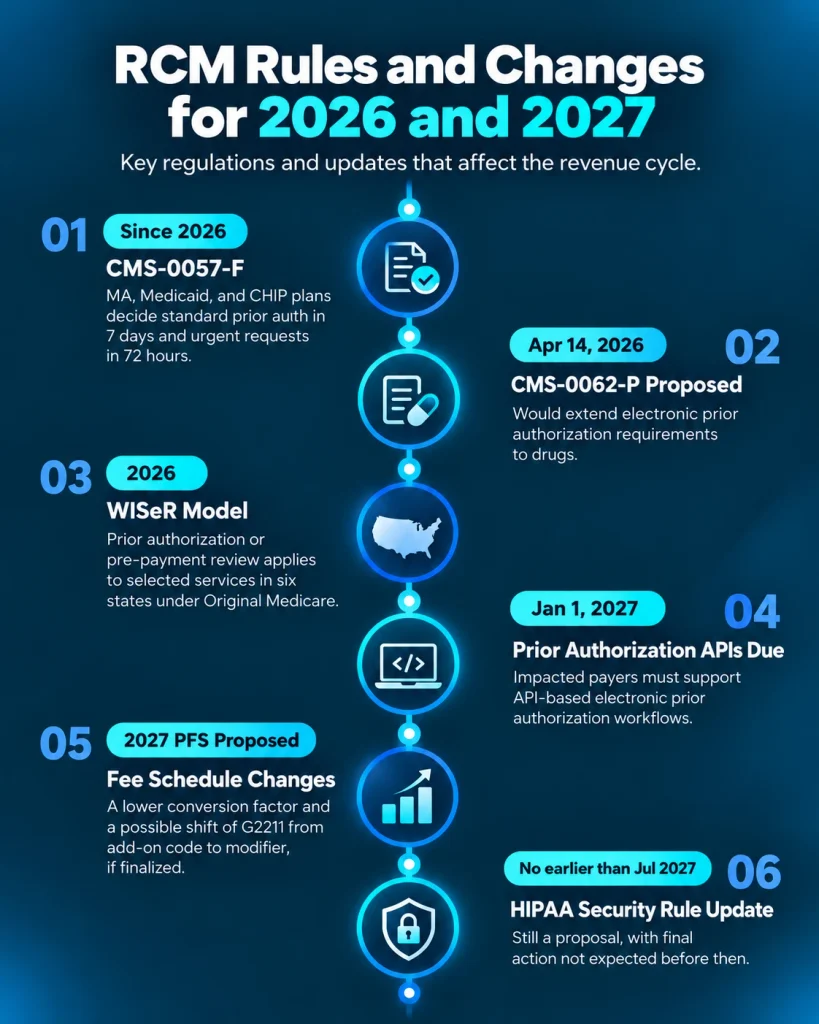
| Rule or Change | What It Means for the Revenue Cycle |
|---|---|
| CMS Interoperability and Prior Authorization rule (CMS-0057-F) | Since 2026, Medicare Advantage, Medicaid and CHIP plans decide standard requests in 7 days and urgent ones in 72 hours; Prior Authorization APIs are due January 1, 2027 |
| Proposed drug prior authorization rule (CMS-0062-P) | Would extend electronic prior authorization requirements to drugs; proposed April 14, 2026 |
| WISeR model | Prior authorization or pre-payment review for selected services in six states under Original Medicare |
| Proposed 2027 Physician Fee Schedule (summary) | A lower conversion factor and G2211 changing from an add-on code to a modifier, if finalized |
| No Surprises Act | Good Faith Estimates for uninsured and self-pay patients and limits on surprise out-of-network bills |
| Proposed HIPAA Security Rule update | Still a proposal; final action targeted no earlier than July 2027 |
How Is Technology Changing Revenue Cycle Management?
Automation now handles much of the repetitive work: real-time eligibility checks, claim scrubbing, electronic remittance posting and status checks. Electronic prior authorization is moving toward standard FHIR-based APIs, and AI tools increasingly suggest codes, predict denials and draft appeals. Technology speeds the cycle, but it does not replace judgment. Any vendor that handles patient data needs a business associate agreement, and automated coding still needs human review, because an automated error repeats across every claim.
What Does an RCM Team Do?
An RCM team divides the cycle into specialized roles, as Practice EHR describes. In a small practice, two or three people may cover all of them; in a large group, each is a separate team.
| Role | Responsibility |
|---|---|
| Patient access specialist | Scheduling, registration, eligibility and estimates |
| Authorization specialist | Prior authorizations and referrals |
| Medical coder | Diagnosis and procedure coding from documentation |
| Billing specialist | Claim creation, scrubbing and submission |
| Payment poster | Posting payments and adjustments |
| A/R and denial specialist | Follow-up, corrections and appeals |
| Credentialing specialist | Payer enrollment and recredentialing |
| RCM manager or analyst | KPIs, reporting and process improvement |
Should You Manage RCM In House or Outsource It?
| In-House RCM | Outsourced RCM | |
|---|---|---|
| Cost | Salaries, benefits, software, training and turnover | Usually a percentage of collections |
| Control | Direct oversight of every step | Shared control through reporting and agreements |
| Expertise | Limited to the team you can hire and keep | Specialists across coding, denials, credentialing and payer rules |
| Scalability | Hiring needed as volume grows | Scales with volume |
| Risk | Coverage gaps when staff leave | Depends on the partner’s quality and reporting |
Outsourced billing and RCM companies commonly charge a percentage of collections, with headline rates around 4% to 7%, as Medical Economics reported. Stream RCM starts at 2.99% of monthly collections. Compare what each rate includes, such as authorizations, appeals and credentialing.
What Are the Basic RCM Questions in Medical Billing?
These are the questions every practice should be able to answer about its own revenue cycle:
| Question | Why It Matters |
|---|---|
| What is our net collection rate? | Shows how much of what we are owed we actually collect |
| How many days are claims in A/R? | Shows how fast care turns into cash |
| What is our denial rate, and what are the top three reasons? | Shows where the cycle is breaking |
| Do we verify eligibility before every visit? | Prevents the most common front-end denials |
| Who owns each open claim? | Unowned claims age past deadlines |
| Are all providers credentialed with every payer we bill? | Uncredentialed claims are not payable |
| How quickly are charges entered after the visit? | Long charge lag delays payment and risks filing limits |
Is RCMS Certification Worth It?
It depends on who issues it. “RCMS” is used by several training providers rather than one industry standard, so check the issuer before paying. The most widely recognized revenue cycle credentials come from professional associations: the Healthcare Financial Management Association offers the Certified Revenue Cycle Representative (CRCR) and specialist credentials such as the Certified Specialist Physician Practice Management (CSPPM), as its certification overview shows. For billing and coding roles, AAPC credentials such as the Certified Professional Biller (CPB) and Certified Professional Coder (CPC) are widely recognized by employers.
What Are the Top 5 RCM Companies in the USA?
There is no single official ranking. Among the largest enterprise revenue cycle companies, which mostly serve hospitals and health systems, are R1 RCM, Optum, Ensemble Health Partners, Conifer Health Solutions and Omega Healthcare. Physician practices are often better served by companies that specialize in practice billing, know their specialty’s payer rules and can start with one service, such as Stream RCM.
How Does Stream RCM Manage the Revenue Cycle?
Stream RCM is a medical billing and revenue cycle management company headquartered in El Paso, Texas, serving practices in more than 50 specialties. Its revenue cycle management services cover every step in this guide, from insurance eligibility verification and prior authorization to coding, claim submission, payment posting, denial management, A/R follow-up and provider credentialing. Practices can outsource the full cycle or start with a single service.
Stream RCM’s pricing starts at 2.99% of monthly collections. The company reports a 99% first pass claim acceptance rate for its clients; ask for results from practices in your specialty during evaluation.

Frequently Asked Questions
What is RCM medical billing?
RCM medical billing is billing managed as part of the full revenue cycle: verifying coverage and authorizations before the visit, coding accurately, submitting clean claims, posting payments, working denials and collecting patient balances, with reporting that ties each step to results.
What are healthcare RCM solutions?
Healthcare RCM solutions are the services and software that manage the revenue cycle, such as eligibility tools, practice management systems, claim scrubbers, clearinghouses and outsourced RCM services that handle the work end to end.
What is the RCM cycle in medical billing?
The RCM cycle is the sequence of steps a claim moves through, from scheduling and eligibility through coding, claim submission, payment posting, denial management and patient collections. Each step feeds the next, and errors at the start show up as denials at the end.
How long does it take to improve a revenue cycle?
Front-end fixes such as eligibility checks and claim scrubbing usually show results within one to two billing cycles. Reducing aged A/R and repeat denials takes longer, typically a few months of steady follow-up and root-cause fixes.
What is the difference between RCM and practice management?
Practice management covers the business of running the practice, including scheduling, staffing and operations. RCM covers the financial process of getting paid for care. Practice management software often supports both.
Is outsourcing RCM safe for patient data?
Yes, when the RCM company signs a business associate agreement and follows HIPAA safeguards such as role-based access, encryption and staff training. Ask any vendor to describe its controls before sharing data.