- +1 (773) 985-1869
- info@stream-rcm.com
- 14430 Ocean Point, El Paso, TX 79938
Walk-in medicine moves fast. A patient checks in, gets treated, and leaves often within 25 minutes. But the billing trail they leave behind? That can take months to settle, or disappear entirely into denial queues. Stream RCM specializes in urgent care billing services, built from the ground up for high-volume, multi-payer, same-day service environments. We handle the complexity so you collect what you’ve earned.













We are a billing and coding services company who have AAPC-certified specialists that work exclusively in urgent care. We stay updated on every payer rule change, and treat your revenue with the same urgency your patients receive at your front desk.
Every new engagement starts with a 90-day claim audit. We don’t begin billing until we understand exactly where the current process breaks down and why. We run quarterly internal audits and update coding protocols within 48 hours of rule changes. A compliant claim and a collected claim are the same objective. Monthly reports include denial of reason code breakdowns and coding trend analysis because knowing what you collected tells you nothing about what you missed. We serve urgent care entirely. That isn’t a market niche, it’s a quality decision. Specialization is what allows precision, and precision is what recovers revenue.
As an experienced urgent care medical billing company, we handle the full breadth of services an urgent care clinic delivers not just E/M visits.
We manage workers’ compensation billing, FROI filing, employer-specific formats, state fee schedules, drug screens and narrative reports for accuracy, always.

We bill laceration repairs, incision and drainage, splinting, foreign body removal and wound care with accurate modifier pairing every time.
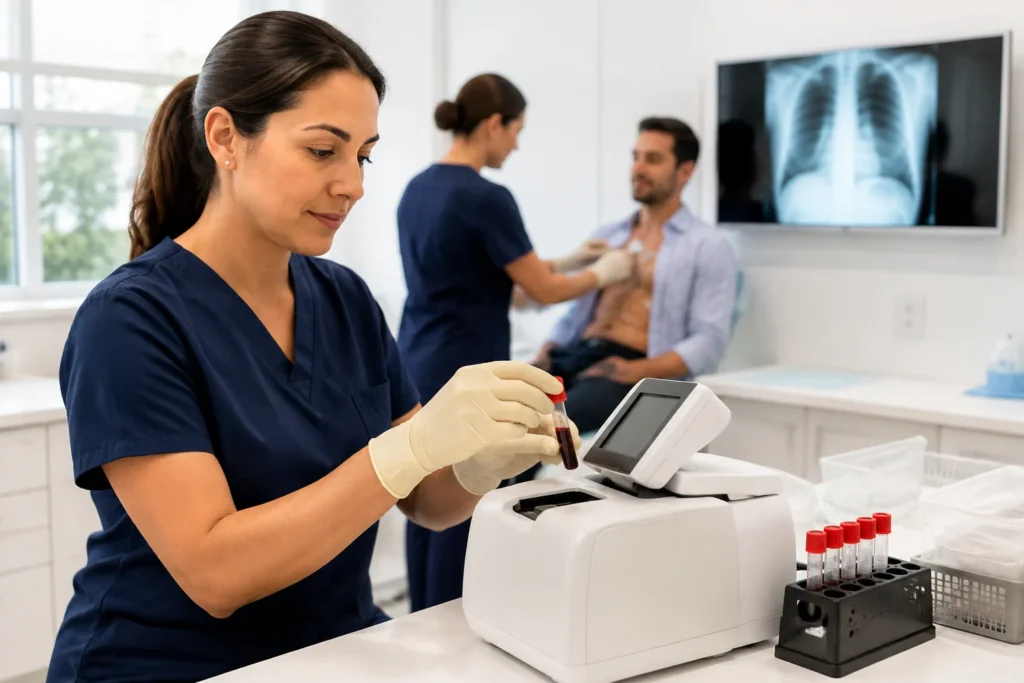
We verify point-of-care labs, chest X-ray interpretation and EKG billing using correct revenue codes, modifiers, and CLIA certification status always.

We bill telehealth visits using correct place-of-service codes, payer-specific modifiers, consent verification and audio-video documentation required under 2026 rules now.

We bill mental health screenings, crisis intervention and integrated behavioral visits with precise CPT pairing under increasing payer scrutiny standards.

At Stream RCM, we take a thoughtful, patient-centered approach to urgent care revenue cycle management. Our billing team handles every step of the process with care, responsibility, and close attention to detail so you can focus on treating patients.
Denied claims slow down your cash flow and create unnecessary stress for your urgent care practice. Our billing services help you spot denial patterns, fix the root causes, and appeal rejected claims quickly. We focus on submitting clean claims from the start so future problems never happen and your revenue stays steady.
Unpaid claims hurt your cash flow and create financial pressure. Our urgent care billing and collection process finds the payers, follows up on unpaid claims aggressively, and gives you clear, honest reports. We speed up your cash flow while maintaining respectful relationships with both patients and insurers.
Good reimbursement starts with good coding. Our certified billers and coders use the correct CPT, ICD-10, and modifier codes for every urgent care visit. This lowers your audit risk and increases the chances that each claim gets accepted without pushback.
We perform thorough audits to catch missed charges, coding errors, and compliance gaps. Our urgent care billing services improve your documentation quality and help you collect revenue, your practice has rightfully earned.
Credentialing delays mean delayed payments. We do everything possible to get your providers enrolled, verified, and updated with payers as quickly as possible. This keeps your urgent care claims processing smooth and your reimbursement on schedule.
We post every payment promptly and match each one to the correct claim. Our team catches underpayments, flags billing discrepancies, and keeps your financial records clear so you always know exactly where your practice stands.
Our experts review your current workflows and point out risk areas at no cost to you.
There’s a window in every growing urgent care practice’s life when the in-house billing model stops making economic sense. The biller who knew your payer contracts leaves. Their replacement is good but not specialized. A new commercial plan joins your network with updated fee schedules that nobody reviews. A modifier rule changes in January and the updated training doesn’t reach your team until March. By mid-year, your denial rate has crept from 6% to 12%, and the collections report still looks fine because volume is up. That’s the trap: rising revenue masking rising leakage.
Outsourcing urgent care billing services to a dedicated company like Stream RCM isn’t just about cost savings, it’s about placing a specialized function in the hands of people who work exclusively in that domain, stay current on every payer update, and have no other job than to make sure your claims are collected. The urgent care billing landscape in 2026 is materially more complex than it was three years ago. New telehealth CPT codes, CMS fee schedule revisions, expanding MA prior authorization requirements, and state-level Medicaid changes have created a difficult environment. The practices that are winning on revenue right now are the ones that recognized this early and made the right staffing decision.
The AMA introduced 288 new CPT codes for 2026. Our coders are already updated. Are yours? Here’s what we actively manage for urgent care practices.
| Code - Range | Service & Billing Context |
|---|---|
| 99202–99205 | New patient E/M visits. We ensure level selection follows MDM or total time per 2021 AMA guidelines. We catch undercoding in walk-in environments where providers default to 99203 out of habit rather than documentation support. |
| 99212–99215 | Established patient E/M. We correct the most common underbilling error in urgent care. When two or more chronic conditions are managed alongside the presenting complaint, we code level 4 while most practices bill level 3. |
| S9083 - S9088 | Urgent care S-codes used by many commercial payers to bundle services into one global payment. We verify payer by payer before submission since Medicare does not accept S-codes and billing them to CMS results in automatic rejection. |
| 10060 - 10061 | Incision and drainage of abscess. We apply modifier -25 on the accompanying E/M code to indicate a separately identifiable service. Without this modifier, the E/M bundles automatically and the practice loses the visit reimbursement entirely. |
| 98000–98016 | New 2026 telehealth E/M codes replacing legacy 99201–99215 for virtual encounters. We use POS 02 or POS 10, document real-time audio-video, and apply payer-specific modifiers. Many practices still use legacy codes and face silent non-payment. |
| 36415 - 85025 | Venipuncture and CBC. We prevent incorrect bundling with other diagnostic services by reviewing NCCI edits regularly. When services are clinically distinct and separate, we apply modifier -59 with clear documentation to support it. |
A 4-site urgent care group in Florida came to us in Q1 2024. They’d been with a general billing vendor for three years. Here’s what we found and what changed.
Coding audit across 300 encounters revealed three systemic failures: every laceration claim was missing Modifier -25 on the accompanying E/M, all telehealth visits were still using legacy POS 02 with the GT modifier despite the 2026 code transition, and 100% of workers’ compensation claims lacked the required employer narrative report. None of this was visible in their monthly billing reports, their vendor tracked collections, not causes.
But after working with Stream RCM, the denial rate fell to 5.8% within 60 days, and workers’ compensation claim recovery improved significantly within 90 days. By month six, the practice collected over twenty percent more than the same period the previous year against identical patient volume. The root cause wasn’t bad documentation. It was a billing partner who didn’t understand urgent care billing codes well enough to catch what was going wrong.
We integrate effortlessly with the EHR and practice management software you already trust. Your urgent care workflows keep running exactly as they always have. Our billing solutions work silently alongside your systems to improve revenue.


Emergency departments handle life-threatening trauma and critical illness around the clock. Their billing relies on higher-level CPT codes and facility fees using POS 22, which brings tighter scrutiny and greater complexity. Good triage documentation is essential to justify high-level reimbursement and prevent major denials.
Our AAPC-certified team removes compliance worries by mastering the unique coding rules for each emergency setting. We help urgent care centers to get maximum returns on their patient volume. Hospital-affiliated emergency practices get fair, appropriate reimbursement for the most complex cases they treat every day.
We transform urgent care billing obstacles into opportunities with precision coding, payer enrollment management, and thorough pre-submission claim reviews.
Coding mistakes lead to denied claims and delayed payments, creating unnecessary financial strain across busy urgent care practices nationwide daily.
Our certified coders use correct CPT and ICD-10 codes consistently, so claims get paid quickly without unnecessary payer pushback.
Slow payments arrive weeks late, hurting your cash flow and creating ongoing financial stress for urgent care practice operations overall.
We handle provider enrollment and payer updates proactively, preventing payment delays before they start and disrupt cash flow.
Credentialing delays keep your providers from billing for work they have already completed, creating unnecessary revenue gaps and frustration.
We manage every step of credentialing, changes, and payer sign-ups carefully, keeping payments consistently on track and timely.
Claim rejections come back often, forcing your staff to resubmit repeatedly and wait even longer for rightful reimbursement overall.
Pre-bill reviews and denial prevention strategies boost clean claims significantly, cutting rejections and improving overall payment turnaround.
Missing documentation causes payers to deny claims that should have been paid promptly, creating avoidable revenue loss consistently.
Our team checks every record for completeness thoroughly, so claims go out accurately and come back fully paid.
We combine smart technology, deep billing knowledge, and strategies built specifically for urgent care to deliver steady revenue and simpler daily operations for your practice.

Our team knows how urgent care centers run, from high patient volumes to shifting payer rules. We use that knowledge to keep your revenue flowing consistently.
Our experienced professionals submit clean claims, lower your denial rates, maintain full compliance, and manage your entire revenue cycle with skill and care.
We provide simple, easy-to-read reports that show your claim status, payment tracking, and revenue growth so you always know exactly where you stand.
We study denial patterns, fix documentation gaps, and build smart processes that catch problems early, reducing rejections long before claims go out.
No, Medicare does not accept S9083 or S9088. These codes work for many commercial payers, but Medicare requires CPT codes only. Submitting S-codes to Medicare leads to automatic rejection every time.
Very urgent. New telemedicine codes 98000–98016 launched for 2026. Many payers no longer pay legacy codes 99201–99215 for virtual visits. Our team switched all clients before January 31, 2026.
Yes, this is a core strength. Workers’ comp billing is state-specific with different fee schedules and forms. We maintain a library across thirty states and track claims from first report to final settlement.
We apply Modifier -25 only when the note clearly documents a separately identifiable medical decision. A coder supervisor reviews any account using -25 on over 65% of same-day procedure claims.
Most urgent care practices go live within ten to fourteen business days. We audit your recent claims, run parallel processing during transition, and assign a dedicated account manager from day one.

Connect with a billing specialist dedicated exclusively to urgent care. Receive focused expertise that is designed specifically for your practice.