


Even after completing the residency program, passing the board certification examination, and signing the employment agreement, a doctor may not be able to examine insured patients for months. This highlights the importance of the provider credentialing timeline, which involves verifying a provider’s credentials and linking the physician to an insurance network before they can receive reimbursement. Organizations such as the National Committee for Quality Assurance, Centers for Medicare & Medicaid Services, and Council for Affordable Quality Healthcare establish standards that help practices plan their provider credentialing timeline more accurately.
If you ask ten billing managers how long the credentialing process usually takes, most would say between two and six months. A typical provider credentialing timeline ranges from 60 to 120 days, although the exact timeframe can vary significantly by insurance company. Factors such as application accuracy, CAQH profile completeness, and the speed of primary source verification can either shorten or extend the provider credentialing timeline. Understanding these factors helps practices plan ahead and avoid revenue delays. Practices that hand off tracking, follow-up, and documentation to dedicated provider credentialing services consistently clear payor review faster than those managing it internally.
What Provider Credentialing Actually Verifies
Credentialing involves the process of validating education, training, licensing, work experience, malpractice record, and sanctions status for an individual through direct verification from the issuing authority instead of relying on information provided by the applicant. Credentials are verified directly with the issuing authorities which include state licensing boards, National Practitioner Data Bank, American Medical Association, and accredited medical schools, and cannot be verified through photocopies or by self-reported data. Primary source verification is recognized as the most time-consuming process throughout the whole process.
Credentialing and enrollment are linked but different processes. Credentialing involves validating the identity and qualifications of an individual. The process of enrolling the provider with a payer organization involves registering the verified provider for billing purposes. The provider may be completely credentialled but not enrolled with a particular payer, resulting in non-billing.
Expert Insight: Being credentialed doesn’t mean you can bill. Confirm active enrollment status directly with each payer before scheduling a provider’s first patient; a completed credentialing file with a pending enrollment record still generates a denied claim, not a paid one.
The Rules Changed in 2025, and the Timeline Got Shorter
Factually, the industry standard for the verification period was one hundred and eighty days. However, this changed on July 1, 2025, when the period for Primary Source Verification was lowered from one hundred and eighty days to one hundred and twenty days for organizations with Credentialing Accreditation and to ninety days for organizations with Credentialing Certification. The standard was completed in August 2024 after receiving nine hundred and fifty comments from sixty-five organizations over a six-week comment period. The initial proposed period by the regulators was ninety days.
Recredentialing did not escape the tightening either. Providers must now be re-credentialed every thirty six months from their last approval date, with the process formally initiated ninety to one hundred twenty days in advance rather than left to informal tracking. Monthly license expiration checks and monthly exclusion screening against federal and state databases are now required, with issues escalated to peer review when they arise. Files that were credentialed before the July 2025 cutoff persist under the older rules, which means many practices are presently operating under two different timelines depending on when a given provider was last processed. Practices onboarding several providers at once benefit from medical billing audit services that catch credentialing-related billing errors before they compound into larger denials.
Provider Credentialing Timeline by Payer: What the Numbers Show
No single national clock governs credentialing. Each payer type runs on its own track, and treating them as interchangeable is one of the most common planning mistakes practices make.
Medicare
Enrollment runs through the Provider Enrollment, Chain, and Ownership System, known as PECOS. A clean electronic application typically processes in forty five to sixty days, though the target for a genuinely clean internet submission is fifteen days. Paper submissions on the CMS 855 form run closer to thirty days at the contractor stage alone, and roughly one third of applications are returned for correction. One Medicare Administrative Contractor has publicly stated that web based applications can take forty five calendar days compared with sixty calendar days for paper submissions in comparable categories. Seasonal volume also matters: this phase typically takes forty five to sixty days but can extend past ninety days during peak hiring periods in January through March and July through September.
Medicaid
This is where the range widens the most, because Medicaid is not one program but a collection of more than fifty separate state systems. The same provider type can enroll in forty five days in one state and one hundred twenty days in another, and the underlying platforms differ by name and design from state to state. Direct state Medicaid enrollment generally takes thirty to ninety days depending on the state, and retroactive billing allowances vary just as widely, with some states permitting ninety days of retroactive billing and others offering none. Managed care organizations complicate this further, since each one requires its own separate application, individually taking forty five to ninety days, and in states with five or more managed care plans this can mean five or more parallel timelines running at once. Underneath all of this state variation sits a shared federal framework, since federal regulation under 42 CFR Part 455, Subpart E governs every state Medicaid program.
Commercial payers
Major commercial carriers typically require ninety to one hundred fifty days, with complex specialty networks or Medicare Advantage panels frequently stretching to one hundred eighty days. Most of these carriers pull their underlying provider data from the same source.
CAQH ProView
CAQH is the most widely used source of provider credentialing data in the country, maintaining records on roughly four point eight million providers. The typical timeline from the start of a CAQH profile to full completion runs three to six months, or ninety to one hundred eighty days. Providers who begin preparation early, ideally at least a month before they need to see patients, generally avoid what amounts to a self-inflicted delay caused by incomplete applications sitting idle. The profile itself, once all documentation is gathered, can often be completed in a day or two of focused effort, with CAQH taking one to two business days to issue an ID afterward. The bottleneck is almost never the platform itself; it is the gathering of documentation beforehand.
Credentialing Timelines by Payor: What Were Expectations in 2026
| Payor / Program | Typical Timeline | Portal | Practice Notes |
| Medicare (PECOS) | 45–90 days | CMS PECOS | Effective date = date of filing, not retroactive. A clean application processes far faster than one returned for corrections, so first-pass accuracy is the biggest lever a practice has. |
| State Medicaid | 30–180 days | State MMIS | Range swings widely by state; large states routinely run past 90 days. Confirm whether your state requires forms beyond the standard federal application. |
| SoonerSelect (OK Medicaid Managed Care) | Varies by plan | OHCA / plan portals | Oklahoma providers must credential separately with each Sooner Select managed care organization, not just the state. December 31, 2026 is the deadline providers should be tracking now. |
| UnitedHealthcare | 60–90 days | CAQH ProView | Application stalls almost always trace back to an incomplete or unattested CAQH profile. Specify product lines (retail, employer, Medicaid) at submission. |
| Aetna | 60–90+ days | CAQH ProView | Specialist panels close in competitive markets; verify openings before filing, not after. |
| Cigna | 60–120 days | CAQH ProView | Specialty applications run longer. Status doesn’t always update automatically; a follow-up calls every 10–14 business days keeps the file active. |
| Blue Cross Blue Shield | 60–120 days | Varies by state plan | BCBS is 35+ independently operated state plans, not one insurer. Panel status, portal, and timeline must be confirmed with the specific state plan. |
| Humana | 60–90 days | CAQH ProView | Standard CAQH flow, but value-based network specialties can trigger a separate review track. |
| Tricare | 90–120 days | Availity | Enrollment runs through regional contractors (Humana Military – East, TriWest – West), not Tricare centrally. Applying to the wrong region is a common cause of restarts. |
| Medicare Advantage Plans | 90–150 days | Plan-specific | Traditional Medicare enrollment does not carry over. Each MA plan requires its own application and contract. |
| VA Community Care Network | 60–120 days | TriWest / Optum (region-dependent) | Administered regionally like Tricare; confirm which third-party administrator covers your service area before applying. |
| Workers’ Compensation | Variable, state-specific | State WC boards | Some states have no formal credentialing process at all; others require panel enrollment. Frequently missed by occupational medicine and specialty practices. |
What Slows the Provider Credentialing Timeline Down
The biggest factor which causes delays is not who the payment source is, but rather, it is the application. Various industry surveys suggest that as much as 85% of the credentialing applications that go into commercial healthcare organizations have some sort of discrepancy which results in a prolonged process. A slight mismatch of details such as name, address, or license number is enough to cause delays.
Revalidation lapses carry their own steep penalty. Existing Medicare providers must revalidate their enrollment every five years, or every three years for durable medical equipment suppliers, and providers who miss this deadline are deactivated, with reactivation taking sixty to ninety days and no retroactive billing permitted for services rendered during that gap. This is a completely avoidable loss, since revalidation dates are known in advance, yet notices routinely fail to reach the right person. Once an application reaches review, providers generally have thirty days to respond to a request for corrections before the application is rejected outright.
Timing within the calendar year matters too. A November 2025 industry poll found that nearly two thirds of medical groups reported their provider files were on schedule, while roughly a third reported some form of backlog, contractor delay, or a slip into the following quarter, a pattern that tends to worsen toward year end as verification requests, sanctions checks, and committee reviews all stack up at once.
What a Delayed Credentialing Timeline Actually Costs
The financial exposure here is not abstract, and the figures are larger than most administrators expect. A physician or surgeon facing a typical one hundred twenty day credentialing delay loses up to one hundred twenty two thousand one hundred forty four dollars in revenue during that period alone, with dentists losing up to eighty seven thousand two hundred seventy four dollars, podiatrists losing up to seventy two thousand three hundred thirty two dollars, and nurse practitioners and nurse anesthetists losing up to sixty six thousand one hundred eighteen dollars. For a practice hiring ten new physicians in a single year with an average ninety day delay for each, this can mean absorbing over nine hundred thousand dollars in forgone billings, before even counting the salaries paid to those providers while they wait.
A January 2026 survey of two hundred fourteen healthcare organizations found that more than four in ten respondents lose up to fifty thousand dollars in billings every month specifically because of credentialing delays. Broader research from the Medical Group Management Association points in the same direction: delays in the credentialing process have been shown to cost newly hired physicians as much as twenty five percent of their entire first year earnings. Per day, the range depends heavily on specialty, but practices commonly report losing between one thousand and five thousand dollars per provider per day in uncollectible patient revenue while enrollment is pending.
The cost of the process itself is also worth planning for. Industry levels put the average internal cost of credentialing a single provider at around two hundred dollars, while outsourced credentialing typically runs a one time enrollment fee of two hundred fifty to six hundred dollars per provider plus a monthly fee of sixty six to one hundred twenty nine dollars, compared with thirty three thousand to fifty thousand dollars to hire a dedicated in house credentialing specialist. And when credentialing gaps do produce denied claims, the average cost to rework and appeal a single denied claim is one hundred eighteen dollars, a cost that compounds quickly across a busy practice. Submitting claims even one day before a provider’s official effective date guarantees denial, which is why claim submission services need direct visibility into credentialing timelines.
Professional Guidance: Build the average $1,000–$5,000 daily revenue loss into every new-hire timeline before the offer letter goes out. Practices that budget for credentialing delay upfront negotiate realistic start dates and avoid the surprise of absorbing six figures in forgone billings per provider.
Why Is My Credentialing Taking So Long? The Six Most Common Delays
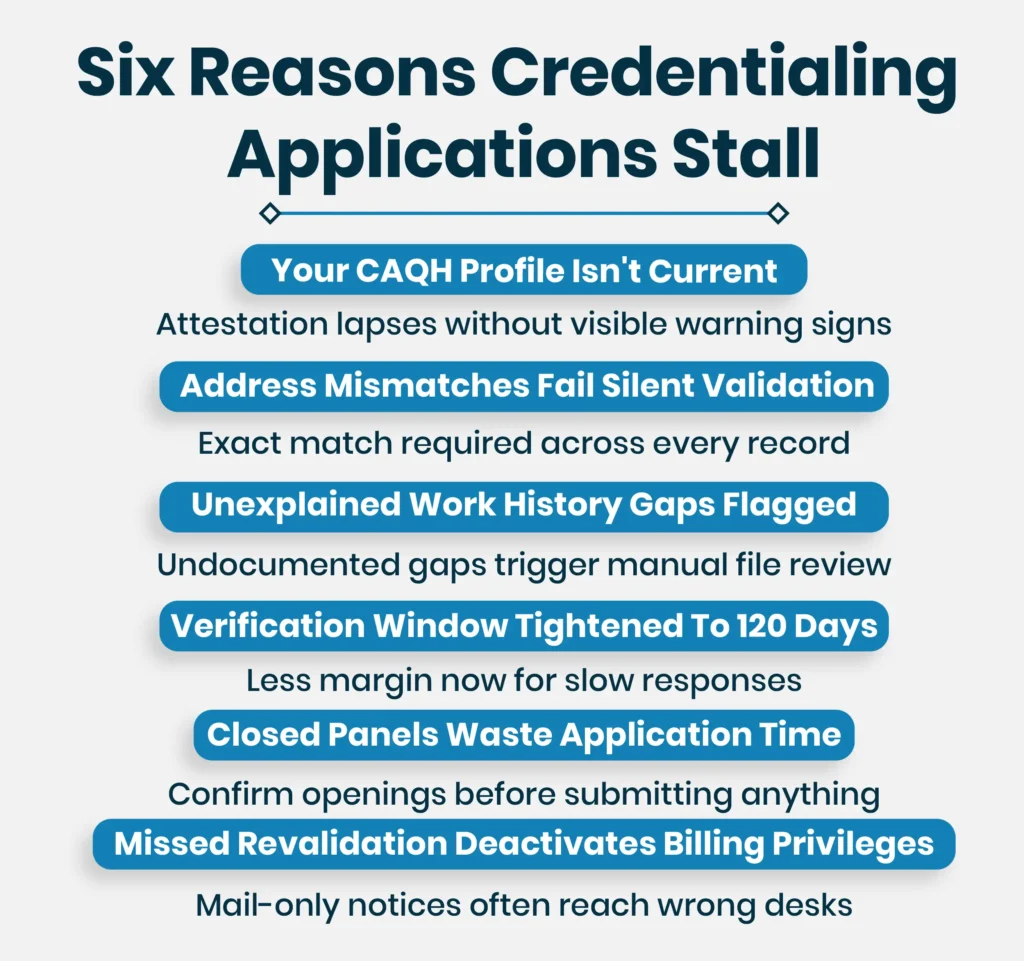
Payors rarely reject a credentialing application outright. Instead, they let it sit; pending, unexplained, quietly aging in a queue while a fixable error waits to be caught. Most practices never learn what stalled their file until they call and ask. Every credentialing application involves sensitive provider data, and maintaining HIPAA compliance in medical billing throughout that process is non-negotiable from the first document collected. Below are the six issues that account for the overwhelming majority of delays we see, along with what actually resolves each one.
1. A CAQH Profile That’s Technically “Complete” But Actually Isn’t
A CAQH Proview profile can show as attested and still contain the problem that stops your application: an expired malpractice certificate, a license upload that’s one renewal cycle out of date, or a practice address that was accurate three moves ago. Payors don’t process against a stale profile, and most won’t flag which field is wrong; they simply leave the file in review. Attestation is required every 120 days regardless of whether anything changed, which means a profile can go stale even between updates if no one is tracking the clock.
2. Address Formatting Inconsistencies Across Applications
The payor application, your CAQH Profile, and your NPPES record must all be identical, including down to the letter, “Ave” vs. “Avenue,” missing suite number, and lack of formatting for Zip + 4. Many payor applications validate using exact match verification instead of human review, meaning what may seem like an inconsequential difference to you can cause the field to fail silent validation. This is among the most common reasons why your completed application is hung up on their side.
3. Unexplained Gaps in a 10-Year Work History
Payors expect a continuous decade of employment history with any gap over 30 days accounted for in writing; parental leave, locum tenens work between permanent roles, sabbaticals, relocation. An unexplained gap doesn’t get rejected; it gets escalated to manual review, which is where timelines quietly double. The fix is procedural: document every gap the first time, with dates, before submission but not after a payor asks.
4. Primary Source Verification Running Against a Tightened Clock
Once your application is in review, the payor performs primary source verification; contacting the issuing medical boards, residency programs, and certifying bodies directly rather than accepting your copies. As of July 2025, NCQA shortened this window significantly: all verification must now be completed no more than 120 days before the credentialing committee’s decision for accredited organizations, and 90 days for certified verification organizations; down from the previous 180-day standard. In practice, this means there’s less margin than there used to be for a slow-responding licensing board or a missing document to be absorbed without pushing the whole file past the deadline. Confirming panel status before submission is really a form of insurance eligibility verification for the provider, not just the patient, and it prevents applications from entering closed panels.
5. Applying to a Panel That Isn’t Accepting New Providers
Closed panels do not generate a rejection notice; they generate silence, or a form letter weeks later. Submitting into a closed panel costs your practice the administrative time of preparing the application with zero possible approval. A five-minute call to the payor’s provider relations line before submission is the single highest-leverage step in this entire list, and it’s the one most frequently skipped.
6. Missed Medicare Revalidation
Enrolled Medicare providers must revalidate every 5 years (3 years for DME suppliers), and CMS sends notice by mail to whatever address is on file, which may not be current, may go to a staff member who’s since left, or may simply get lost in general correspondence. Miss it, and CMS deactivates billing privileges outright. Reactivation takes 60–90 days, with no retroactive billing for anything rendered during the gap; meaning a missed piece of mail can translate directly into unrecoverable revenue. This is worth a standing calendar reminder independent of CMS correspondence, owned by a specific person, not a shared inbox.
A Realistic Credentialing Checklist
Practices that consistently hit shorter timelines tend to follow the same sequence, regardless of specialty or state. Begin gathering documentation before a start date is set, not after. This includes a current curriculum vitae, active state license, DEA registration where applicable, malpractice history and current coverage, board certification records, and a complete, attested CAQH ProView profile, since commercial carriers pull directly from that single source.
Confirm panel status before submitting anything. Some payers operate closed panels for certain specialties or regions, and an application submitted to a closed panel consumes weeks of processing time for no possible approval. Keep track of each submission on one centralized document containing the date of the submission, the payer contact, the anticipated timeline, and the next follow up date because the untracked applications are the ones that stall easily.
Respond to all requests for correction within days and not weeks because most payers have a strict response period within which an application must be responded to in order to prevent rejection of the file. Calendar revalidation and re-credentialing dates the moment initial enrollment is approved, rather than waiting for a notice that may never reach the right desk.
- Start documentation early – Gather your CV, active state license, DEA registration, malpractice history, and board certifications before a start date is set not after.
- Attest your CAQH profile fully – Commercial carriers pull directly from this one source, so an incomplete or expired profile stalls every downstream application at once.
- Check panel eligibility first – Check if the payor is enrolling new providers in your specialty and location before sending an application since a full panel will waste weeks without an approval.
- Maintain tracking of each application – Maintain records of submission date, payor contacts, timelines, and follow-up dates; untracked applications are usually the ones that get stuck.
- Check-in on a regular basis – You should not wait until the payor gets back to you since a regular check-in will allow you to spot delays.
- Respond to corrections within days – Most payors enforce a strict response window, and missing it can mean rejection rather than delay.
- Calendar revalidation the day you are approved – Set your own reminder for re-credentialing and revalidation; do not rely on a notice that may never reach the right desk.
Building the Timeline into the Business Plan
The single biggest variable a practice can control is when preparation begins relative to a provider’s intended start date. A provider whose paperwork is complete before their first day can realistically clear commercial credentialing inside the ninety to one hundred twenty day window regulators now enforce. A provider whose documentation is assembled reactively, after they have already started seeing patients, is the one most likely to end up in the one hundred eighty day range, generating months of unbillable clinical time along the way.
Due to the amount of money involved, credentialing should be viewed as part of the revenue cycle planning process, rather than being an administrative process dealt with only after the hiring process is completed. Practices that include the timeline for credentialing as part of the hiring process calendar, follow up on all applications and immediately react to the payer requests fare much better than those practices that don’t. Claims submitted before credentialing is finalized are a leading cause of denials, which is why denial management services and credentialing timelines need to be planned together, not separately.
Credentialing vs. Privileging: Two Clocks Running in Parallel
Practices often treat these as one process with two names. They aren’t and confusing them is how a fully credentialed provider still ends up unable to see patients on day one.
- Credentialing verifies a provider’s identity, licensure, education, and history at the payor level. It determines whether an insurer will recognize and reimburse that provider at all.
- Privileging grants permission to perform specific clinical procedures at a specific facility; a hospital, ASC, or surgical center. It’s governed by that facility’s medical staff bylaws, not by insurance rules.
The two run on separate tracks with separate decision-makers, which is exactly why they can fall out of sync. A provider can clear payor credentialing cleanly and still be blocked from the OR because the hospital’s medical staff committee hasn’t met, or vice versa.
One safety valve exists on the privileged side: under Joint Commission standards, hospitals may grant temporary privileges for up to 120 consecutive days while a new applicant’s full file is under review. This is a hard ceiling, not a renewable grace period; once it expires without full privilege complete, the provider comes off the schedule regardless of how close the file is to done. Insurance payors rarely offer an equivalent workaround, which makes tracking the payor-side clock even more critical.
| Process | Governing Entity | Typical Duration |
| Credentialing | Insurance payors (commercial) | 90–150 days |
| Enrollment | Medicare / Medicaid | 60–120 days |
| Privileging | Hospitals / ASCs (medical staff committee) | 30–90 days |
| Temporary privileges | Hospitals (Joint Commission standard) | Up to 120 days, non-renewable |
How Stream RCM Helps Providers Move Through Credentialing Faster
Stream RCM will handle the credentialing and enrollment process on behalf of the practices such that the problems highlighted above occur only in exceptional cases. The Stream RCM team is dedicated to developing full CAQH ProView profiles from the very beginning, where the missing attestations, out-of-date addresses, and discrepancies will be detected that cause the most problems with commercial application processes. Every submission, whether Medicare through PECOS, state Medicaid, individual managed care organizations, or commercial carriers, is tracked from the day it is filed through its effective date, with a dedicated point of contact following up on development requests within days rather than letting a correction window lapse and reset the clock. Stream RCM also calendars re-credentialing and revalidation deadlines the moment initial enrollment clears, so practices are never caught by a missed five year Medicare revalidation or a lapsed thirty six month re-credentialing cycle that could deactivate billing privileges without warning. Because credentialing preparation begins before a provider’s start date rather than after, practices working with Stream RCM are positioned to reach in network billing status closer to the ninety to one hundred twenty day range payers now enforce, rather than drifting into the six month delays that erode a new provider’s first year revenue. The result is fewer unbillable clinical days, fewer denied claims tied to enrollment gaps, and a credentialing process that supports growth instead of stalling it.
FAQs
How long does provider credentialing take from start to finish?
Generally, most providers should expect the time to be between sixty and one hundred twenty days, although ninety to one hundred fifty days may be required for commercial payers. The time frame will vary depending on the payer, accuracy of the application, and completeness of the CAQH ProView profile.
What is the difference between credentialing and provider enrollment?
Credentialing verifies a provider’s license, training, and history directly with issuing authorities. Enrollment registers that verified provider with a specific payer so claims can be paid. A provider can be fully credentialed yet still unable to bill until enrollment reaches its effective date.
How long does CAQH credentialing take to complete?
Creating and verifying a CAQH ProView profile can take only about one or two days depending on how prepared the documentation is. The CAQH generates an ID number in one or two days upon submission; however, the process of credentialing using the profile lasts for ninety to one hundred eighty days.
Why does Medicaid credentialing take longer in some states than others?
Medicaid is not one program but more than fifty separate state systems, each with its own portal and screening rules. Enrollment can take forty five days in one state and one hundred twenty in another, and managed care organizations often require separate applications on top of that.
What causes most provider credentialing delays?
Incomplete or inconsistent documentation causes the majority of delays. Mismatched names, addresses, or license numbers across systems trigger manual review and extend processing well beyond standard timelines. Missed response windows for payer correction requests are another frequent, and avoidable, cause of extended delays.
How much does a delayed credentialing timeline cost a practice?
A typical one hundred twenty day delay can cost a physician over one hundred twenty thousand dollars in lost revenue while salary and overhead continue. Many practices report losing between one thousand and five thousand dollars per provider, per day, while enrollment remains pending.