From Sioux Falls to Rapid City, medical billing in South Dakota requires careful attention to Medicaid referral requirements, filing deadlines and payer rules. Our AAPC-certified medical billers and coders check referrals, code patient visits and submit claims within South Dakota Medicaid’s six-month filing deadline. We also follow up on denied claims and handle billing for Medicare, Medicare Advantage and private insurers, including Wellmark, Sanford Health Plan, Avera Health Plans and UnitedHealthcare.

South Dakota Medicaid payments can be delayed by missing referrals, late filing or changes in patient coverage. The Department of Social Services (DSS) pays claims through a fee-for-service system. About 80% of members must enroll with a Primary Care Provider (PCP), whose referral is needed for many specialist, hospital or therapy visits. Claims must reach DSS within six months after the month of service. Starting January 1, 2027, some Medicaid expansion adults will face new work requirements and six-month renewals, along with shorter retroactive coverage.
Medicaid Members
PCP Required
Filing Limit

We handle billing for more than 50 specialties, each with different coding and payer requirements. South Dakota Medicaid often requires PCP referrals before specialist visits, while private insurers may require prior authorization. Providers in the BabyReady and Care Connect programs follow separate care coordination and payment rules. FQHCs and rural health clinics use encounter-based payment methods. Critical access hospitals follow their own Medicaid reimbursement rates, including payments based on a percentage of charges. Our coders review each claim against the medical record before submission.
Our medical billing specialists in South Dakota handle South Dakota Medicaid, Medicare and commercial insurance claims. Each account gets coders who know the PCP referral rules and the state’s filing limits.
Our medical billing and coding process in South Dakota runs every claim through the same 8 steps. Patient details, referrals and codes are checked before the claim leaves and we track it until it’s paid or closed.
We confirm each patient's legal name, date of birth, address, Medicaid ID and any other coverage. Medicaid pays last in South Dakota, so Medicare and private plans are billed first. From January 1, 2027, DSS backdates coverage by only 1 month for adults on Medicaid expansion and 2 months for everyone else. A late application can leave earlier visits unpaid.

Before each visit, we check coverage in the South Dakota Medicaid portal and confirm whether the patient is in the PCP program. If so, the PCP must give a referral for most visits to other physicians, hospital services, therapy and outside lab or X-ray work. Emergency care, family planning, dental, chiropractic and the first 4 urgent care visits each plan year don't need one. See our insurance eligibility verification services.

Our certified medical coders read each provider note and use only the procedure codes (CPT and HCPCS) and diagnosis codes (ICD-10-CM) that the note backs up. We also run National Correct Coding Initiative (NCCI) edits, which identify code combinations that may need correction or an appropriate modifier. South Dakota Medicaid publishes a list of approved modifiers (codes that add detail to a service) and some change the payment amount. We apply only the modifiers on that list.

If a charge is never entered, it never turns into a claim or a denial and the practice may miss the payment entirely. That's why we match visit notes, procedure logs and superbills (visit charge sheets) against the charges in your system. Injections, supplies and add-on codes are the usual gaps. South Dakota Medicaid also requires providers to bill their usual and customary charge, which is the standard amount the practice charges for that service.

Original Medicare Part A and B claims go to Noridian Healthcare Solutions, the Medicare contractor for South Dakota. Medicare Advantage claims go to the plan itself, such as Wellmark or UnitedHealthcare. For Medicaid, we send claims to DSS through the state portal or by electronic data interchange (EDI). DSS handled more than 9.6 million claims in SFY 2025 and took about 3 days on average to process each one. Claims filed after the regular six-month deadline must qualify for an exception and include the required supporting documents. Wellmark, Sanford, Avera and UnitedHealthcare also run their own claim checks.

Electronic remittance advice (ERA) and paper explanations of benefits (EOBs) are posted one line at a time. We record each payment, adjustment and patient balance under the correct claim line. DSS publishes a set price list (fee schedule) for physician services, so we compare each Medicaid payment with it. For covered services, a Medicaid patient can't be billed for the balance, so we adjust that amount instead of sending it to the patient.

In South Dakota, most denials come from a missing referral, an eligibility gap, a coding error, other insurance or a late claim. We find the cause first, then correct, resubmit or appeal the claim. State rules give you 3 months from the denial date to resubmit a denied Medicaid claim. Repeat denials are tracked so the same error doesn't happen again.

For accounts receivable (A/R) follow-up, we sort open claims by filing deadline first and then by age and balance. We check status in payer portals, call when a status is unclear and send corrected claims when needed. Medicare, Medicaid and commercial plans each set their own appeal limits, so we review unpaid balances regularly and follow each payer's deadline. Learn more about our A/R follow-up services.

It comes down to the full cost of billing, not just one person’s salary. Keeping billing in-house means paying for benefits, training, software and backup staff. Your team also needs time to learn the PCP referral rules and the 2027 Medicaid changes. When you outsource medical billing in South Dakota, most of that cost becomes a fee tied to your collections. The table below compares both options on five points.
| Billing Consideration | In-House Billing | Outsourced Stream RCM |
|---|---|---|
| Staffing Structure | Hiring, payroll and coverage for time off | A certified medical billing team assigned to your account |
| Claim Performance | Depends on each biller's skill and workload | 98% clean claim rate |
| Denial Management | Worked between front-desk and phone tasks | Root-cause review, correction and appeal |
| Operating Cost | Salaries, benefits and software each month | 40–50% Higher Revenue |
| Performance Visibility | Limited to what your software reports | Real-time reports on claims, denials and A/R |
Choose the services you need or hand us your full revenue cycle.
Claims are checked, sent and tracked until the payer responds. Rejected claims are fixed and resent.
Coders match procedure codes, diagnosis codes and modifiers to the chart before any claim is released.
Denials are sorted by cause, fixed at the source and appealed when the medical record supports payment.
Open balances are worked by deadline, age and amount through portal checks, payer calls and corrected claims until resolved.
We handle provider credentialing with South Dakota Medicaid, Noridian and commercial payers, including updates and re-enrollment when due.


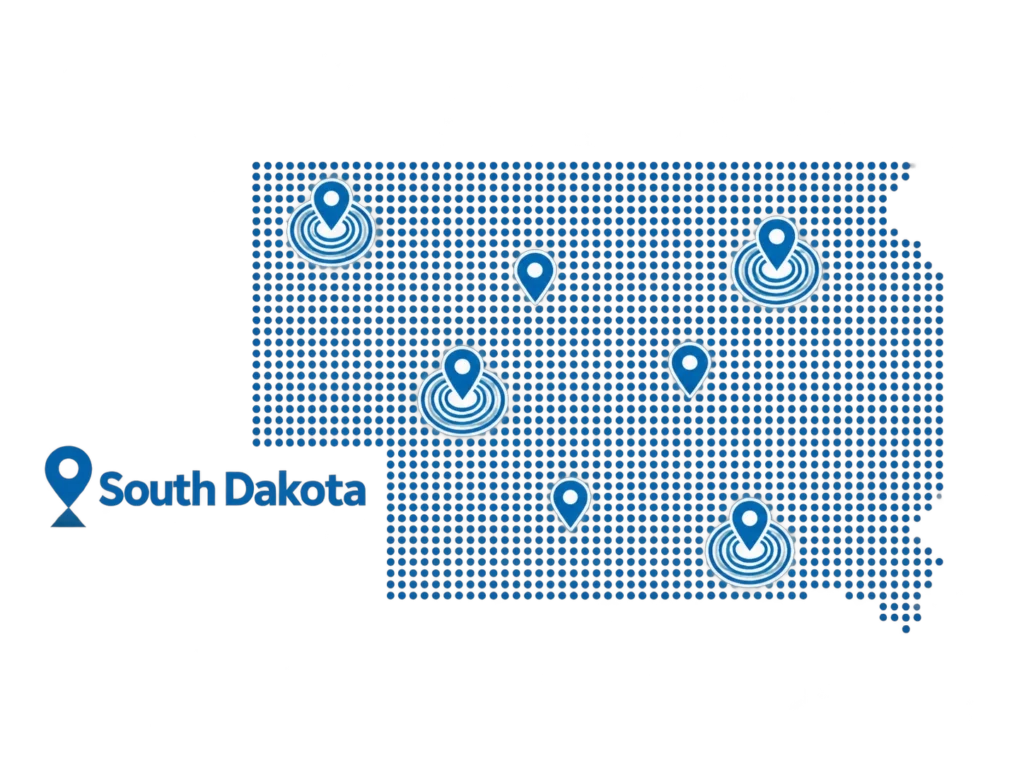
Our team supports practices in all 66 South Dakota counties. The figures below show average monthly Medicaid enrollment in SFY 2025 (July 2024 to June 2025), from the DSS South Dakota Medicaid Report.


Minnehaha County, home to most of Sioux Falls, averaged 32,211 Medicaid enrollees a month in SFY 2025.

Pennington County, home to Rapid City and Box Elder, averaged 18,784 monthly Medicaid enrollees during SFY 2025.

Oglala Lakota County, which includes Pine Ridge, had 59.9% of residents enrolled in Medicaid in SFY 2025.

Todd County, home to Mission and the Rosebud area, had the state's highest Medicaid share at 63.0%.

Aberdeen is in Brown County, where Medicaid enrollment averaged 5,620 people a month or 15.0% of residents.

Lincoln County, which includes Tea, Harrisburg and Canton, averaged 4,733 Medicaid enrollees, only 6.3% of its residents.

Beadle County, home to Huron, averaged 4,623 Medicaid enrollees a month, equal to 23.8% of its population.

Codington County, including Watertown and Florence, averaged 3,767 Medicaid enrollees a month, about 12.9% of its residents.

In Yankton County, about 14.4% of residents were on Medicaid, an average of 3,397 people each month.

Mitchell is in Davison County, where an average of 3,301 people were enrolled in Medicaid each month.

Sturgis and Piedmont are in Meade County, where an average of 3,047 people a month had Medicaid.

Spearfish, Lead and Deadwood are in Lawrence County, which averaged 3,018 monthly Medicaid enrollees in SFY 2025.

In Dewey County, home to Eagle Butte and the Cheyenne River Reservation, 55.8% of residents had Medicaid.

Brookings and Volga are in Brookings County, where about 8.0% of residents or 2,920 people, had Medicaid.

Pierre, the state capital, sits in Hughes County, which averaged 2,852 Medicaid enrollees or 16.3% of residents.

These figures come from Stream RCM client results across many specialties. Your numbers can differ based on payer mix, claim volume and where your billing stands today.
Our South Dakota billing services cover eligibility and referral checks, coding, claim submission, payment posting, denial management and A/R follow-up. Provider credentialing is also available.
No. DSS pays Medicaid claims directly on a fee-for-service basis. The PCP program manages referrals, but it doesn’t process claims like a managed care plan.
DSS must receive the claim within six months following the month of service. A denied claim can be resubmitted within 3 months of the denial.
Our pricing begins at 2.99% of your monthly collections. The exact rate is based on your specialty, how many claims you send and which services you pick.
Starting January 1, 2027, some adults ages 19 to 64 on Medicaid expansion must log 80 hours a month of work or other approved activities. Renewals for Medicaid expansion also move to every six months.
Compare medical billing companies in South Dakota on three things: certified coders, state Medicaid experience and clear pricing. It also helps to ask for sample reports and results from your specialty.

Our team will review your recent claims and show you where payments are slowing down.
Get a complimentary billing audit and discover potential revenue leaks, claim issues, and missed opportunities affecting your practice.
Find areas where your practice may be losing collectible revenue.
Get insights into your current billing and claims process.
Receive your audit without committing to a service.
Complete the short form and our billing team will review your request.