Stream RCM offers medical billing services for New Hampshire doctors, nurse practitioners, hospitals, clinics, and other healthcare providers, handling every step until a claim is paid. Our AAPC-certified medical billers and coders verify coverage, code each visit, send claims, post payments and work on denials until balances are resolved. We bill Medicare, Medicare Advantage, commercial insurers and New Hampshire Medicaid, including all three of its managed care health plans.

Medicaid payments slow down in New Hampshire when a patient loses coverage between visits and the claim is billed on old eligibility. CMS data for April 2026 shows that only 32% of New Hampshire renewals were completed automatically, compared with 47% nationwide. Another 26% of members due for renewal lost coverage for paperwork reasons, such as a form that never came back, compared with 15% nationwide.
Medicaid Members, Sept. 2026
Enrollment Drop, June 2025 to Sept. 2026
Expansion Adults, Sept. 2026

Medical billing and coding in New Hampshire works differently from one specialty to another. A routine pediatric checkup and an orthopedic surgery follow different billing rules. For a surgery with a 90-day global period, most routine follow-up visits are already included in the surgical payment. CMS counted 84,991 New Hampshire children with Medicaid coverage in April 2026, so many pediatric claims go to a Medicaid health plan. Stream RCM bills for more than 50 specialties, including cardiology, gastroenterology, neurology and radiology. Before a claim goes out, our coders match the documentation, modifiers, units and diagnosis codes to each payer’s policy.
Our medical billing specialists support New Hampshire practices by handling Medicare, Medicaid and commercial claims in one place, and you see the same reports we use. If you’re comparing medical billing specialists in New Hampshire, ask who will work your claims and how you’ll track the results. Here’s what that includes.
Our medical billing process works in 8 stages, from the first review of patient details to the last unpaid claim. Our team checks the work at each stage before the claim moves on. Small errors get fixed early, before they turn into denials. Here’s how our team handles each step of the medical billing process.
Every claim starts with the details collected at check-in. We confirm the patient's legal name, date of birth, address and member ID, and we ask about other coverage. Medicare or employer-provided insurance usually pays before Medicaid. Sending claims in the wrong order can lead to rejections or payment delays. We also flag uninsured patients who may qualify for Medicaid. Starting January 1, 2027, federal law limits how far back new Medicaid coverage reaches. Adults in the Granite Advantage Health Care Program, New Hampshire's Medicaid expansion, get one month before their application, and other members get two.

We confirm that each patient is still covered before every appointment, along with deductibles, copays and prior authorization (advance approval) rules. For New Hampshire Medicaid, we look up the member in the NH MMIS Health Enterprise Portal, which also shows the patient's managed care plan. Coverage can change quickly here. Starting in 2027, Granite Advantage adults renew every six months instead of once a year. A patient covered in March may not be covered in June. See our insurance eligibility verification services.

Our certified coders read each provider note and assign the procedure, diagnosis and supply codes it supports (CPT, ICD-10-CM and HCPCS). Units and modifiers are checked against NCCI edits, the federal rules that catch code pairs that shouldn't be billed together. Each diagnosis has to support the service on its claim line. When a note doesn't back up the level of service billed, we ask the provider before the claim goes out, not after a payer denies it.

We match every documented service to a charge, because a missed charge never shows up on a denial report. We compare visit notes with posted charges and look for injections, supplies, lab work and add-on codes that were left off. Groups with several providers, or with hospital rounds, usually have the most gaps. Charges are reviewed on a set schedule, and missing items are added before the claim is built.

Most New Hampshire Medicaid members get care through a managed care plan, so their claims go to that plan instead of the state. Services that stay under regular Medicaid, such as children's dental care and nursing home care, are billed directly to the state (fee-for-service) through the NH MMIS portal, which Conduent runs. Medicare Part A and B claims go to National Government Services (NGS), the Jurisdiction K Medicare Administrative Contractor for New Hampshire. Before release, every claim is checked for payer rule errors and missing data.

We post electronic remittances (ERAs), paper explanations of benefits (EOBs) and payment statements from the NH MMIS portal line by line. Each payment and adjustment is matched to the right claim line. When a payer pays less than your contract or the Medicaid fee schedule allows, the claim is flagged for review instead of written off. Correct posting keeps patient statements and A/R reports accurate, and deposits are reconciled against posted totals.

Claims are often denied for one of five reasons: lapsed eligibility, a missing prior authorization, a coding error, a late filing or a provider enrollment problem. We find the exact cause before anything is resent. Enrollment needs close attention in New Hampshire right now. NH Medicaid has started accelerated provider revalidations under a federal CMS initiative, and many providers must revalidate, or re-confirm their enrollment, before their usual five-year cycle. Our credentialing team tracks those dates. Learn more about our denial management services.

We sort unpaid claims by filing deadline, then by age and balance. New Hampshire Medicaid fee-for-service claims must be filed within one year of the date of service, while each health plan and commercial payer sets its own limit. Our team checks payer portals, calls when a claim status is unclear, sends corrected claims and files appeals the records support. Older balances are worked on a schedule instead of being left until time runs out.

The better choice depends on what in-house billing costs you, and salary is only one part. Benefits, training, software and coverage for sick days add up. When you outsource medical billing in New Hampshire, most of those fixed costs become one fee based on what you collect. Here’s how the two models compare.
| Billing Consideration | In-House Billing | Outsourced Stream RCM |
|---|---|---|
| Staffing Structure | Hiring, payroll and cover for staff time off | An AAPC-certified team assigned to your practice |
| Claim Performance | Depends on each biller's training and workload | 98% clean claim rate |
| Denial Management | Worked between other front-desk tasks | Each denial traced to its cause and followed up |
| Operating Cost | Salaries, benefits, software and training every month | 40–50% cost savings |
| Performance Visibility | Limited to what your billing software reports | Real-time reports on claims, payments and A/R |
Practices can choose from five core services or hand us the full revenue cycle.
We check, submit and track claims until the payer responds. Rejected claims are corrected and resubmitted.
Certified coders match CPT, ICD-10-CM and HCPCS codes to the chart and check modifiers before any claim is released.
Denials are sorted by reason. We fix the root problem, correct the claim and appeal when the records support it.
Unpaid balances are worked by age and amount through portal checks, payer calls, corrected claims and appeals.
We provide credentialing services for NH Medicaid, Medicare and private health plans, plus renewals.


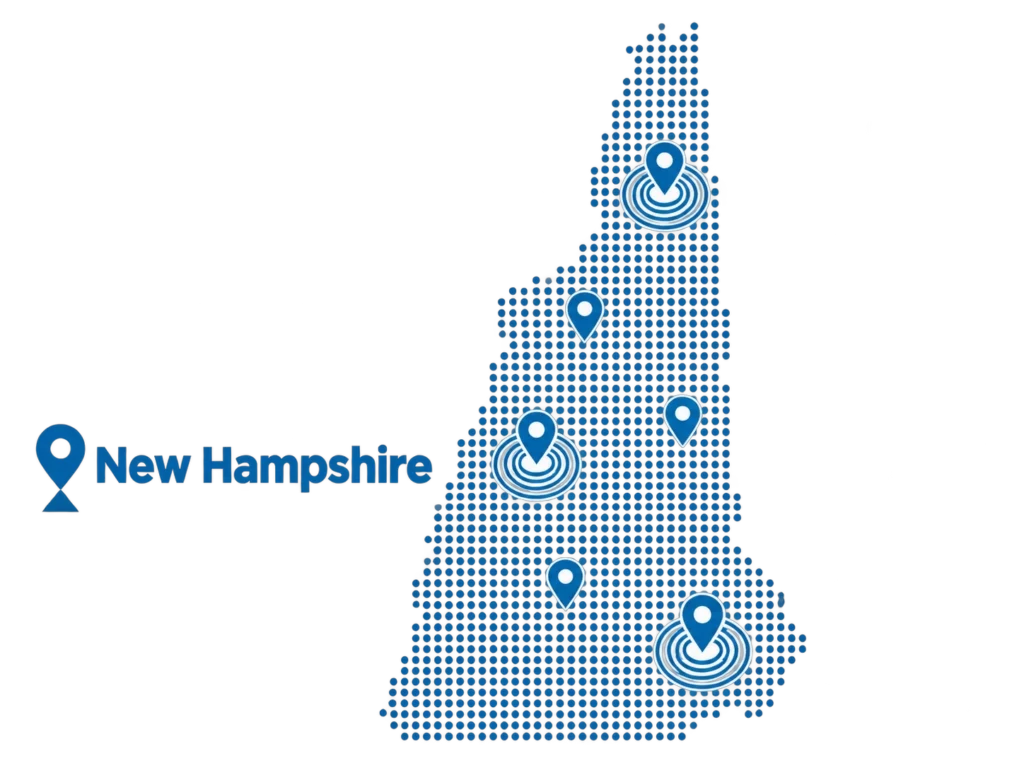
Our billing team can support practices in any of New Hampshire’s 10 counties. KFF’s 2025 fact sheet shows that 42% of New Hampshire Medicaid enrollees live in rural areas. Each card uses DHHS member counts from September 2026.


Manchester's 25,478 and Nashua's 14,214 Medicaid members pushed Hillsborough County to 56,818, the highest total in the state.

Derry led Rockingham County with 3,882 Medicaid members, while coastal New Castle had just 15 enrolled residents.

Merrimack County counted 19,115 Medicaid members across 27 cities and towns, and the capital, Concord, accounted for 6,937.

Rochester and Dover together had 9,731 Medicaid members, well over half of the 16,148 enrolled across Strafford County.

In Grafton County, 10,120 residents had Medicaid, led by Lebanon with 1,318 members and Littleton with 1,149.

Keene accounted for 3,674 of Cheshire County's 11,145 Medicaid members in September, and neighboring Swanzey added 1,203.

With 3,768 members, the city of Laconia held about four in ten of Belknap County's 9,182 Medicaid enrollees.

Of Carroll County's 6,694 Medicaid members, 1,750 lived in Conway, the county's largest local count by far.

Claremont's 3,144 members made up nearly half of Sullivan County's 6,933 Medicaid total, with Newport adding 1,456.

Coos County had the lowest county total, 5,865 Medicaid members, and 2,270 of them lived in Berlin.

Stream RCM clients have reached a 98% clean claim rate and up to 75% fewer denials across many specialties. Compare them with your current clean claim and denial rates. Your own numbers depend on your payer mix, claim volume and how your billing runs today.
Medical billing services cover a claim from the first insurance check to the final payment. That includes coding, claim submission, payment posting, denial work and A/R follow-up. Credentialing is often added to keep Medicaid and Medicare enrollment current.
We bill all three plans in New Hampshire’s Medicaid Care Management program: AmeriHealth Caritas New Hampshire, NH Healthy Families and WellSense Health Plan. The plans cover the same Medicaid services but have their own provider networks and rules, such as prior authorization.
Starting January 1, 2027, most Granite Advantage adults ages 19 to 64 must meet new work and community engagement requirements: 80 hours a month of work, school, volunteering or another approved activity. Federal law exempts some groups, such as pregnant members, parents of children 13 or younger and people who are medically frail.
Yes. Our billers work in the EHR or practice management system your office already uses, such as athenahealth, eClinicalWorks, NextGen or AdvancedMD. Setup time depends on the user access your system allows.
Start with a company whose certified coders already bill New Hampshire Medicaid health plans and Medicare. Ask for its clean claim and denial rates and how it plans to handle the 2027 Medicaid changes, then compare pricing. A free billing review gives you a starting point.
Pricing differs by company. Some charge a flat monthly fee, and others take a percentage of collections. Stream RCM fees start at 2.99% of monthly collections, and your rate depends on specialty, claim volume, payer mix and the services you choose.

Our team will show you which claims are holding up payment and what to fix first.
Get a complimentary billing audit and discover potential revenue leaks, claim issues, and missed opportunities affecting your practice.
Find areas where your practice may be losing collectible revenue.
Get insights into your current billing and claims process.
Receive your audit without committing to a service.
Complete the short form and our billing team will review your request.