


Medicaid is the main health-insurance program in the USA targeting low-income populations and funded by the government at both federal and state levels, run via state plans within the framework of federal laws. It was established back in 1965 under the Social Security Act Title XIX. Today, tens of millions of people in the USA are covered by Medicaid – children, pregnant women, adults, older patients, and disabled individuals. As reported by the CMS, there were 66.4 million Medicaid enrollees in May 2026.
The significance of the Medicaid program goes further than just the number of participants. Medicaid pays for a significant portion of health services and long-term care in the US while relying on the federal-state management structure. State plans are funded by the federal matching payments, but states have a lot of flexibility in defining their eligibility criteria, benefits, reimbursement, service delivery models, and administration. Thus, Medicaid cannot be seen as a single insurance product on a national level, because of considerable discrepancies between the state-level coverage and eligibility. A medical billing company in USA supports healthcare providers managing claims, payments, billing, and reimbursement processes professionally.
What Is Medicaid Insurance?
Medicaid is an insurance program that is meant to give people health cover especially those with low incomes and with particular situations. Unlike a standard insurance program where payments come from private individuals, Medicaid is funded through both federal and state government with each state running the program according to the law of the federal government. It is also very big since 66.4 million people had enrolled in the program in May 2026. Enrollment is usually based on situations like income, age, pregnancy, disability, being part of a family, etc.
There are clear differences between Medicaid and Medicare with respect to eligibility and implementation. While Medicare is a federal health insurance scheme mostly aimed at individuals 65 years and above and those below who have certain disabilities, Medicaid can offer health care coverage to all individuals at any age who meet the criteria of the income and categorical eligibility tests. Medicare uses relatively uniform eligibility and coverage criteria that are federal, whereas Medicaid provides for some degree of discretion at the state level. Some individuals qualify for both programs at once.
Financing arrangements also provide one with the explanation of why Medicaid is different from state to state. States are responsible for the implementation of programs, setting the rate of payments, and defining the type, duration, and nature of some services based on federal rules. The federal law mandates specific benefits that include hospital care, physician visits, laboratories, nursing facility services, and home health services. However, states are free to choose additional services which include prescriptions, dentistry, personal care, and rehabilitation. In other words, Medicaid varies greatly depending on the location and the state. Outsourcing medical billing services permits medical practices to delegate billing tasks to experienced professionals while minimizing administrative workload.
Who Is Eligible for Medicaid?
Medicaid eligibility is wide-ranging and includes numerous segments of the population, with financial status being a primary determining factor. The mandatory groups include poor families, pregnant women, children under age 19 and some individuals who get disability aid. As for the expansion route, the states which participate typically provide coverage for adults between ages 19-64 with incomes of up to 133 percent of the federal poverty level, with children being covered to at least that percentage.
Eligibility can also apply to those 65 years and older, people with disabilities, former foster care children, or anyone in need of community or long-term care, depending upon the appropriate pathway. The difference between mandatory and optional categories is that while there are federal requirements for certain categories, states have the flexibility to select others, thus resulting in different levels of eligibility in different states. Income criteria are also quite diverse; in 2023, state statistics indicate that the level of income for children receiving Medicaid was anywhere from about 133% to over 260% FPL.
Medicaid Income and Financial Eligibility
For financial Medicaid eligibility, income, category, and State regulations play major roles. In case of children, pregnant women, parents, and adults, the use of Modified Adjusted Gross Income (MAGI) is prevalent; MAGI typically does not take an asset test into account but uses percentage of income standards based on the Federal Poverty Level (FPL). MAGI includes a 5% FPL income disregard, although state cutoffs vary significantly, such as 2023 data illustrating that the maximum Medicaid income for children varies between around 133% and 261% of FPL.
However, the financial criteria become very complicated for those who are above the age of 65 years or have disabilities and blindness and usually adopt non-MAGI approaches that are based mainly on SSI regulations and are subjected to income as well as resources tests. Unlike MAGI applicants, it is possible that the countable assets will have an impact on their eligibility criteria, and the asset limits will vary for each program as well as for each state; for instance, asset limits for 2026 Medicare Savings Program include $9,950 for a single applicant and $14,910 for a couple in several categories.
Non-Financial Medicaid Eligibility Requirements
Medicaid eligibility is based not only on financial factors, but also on certain non-financial factors related to an applicant’s residence, his or her citizenship or immigration status, age, pregnancy, disability, family situation, or any other qualifying criteria. Such factors play a significant role in defining which pathway of eligibility is to be used. Provider credentialing services help healthcare professionals complete enrollment and verification requirements with insurance companies and healthcare networks.
State Residency Requirements
Residency is required for most individuals seeking Medicaid coverage. Residency standards are determined by federal and state laws; however, Medicaid cannot make residency requirements based on the amount of time one has lived in the state prior to application. This ensures that residency requirements do not become an unnecessary barrier to coverage.
Citizenship Status Requirements
Citizenship status is usually necessary to be proven through relevant documentation whenever such information is asked for in Medicaid applications by U.S. citizens. This process will include using any existing electronic information or records and documentation. Citizenship is a critical requirement as federal Medicaid funds usually apply only to qualified citizens and qualified noncitizens but not others.
Qualified Noncitizen Eligibility
Immigrants who are not citizens are able to access Medicaid as long as they satisfy immigration and other eligibility criteria. Eligible immigrant groups can include legal permanent residents, refugees, asylees, and others. Immigrants who are eligible to access Medicaid under federal policy guidelines can be subject to a waiting period of five years, except in specific cases.
Age Related Eligibility Rules
Different Medicaid programs apply depending on age. Children tend to fall into income levels that are different than those of adults, whereas individuals who are 65 years old or older tend to use income levels that are designed for aged people. In addition, states can set up other pathways based on age.
Category Specific Eligibility Requirements
In this regard, pregnant women, parents, children, elderly people, and persons with disabilities have varying criteria that are non-monetary due to different pathways for Medicaid eligibility that each category uses. The disability pathway involves having an eligible determination while pregnancy pathways rely on being pregnant.
Differences Between Eligibility Groups
Medicaid is not governed by a single universal eligibility criterion. The federal government identifies certain individuals who are automatically eligible for Medicaid and allows states to expand coverage for other groups via approved methodologies. The result is that there can be variation in criteria based on factors such as age, disability, pregnancy, and household situations.
Professional Insight: It is always important to confirm your eligibility criteria for Medicaid besides those pertaining to finances through your state Medicaid office. Citizenship, residency, immigration status, age, pregnancy, disability, and household composition may affect the routes that an individual will take to become eligible for Medicaid benefits.
How to Apply for Medicaid
Application for Medicaid consists of filling out an application form, gathering necessary information for determining eligibility, going through the verification process, and getting the eligibility determination. Even though there is some difference in procedure from state to state, generally, the process complies with the federal guidelines. AR management services focus on outstanding patient and insurance balances, helping providers follow up on unpaid claims and improve collections.
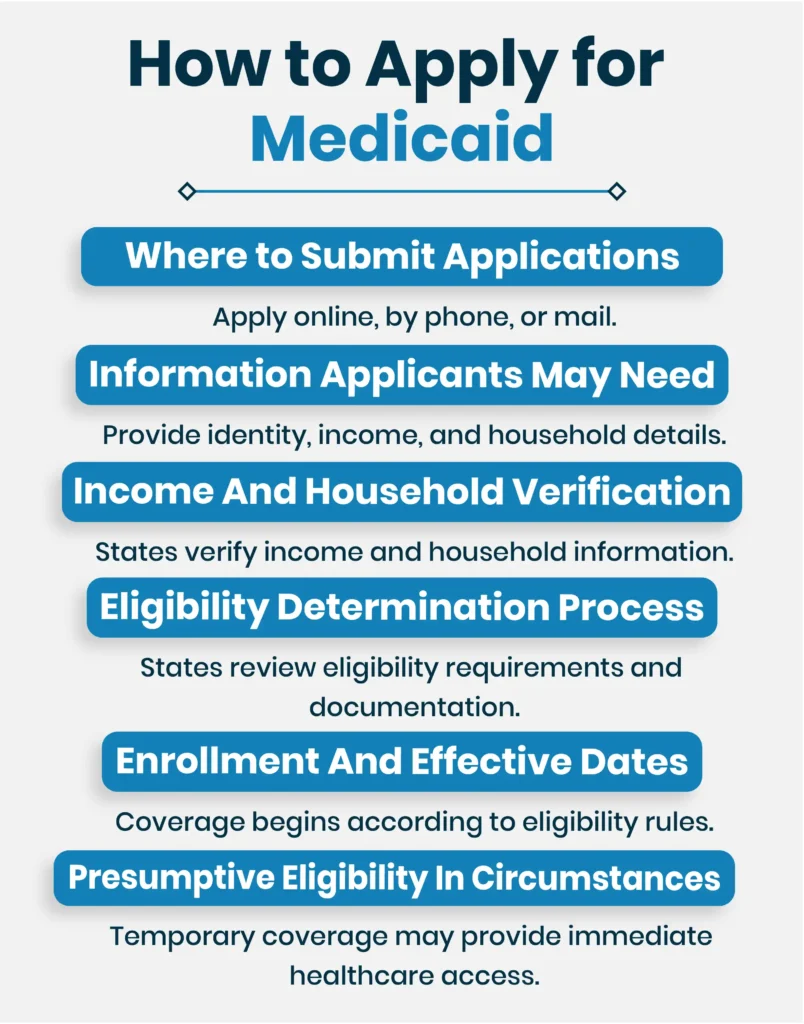
Where To Submit Applications
The application process for Medicaid is flexible, and it can be completed either through the state’s Medicaid office or online, by phone, by mail, or in person, according to the availability of state options. The applications can also be done through the federal health insurance exchange site that will evaluate the eligibility.
Information Applicants May Need
Common elements found in application forms include full name, date of birth, social security number when available, address, family situation, income information, status of citizenship or residency, and whether the applicant has any health insurance. Other documents may be asked for depending on the eligibility group to which the applicant belongs.
Income And Household Verification
Income Eligibility is based on income and household data relevant to the eligibility pathway chosen by the applicants. For groups where MAGI methodology is applied, reported income will often follow household concepts applicable to taxes. States can use government records and ask for documentation where there are inconsistencies in information through an electronic verification process.
Eligibility Determination Process
Once the application has been received, the state reviews whether the applicant is eligible for all the financial and other qualifications. The requirements will vary depending on the group involved which may include children, pregnant women, adults, elderly, or disabled. It is mandatory for the state to handle the application through certain standards.
Enrollment And Effective Dates
After eligibility is determined, the process of enrolling will define when the benefits will be available under Medicaid. The time frame of benefits depends on the type of eligibility as well as on the circumstances of application. In some cases, Medicaid can provide services retroactively for up to three months prior to the month of application.
Presumptive Eligibility In Circumstances
Presumptive eligibility gives qualified organizations or people the opportunity to make a preliminary determination on whether or not the individual qualifies for Medicaid and any other similar insurance. This may be specifically applicable to categories such as pregnant women and children. The provisional cover is meant to help the individuals qualify for essential services until the final eligibility determination is made.
Medicaid Eligibility Renewals
Review of Medicaid eligibility is necessary periodically so that those people who have the right to use services provided under Medicaid meet all necessary criteria. The process of review involves reassessment of income, household circumstances, residence, and other related factors. In some cases, beneficiaries are notified of the need to submit certain information and documentation as a part of the renewal process.
Beneficiaries can avoid any unnecessary discontinuities by making sure that the state knows their current address and contact information, responding to renewal notifications and reporting all necessary changes. It is the obligation of the state to perform renewal properly and timely, using all available information. In case of changes in eligibility, beneficiaries are always notified.
How Medicaid Is Administered
The Medicaid system functions based on a dual federal-state administration whereby the federal government lays out basic criteria while states implement the everyday processes of running the program. Federal funding, regulations, and standards work with the state choice in issues such as who qualifies, what is covered, how payments are handled, and how services are delivered.
Role of Federal Government
The federal government creates rules for Medicaid regarding eligibility, funding, benefits, and administration. The government contributes financial assistance to state governments using matching formulas. Additionally, there are certain national standards that must be met by the Medicaid programs of the various states. In this regard, the federal rules create the basic guidelines for the operation of the Medicaid programs.
Role of State Agencies
State agencies for Medicaid operate the programs, receive applications, make eligibility determinations, enroll the eligible participants, make payments to providers, and monitor the services provided. In addition, state agencies develop operating procedures within the framework of the federal requirements and maintain relationships with healthcare providers and managed care organizations. Given the significant control exercised by states, variations arise in the processes.
CMS Oversight and Guidance
Federal oversight consists of assessing state compliance, approving certain program changes, tracking performance, and administering guidance. Oversight is concerned with finance, eligibility, benefits, quality, and beneficiary rights. Federal assessments may uncover problems and compel corrective action if the programs fail to meet all the relevant criteria.
State Medicaid Plans
States implement their Medicaid programs through the process of an approved state plan, which outlines how their program satisfies federal regulations. The state plan contains information regarding eligibility categories, service benefits, payment methods, and administration processes. Although there are federal guidelines that dictate certain elements of the Medicaid program, states may use some optional measures as well.
State Plan Amendments
State Plan Amendments are used by States in requesting modification to policies, benefits, eligibility, reimbursement, and administrative processes already approved for their Medicaid programs. State Plan Amendments are evaluated against the requirements at the federal level. Upon approval, the State Plan Amendment is considered part of the governing structure of the Medicaid program in the respective State.
Eligibility Enrollment Systems
The systems for eligibility and enrollment gather the information of the applicants, verify the data available, establish the eligibility, and also handle case management. The increasing trend of automation of systems is such that the systems can be connected to databases of the government like income tax, identification etc., for manual verification to be minimized.
Program Reporting and Monitoring
Medicaid management relies on continuous reporting and monitoring of performance. States report information related to enrollment, costs, eligibility, services, and other program operations. Information analysis could identify any administration mistakes, irregularities in cost, delays, and any utilization change. Thus, monitoring is essential for accountability, regulation, program integrity, and evidence-based improvement of Medicaid administration.
Expert Insight: The knowledge of the common functions performed by both the federal and state governments will make it much easier to understand the process of administering Medicaid. It is important to always review the most recent state Medicaid plan, eligibility criteria, and any guidelines from CMS because everything can be different in each state.
Medicaid Eligibility Determinations
Medicaid eligibility is determined by applying federal and state regulations to the specific applicant based on their income level, family situation, age, residency, citizenship or immigration status, and category that qualifies them. For most children, pregnant women, parents, and adults who are eligible, the process of determining Medicaid eligibility is done using MAGI methodology, which is not accompanied by an asset test. Eligibility for most seniors and individuals with disabilities is done through a different procedure that is based on age, disability, income, and resources.
Other coverage programs include Medicare, CHIP, and marketplace coverage. Medicaid eligibility determination must be made in coordination with the other insurance programs. The federal regulations create the basic criteria, whereas the state determines the specific eligibility and enrollment systems. It is crucial to have accurate determinations, otherwise there may be inappropriate coverage, costs, and delays in getting services or losing coverage. Moreover, the appropriate eligibility for ICD-10-CM code for left leg pain depends on the documented diagnosis and symptoms, so providers should verify the current code and Medicare billing requirements before submitting a claim.
Medicaid Appeals and Fair Hearings
The denial of the application for Medicaid coverage gives the applicants the right to know why it has been denied and even file for an appeal. Beneficiaries can ask for a review of their case in case they feel that the decision has not been made on the correct information and facts. The rights of Medicaid beneficiaries include being given a notice, information, and the opportunity to give explanation or evidence about their situation.
The fair-hearing process enables beneficiaries to formally get their cases reviewed. It is the responsibility of the states to design and implement the appeal process that will ensure fair hearings and give beneficiaries information regarding the process and the deadlines. The state needs to review the case and make a decision. Medical billing software for small businesses can regulate claims, patient billing, payment tracking, reporting, and other revenue-cycle tasks.
Medicaid Administration Challenges
There are a number of problems that Medicaid agencies face when trying to keep their eligibility information up-to-date. First of all, there should be an effective application/renewal processing system and at the same time people need to be assured that they get all the coverage for which they are eligible. To achieve it, there should be proper interaction between Medicaid, the Children’s Health Insurance Program (CHIP) and Marketplace coverage in order to ensure that those who are eligible for a certain program enroll in it without any gap or duplications.
One more problem concerns the difficulty of handling complex eligibility systems and substantial amounts of beneficiaries’ data. It is important that a reliable information system would be established to verify eligibility and perform timely updates and processing of any changes. On the other hand, there needs to be proper prevention of any enrollment mistakes, errors and maintenance of program integrity.
How Stream RCM Helps with Medical Billing and RCM
Stream RCM makes it easier for the healthcare provider to streamline its revenue cycle by providing complete medical billing, coding, denial management, accounts receivable management, credentialing, and billing audit services. The experts at Stream RCM can help ensure that claims are properly submitted, payments are tracked, and administrative tasks are efficiently carried out, while also enabling the healthcare provider to spot areas of revenue leakage and billing problems.
FAQs
What is Medicaid insurance?
Medicaid is one of the federal health insurance programs of the United States which offer coverage of medical benefits to qualified poor people. Qualification for coverage depends on criteria including income, family size, age, disability status, pregnancy status, and others, depending on the state concerned.
Who is eligible for Medicaid?
Eligibility for Medicaid is state-dependent and also depends on individual situations. Some of the categories that can be considered include poor adults, children, pregnant women, the elderly, and those with disabilities. Information concerning the person’s income, residence, and other such criteria can help in determining eligibility.
How is Medicaid administered?
Medicaid is financed through a partnership between the national and state governments. The administration of each state’s program and many aspects of its operation fall to the states within the parameters set by the federal government. In general, state Medicaid agencies administer many facets of their programs.
How do people make their application for Medicaid?
People apply for Medicaid by filing their application to the state agency responsible for the administration of Medicaid or through any other form of enrollment approved by the same agency. Information regarding the income status, family structure, and place of stay are among the information provided. The agency evaluates the application and sends a notification regarding eligibility and coverage.
What does one do if the Medicaid application is rejected?
If the application for Medicaid is rejected, the claimant is usually informed accordingly and provided with information concerning the right to appeal against the rejection. If the claimant feels that the rejection is not right, he or she can request for a fair hearing within the stipulated period.
How does Medicaid coordinate with other coverage?
It should be noted that Medicaid could interact with other programs like CHIP and the Marketplace in order to facilitate proper coverage of an individual. Eligibility systems rely on data provided by applicants in order to identify what kind of program might be applicable.