
Emergency Department Billing Services That Never Stops
Our professionals at Stream RCM manage emergency physician services billing for hospital-based groups, freestanding EDs, and urgent care networks operating under constant pressure. Our expert coders convert high-acuity visits, trauma activations, and critical care minutes into accurate, defensible claims on the first submission. We offer emergency department billing all day long, following the same 24/7 schedule that you have for your clinicians.














Your Billing Specialist Who Speak Emergency Medicine
Emergency groups frequently complain that standard billing vendors fail to understand the rapid pace of an ED. But our team works alongside physicians, coders, and hospital administrators to close the gap between chaotic triage documentation and clean, submission-ready claims. We are experts in solving the problem between a Level 4 and Level 5 visit. It’s revenue based and we built our process around emergency room billing services. Our experience ranges from single-hospital emergency departments to multi-hospital freestanding emergency departments managing thousands of cases per month. All clients are supported by our specialized coders specializing in emergency medicine who know how to code E/M levels, critical care hours, and trauma activations. The providers can realize the difference that accurately reflects the level of care provided on a daily basis.
Emergency Care Areas We Cover at Stream RCM
Level I & II Trauma
We manage the layered coding trauma activation requires, aligning critical care minutes, procedure bundles, and multi-specialty consults into one accurate, audit-ready claim your team can submit every time.

Freestanding EDs
Our billers understand the facility-fee structures unique to freestanding emergency centers by submitting claims and we defend firmly against payer downcoding attempts on every single encounter.

Hospital-Based Groups
We resolve physician and facility documentation for hospital-employed emergency groups by reducing the mismatched claims whenever two separate billing streams describe the very same patient visit.

Observation Units
We separate observation hours from emergency encounter time correctly; a distinction payers inspect closely by protecting reimbursement that is otherwise quietly lost to preventable status.

Time-Critical Protocols
Stroke, sepsis, and cardiac protocols carry strict time-stamped documentation requirements. Our coders verify that door-to-treatment intervals are captured accurately.

Emergency Medical Billing Services We Provide
Our emergency billing team owns the entire revenue cycle from the moment a patient is triaged to the final payment posted so you can focus on life-saving care.
Denial Management Services
We investigate every emergency claim denial down to its exact cause, correct the underlying coding or documentation issue, and resubmit with payer-specific appeal language built to win each dispute quickly.
Accounts Receivable Recovery
We work aging emergency accounts on a fixed weekly schedule, escalating stalled claims before timely-filing deadlines expire, so owed revenue never quietly disappears into an unmanaged, aging accounts receivable ledger.
Medical Billing Audits
Our team runs recurring medical billing audits against current payer policy and documentation standards, catching coding gaps before an external auditor ever finds them, protecting revenue and long-term compliance, always.
Medical Coding Accuracy
Our certified coders apply E/M levels, critical care time, and procedure codes with documentation-backed precision, reducing the downcoding that quietly erodes emergency department reimbursement claim after claim.
Provider Credentialing Support
We handle registration and credentialing of emergency physicians and advanced practice providers, staying on top of the deadline for renewals to ensure that nothing stands in the way of billing for the services provided.
Payment Posting Precision
We post every payment and adjustment against the correct emergency claim promptly, reconciling remittances line by line so underpayments, denials disguised as payments, and posting errors never slip past review.
Stop Losing Nights to Emergency Billing Backlogs
Hand your emergency claims to a team that never clocks out, sized correctly for the true claim volume your department handles every single day, always.

Outsourced Emergency Room Medical Billing Services
The ED never closes, nor do its claims with overnight surges, holiday spikes, and unpredictable mass-casualty events waiting for an adequately staffed billing department. The ability to keep up is constantly hampered by the need for continuous hiring, training, and turnover, due to the scarcity and high cost of experienced emergency coders. Outsource medical billing services to Stream RCM removes that staffing burden completely. We scale coverage to match claim volume automatically, protect coding accuracy through every shift change, and keep your reimbursement cycle moving whether your department sees a quiet Tuesday or a mass casualty weekend.
Emergency Room Billing Services Start with Codes
Accurate emergency coding depends on matching acuity, procedure, and diagnosis correctly. Here is how our coders apply the CPT codes most common to emergency encounters, and the ICD-10 codes we pair with them.
| CPT / ICD-10 | Encounter Type | How We Bill It |
|---|---|---|
| 99284 / S72.001A | Level 4 Visit | Our coders apply CPT 99284 for high-severity ED encounters such as fractures, pairing it with precise ICD-10 codes to justify medical necessity and support full reimbursement. |
| 99285 / I21.3 | Level 5 Visit | In case of most severe presentations, we make use of CPT code 99285 together with diagnoses such as STEMI to ensure that the documentation justifies the highest E/M level and avoids downcoding by the payers. |
| 99291 / R57.0 | Critical Care (1st Hr) | We submit CPT 99291 for the first hour of critical care service based on documented time and unstable patient criteria to ensure that the time-based billing can withstand an audit. |
| 99292 / R65.21 | Additional Critical Care | Our team documents each additional 30 minutes in the case of critical care with CPT 99292 codes complemented by relevant diagnoses to avoid underbilling of the services provided. |
| 99283 / R07.9 | Chest Pain Workup | We apply CPT code 99283 for moderate severity visits such as evaluation for chest pain using ICD-10 codes and make sure documentation trail supports the diagnostic workup performed. |
Why EMTALA Documentation Now Drives Billing Outcomes
Emergency professional services billing increasingly depends on how well a chart documents the medical screening exam and stabilization decisions EMTALA requires, since payers now cross-reference this documentation when disputing medical necessity. A thin screening note that satisfies compliance obligations may still fail to justify the billing level a payer question later. Stream RCM reviews screening and stabilization documentation as part of our standard revenue cycle management workflow, not as a separate compliance step, so the same record that protects your facility legally also supports the claim financially. This dual-purpose approach to documentation is becoming standard practice among emergency groups that want to avoid rewriting charts twice, once for compliance and again for reimbursement defense.
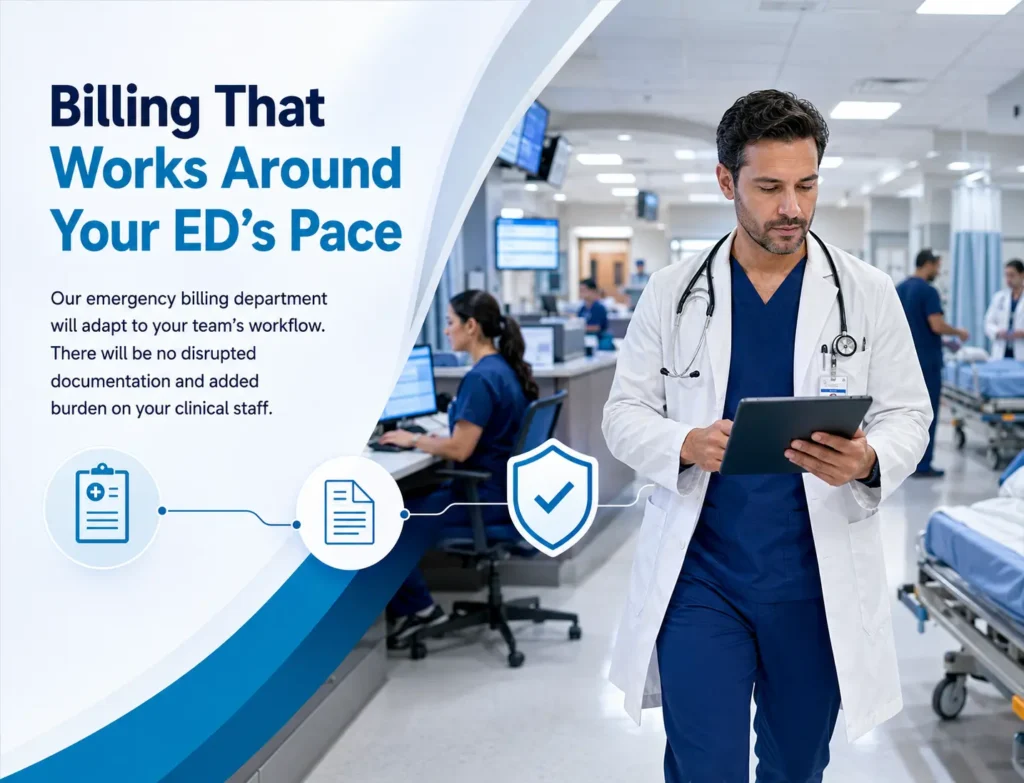
Billing That Works Around Your ED's Pace
Our emergency billing department will adapt to your team’s workflow. There will be no disrupted documentation and added burden on your clinical staff.
Trusted Partner
Fully Compliant
24/7 Coverage
Higher Approvals
How the No Surprises Act Affects Emergency Medical Billing
Federal balance billing laws have tightened the allowable charges by emergency provider services that are out-of-network with respect to how much they can charge in disputes for reimbursement going forward. This implies that emergency providers now have to be able to prove the need for their charges in order to get payment through arbitration, which wasn’t a concern before. Stream RCM ensures that all emergency claims are developed keeping in mind the analysis that is expected from independent dispute resolution arbitrators. Those emergency practices that view this compliance law not only from a legal perspective but also from a documentation viewpoint have seen a higher amount of reimbursement from their claims.
Emergency Physician Services Billing Challenges We Solve
Five recurring problems emergency groups bring us, and how our team resolves each one directly.
Challenges
Critical care time is frequently undercharted, causing coders to default to lower-level visit codes than the encounter actually warranted.
Solutions
We identify undertimed critical care notes for physician clarification immediately, recovering revenue before the claim is ever submitted for payment.
Challenges
Patients arrive without verified insurance, leaving billing teams to guess coverage details after the emergency encounter has already concluded entirely.
Solutions
Our team runs retroactive insurance eligibility verification within hours of discharge, catching coverage issues long before timely-filing deadlines become a real risk.
Challenges
Multiple providers document the same encounter differently, creating conflicting charts that payers use as grounds for automatic claim denial.
Solutions
We reconcile multi-provider documentation before submission, resolving conflicts internally so payers receive one consistent, defensible account of care.
Challenges
Observation status gets confused with inpatient or outpatient emergency status, a distinction between payers audit and reverse when incorrect.
Solutions
Our coders apply status-specific documentation checklists before billing, verifying observation criteria are met and clearly supported in every chart.
Challenges
High claim volume during surge periods overwhelms internal staff, causing filing delays that push claims past timely submission windows.
Solutions
We scale billing capacity to match surge volume automatically, keeping submission timelines intact regardless of how busy your department gets.
How We Approach Emergency Billing Differently
We built our emergency billing workflow around the specific pace, documentation style, and payer scrutiny emergency medicine faces. We tackle the most persistent obstacles in emergency department revenue cycle management.

Specialty-Only Coders
Our emergency billing coders work within emergency medicine, building pattern recognition specifically in ED documentation, trauma activation charges, and critical care time rules
Same-Week Claim Filing
We submit emergency claims within days of the encounter, not weeks, keeping your reimbursement cycle aligned with the pace your department already operates at.
Transparent Denial Reporting
You see denial reasons and trends in plain terms every month, not buried in a dashboard so your team understands exactly where revenue is at risk.
No Long-Term Lock-In
We earn renewed contracts through performance, not binding terms, because we expect our results to be the reason emergency groups stay with us.
Frequently Asked Questions (FAQs)
How much does emergency room billing cost?
Costs vary by claim volume and complexity, but most emergency billing services price around a percentage of collections rather than flat fees.
What is the CPT code for an emergency room visit?
Emergency room visits are billed using E/M codes 99281 through 99285, based on severity, plus critical care codes 99291 and 99292 for the most complex cases.
How long does it take to get paid for emergency claims?
Most emergency claims are coded and submitted within three to five business days of the encounter. Clean claims with strong documentation are typically reimbursed within two to four weeks.
Do emergency billing services handle out-of-network claims?
Yes. Emergency care often involves out-of-network scenarios, and current balance billing regulations shape how these claims are resolved.
What causes most emergency department claim denials?
The leading causes are undercharted critical care time, mismatched multi-provider documentation, and incorrect observation-versus-emergency status classification.

Boost Your ED Revenue Today
Schedule a free revenue assessment and see how we can improve your emergency department’s financial performance.