


The CO-29 denial code suggests that the health insurance claim has been rejected due to its tardiness, i.e. being submitted after the timely filing period established by the payer. Medicare allows the submission of original claims up to 12 months from the date of service. On the other hand, each commercial insurer establishes its own timely filing period.
Late filing denials form a significant portion of lost money by the medical institutions. Studies show that rejections and denials may occur at the rate of 5% to 10% of total claims submitted in the medical field, with late filing among the preventable causes. This blog discusses the factors leading to CO-29 denial codes and the steps needed to overcome such denials. It also outlines the ways in which the health institutions can avoid timely filing problems. The involvement of a good medical billing company in USA will be an added advantage to the institution.
What Is the CO-29 Denial Code?
Code CO-29 falls under the category of Claim Adjustment Reason Codes (CARCs), and it is applied by insurance companies on claims that were denied due to untimely filing beyond the prescribed time frame. The standard denial statements used by CMS include the use of eMDR codes for claims denial to enable providers to understand reasons why their claims were denied.
Timely filing in medical billing means the maximum period in which the claim can be filed following the date of service. These filing periods differ from one payor and health plan to another. The insurance companies send denials under CO-29 for ensuring claims are filed on time before the time period expires.
CO-29 denial code is quite different from other denial codes in that it depends on timing of the filing of claims rather than the coding, documentation, or necessity. Some denial codes are linked to missing data, wrong procedure codes, no prior authorization, but CO-29 refers to the case when claims have been submitted past the deadline of the insurance company. It is vital to comprehend the difference to choose an appropriate solution and avoid future problems with timely filing.
What Is a Timely Filing Limit?
Timely filing limit refers to the maximum amount of time that should elapse between the date of the service and the submission of the claim for payment. This depends on either the federal government guidelines, the state guidelines, or payer agreement. Failure to file within this time may lead to denial of the claim through CO-29 rejection despite all being valid.
Filing deadlines can differ among payers. Original claims must be filed within a year of the service date according to Medicare rules, but Medicaid rules are determined based on each state. Commercial payers set filing deadlines according to contractual agreements with providers, which are usually anywhere from 90 to 365 days. Filing deadlines for workers’ compensation claims are governed by each individual state. It is critical that the billing team know what those are before filing claims.
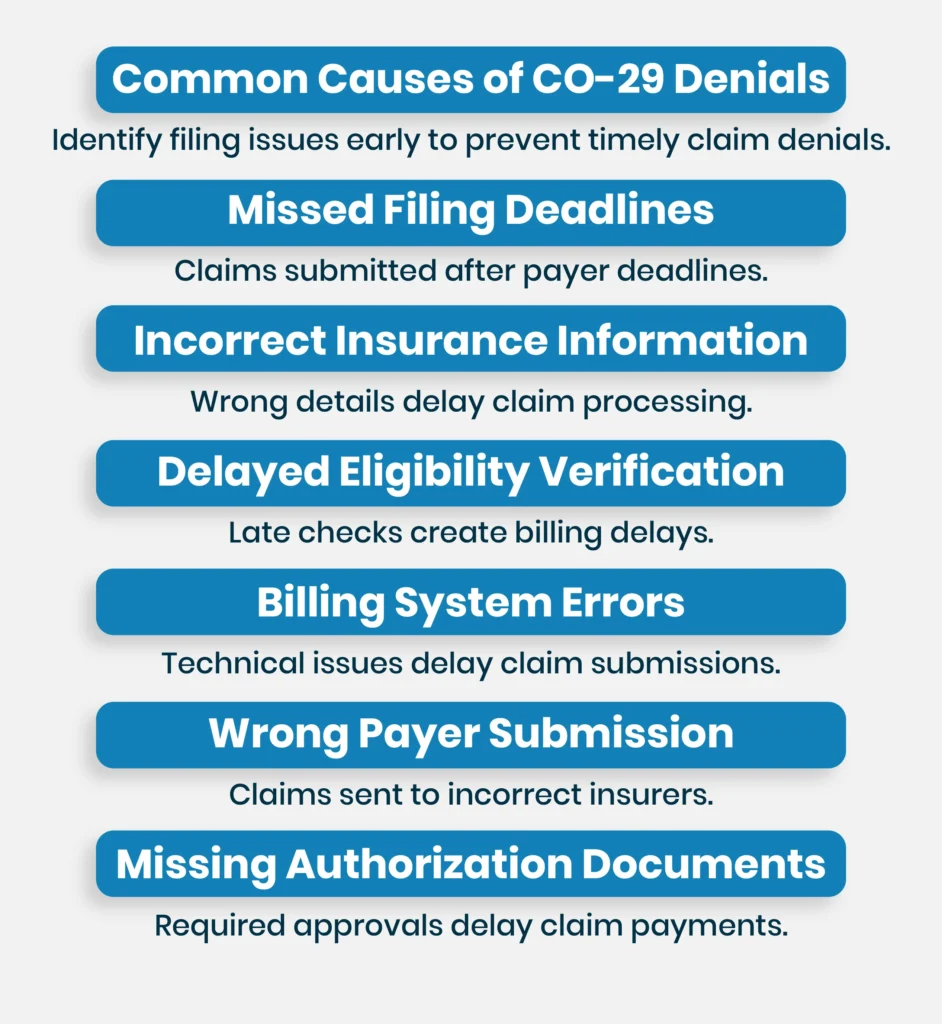
Common Causes of CO-29 Denials
Knowing the common reasons for CO-29 denial codes allows healthcare providers to minimize the number of timely filing denials and increase claim acceptability.
Missing the Filing Deadline
Denial of claims coded as CO-29 is primarily due to timely filing of claims beyond the time frame allowed by the payer. Late filing of claims due to inadequate documentation, staff shortages, and other inefficiencies of the billing process may lead to timely filing of claims denial by the insurance company.
Incorrect Patient or Insurance Information
Mistakes in demographics, policy number or insurance can delay the claims process and eventually result in denial of the claim with a CO-29 reason code. Wrong information usually results in rejection of the claim, which means it will have to be resubmitted, and that may cause a timely filing denial.
Delayed Eligibility Verification
A failure to confirm insurance eligibility prior to service delivery can lead to billing delays. Insurance problems that are found after provision of service will involve either claims modification or changing the payer, thus leaving little time for the timely filing period in medical billing, leading to a CO-29 denial.
Billing System Errors
Technical problems like software breakdowns, delays in submission of claims in batches, or failure in the electronic submission of claims may result in the claims not being submitted to the payers within the stipulated period. Continuous monitoring and tracking of the claims will ensure that there are no problems related to denial codes CO-29. Outsource medical billing services is another important method used by many healthcare facilities.
Claims Submitted to the Wrong Payer
The submission of claims to the wrong insurance organization is known to lead to claim denial, thus requiring resubmission after some period of time. By then, the claim filing deadline may have expired, hence requiring the process of CO-29 denial appeal, or making the claim non-receivable forever.
Delays Caused by Clearinghouses
Claims are reviewed by clearinghouses before submission to insurance companies. When the claims get rejected due to issues related to format or validation and corrections are not made on time, there is a possibility that providers will be late with their submission deadlines.
Missing Referral or Authorization
Some healthcare insurance plans have requirements for referrals or prior authorizations. Missing such documents can cause the claims to be delayed since providers will be working to get the required approvals. The delay caused by the process can cause the insurance claim to be denied due to lack of timely filing.
How to Identify a CO-29 Denial
The first step in identifying the code of denial CO-29 is to look at the Explanation of Benefits (EOB) from the insurance carrier. The EOB gives a reason for denial of the claim. It usually contains an explanation of the adjustment reason code, the description of denial, claim data, and payment details. The coding team needs to search for evidence that the claim was denied because of timely filing.
ERA reports and revenue cycle management system alerts may also assist in the detection of timely filing denials promptly. The information in ERA documents includes standard denial codes and payment information, whereas an RCM system will be able to identify late filing, missed deadlines, and outstanding rejected claims. It is easier to identify early on and resolve any problems regarding a potential CO-29 denial appeal.
How to Fix a CO-29 Timely Filing Denial
The resolution of a CO-29 denial code requires a timely response, proper documentation, and adherence to the payer’s policies to maximize the chances of reimbursement. Effective denial management services help healthcare providers identify filing issues, review denial reasons, prepare accurate appeals, and implement preventive strategies to reduce recurring timely filing denials and improve revenue cycle performance.
Step 1: Verify the Filing Deadline
Start off by analyzing the limitation of timely filing for the particular payer. This is done by comparing the dates of service, claim filing, and the notification of denial to see whether the claim really was not filed on time. There could be some exclusions found in the payer’s manual.
Step 2: Gather Supporting Documentation
Gather all the documents that will help you prove your case, such as claims submission verification, clearinghouse information, receipt of electronic acceptance, medical documents, and any correspondence with the payer. They play an important role in learning how to resolve problems related to CO-29 denial and also proving proper claims submission.
Step 3: Determine Whether an Appeal Is Allowed
Check your insurer’s policy on appeal to determine if an appeal for denial CO-29 is allowed. Some insurers permit appeals based on evidence that the submission was on time and any technical problems that existed at that point in time. It is important to know how the appeal process works.
Step 4: Submit a Corrected Claim (If Eligible)
In case the denial is due to an avoidable mistake rather than being late in meeting the deadline, prepare your corrected claim according to the payer’s requirements. Make sure that you provide complete and accurate patient information and insurance data to avoid another denial of CO-29 claims.
Step 5: File an Appeal with Supporting Evidence
If a claim cannot be modified, the next step would be to generate a well-formatted appeal along with relevant documentation. Provide information regarding the timely filing of the claims, clearance of the claims through the clearinghouse, or any issues that might have occurred at the end of the payer side.
Step 6: Follow Up with the Insurance Payer
Following the submission of the appeal or revised claim, you will need to check the status frequently, while keeping documentation of all correspondence. The process of frequent follow-up will help to settle any open matters and avoid any unnecessary delays, thus ensuring that your case of denial code CO-29 gets handled.
Documents Needed for a CO-29 Appeal
The submission of a comprehensive appeal together with correct documentation increases your chances of overturning an application that was rejected using the CO-29 denial code.
Original Claim Submission Proof
Proof of filing of the claim, such as e-mail timestamp, proof of claim receipt, or mail receipt, is a very strong piece of evidence in a CO-29 denial appeal case. It proves that the claim was filed within the required filing period of the payer.
Clearinghouse Reports
Information from the clearinghouse reports can indicate when the claim was received, processed, and submitted to the insurance payor. This information can prove helpful in showing that there were any delays post-submission, and hence can be very useful in proving a timely filing denial for the insurance claim.
Electronic Acceptance Reports
Electronic accept reports indicate that the payment has been properly processed by the payer or the clearing house. These documents help in resolving issues related to CO-29 denials as they establish the dates of filing and show that the claims were filed before the deadline.
Medical Records (If requested)
Medical records can be requested by some insurers to confirm that the medical procedures have been performed correctly. Medical records cannot show that the filing was timely. But medical records may be needed to finish the appeal process on a claim denial of CO-29.
Authorization Documents
When an appeal was due to an authorization and/or referral, provide copies of all approval papers in your appeal process. This is because submitting complete authorization documents ensures no extra denial factors can be considered while complying with the timeliness filing requirement for payers.
Appeal Letter
It is important that a professional and well-formulated letter of appeal highlights the need for the CO-29 denial code to be reviewed. It needs to include the claim number, the name of the patient, the dates of service, the grounds for appeal and all documentation.
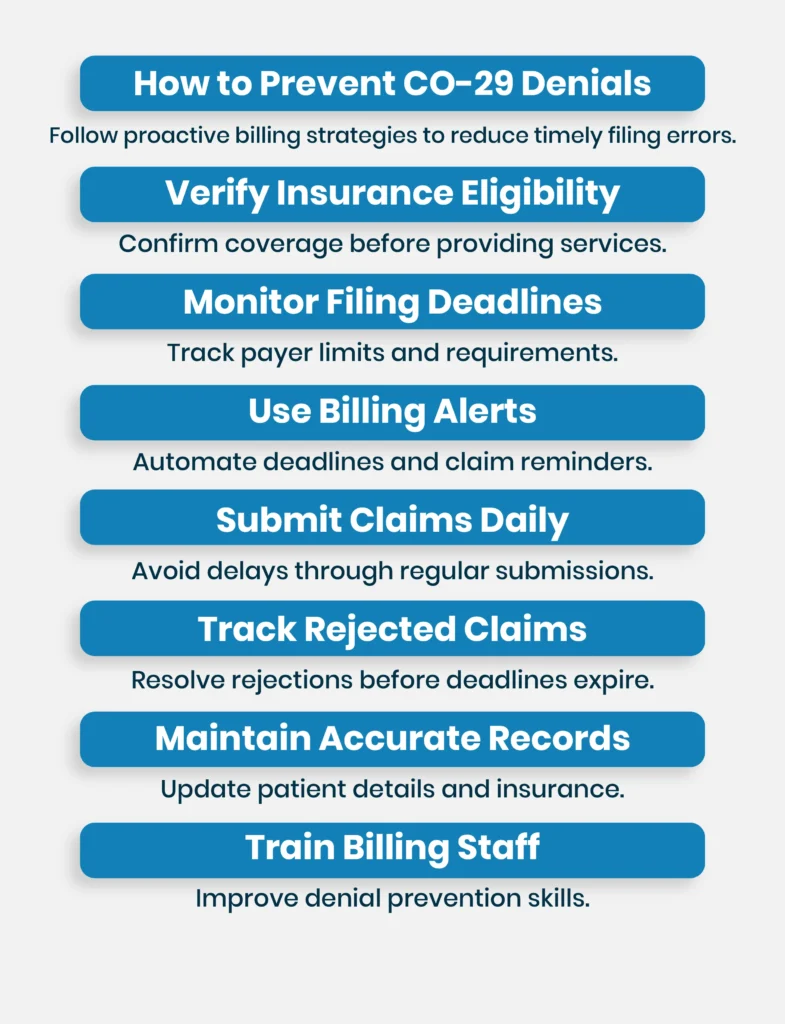
How to Prevent CO-29 Denials
The use of proper billing practices, accurate medical coding services, and continuous claim monitoring helps healthcare providers minimize CO-29 denial code problems, prevent timely filing denials, and maintain consistent claim payments. Effective coding processes ensure claims are submitted accurately, while proactive billing strategies help reduce errors, improve reimbursement rates, and support a more efficient revenue cycle.
Verify Insurance Eligibility Early
Checking the eligibility of patients for their insurance coverages prior to the delivery of services assists in verifying active insurance coverages and billing needs. Checking helps prevent delays in claims arising from erroneous insurance coverages and prevents timely filing denials due to late corrections.
Monitor Filing Deadlines
It is imperative to keep track of the payer deadline in order to avoid any problems that may arise from CO-29 denials. It is important to ensure that filing deadlines for Medicare, Medicaid, and commercial payers are known and updated.
Use Billing Software Alerts
The automated billing notifications help in recognizing upcoming deadlines for filing, denied claims, and open billing issues. The automated system helps in efficient management of revenue cycles through alerts to the employees and assists in preventing timely filing denials which lead to the issuance of CO-29.
Submit Claims Daily
Daily submission of claims, instead of waiting for big batches, increases the efficiency of the process. The steady process of submission gives billing staff enough time to fix any mistakes, reject any claims, and prevent the delay-related rejection of claims because of timely filing failure.
Track Rejected Claims Immediately
The processing of rejection claims must be done in good time so that they do not become late claims. This will ensure that mistakes can be noted by the billing department and that claims can be resubmitted within the required period of time to prevent CO-29 denial.
Maintain Accurate Patient Records
Proper demographic, insurance, and medical data ensures that claims are not processed through any delays. Updating records on a regular basis reduces billing mistakes and allows for the successful filing of claims, thus preventing problems arising from CO-29 denial code mentioned above.
Train Billing Staff Regularly
Regular training ensures that the billing team stays informed about payer policies, limitations, coding needs, and denial management. Good training will enable employees to detect any issues early, implement the right workflow, and adopt the right measures to address any CO-29 denials.
Best Practices for Medical Billing Teams
Adherence to structured billing processes will help healthcare institutions minimize CO-29 denial code occurrences and ensure accurate claims submissions while maintaining an efficient revenue cycle management process. You also need to understand about denial Code 24 in Medical Billing for better understanding.
Create a Timely Filing Checklist
The use of timely filing checklists ensures that the billing staff are aware of deadlines, documentation needed, and payer guidelines prior to claim submission. This helps in avoiding late filing denial of claims because all the claims will be processed during the specified time frame.
Automate Claim Tracking
Claim tracking software gives information on the progress of the claim, the date of the submission of the claim, and any outstanding work to be done. This helps to detect claims that have been delayed and prevents a denial of a CO-29 claim.
Conduct Weekly Aging Reports
A weekly account receivable aging report is essential for the identification of unpaid, denied, or delayed claims that need urgent action. It helps in addressing payment problems and ensures that claims are not beyond the timely filing threshold through regular review of the aging report.
Review Payer-Specific Filing Rules
Each insurer has its own criteria for the submission of claims. It is important to keep oneself updated about the policies of the insurers so as to avoid mistakes that might result in denial of the timely filing of an insurance claim.
Audit Claim Workflows Regularly
Routine claim processing audits allow for identification of process loopholes, delayed submissions, and any other billing errors that have been occurring. Through auditing all stages from the time patients register up to when claims are filed, efficiency is improved, and future CO-29 denial codes are avoided.
How Stream RCM support with CO-29 denial code
Through Stream RCM, healthcare providers can better handle the issues of CO-29 denial code through improved claim management, denial detection, and the revenue cycle process. The skilled billing support provided by Stream RCM will enable staff members to monitor timely filing periods, examine denied claims, organize paperwork, and abide by payor guidelines. This will lead to timely submission and accurate claims and fewer timely filing denials.
FAQs
What does the CO-29 denial code mean?
CO-29 denial code refers to an insurance claim that has been denied for having been filed beyond the payer’s allowed timely filing deadline. It is therefore important for providers to ensure timely filing of their claims within the payer’s deadlines.
Can a CO-29 denial be appealed?
Indeed, a denial appeal on the basis of CO-29 can be considered where there is evidence of prompt submission, payer delay, technical problems, or other acceptable exceptions. This can be backed by documentation such as claim receipts and clearinghouse reports.
What is the timely filing limit for Medicare?
Most Medicare claims have the time frame to be filed within 12 months of the date of service. Claims which get filed after the mentioned time period may be denied as a CO-29 claim.
Does every insurance company have the same filing deadline?
This is not the case because each insurance company has its own deadline for submitting claims depending on their policy and contract with the provider. Different payers such as commercial insurers and Medicaid have different limits for timely filing.
What documents are needed to appeal a timely filing denial?
A successful denial appeal for a timely filing will need proof that the claim was submitted, reports from the clearinghouse, an electronic acceptance receipt, authorization, medical records if required, and a written explanation of the appeal.
How can healthcare providers avoid CO-29 denials?
Providers can avoid CO-29 denial codes by confirming patient eligibility in time, being aware of the deadline for submission, submitting claims in time, keeping accurate documentation, following up on denied claims, and continuously training their billing staff.