


A 5 physician cardiology practice had $180,000 sitting in claims that were denied, underpaid or simply never followed up. Its billing staff was busy keeping new claims moving, so older accounts aged quietly until some were close to the payers’ filing and appeal deadlines. Stream RCM audited every open claim, worked them in deadline order and recovered the full $180,000 in 6 months, then fixed the front-end problems that had created the backlog.
The practice’s story is common. In Experian Health’s 2025 State of Claims survey, 41% of providers said at least 10% of their claims were denied. This case study shows exactly how the money was recovered, what the practice changed and how to tell whether your own practice has revenue waiting in its A/R.
| Case Study at a Glance Client: A 5 physician cardiology practice in Dallas, Texas Starting point: $284,000 in accounts receivable older than 90 days and 436 denied claims that had never been worked. Services: Stream RCM A/R recovery, denial management, appeals, underpayment review and full-cycle billing Timeframe: 6 months, from January 2026 to June 2026 Result: $180,000 in unpaid claims recovered, plus denial rate reduced from 12% to 3% |
About the Practice
The client is an independent cardiology group with five physicians and 3 advanced practice providers, seeing about 2400 patients a month across 2 locations in Texas. Its payer mix was roughly 42% Medicare, 8% Medicaid and 50% commercial insurance. Before working with Stream RCM, billing was handled by an in house team of two billing specialists.
The Challenge: $180K Stuck in Unpaid Claims
The practice did not have one billing problem. It had several small ones that had been building for months. When Stream RCM pulled the full accounts receivable report, the unpaid revenue fell into four groups.
Denials nobody had time to work
436 claims worth $164,000 had been denied and never appealed or corrected. The most common reasons were missing prior authorization, medical necessity documentation, eligibility issues, modifier errors and procedure bundling edits..
Claims with no response
124 claims worth $71,000 had been submitted but never paid or denied. Without follow-up, they were drifting toward the payers’ timely filing limits.
Underpaid claims
Payments on 69 claims came in below the practice’s contracted rates, a gap of $49,000 that nobody had compared against the fee schedules.
Upstream causes that kept creating new denials
Behind the backlog were front-end gaps: Prior authorization checks were not consistently completed before certain diagnostic services, medical necessity documentation requirements varied by payer and coding or modifier issues were not always identified before claim submission. Denial trends were also not being used to identify recurring problems.. Until those were fixed, every month added new unpaid claims to the pile.
| Metric | Before Stream RCM |
|---|---|
| A/R older than 90 days | $284,000 |
| Denial rate | 12% |
| Days in A/R | 51 days |
| Unworked denials | 436 claims, approximately $164,000 |
| Claims near a filing or appeal deadline | 87 claims |
Every one of those unworked claims also carried a cost to fix. Premier found that fighting a single denied claim cost hospitals an average of $57.23 in 2023, which is why so many practices let older denials sit.
How Stream RCM Recovered the Revenue
Recovery worked as a structured project in six phases, followed by ongoing billing so the backlog would not rebuild.
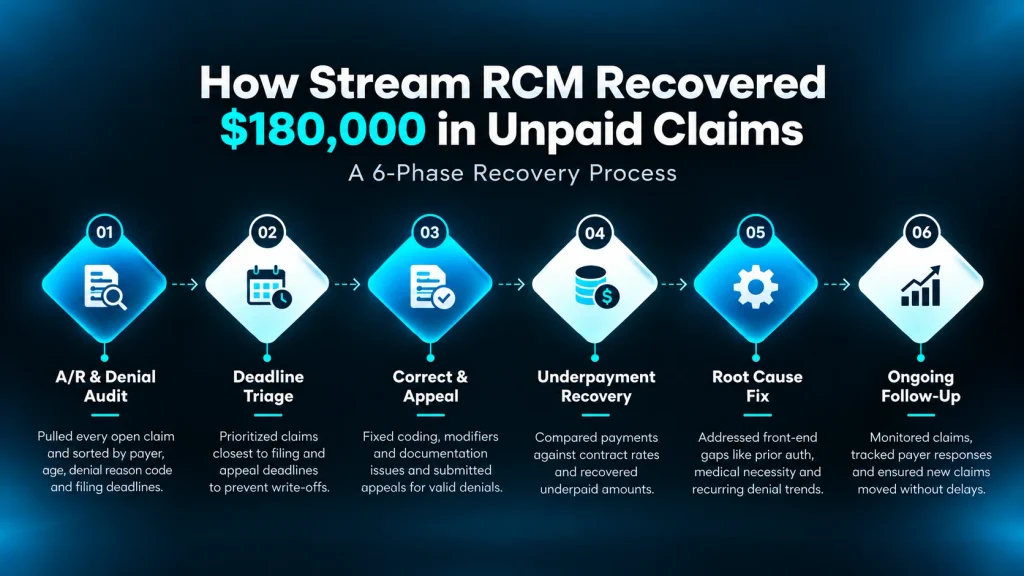
Phase 1: A complete A/R and denial audit
Stream RCM pulled every open claim and sorted it by payer, age, denial reason code and remaining time to the filing or appeal deadline. The audit took 5 Business Days and turned a single A/R number into a working list of what could be recovered and how.
Phase 2: Deadline first triage
Claims closest to a timely filing or appeal deadline were worked first, regardless of size. A $300 claim that expires next week is worth more than a $3,000 claim with six months left, because once a deadline passes the money is gone.
Phase 3: Corrected claims and appeals
Denials caused by fixable errors, such as wrong patient data, a missing modifier or an outdated code, were corrected and resubmitted. Denials that challenged medical necessity or authorization were appealed with the clinical notes and records the payer had not seen. Each appeal was tracked by deadline and level.
Phase 4: Underpayment recovery
Every payment was compared with the practice’s contracted rates. Underpaid claims were sent back to the payer for reprocessing, with the contract terms attached.
Phase 5: Fixing the root causes
While the backlog was being worked, Stream RCM fixed what created it: The practice introduced more consistent eligibility and authorization verification before diagnostic procedures, stronger payer-specific medical necessity checks, improved coding and modifier review and recurring denial analysis.
Instead of repeatedly correcting the same type of denial after submission, the goal was to prevent those errors earlier in the revenue cycle.
Phase 6: Ongoing billing and A/R follow up
After the recovery project, Stream RCM took over full-cycle billing and continued A/R follow-up with weekly follow-up on open claims and monthly reporting by payer and denial reason.

The Results
Over 6 months, Stream RCM recovered $180,000 in unpaid claims for the practice. The recovered revenue came from four sources:
| Source of Recovery | Claims | Amount Recovered |
|---|---|---|
| Denials overturned on appeal | 148 | $72,400 |
| Corrected and resubmitted claims | 121 | $46,800 |
| No-response claims followed up and paid | 96 | $38,600 |
| Underpayments recovered | 54 | $22,200 |
| Total | 419 | $180,000 |
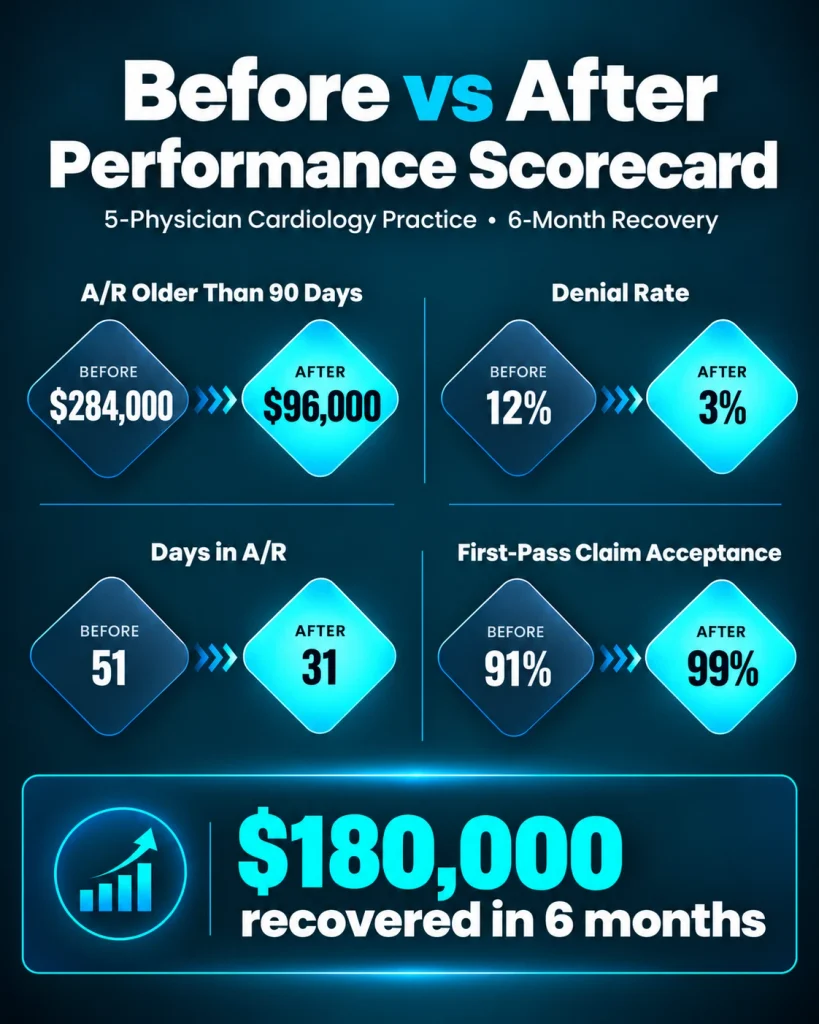
The practice’s day to day numbers changed as well:
| Metric | Before | After |
|---|---|---|
| A/R older than 90 days | $284,000 | $96,000 |
| Denial rate | 12% | 3% |
| Days in A/R | 51 Days | 31 Days |
| First-pass claim acceptance | 91% | 99% |
| What the practice said “We were stuck with aging claims and a growing denial backlog that our team simply did not have the time to work through. Stream RCM stepped in, identified where the revenue was getting held up and gave us a clear recovery process. Within six months, they helped us recover $180,000 and brought our denial rate down significantly. The biggest difference is that we now have much better visibility and control over our A/R”. Practice Administrator, 5 Physician Cardiology Group |
Results vary by practice. This case reflects one client’s results.
Five Lessons for Practices With Unpaid Claims
The specifics in this case belong to one practice, but the lessons apply to almost any group with a growing A/R.
1. Work claims by deadline, not by dollar amount
Every payer sets a limit for filing a claim and for appealing a denial. Medicare, for example, requires claims within 12 months of the date of service and a redetermination request within 120 days of the initial determination. Commercial payers often allow less. Sorting your unpaid claims by days left before a deadline is the fastest way to stop losing money you could still collect.
2. Separate denials, underpayments and silent claims
A denied claim, an underpaid claim and a claim with no response each need a different fix. Lumping them together as “unpaid A/R” hides the underpayments, which are often the easiest money to recover because the claim was already accepted.
3. Most denials are worth fighting
Many practices write off denials they could win. Premier found that about 70% of denied claims were eventually overturned and paid, and KFF found that 80.7% of appealed Medicare Advantage prior authorization denials were overturned in full or in part in 2024.
4. Every denial points to a front-end problem
The top denial triggers in Experian’s survey were missing or inaccurate claim data at 50% and authorization problems at 35%, as Becker’s reported. Appeals recover this month’s money; fixing eligibility checks, authorizations and coding protects next month’s.
5. Recovery is a project, prevention is a system
Working a backlog is a one-time push. Keeping A/R clean takes weekly follow-up, monthly reporting by payer and denial reason and someone who owns the process. Without that, the backlog comes back.
Signs Your Practice Has Revenue Waiting to Be Recovered
If two or more of these sound familiar, there is likely recoverable money in your A/R:
| Sign | What It Usually Means |
|---|---|
| A/R older than 90 days keeps growing | Claims are not being followed up on a schedule |
| Denials sit in a queue with no owner | Appeals deadlines are passing unnoticed |
| Nobody compares payments with contracted rates | Underpayments are being posted as paid in full |
| The same denial reasons repeat every month | A front-end process, such as eligibility or authorization, is broken |
| Your billing staff also runs the front desk | Follow-up is the first task that gets dropped |

How to Choose a Medical Billing Company for Revenue Recovery
Not every billing company is set up to recover old revenue. Before you hand over a backlog, ask these questions:
| Question | A Strong Answer Includes |
|---|---|
| How do you prioritize old claims? | Sorting by filing and appeal deadline, not only by dollar amount |
| Do you recover underpayments as well as denials? | Payment review against your contracted rates |
| How will we see progress? | Weekly or monthly reporting on claims worked, recovered dollars and remaining A/R |
| What happens after the backlog is cleared? | A plan to fix the root causes and keep A/R current |
| Can you show results from practices like ours? | Case studies or references from practices of similar size and specialty |
| How is the work priced? | A clear model, such as a percentage of what is collected, with exclusions in writing |
Stream RCM offers full cycle medical billing services for practices that want ongoing billing, and individual services such as denial management and A/R recovery for practices that want help with a specific problem.
Frequently Asked Questions
How can a medical billing company recover denied claims?
A billing company recovers denied claims by auditing every open denial, sorting it by appeal deadline and reason, correcting and resubmitting claims with fixable errors and appealing the rest with the records the payer needs. It then tracks each appeal to a final decision and fixes the front-end process that caused the denial.
How can outsourced medical billing improve revenue?
Outsourced billing improves revenue by making sure every claim is followed up, every denial is worked before its deadline and every payment is checked against contracted rates. It also frees in-house staff from billing tasks that are easy to drop when the front desk is busy.
How do I choose a medical billing company for revenue recovery?
Look for a company that prioritizes claims by deadline, recovers underpayments as well as denials, reports progress regularly, fixes root causes after the backlog is cleared and can show results from practices like yours. Ask for its pricing model in writing before you start.
Which medical billing companies help recover lost revenue?
Many billing companies offer A/R recovery and denial management, but the right partner depends on your practice size, specialty and payer mix. Compare companies on their recovery process, reporting and references rather than headline percentages.
What are medical claims recovery services?
Medical claims recovery services work a practice’s unpaid accounts receivable, including denied claims, claims with no response and underpaid claims. The goal is to collect revenue that was earned but not paid before filing and appeal deadlines pass.
How far back can a practice recover unpaid claims?
It depends on each payer’s deadlines. Medicare allows 12 months from the date of service to file a claim and 120 days from the initial determination to request a redetermination. Many commercial plans allow less, so older claims should be reviewed as soon as possible.
What is the difference between a denied claim and an underpaid claim?
A denied claim was refused in full or in part by the payer. An underpaid claim was accepted and paid, but for less than the contracted rate. Underpayments are often missed because the claim shows as paid.
Is outsourced denial management worth it for a small practice?
Often, yes, when nobody in the practice has time to work denials before their deadlines. Small practices feel each lost claim more, and a billing partner that works denials every week usually recovers more than it costs.