- +1 (773) 985-1869
- info@stream-rcm.com
- 14430 Ocean Point, El Paso, TX 79938
Ambulatory surgery centers contend with hospital-level billing complexity while operating with lean administrative teams. Stream RCM bridges that gap. We manage the full spectrum of your revenue cycle from intricate medical coding services and CMS compliance to federal regulatory oversight. Our expert approach reduces risk, accelerates reimbursements, and ensures your ASC remains compliant and profitable.













The financial health of an ambulatory surgery center is directly tied to the accuracy and speed of its billing operations. We embed ourselves into your revenue cycle management workflow from charge capture through payment reconciliation, uncovering every source of lost revenue. Our team performs prospective audits on charge sheets before submission, cross-referencing operative documentation against CPT selections to ensure every service performed is captured and coded correctly. We also conduct retrospective payment reviews against contracted fee schedules, identifying underpayments for appeal with documented line-item support. ASC clients who partner with us typically see their clean claim rates exceed 96% within the first 90 days, denial rates drop by a third, and net collections improve by an average of 18% to 27% annually.
Ambulatory surgery centers perform procedures across dozens of surgical disciplines. Our coders are trained across every major outpatient surgical category with payer-specific billing protocols for each.
Our team handles arthroscopy, joint repair, fracture fixation, carpal tunnel release, rotator cuff procedures requiring precise laterality and approach modifiers on every claim submission.

Our coders manage cataract extraction with IOL insertion, glaucoma drainage, corneal procedures, retinal photocoagulation all requiring frequency edits and medical necessity documentation.

We process colonoscopy, upper endoscopy, polypectomy, biopsy, and dilation procedures with screening vs. diagnostic differentiation affecting patient cost-sharing and payer reimbursement rates.

Our billing specialists bill epidural steroid injections, nerve blocks, spinal cord stimulator trials, trigger point injections with fluoroscopic guidance requiring imaging documentation for coverage.

We code reconstructive vs. cosmetic classification, skin grafting, lesion excisions, and wound closure procedures requiring ICD-10 specificity to differentiate covered reconstructive intent.

From charge entry to payment reconciliation, our end-to-end medical billing services eliminate revenue gaps across every stage of your financial cycle.
We verify every charge against operative reports before submission, catching unbundling errors and missed charges that routinely cost ASCs thousands in monthly revenue leakage.
Our team analyzes your payer mix and fee schedules to identify underpayments, then supports renegotiation of ASC-specific rates that reflect your facility's case complexity.
Every denial is categorized, root-cause analyzed, and appealed within 48 hours. We track denial patterns by payer and procedure to prevent recurring revenue losses at the source.
We manage preauthorization requests for scheduled surgical procedures, reducing day-of cancellations and protecting your facility from non-covered claim write-offs post-service.
We send timely, respectful patient statements and follow up on balances due, improving your self-pay collection rates without damaging patient satisfaction or referral relationships.
Monthly dashboards display your AR aging buckets, collection rates by payer, and denial trends giving your leadership team actionable financial intelligence, not just raw numbers.
Our specialists will conduct a free review of your recent claims activity and pinpoint the leading causes of missed reimbursement opportunities.

ASCs are turning to us because we combine deep expertise with genuine partnership. Our billing professionals specialize exclusively in ambulatory surgery center revenue cycles, staying ahead of evolving codes, payer rules, and compliance mandates. We offer comprehensive solutions from error-free claim submissions and aggressive denial management to transparent reporting that pinpoints revenue leaks. We meticulously track deductibles, co-payments, and fee schedules while providing code auditing and patient statement services. With our expert team, you get a strategic partner dedicated to boost reimbursements and reduce billing fatigue.
Accurate CPT and ICD-10 coding is the foundation of every reimbursable claim. Our certified coders specialize in outpatient surgical coding with payer-specific modifier rules and APC grouping knowledge.
| CPT Code & Procedure | Description | Related ICD-10 |
|---|---|---|
| 27447 — Total Knee Arthroplasty | We ensure precise billing for total knee replacement procedures, capturing all facility fees, implant costs, and laterality modifiers to prevent underpayments from Medicare and commercial payers. | M17.11 (Primary osteoarthritis, right knee), M17.12 (Primary osteoarthritis, left knee). |
| 43239 — Upper GI Endoscopy with Biopsy 43239 — Upper GI Endoscopy with Biopsy | Our ASC billing team accurately differentiates screening versus diagnostic endoscopy claims, applying correct modifiers and diagnosis codes that directly affect patient cost-sharing and payer reimbursement rates. | K21.0 (GERD with esophagitis), K92.1 (Melena), Z12.11 (Screening for malignant neoplasm of colon). |
| 66984 — Cataract Extraction with IOL Insertion | Our team manages frequency edits and medical necessity documentation for cataract procedures, ensuring ophthalmology ASCs receive full facility reimbursement without triggering payer-initiated prior authorization delays or coverage denials. | H26.9 (Unspecified cataract), H25.11 (Age-related nuclear cataract, right eye), H25.12 (Age-related nuclear cataract, left eye). |
| 29827 — Arthroscopic Rotator Cuff Repair | Our certified coders apply correct shoulder arthroscopy CPT sequencing, laterality modifiers, and medical necessity ICD-10 linkage, recovering reimbursement that orthopedic ASCs routinely lose to modifier 51 bundling errors. | M75.101 (Unspecified rotator cuff tear, right shoulder), M75.102 (Unspecified rotator cuff tear, left shoulder). |
| 62323 — Epidural Steroid Injection with Imaging Guidance | We document fluoroscopic guidance requirements and apply correct spinal level descriptors for pain management ASCs, preventing medical necessity denials that commonly affect epidural injection claims across all major payers. | M54.4 (Lumbago with sciatica), M51.16 (Intervertebral disc degeneration, lumbar region), M54.32 (Sciatica, left side). |
We solved the case of an orthopedic surgeon group from Ohio who were struggling with a 28% denial rate on arthroscopy and joint repair claims nearly triple the industry benchmark. Most denials were traced to incorrect modifier pairing on multi-procedure claims and missing medical necessity documentation on certain implant-inclusive procedures. Within 90 days of transition after they outsourced ambulatory surgery billing services to us, we implemented a pre-submission audit workflow, retrained charge entry staff on modifier 51 rules, and established a same-day documentation query protocol with the OR team. Their denial rate dropped to 9%, clean claim acceptance rose to 97%, and annual net collections improved significantly without adding a single billing staff member on the client’s payroll.

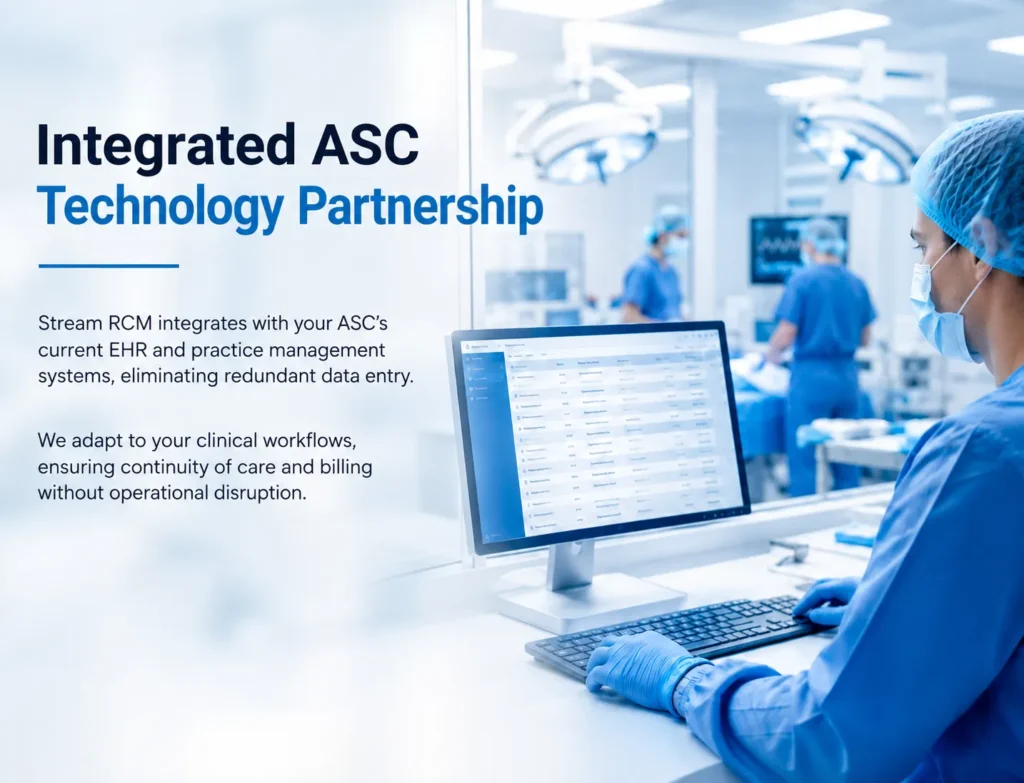
Stream RCM integrates with your ASC’s current EHR and practice management systems, eliminating redundant data entry. We adapt to your clinical workflows, ensuring continuity of care and billing without operational disruption.
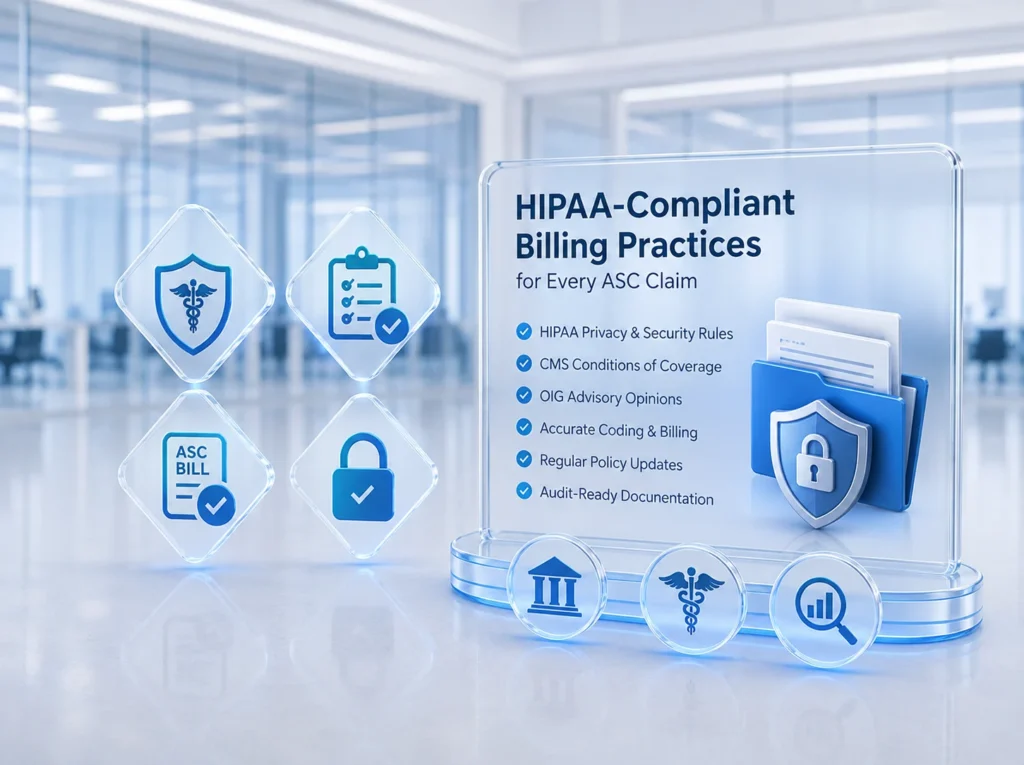
Ambulatory surgery centers operate under a layered regulatory framework that includes CMS Conditions of Coverage, HIPAA compliance in medical billing, Office of Inspector General (OIG) Work Plan priorities, and state-specific licensing requirements. We maintain a compliance-first culture because we understand that billing errors in the ASC setting don’t just result in claim denials, they can trigger payer audits, pre-payment review programs, and in serious cases, federal False Claims Act exposure. Our team conducts routine internal audits on a statistically valid sample of coded claims each month, measuring accuracy against AAPC and CMS published coding guidelines. We also monitor OIG advisory opinions and CMS transmittals for ASC-specific billing rule changes, updating our coding protocols before new requirements take effect.
We conduct thorough assessments of ASC billing vulnerabilities and implement customized revenue cycle strategies to deliver sustained financial predictability.
Incorrect modifier pairing on multi-procedure surgical claims triggers automatic bundling edits, causing widespread denials that drain ASC revenue consistently.
We apply payer-specific modifier protocols with pre-submission audits to make sure every surgical claim carries correct sequenced modifiers before transmission.
Missing or expired prior authorizations on scheduled surgical procedures result in post-service claim denials that become nearly impossible to overturn successfully.
Our team verifies and secures prior authorizations for every scheduled procedure, eliminating day-of cancellations and protecting your ASC from non-covered write offs.
High-cost surgical implants billed without proper invoice documentation and pass-through threshold analysis routinely result in significant underpayments from commercial payers.
We track every implant cost against CMS thresholds, attach invoice documentation, and appeals underpayments with line-item contract rate comparisons.
ASCs frequently accept underpayments without realizing reimbursements fall below contracted rates, accumulating thousands in unrecovered revenue across high-volume procedure categories.
Our team audits every EOB against contracted fee schedules, identify underpayments immediately, and initiates appeals with supporting documentation to recover owed reimbursement.
Disorganized charge capture workflows and delayed claim submissions push surgical claims past payer timely filing windows, resulting in permanent unrecoverable revenue loss.
We enforce a 72-hour charge submission cycle with automated deadline tracking, ensuring no surgical claim crosses a payer’s timely filing threshold during the medical claim submission process.
Not every medical billing company understands the structural and financial complexity of operating an ambulatory surgery center. Here is what differentiates Stream RCM.

Our billing team works exclusively with outpatient surgical centers. This focus means coders understand APC grouping, facility fee separation, and implant billing at a depth.
Our team investigates the payer-level and code-level cause of each denial and implements upstream corrections in your charge capture process to prevent recurrence.
Each payer in your contract portfolio has a personalized billing protocol in our system including prior auth requirements, timely filing windows, and appeal letter templates.
We provide monthly financial reports like payer collections, AR aging, denial trends, and clean claim rates everything your CFO needs in one clear document.
ASC billing follows a separate Medicare fee schedule with specific covered procedure lists, facility fee structures, and APC grouping rules that differ entirely from hospital outpatient department reimbursement methodology.
Common causes include incorrect modifier pairing, missing prior authorizations, and unbundled multi-procedure claims. We identify your denial root causes and implement upstream corrections within the first 60 days.
Most of our clients see measurable improvement in clean claim rates and denial percentages within 30 to 90 days of transition, depending on current billing baseline and payer mix complexity.
Yes, we manage facility fee billing on UB-04 and professional fee billing on CMS-1500, coordinating both streams to eliminate payer cross-referencing errors and ensure complete reimbursement per surgical case.
Our team monitors CMS transmittals, OIG work plans, and payer policy updates continuously. Coding protocols are updated before new requirements take effect, keeping your ASC compliant and reimbursement-ready at all times.

Our team reviews your billing processes and uncovers strategies to strengthen revenue capture and reduce preventable claim denials.