


The Medicare 2027 Physician Fee Schedule reduces the conversion factor by 2.31% for clinicians who are not qualifying APM participants. Actual reimbursement changes vary by procedure, RVUs and applicable payment policies and specialty-level changes raise the estimated loss to between 3% and 8% for specialties such as gastroenterology, dermatology and orthopedic surgery. A practice that collects $500,000 a year from Medicare Part B loses about $11,550 from the conversion factor cut alone, before any specialty adjustment.
CMS released the CY 2027 physician fee schedule final rule on November 4, 2026, and the payment rates take effect on January 1, 2027. Medicare’s proposed conversion factor reduction follows projections for a 2.6 percent rise in the Medicare Economic Index, CMS’s benchmark for estimating practice expenses’ growth rate. This resource guide segments the 2027 Medicare Physician Fee Schedule into four major categories: conversion factor reduction, specialty-specific cuts, policy drivers behind them and calculations for determining a practice’s potential lost revenues.
What is the Medicare physician fee schedule 2027?
The Medicare physician fee schedule 2027 is the CMS payment table that sets 2027 Medicare Part B rates for more than 10,000 physician and practitioner services, from office visits to surgery. CMS updates the physician fee schedule every year through a proposed rule in July and a final rule in November. The 2027 final rule appeared in the Federal Register on November 9, 2026.
How is the Medicare physician fee schedule used?
The Medicare physician fee schedule is used to calculate the Medicare allowed amount for each CPT or HCPCS code by multiplying geographically adjusted relative value units (RVUs) by a dollar conversion factor. Each code carries 3 RVU components, and each component receives a geographic practice cost index (GPCI) for the practice locality:
| Component | What the component measures | Geographic adjustment |
|---|---|---|
| Work RVU | Physician time, skill and effort | Work GPCI |
| Practice expense RVU | Staff, supplies, equipment and overhead | Practice expense GPCI |
| Malpractice RVU | Professional liability insurance cost | Malpractice GPCI |
The payment formula equals the sum of each RVU multiplied by the matching GPCI, then multiplied by the conversion factor. For most covered physician services, Medicare Part B generally pays 80% of the Medicare-approved amount after the annual deductible is met, while the beneficiary or secondary payer is responsible for the remaining 20%. Certain preventive services have no beneficiary cost-sharing. Many commercial and Medicare Advantage contracts also price services as a percentage of the Medicare fee schedule, so a Medicare cut often reaches other payer revenue.
What does the CMS physician fee schedule final rule change for 2027?
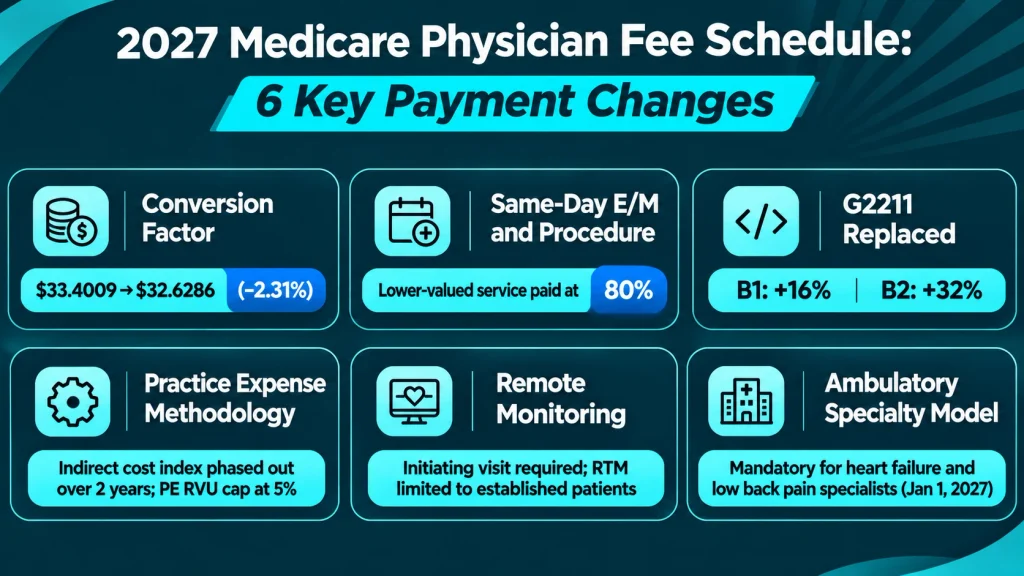
The CMS physician fee schedule final rule changes 6 payment areas for 2027. The table below lists each change and the type of practice most exposed to each change.
| 2027 change | What changes | Most exposed practices |
|---|---|---|
| Conversion factor | $33.4009 to $32.6286 (-2.31%) for most physicians | All practices billing Medicare Part B |
| Same-day E/M and procedure reduction | Lower-valued service paid at 80% when an E/M with modifier 25 and a 0-day global procedure occur on the same day | Dermatology, podiatry, ENT, orthopedics |
| G2211 replaced by modifiers B1 and B2 | B1 adds 16% to the E/M payment; B2 adds 32% for MSSP or LEAD participants | Primary care and longitudinal specialty care |
| Practice expense methodology | Indirect practice cost index phased out over 2 years; annual PE RVU changes generally capped at 5% | Procedure-heavy specialties |
| Remote monitoring | Initiating visit required before RPM or RTM; RTM limited to established patients; employed-staff rule delayed to 2029 | Cardiology, primary care, pulmonology |
| Ambulatory Specialty Model | Mandatory model for heart failure and low back pain specialists begins January 1, 2027 | Cardiology, pain management, spine |
These 6 changes explain why specialty losses in 2027 vary from about 2% to more than 8%.
How much does the 2027 conversion factor cut reduce Medicare payments?
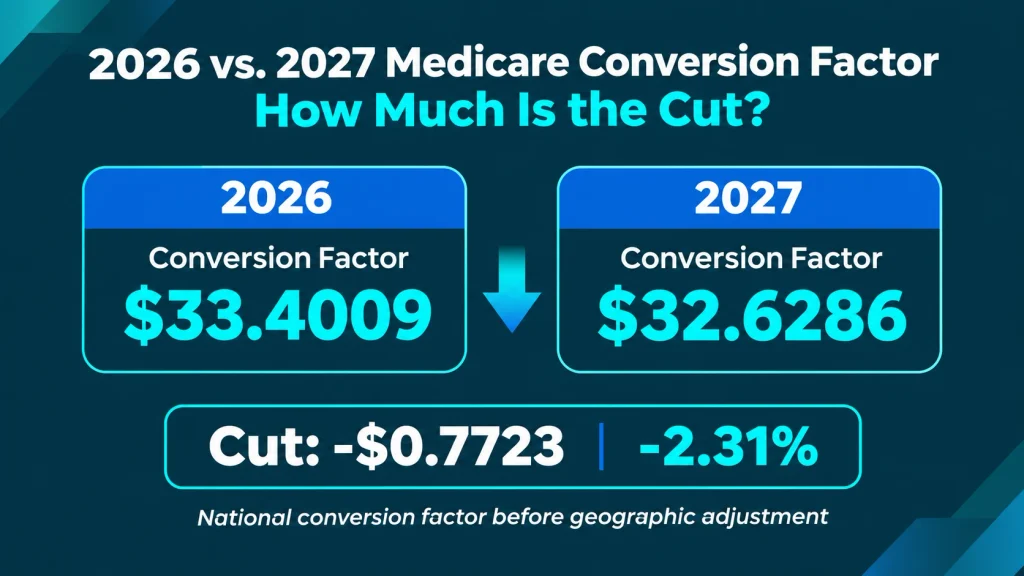
The 2027 conversion factor cut reduces Medicare payments by 2.31% for physicians outside advanced alternative payment models (APMs) and by 1.83% for qualifying APM participants. The physician fee schedule conversion factor applies to services priced using the applicable RVU-based payment methodology. Other Medicare Part B services may be paid under separate fee schedules or payment methodologies.
| Physician group | 2026 conversion factor | 2027 conversion factor | Change |
|---|---|---|---|
| Most physicians (non-qualifying APM) | $33.4009 | $32.6286 | -2.31% |
| Qualifying APM participants | $33.5675 | $32.9548 | -1.83% |
The conversion factor table shows a $0.77 drop per RVU for most physicians, based on the $32.6286 figure in the Washington State Medical Association summary of the final rule.
Why is the 2027 cut deeper than the proposed rule?
The 2027 final cut of 2.31% is 0.63 percentage points deeper than the 1.68% cut CMS proposed in July, and the overall decrease comes mainly from the expiration of the one-year 2.5% increase Congress granted for 2026. The July proposal projected 1.19% for APM participants, and the final figure is 1.83%. CMS coverage of the final rule does not give a single reason for the gap between the proposed and final figures. KFF’s analysis of the 2027 changes attributes the decrease to 3 factors: the 2.5% expiration, a -0.12% budget neutrality adjustment and statutory updates of only 0.25% (most physicians) and 0.75% (APM participants).
How does the 2027 cut compare with practice cost growth?
The 2027 cut runs opposite to practice costs, which CMS projects to rise 2.6% under the Medicare Economic Index. A 2.31% payment cut against a 2.6% cost increase widens the gap between Medicare revenue and practice expense by roughly 5 percentage points in a single year. The American Medical Association reports that Medicare physician payment has fallen about 33% since 2001 after adjusting for inflation.
Which specialties lose the most under the 2027 Medicare fee schedule?
Orthopedic surgery, otolaryngology, dermatology and hand surgery lose the most under the 2027 Medicare fee schedule, with RVU and coding changes of -4% to -6% before the 2.31% conversion factor cut. CMS specialty impact estimates, reported in Becker’s Hospital Review specialty breakdown, exclude the conversion factor. The table below adds the conversion factor cut to show an estimated combined impact and the dollar effect on $500,000 of Medicare allowed revenue.
| Specialty | CMS RVU and coding change | Estimated combined 2027 impact | Effect on $500,000 of Medicare revenue |
|---|---|---|---|
| Orthopedic surgery | -6% | -8.2% | -$40,860 |
| Otolaryngology | -5% | -7.2% | -$35,970 |
| Dermatology | -4% | -6.2% | -$31,090 |
| Hand surgery | -4% | -6.2% | -$31,090 |
| Colon and rectal surgery | -3% | -5.2% | -$26,200 |
| Ophthalmology | -3% | -5.2% | -$26,200 |
| Neurosurgery | -2% | -4.3% | -$21,320 |
| Interventional pain management | -2% | -4.3% | -$21,320 |
| Gastroenterology | -1% | -3.3% | -$16,440 |
| Urology | -1% | -3.3% | -$16,440 |
| Podiatry | -1% | -3.3% | -$16,440 |
| Specialty with no RVU change | 0% | -2.3% | -$11,550 |
The combined impact is calculated by multiplying one plus the CMS specialty-level percentage change by one minus the 2.31% conversion factor reduction, then subtracting one from the result. Actual results differ by service mix, locality and payer contracts, so the table works as a planning estimate for each specialty, not a guarantee.
Which specialties gain under the 2027 fee schedule?
Behavioral health and several facility-based specialties gain under the 2027 fee schedule. Clinical social workers gain 11% and clinical psychologists gain 9% before the conversion factor cut, which leaves estimated combined increases of about 8.4% and 6.5%. Geriatrics, interventional radiology, physical and occupational therapy and vascular surgery gain 3% each (about +0.6% combined). Psychiatry and nurse practitioners gain 2% each, which nets to about -0.4% after the conversion factor cut.
Why do association estimates differ from CMS specialty figures?
Association estimates differ from CMS specialty figures because associations add the conversion factor cut and specialty-specific policies to the CMS RVU change. The American Academy of Dermatology Association estimates a combined dermatology cut of about 6%, including the conversion factor, practice expense changes and the same-day modifier 25 policy. The American Podiatric Medical Association estimates an overall podiatry decrease of about 3.2%. Both estimates sit close to the combined figures in the specialty table above.
How much revenue could your practice lose in 2027?
A practice can estimate 2027 Medicare revenue loss by multiplying annual Medicare Part B allowed revenue by the combined impact percentage for its specialty. The 4-step method below uses data every practice management system already holds.
- Pull 12 months of Medicare Part B allowed amounts (not charges) from the practice management system.
- Find the specialty’s estimated combined impact in the specialty table above (for example, -6.2% for dermatology).
- Multiply the allowed amount by the combined impact to get the base Medicare loss.
- Add exposure from commercial and Medicare Advantage contracts priced as a percentage of Medicare rates.
A dermatology practice with $750,000 of annual Medicare allowed revenue loses about $46,630 in 2027 under the -6.2% estimate. A family medicine practice with the same Medicare revenue and no specialty RVU change loses about $17,330 from the conversion factor cut alone. The method provides a preliminary estimate, while a code-level review using the CMS Physician Fee Schedule Look-Up Tool and historical service utilization provides a more detailed projection of the practice’s potential revenue loss.

Which 2027 policy changes reduce revenue beyond the conversion factor?
Five additional Medicare policies affect practice reimbursement: the same-day procedure reduction, the transition from G2211 to modifiers B1 and B2, practice expense methodology changes, remote monitoring requirements and the Ambulatory Specialty Model. Their financial effects vary by practice, and Ambulatory Specialty Model payment adjustments begin in 2029.
How does the same-day E/M and procedure reduction work?
The same-day payment reduction pays the highest-valued service at 100% and other applicable services at 80% when a separately identifiable office or outpatient E/M service is furnished on the same day as a 0-day global procedure by the same physician or a physician of the same specialty within the same group practice. CMS proposed a 50% reduction and finalized 20%, according to the California Medical Association summary of the final rule. The policy applies only to procedures with a 0-day global period, such as many skin biopsies, joint injections and nail procedures. Dermatology, podiatry and orthopedic practices bill this combination often.
What replaces G2211 in 2027?
Modifier B1 replaces G2211 in 2027 and adds 16% to the base E/M payment for longitudinal care. Modifier B2 adds 32% for practices participating in the Medicare Shared Savings Program or the LEAD model, as reported in the HFMA summary of the 2027 cuts. Practices that billed G2211 in 2026 lose that revenue entirely when the claim template still carries G2211 instead of B1.
How does the practice expense change affect payment?
The practice expense methodology phases out the indirect practice cost index over two years and allocates indirect practice expenses using both work RVUs and clinical labor RVUs, except for procedures with 10-day and 90-day global periods. CMS generally caps annual practice expense RVU changes at 5% in either direction during the transition. The specialty-level RVU changes in the specialty table reflect these practice expense shifts together with work RVU updates.
What changes for remote patient monitoring in 2027?
Remote monitoring changes in 2027 require a separately reportable initiating visit before RPM or RTM billing and limit RTM to established patients. CMS reduced payment for 8 remote monitoring codes. The proposed rule limiting payment to clinical staff employed directly by the practice is delayed until January 1, 2029, according to Fierce Healthcare coverage of the final rule.
How does the Ambulatory Specialty Model affect revenue?
The Ambulatory Specialty Model adjusts Medicare Part B payments for covered professional services furnished by selected heart failure and low back pain specialists based on their performance across applicable model measures. Payment adjustments may be positive, neutral or negative.The model starts on January 1, 2027 and runs 5 performance years, with payment adjustments starting in 2029. Cardiology, pain management, interventional pain, neurosurgery, orthopedic surgery and physical medicine and rehabilitation clinicians fall within the model’s specialty list, and pain management billing teams now track low back pain cost measures alongside claims.
How do you use the CMS physician fee schedule search to check 2027 rates?
The CMS physician fee schedule search, also called the PFS Look-Up Tool, shows the 2027 national and locality payment amount for each HCPCS code in 6 steps.
- Open the PFS Look-Up Tool overview page on cms.gov and select Begin Search.
- Accept the AMA CPT license agreement to open the search page.
- Select the year (2027) and the type of information, such as Pricing Information.
- Choose a single HCPCS code, a list of up to 5 codes or a range of codes.
- Select a Medicare Administrative Contractor (MAC) and locality, or select National Payment Amount.
- Compare the 2027 non-facility and facility prices with the 2026 prices for the same codes.
The 6-step search covers one code group at a time, so a practice usually starts with its 20 highest-volume codes. CMS states that the tool is a reference aid and that the official payment files come from each MAC.
How can practices offset the 2027 Medicare payment cuts?
Practices offset the 2027 Medicare payment cuts through 6 revenue cycle actions that recover revenue the practice already earns. None of the 6 actions changes clinical care.
1. Replace G2211 with modifier B1. Update E/M claim templates before January 1, 2027, so longitudinal visits keep the 16% add-on.
2. Review same-day modifier 25 billing. Identify 0-day procedures billed with E/M visits and confirm that each E/M is significant and separately documented.
3. Audit E/M levels. Undercoded visits lose more than the 2.31% cut on each claim; a medical coding audit of 50 to 100 notes per provider shows the gap.
4. Reduce avoidable denials. Every denied claim that never gets reworked removes 100% of that payment, so denial management can recover more revenue than the conversion factor removes for practices with high denial volume.
5. Review payer contracts tied to Medicare rates. Contracts priced at a fixed percentage of the current Medicare fee schedule fall with the 2027 cut; contracts tied to a fixed-year schedule do not.
6. Track congressional action. Physician groups are asking Congress to extend the 2.5% update through 2027 and to delay the modifier 25 reduction by one year.
Is Congress reversing the 2027 Medicare cuts?
As of November 25, 2026, Congress has not enacted legislation reversing the finalized 2027 Medicare conversion factor reductions or extending the temporary 2.5% payment increase provided for 2026. The Patients First Act of 2026 and the Provider Reimbursement Stability Act each have more than 60 bipartisan cosponsors, and a House Energy and Commerce subcommittee held a hearing on both bills on September 15, 2026. A lame-duck session remains the next opportunity for action.

Conclusion
Medicare 2027 physician payment cuts lower the conversion factor by 2.31% for most physicians and by 1.83% for APM participants. Specialty changes push estimated combined losses to about 8.2% in orthopedic surgery, 7.2% in otolaryngology and 6.2% in dermatology, while behavioral health gains. The same-day modifier 25 reduction, the B1 switch, practice expense changes, remote monitoring limits and the Ambulatory Specialty Model add further exposure. Practices that measure Medicare allowed revenue, update claim templates and recover denied claims limit the revenue loss from the Medicare 2027 physician payment cuts.
Frequently asked questions
What is the 2027 Medicare conversion factor?
The 2027 Medicare conversion factor is $32.6286 for most physicians, a 2.31% cut from $33.4009 in 2026, and $32.9548 for qualifying APM participants, a 1.83% cut.
How is the Medicare physician fee schedule used?
The Medicare physician fee schedule is used to calculate the allowed amount for each CPT or HCPCS code by multiplying geographically adjusted work, practice expense and malpractice RVUs by the conversion factor.
When does the CMS 2027 fee schedule take effect?
The CMS 2027 fee schedule takes effect on January 1, 2027. CMS released the final rule on November 4, 2026, and the Federal Register published the rule on November 9, 2026.
Which specialties face the biggest 2027 Medicare cuts?
Orthopedic surgery (-6%), otolaryngology (-5%), dermatology (-4%) and hand surgery (-4%) face the biggest RVU and coding cuts before the 2.31% conversion factor cut.
How do I search the CMS physician fee schedule?
The CMS physician fee schedule search runs through the PFS Look-Up Tool on cms.gov. Select the year, the information type, the HCPCS codes and the MAC locality to view facility and non-facility payment amounts.
Do the 2027 Medicare cuts affect commercial payments?
The 2027 Medicare cuts affect commercial and Medicare Advantage payments when those contracts are priced as a percentage of the current Medicare fee schedule.
What does Medicare for physicians look like after 2027?
Medicare for physicians after 2027 depends on Congress. MACRA updates stay at 0.25% a year for most physicians, while bills such as the Patients First Act of 2026 propose updates tied to practice cost inflation.