


Here is a contract detail most practices never check: if a billing company receives your Medicare payments in its own name, federal rules bar it from being paid a percentage of what it bills or collects. Under 42 CFR 424.73(b)(3), Medicare can pay a billing agent only if the agent’s compensation is not related in any way to the dollar amounts billed or collected, and Medicaid has a similar rule. Percentage pricing is common and legitimate, but only when the payments go straight to your practice’s bank account.
That one clause tells you a lot about how to choose a medical billing company. The sales pitch is about results. The decision should be about how the company handles your money, your data, your denials and your exit. This guide walks you through each check, with the questions to ask, the numbers to compare and the red flags that should end the conversation.
Quick answer: To choose the right medical billing company, check ten things: your own baseline numbers, specialty and payer experience, performance metrics with written formulas, pricing and what it includes, how payments flow, HIPAA compliance and a signed BAA, EHR fit, the denial management process, reporting and the contract’s exit terms. Score each vendor on the same weighted scorecard and test them on the same sample of your claims.

What Does a Medical Billing Company Do?
A medical billing company manages the work of getting you paid: verifying eligibility, coding visits, submitting claims, posting payments, working denials, following up on A/R and billing patients. Many also handle credentialing and prior authorization. A full revenue cycle management (RCM) company covers every step from scheduling to final payment, while a narrower billing service may only submit claims and post payments.
That difference matters when you compare quotes. Two companies can both say “medical billing services for physicians” and mean very different scopes, so the first thing to get in writing is exactly what is included.
When Should You Outsource Medical Billing?
| Signal | What It Usually Means |
|---|---|
| Denial rate rising quarter over quarter | Front-end or coding problems no one has time to fix at the source |
| A/R over 120 days growing | Follow-up is falling behind |
| Charge lag longer than a few days | Claims start late, which pushes every payment back |
| Billing stalls when one person is out | Single-person risk |
| New providers waiting to bill | Credentialing is behind |
| You cannot say your net collection rate | No reporting, so no way to know what is lost |
Denials alone justify a look. In Experian Health’s 2025 State of Claims survey, 41% of providers said at least 10% of their claims were denied, and Premier found that working each denied claim cost about $57.23, according to its claims cost analysis.
How to Choose a Medical Billing Company: 10 Steps
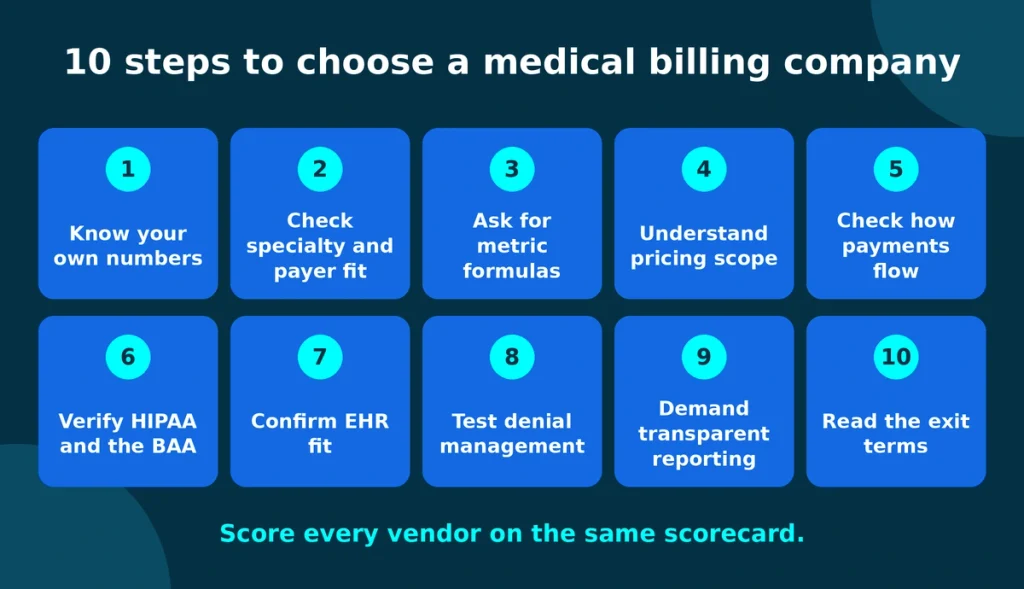
1. Know your own numbers first
Pull 6 to 12 months of data before you talk to any vendor: denial rate and top denial reasons, days in A/R, A/R over 120 days, clean claim rate and net collection rate. Without a baseline, every vendor’s promise sounds the same.
Ask: Will you review our data before quoting?
Red flag: A quote or a guaranteed result before anyone looks at your numbers.
2. Check specialty and payer experience
Billing rules differ by specialty, and payer rules differ by state. A company that bills cardiology well may not know behavioral health carve-outs or your state’s Medicaid managed care plans.
Ask: How many practices in my specialty and state do you bill for today, and can I speak to two of them?
Red flag: No references in your specialty, or references from a different state and payer mix.
3. Ask for performance metrics with written formulas
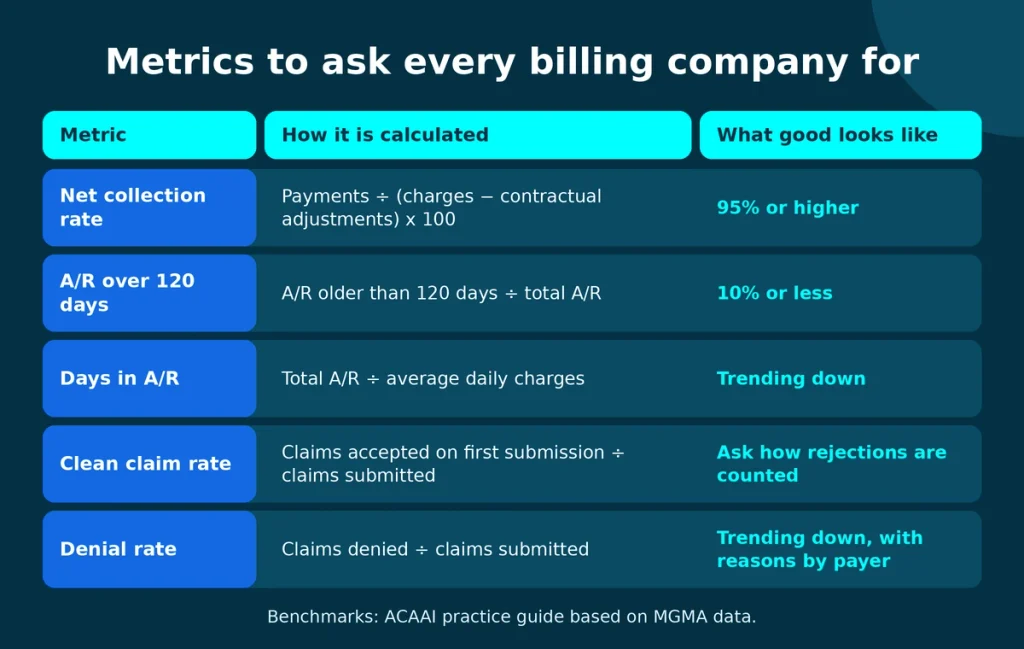
Every company quotes a clean claim rate. Ask how it is calculated, because vendors define it differently, and compare against published benchmarks:
Ask: Can you show a sample monthly report and the formula behind each number?
Red flag: Headline percentages with no formula, or no sample report.
| Metric | How It Is Calculated | What Good Looks Like |
|---|---|---|
| Net collection rate | Payments ÷ (charges − contractual adjustments) x 100 | 95% or higher |
| A/R over 120 days | A/R older than 120 days ÷ total A/R | 10% or less |
| Days in A/R | Total A/R ÷ average daily charges | Trending down; varies by specialty |
| Clean claim rate | Claims accepted on first submission ÷ claims submitted | Ask how rejections are counted |
| Denial rate | Claims denied ÷ claims submitted | Trending down, with reasons by payer |
4. Understand pricing and what it includes
Most billing companies charge a percentage of collections, with headline rates commonly around 4% to 7%, as Medical Economics reported. The rate means little until you know what it covers: coding, appeals, patient statements, credentialing and work on old A/R are common extras.
Ask: What exactly does the rate apply to, and what costs extra?
Red flag: A low rate with setup fees, monthly minimums or a higher rate for “legacy” A/R hidden in the contract.
5. Check how payments flow
Payments should go straight from payers to your practice’s bank account by EFT. If a company wants Medicare or Medicaid payments sent to its own account, it cannot also charge you a percentage of collections under the federal reassignment rules.
Ask: Will payments go directly to our account, and who controls the EFT enrollment?
Red flag: Payments routed through the billing company’s account on a percentage contract.
6. Verify HIPAA compliance and the BAA
A billing company is a HIPAA business associate and must sign a business associate agreement before it touches patient data. HHS publishes sample BAA provisions you can use as a checklist. Ask about a written compliance program too; OIG has long published compliance guidance specifically for third-party medical billing companies, as Morgan Lewis noted.
Ask: Can we see your BAA, your compliance program and where our data is stored and accessed, including any offshore teams?
Red flag: No BAA until after signing, or vague answers about who can see patient data.
7. Confirm EHR and technology fit
The best setup is a billing team that works inside your existing EHR and practice management system, with clearinghouse reports you can see yourself.
Ask: Do we keep our EHR, our payer portal logins and access to clearinghouse reports?
Red flag: A required software switch or no direct access to your own claim data.
8. Test the denial management process
Denial management is where billing companies differ most. A strong process triages denials weekly, fixes the claim, finds the root cause and tracks appeal deadlines by payer.
Ask: Walk me through what happens to a denial in its first week. How do you stop it from repeating?
Red flag: Monthly batch appeals with no root-cause reporting.
9. Demand transparent reporting
You should see the same numbers the billing company sees: collections, denials by reason and payer, A/R aging and net collection rate, every month.
Ask: Who reviews the report with us each month, and what happens when a metric slips?
Red flag: A monthly deposit total with no breakdown.
10. Read the contract’s exit terms
The contract decides what happens when the relationship ends. Check the term length, auto-renewal, notice period, termination fees, who works open claims after you leave and how and when your data comes back.
Ask: If we leave in a year, who works the remaining A/R, and in what format do we get our data back?
Red flag: Long auto-renewing terms with no data return clause.
Stream tip: Send the same de-identified sample of 50 claims and denials to every vendor on your shortlist and ask each one what they would fix first. Their answers tell you more than any sales deck.
What Questions Should You Ask a Medical Billing Company?
| Question | A Strong Answer Includes |
|---|---|
| What is included in your rate? | A written list of included and excluded services |
| How do you calculate your clean claim and net collection rates? | Written formulas and a sample report |
| Who will manage our account? | A named contact and an escalation path |
| How do you handle our existing A/R? | A defined plan and rate for legacy balances |
| How do payments reach us? | Direct EFT to the practice account |
| Where is our data stored and who can access it? | Role-based access, a signed BAA and disclosed subcontractors |
| How long does onboarding take? | A timeline with milestones and a parallel run |
| What happens to open claims if we leave? | A written run-out plan |
How Do You Compare Medical Billing Companies? Use a Weighted Scorecard
Score each company from 1 to 5 on every row, multiply by the weight and add the totals. Adjust the weights to your practice: a practice with high denials might weight denial management higher, while a new practice might weight credentialing.
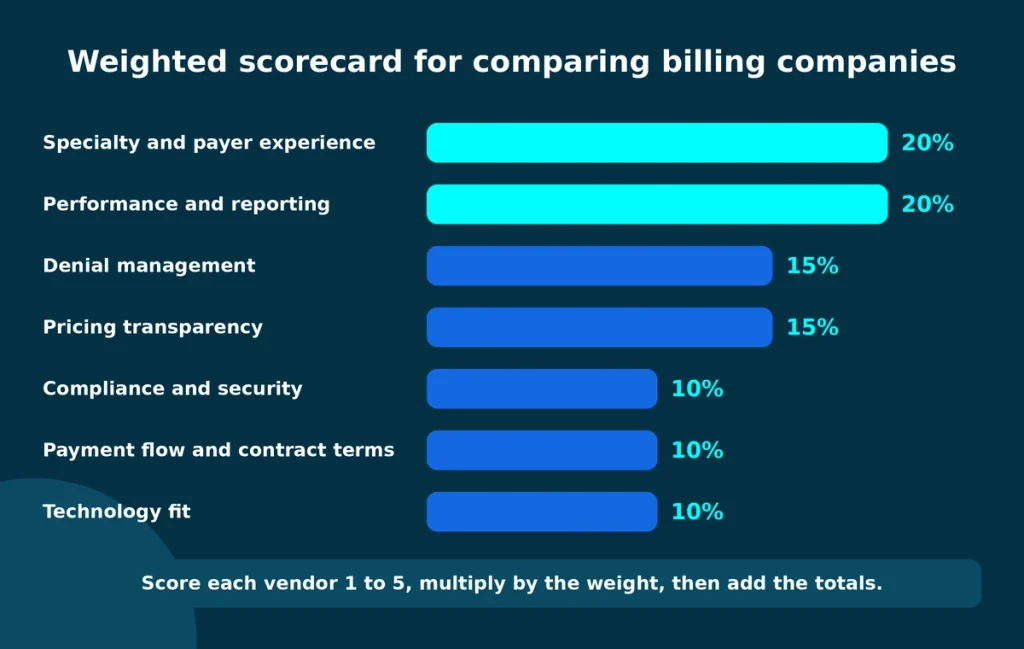
| Criterion | Weight | What Earns a 5 |
|---|---|---|
| Specialty and payer experience | 20% | Current clients like you, with references |
| Performance and reporting | 20% | Written formulas, sample report, monthly review |
| Denial management | 15% | Weekly triage, root-cause reporting, deadline tracking |
| Pricing transparency | 15% | Full fee schedule in writing, no hidden charges |
| Compliance and security | 10% | BAA, compliance program, access controls |
| Payment flow and contract terms | 10% | Direct EFT, clear exit and data return terms |
| Technology fit | 10% | Works in your EHR with your access intact |
What Are the Red Flags When Choosing a Medical Billing Company?
- Guarantees a specific revenue increase before seeing your data.
- Will not sign a BAA before onboarding or share its compliance program.
- Routes payments through its own account while charging a percentage.
- Cannot show a sample report or explain how its metrics are calculated.
- Hides setup fees, minimums or legacy A/R rates outside the headline rate.
- Requires a long auto-renewing contract with no data return terms.
- Has no named account manager or escalation path.
How Should a Small Practice Choose a Medical Billing Company?
Small practices should weigh three things more heavily: a named contact who knows the practice, the option to outsource one service before everything and pricing without monthly minimums that eat into low-volume months. One full-time in-house biller at the median wage costs about $50,250 a year before benefits, according to the Bureau of Labor Statistics, so compare that, plus software and coverage gaps, with the total outsourced cost.
What Are the Best Medical Billing Companies?
The best medical billing company is the one that scores highest on your scorecard for your specialty, size and payer mix. National rankings rarely match a specific practice’s needs. Use the ten steps and the scorecard to compare two or three finalists, test them on the same sample of claims and check references from practices like yours.
How Does Stream RCM Measure Up Against This Checklist?
Stream RCM is a medical billing and revenue cycle management company headquartered in El Paso, Texas, serving practices in more than 50 specialties across the USA. Here is how it answers the questions above:
| Checklist Item | Stream RCM |
|---|---|
| Scope | Full-cycle revenue cycle management services, or individual services on request |
| Pricing | From 2.99% of monthly collections |
| Payment flow | Payments go to your practice account |
| EHR fit | Works in eClinicalWorks, athenahealth, AdvancedMD, NextGen, DrChrono, CureMD, Kareo (Tebra) and others |
| Denials | Denial management with root-cause tracking and A/R follow-up |
| Front end | Insurance eligibility verification and provider credentialing |
| Published metric | 99% first-pass claim acceptance (company reported) |

Frequently Asked Questions
How do I choose a medical billing company?
Start with your own denial, A/R and collection numbers, then compare companies on specialty experience, metrics with written formulas, pricing scope, payment flow, HIPAA compliance, EHR fit, denial management, reporting and contract exit terms, using a weighted scorecard.
How do I evaluate a medical billing company?
Ask for a sample report, the formulas behind its metrics, references from practices like yours and its BAA. Then send the same sample of your claims to each finalist and compare what they would fix first.
How much does a medical billing company charge?
Most charge a percentage of collections, commonly around 4% to 7% for headline rates. Stream RCM starts at 2.99%. Compare what each rate includes, not just the number.
Is it legal for a billing company to charge a percentage of collections?
Yes, when payers pay your practice directly. Medicare and Medicaid reassignment rules bar percentage-based pay only for agents that receive payments in the provider’s name, so payments should go straight to your account.
What should a medical billing company contract include?
Scope of services, pricing and every fee, performance reporting, a business associate agreement, data ownership, term and termination, notice periods and a run-out plan for open claims.
What makes a medical billing company HIPAA compliant?
A signed business associate agreement, a written compliance program, role-based access to patient data, staff training and disclosure of any subcontractors or offshore teams that handle data.