

Knee pain has three core ICD 10 CM choices when the provider has documented pain but has not established a more specific diagnosis: M25.561 for the right knee, M25.562 for the left knee and M25.569 when the knee is not specified. There is no single bilateral knee pain code in the M25.56 family. If both knees are documented and no bilateral code exists, report M25.561 and M25.562 together.
The code itself is the easy part. The claim gets harder when the chart also mentions a fall, possible meniscus tear, osteoarthritis, chronic pain or a procedure that needs medical necessity support. Those details can change which diagnosis belongs on the claim and whether knee pain should remain the first listed code at all.
There is also a date issue that older ranking pages can now miss. As of October 1, 2026, the FY 2027 ICD-10-CM Official Guidelines for Coding and Reporting apply to current dates of service. The M25.561, M25.562 and M25.569 knee pain codes remain valid, but practices should verify the applicable fiscal year code set instead of relying on a static 2026 cheat sheet.
What Is the ICD 10 Code for Knee Pain?
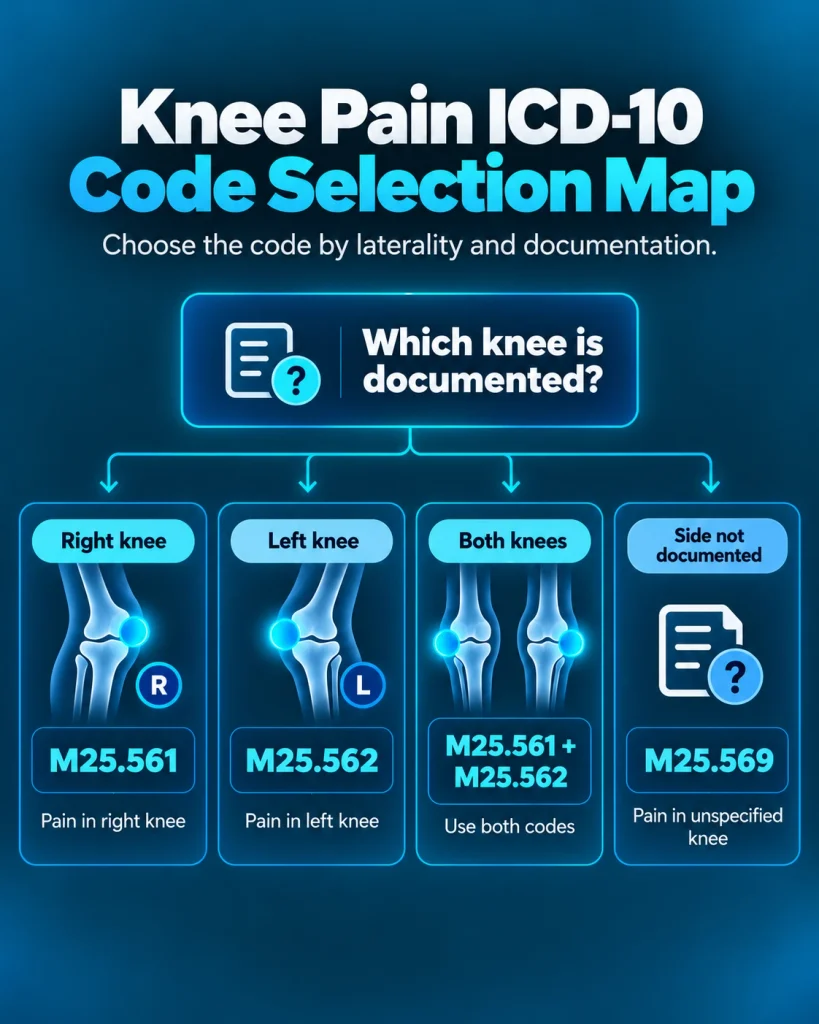
The ICD 10 code for knee pain depends on laterality. Use M25.561 for pain in the right knee, M25.562 for pain in the left knee and M25.569 when the documentation does not identify a side. Bilateral knee pain requires both the right and left codes because this code family does not provide one bilateral option.
| Clinical documentation | ICD-10-CM code | Official description | Coding point |
| Right knee pain | M25.561 | Pain in right knee | Use when right knee pain is documented and no more specific confirmed diagnosis replaces the symptom code |
| Left knee pain | M25.562 | Pain in left knee | Use when left knee pain is documented and no more specific confirmed diagnosis replaces the symptom code |
| Bilateral knee pain | M25.561 + M25.562 | Pain in right knee + pain in left knee | Report both because there is no single bilateral M25.56 code |
| Knee pain, side not documented | M25.569 | Pain in unspecified knee | Use only when laterality cannot be determined from the available record |
Coding point: M25.56 is the parent knee pain category. The claim should use the complete child code that matches the documentation, not stop at the parent when additional characters are required.
M25.561: Right Knee Pain ICD-10 Code
M25.561 is the ICD-10-CM code for pain in the right knee. The M25.561 diagnosis code is appropriate when the provider identifies right knee pain and the encounter has not established a more specific confirmed condition that better describes the reason for care.
A chart that says ‘right knee pain for three weeks, etiology not yet established’ supports M25.561. A chart that confirms unilateral primary osteoarthritis of the right knee tells a different coding story. In that situation, the diagnosis specific M17.11 code usually represents the condition more accurately than a symptom code standing alone.
Right side documentation should agree across the assessment, order, procedure note and final claim. That matters in orthopedic billing because the diagnosis may need to support a right sided X-ray, injection, therapy plan or other service. Stream RCM’s orthopedic billing services use laterality and documentation checks as part of the claim review rather than treating M25.561 as a code that can be copied forward automatically.

M25.562: Left Knee Pain ICD 10 Code
M25.562 is the ICD-10-CM code for pain in the left knee. It applies when the medical record identifies the left knee as the symptomatic joint and no confirmed diagnosis requires a more specific disease or injury code for that encounter.
The most avoidable error is using M25.569 even though the note already says left. ICD-10-CM requires coding to the highest level of specificity supported by the record. If laterality is known, the left knee pain ICD-10 code should reflect it.
Coders should also avoid carrying M25.562 forward simply because it appeared on a prior claim. The diagnosis list should still match the current encounter. A resolved left-knee complaint, a new right-knee complaint or a newly confirmed structural diagnosis can change the correct code.
Bilateral Knee Pain ICD 10: Why Two Codes Are Required
Bilateral knee pain is reported with M25.561 and M25.562 when both knees hurt and no single bilateral code exists for the condition. The current ICD-10-CM laterality rule instructs coders to assign separate right and left codes when a bilateral condition has no bilateral option.
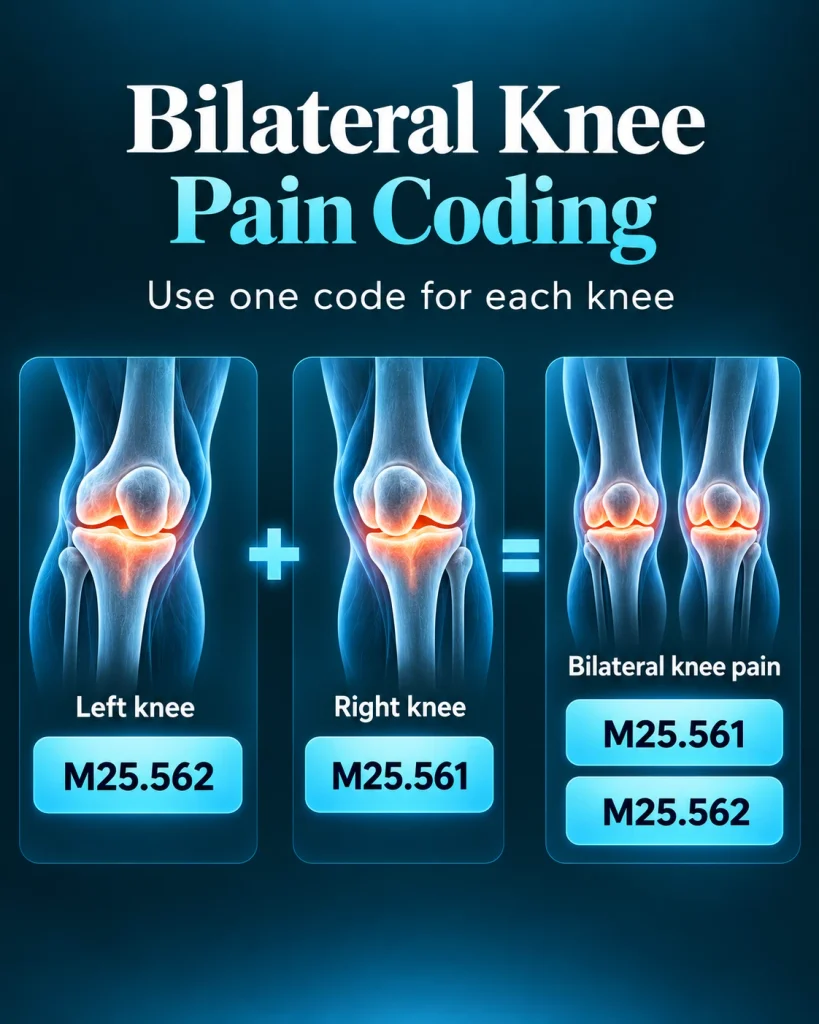
This is different from code families that contain a dedicated bilateral code. For M25.56 knee pain, there is no M25.56x code that means ‘both knees.’ Using only M25.569 would lose documented laterality and using only one side would describe only half of the condition.
The exact ICD-10-CM laterality rule is especially useful here because it also explains what to do when laterality is missing or conflicting. Unspecified laterality is acceptable when the record truly does not establish a side and clarification is not possible. It should not be used as a shortcut when both sides are already documented.
M25.569: When Unspecified Knee Pain Is Actually Appropriate
M25.569 means pain in an unspecified knee. It is appropriate when knee pain is documented but the available medical record does not identify right or left and the side cannot be clarified before coding.
That distinction matters because ‘unspecified’ is not automatically wrong. The official guidelines state that sign, symptom and unspecified codes can be acceptable or necessary when they accurately reflect what is known for the encounter. The problem begins when the chart contains the missing detail but the claim ignores it.
A practical rule is simple: if the note says right, use M25.561. If it says left, use M25.562. If it says both, use both. If the record truly does not identify the knee, M25.569 may be the most accurate code available.
Do Not Replace Documentation With an Assumption
A mechanism of injury does not automatically create an injury diagnosis. A note can say that the patient twisted the knee, fell or felt a pop without the provider having confirmed a sprain, meniscus tear or ligament injury at that visit.
This is where some knee pain guides become too aggressive. In the outpatient setting, a diagnosis documented as probable, suspected, questionable or rule out is not coded as though it were confirmed. The outpatient uncertain diagnosis rule says to code to the highest degree of certainty known for the encounter, which can mean a symptom such as right knee pain when the structural diagnosis is still being worked up.
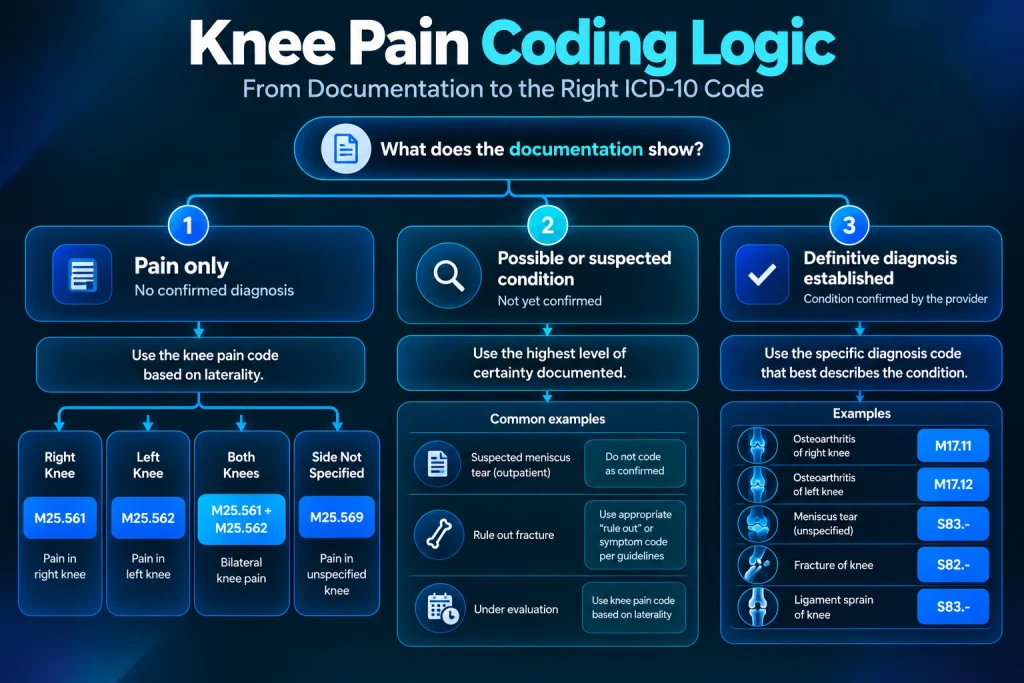
Once the provider confirms a specific condition, the coding should follow that diagnosis. A confirmed meniscus tear, ligament sprain, fracture, osteoarthritis or other knee disorder may move the claim to a different ICD-10-CM family. The coder should never infer that diagnosis from mechanism, imaging language or treatment alone.
When Knee Pain Should Give Way to a More Specific Diagnosis
M25.561 and M25.562 describe a symptom, not the cause of the symptom. When the provider establishes a definitive diagnosis that explains the knee pain, code the confirmed condition according to the applicable ICD-10-CM instructions and do not automatically add the pain code when the pain is routinely associated with that diagnosis.
| Documentation example | Likely coding direction | Why |
| Right knee pain, no diagnosis established | M25.561 | Symptom is the highest confirmed level of certainty |
| Left knee pain, no diagnosis established | M25.562 | Laterality is documented |
| Bilateral knee pain, no diagnosis established | M25.561 + M25.562 | No single bilateral knee-pain code exists |
| Confirmed unilateral primary OA, right knee | M17.11 | Confirmed disease explains the pain more specifically |
| Confirmed unilateral primary OA, left knee | M17.12 | Confirmed disease explains the pain more specifically |
| Suspected meniscus tear, outpatient, right knee pain confirmed | Code the confirmed symptom to the highest certainty supported | Do not code an uncertain outpatient diagnosis as confirmed |
This is why medical coding services should review the full note rather than treating an ICD-10 search result as the final coding decision. The same complaint can lead to different codes when the documentation changes.
Acute vs Chronic Knee Pain: Does M25.561 or M25.562 Change?
M25.561 and M25.562 do not have separate acute and chronic versions. The right or left knee code identifies the site and laterality of pain. Chronicity can involve category G89 when the provider documents chronic pain and the G89 code adds information that is relevant to the encounter.
Do not attach G89.29 to every long standing knee complaint automatically. The category G89 pain coding guidance makes sequencing depend on why the patient is being seen. When the encounter is specifically for pain control or pain management, a G89 code can lead. When the visit is for another reason and no definitive diagnosis has been established, the site specific pain code can be listed first with an appropriate G89 code added when it provides extra information.
If a definitive underlying diagnosis is known, category G89 is generally not assigned unless the encounter is for pain control or pain management rather than management of the underlying condition. That is a more precise rule than simply pairing every chronic knee pain code with G89.29.
Knee Pain vs. Leg Pain: These Are Not the Same Code Family
Knee joint pain belongs to M25.5-, while leg pain belongs to M79.6-. For example, M79.604 means pain in the right leg, M79.605 means pain in the left leg and M79.606 means pain in an unspecified leg. The M79.6 family has an Excludes2 note for joint pain, which is why knee joint pain is coded from M25.5- instead of being treated as generic leg pain.
The difference sounds small in everyday language but it changes the entity being coded. ‘Pain in right knee’ supports M25.561. ‘Pain in right leg’ without joint specificity supports a different code family. Coders should follow the anatomical site the provider actually documents.
Documentation Needed for Clean Knee Pain Coding
Knee pain coding is strongest when the note answers four questions before the claim is built. The coder needs to know where the pain is, which side is affected, whether a diagnosis has been established and what the encounter is actually treating.
Site: Is the problem is in the knee joint, lower leg, thigh, patella or another structure?
Laterality: Right, left, bilateral or genuinely unspecified?
Diagnosis status: Is this still a symptom or has the provider confirmed osteoarthritis, injury or another condition?
Encounter purpose: Evaluation of knee pain, treatment of a diagnosed condition or dedicated pain management?
Clinical support: Do the history, assessment, orders and plan support the diagnosis being sent on the claim?
When the diagnosis code conflicts with the note, the right response is clarification, not a guess. A compliant query is safer than silently switching right to left, inventing a bilateral diagnosis or assigning a structural injury that the provider never established.
Common Knee Pain Coding Errors That Create Rework
| Coding error | Why it happens | Better approach |
| Using M25.569 when laterality is documented | The unspecified code is selected from habit or an old favorite list | Match the side documented in the current record |
| Using only one code for bilateral knee pain | The coder looks for a bilateral M25.56 code that does not exist | Report M25.561 and M25.562 |
| Coding a suspected tear as confirmed in an outpatient visit | Imaging or mechanism is mistaken for a provider confirmed diagnosis | Use the highest confirmed level of certainty |
| Keeping a pain code after a definitive diagnosis is established | The problem list is copied forward | Follow the confirmed diagnosis and coding instructions |
| Adding G89.29 automatically | Chronic duration is treated as a sequencing rule by itself | Use G89 only when documentation and encounter purpose support it |
| Mixing leg pain and knee joint pain | Everyday language is mapped to the wrong anatomy | Use M25.5- for joint pain and M79.6- for limb pain |
If the same error appears repeatedly across providers, it is no longer an isolated coding mistake. Stream RCM’s medical billing audit services can be used to identify recurring documentation and coding gaps, while denial management services focus on the payer response and root cause after a claim has already failed.
Five Practical Knee Pain Coding Scenarios
Scenario 1: Right knee pain with no confirmed cause
The provider documents right knee pain, orders an X-ray and does not establish a definitive diagnosis at the visit. M25.561 matches the confirmed symptom and laterality.
Scenario 2: Bilateral knee pain
The provider documents pain in both knees with no more specific diagnosis. Report M25.561 and M25.562. Do not replace both codes with M25.569.
Scenario 3: Possible meniscus tear in an outpatient office
The note says possible meniscus tear after a twisting event, but the diagnosis is not confirmed. Do not code the uncertain tear as confirmed. Code the highest degree of certainty supported by the encounter, which may be right or left knee pain.
Scenario 4: Confirmed primary osteoarthritis
The provider confirms unilateral primary osteoarthritis of the right knee. M17.11 describes the established condition. Do not automatically add M25.561 if the pain is integral to the osteoarthritis and no separate coding instruction supports it.
Scenario 5: Chronic knee pain managed as pain
The provider documents chronic knee pain and the encounter is specifically for pain management. A G89 code may be sequenced with the site specific knee pain code according to the official pain coding guidance and the purpose of the visit.

How Knee Pain Coding Affects Claims
An accurate diagnosis code does not guarantee payment, but it removes one avoidable source of claim friction. The diagnosis still has to support the billed service, payer policy, medical necessity and documentation. A technically valid code can still be the wrong code for the encounter.
Before claim submission services send a knee related claim, the review should compare the diagnosis with the clinical note, procedure, laterality and payer requirements. This is especially important for imaging, injections, physical therapy and orthopedic procedures where a side mismatch is easy for an edit to catch.
The useful question is not only ‘Is M25.561 valid?’ The better question is ‘Does M25.561 accurately represent what the provider established for this encounter?’ That shift from code lookup to documentation logic is what keeps a clean claim clean.
Quick Reference: Knee Pain ICD-10 Coding
| Question | Answer |
| Right knee pain ICD-10 code | M25.561 |
| Left knee pain ICD-10 code | M25.562 |
| Bilateral knee pain ICD-10 | M25.561 + M25.562 |
| Unspecified knee pain | M25.569 |
| Does M25.561 mean right knee pain? | Yes |
| Does M25.562 mean left knee pain? | Yes |
| Is there one bilateral M25.56 code? | No |
| Should a suspected outpatient injury be coded as confirmed? | No, code to the highest confirmed degree of certainty |
| Current code-set timing as of October 2026 | FY2027 applies for dates of service from October 1, 2026 |
Knee Coding Takeaway
Knee pain coding is mostly a documentation problem disguised as a code search problem. M25.561 is right, M25.562 is left and bilateral pain needs both. M25.569 is reserved for a record that truly does not establish laterality.
The harder decision is knowing when not to use a pain code. A confirmed disease or injury, an uncertain outpatient diagnosis, chronic pain management and a laterality conflict all change the coding logic. Review the diagnosis in the context of the encounter, then verify it against the current CMS ICD-10 code files or the CDC ICD-10-CM Browser Tool before submission.
For practices with recurring orthopedic coding errors, Stream RCM combines medical coding services with claim review and denial management services so the correction happens at the source instead of after the same denial appears again.
Frequently Asked Questions
What is the ICD-10 diagnosis code for leg pain?
Leg pain uses the M79.60- family rather than the knee joint M25.56- family. M79.604 is pain in the right leg, M79.605 is pain in the left leg and M79.606 is pain in an unspecified leg. If the provider specifically documents knee joint pain, use the appropriate M25.561, M25.562 or M25.569 code instead.
How to code right knee pain?
Use M25.561 when the provider documents pain in the right knee and no more specific confirmed diagnosis replaces the symptom code. Confirm that right-side documentation is consistent across the assessment, procedure or imaging order and final claim.
What is the ICD-10 code for unspecified joint pain?
M25.50 is the ICD-10-CM code for pain in an unspecified joint. It should not replace a knee specific code when the medical record already identifies the knee and laterality.
What is the ICD-10 code for knee pain in 2026?
The knee pain codes remain M25.561 for the right knee, M25.562 for the left knee and M25.569 for an unspecified knee. For dates of service on or after October 1, 2026, the FY2027 ICD-10-CM release is the applicable code set. That date detail matters because pages that still call the April 2026 release ‘current’ are now out of date even though these specific knee pain codes did not change.