


Mental health claims get denied for reasons that rarely come up in other specialties. Behavioral health benefits are often carved out to a separate payer, psychotherapy codes depend on exact session time, therapy runs for weeks or months against authorization limits and a single practice may bill for psychiatrists, psychologists, counselors, social workers and marriage and family therapists, each with different payer rules. Add telehealth requirements and ongoing medical necessity reviews, and a claim that looks clean can still come back unpaid.
This guide explains where mental health billing breaks down, what the denial data actually shows, the codes and rules that trigger the most denials in 2026 and how to prevent and recover them.
Why Is Mental Health Billing Harder Than Other Specialties?
Mental health billing is harder because the service, the payer and the provider all vary more than in most of medicine. Six structural problems sit underneath most denials.
| Challenge | Why It Causes Denials |
|---|---|
| Carved-out benefits | Many health plans hand behavioral health to a separate managed behavioral health organization, so claims sent to the medical plan are rejected |
| Time-based codes | Psychotherapy codes are chosen by session length, so missing or rounded times leave the code unsupported |
| Recurring visits | Weekly therapy can exhaust authorized sessions or annual visit limits without anyone noticing |
| Many license types | Each payer decides which clinicians it credentials and how their services are billed |
| Telehealth rules | Place of service codes, modifiers and Medicare’s in-person requirement change the claim |
| Team-based care | Care coordination and peer support often have no billable code at all |
The last point is structural rather than clerical. A 2023 issue brief from HHS’s Office of the Assistant Secretary for Planning and Evaluation found that fee-for-service billing generally pays only for direct care, leaving activities such as team meetings, outreach and care coordination unreimbursed, and that peer support coverage varies by payer and state.
What the Denial Data Actually Shows
Many billing articles claim mental health claims are denied at two or three times the rate of medical claims. The public data is more nuanced, and knowing what it really says helps practices focus on the right problems.
Virginia’s Bureau of Insurance collects claim data from carriers every year. Its November 2025 report on 2024 data found that carriers denied substance use disorder claims more often than medical and surgical claims, but denied mental health claims less often. The difference showed up later in the process: utilization management drove 38% of mental health complaints, and carriers upheld mental health denials in 64% of closed internal appeals, compared with 57% for medical and surgical claims.
Denials overall are rising for every specialty. In Experian Health’s 2025 State of Claims survey, 41% of providers reported denial rates of 10% or higher. For mental health practices, the pattern to watch is not just how often claims deny, but how often utilization management decisions stick when they are appealed.
The 10 Most Common Reasons Mental Health Claims Are Denied
Most mental health denials fall into ten groups. The table pairs each with the claim adjustment reason code (CARC) that usually appears on the remittance, then each reason is explained below.
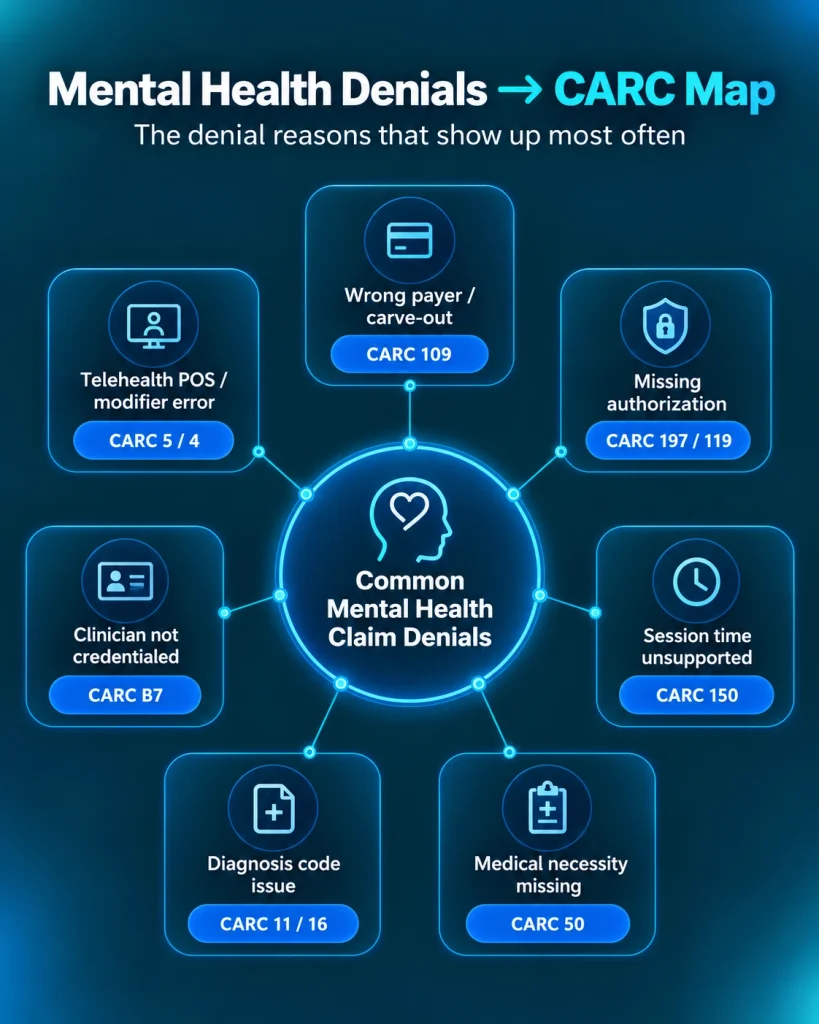
| # | Denial Reason | Typical CARC |
|---|---|---|
| 1 | Claim sent to the wrong payer because behavioral health is carved out | 109 |
| 2 | Missing authorization or authorized sessions used up | 197 or 119 |
| 3 | Session time does not support the psychotherapy code | 150 |
| 4 | Medical necessity or treatment plan not documented | 50 |
| 5 | Diagnosis code issues | 11 or 16 |
| 6 | Clinician not credentialed or license type not covered | B7 |
| 7 | Telehealth place of service or modifier errors | 5 or 4 |
| 8 | Add-on and same-day coding errors | 97 |
| 9 | Missing or wrong license-level modifiers | 4 |
| 10 | Timely filing and coordination of benefits | 29 or 22 |
1. Behavioral health carve outs and eligibility
A patient’s card may show one insurer while a separate company manages the mental health benefit. A claim sent to the medical plan in that case comes back with CARC 109, claim not covered by this payer. Verify the behavioral health payer, the copay and any visit limits at intake and again when coverage changes.
2. Prior authorization and session limits
Many plans authorize therapy in blocks of sessions or limit visits per year. Once the block or limit runs out, claims deny with CARC 197 for missing authorization or CARC 119 for a benefit maximum reached. Track authorized sessions per patient and request the next authorization before the last approved visit.
3. Psychotherapy time that does not support the code
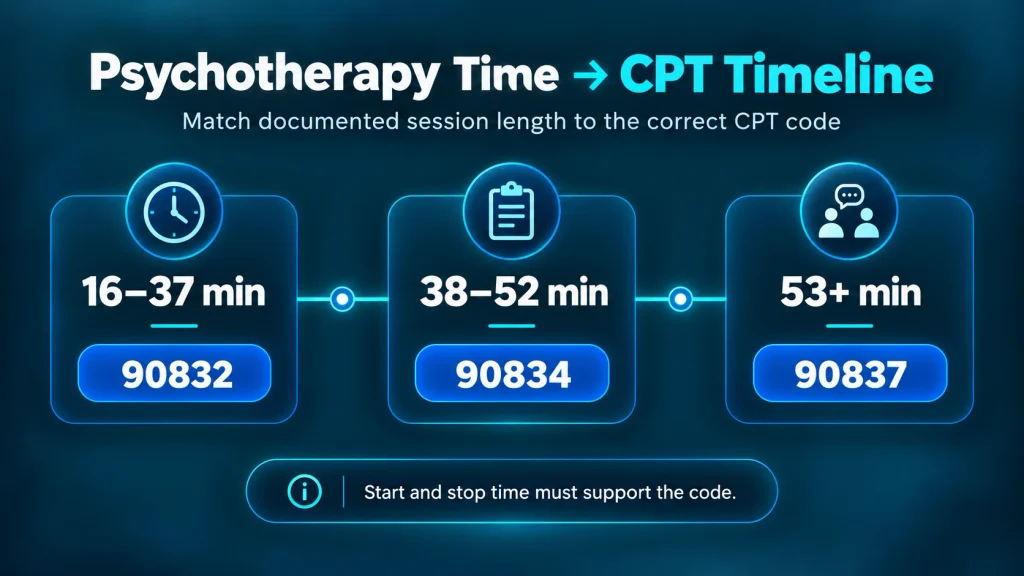
Psychotherapy codes are selected by face-to-face time: 90832 for 16 to 37 minutes, 90834 for 38 to 52 minutes and 90837 for 53 minutes or more. Payers watch 90837 closely. A note without start and stop times, or one that always shows exactly 60 minutes, invites review and CARC 150, information does not support this level of service.
4. Medical necessity and treatment plans
Payers expect each session to tie back to a diagnosis, a current treatment plan with measurable goals and evidence of progress or continued need. Notes that read the same week after week make ongoing therapy look unnecessary, which leads to CARC 50 denials and failed utilization reviews.
5. Diagnosis code problems
Clinicians often think in DSM-5 terms, but claims require ICD 10 CM codes. Unspecified codes such as F32.A or F41.9 may be questioned by some payers when the record supports a more specific diagnosis, and many payers will not accept a Z code for psychosocial factors as the only diagnosis on a psychotherapy claim. Mismatches lead to CARC 11 or 16.
6. Credentialing and license type
A payer may cover a licensed clinical social worker but not an associate level counselor, or credential the practice but not the new clinician. Claims for an uncredentialed provider deny with CARC B7. Medicare added a new layer in 2024, when marriage and family therapists and mental health counselors became eligible to enroll and bill Medicare for the first time.
7. Telehealth errors
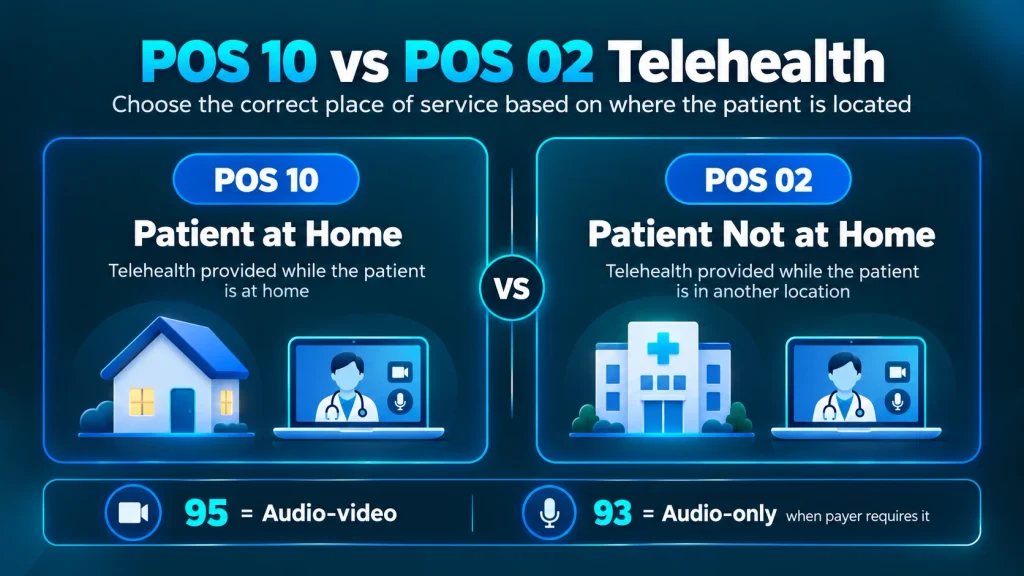
Telehealth claims need the right place of service, POS 10 when the patient is at home and POS 02 when they are elsewhere, plus modifier 95 for audio-video or 93 for audio-only where the payer requires it. Commercial and Medicaid rules differ by plan, so a telehealth setup that works for one payer can fail for another.
8. Add on and same day coding errors
Psychotherapy add-ons (+90833, +90836 and +90838) are billed only with a separately documented E/M service. Interactive complexity (+90785) needs a documented communication barrier, not just a difficult session. Billing a diagnostic evaluation (90791) and psychotherapy on the same day, or repeating 90791 too often, triggers bundling and frequency denials.
9. License-level modifiers
Some payers require modifiers that show the clinician’s license level, such as AJ for clinical social workers or HO, HN and HP for master’s, bachelor’s and doctoral level clinicians in many Medicaid programs. Missing or wrong modifiers deny with CARC 4.
10. Timely filing and coordination of benefits
Small practices often batch claims, and a missed week can push claims past a payer’s filing limit (CARC 29). When a patient has two plans, a claim sent to the wrong primary payer denies with CARC 22 until coordination of benefits is updated.

Mental Health CPT Codes Most Likely to Trigger Denials
A small group of codes accounts for most mental health billing, and each has its own denial risk.
| CPT Code | Service | Common Denial Risk |
|---|---|---|
| 90791 / 90792 | Psychiatric diagnostic evaluation, without or with medical services | Frequency limits; billed with psychotherapy on the same day |
| 90832 | Psychotherapy, 30 minutes (16 to 37 minutes) | Missing time documentation |
| 90834 | Psychotherapy, 45 minutes (38 to 52 minutes) | Time not documented or rounded |
| 90837 | Psychotherapy, 60 minutes (53 minutes or more) | High audit scrutiny; time must be documented |
| +90833 / +90836 / +90838 | Psychotherapy add-on with an E/M visit | E/M not separately documented |
| +90785 | Interactive complexity | No documented communication factor |
| 90846 / 90847 | Family psychotherapy without or with the patient | Patient presence and purpose not clear |
| 90853 | Group psychotherapy | Group size and individual notes missing |
| 90839 / +90840 | Psychotherapy for crisis, first 60 minutes and each added 30 | Crisis criteria and time not documented |
Mental Health Parity Rules in 2026
The Mental Health Parity and Addiction Equity Act requires most group health plans to cover mental health and substance use disorder benefits no more restrictively than medical and surgical benefits, including limits such as prior authorization. The rules around it have shifted.
In September 2024, federal agencies issued a stronger parity rule. In May 2025, they announced they would not enforce the new portions of that rule for the 2025 and 2026 plan years while they reconsider it, as the American Bar Association summarized. The earlier 2013 rule and the comparative analysis requirements added in 2021 remain in force.
Enforcement has not stopped. In September 2026, the Department of Labor published Field Assistance Bulletin 2026-03 with three parity enforcement priorities and a red flags checklist, and the agencies have said a new proposed rule will come by December 31, 2026, as Insurance Business reported. For practices, parity matters most in appeals: when a plan applies stricter authorization or medical necessity rules to therapy than to comparable medical care, the patient can request the plan’s comparative analysis.
Medicare Rules Mental Health Practices Need to Track
New provider types since 2024
Since January 1, 2024, marriage and family therapists and mental health counselors can enroll in Medicare and bill for their services, including telehealth, as Telehealth.org explains. Each clinician still has to be enrolled before their first Medicare claim.
Telehealth through 2027
The Consolidated Appropriations Act, 2026, signed on February 3, 2026, extended Medicare telehealth flexibilities through December 31, 2027, including the delay of the in-person visit requirement for mental health telehealth, as McGuireWoods summarized. The CY 2027 Physician Fee Schedule proposed rule would set that requirement to begin January 1, 2028, but that date is not final until the final rule is published.
When the requirement applies, Medicare expects an in-person visit within six months before the first telehealth mental health service and at set intervals after that. The American Psychiatric Association’s telepsychiatry FAQ advises documenting the date and provider of the last in-person visit, since telehealth claims can be denied when the requirement is not met.
How to Prevent Mental Health Billing Denials
Prevention works best when each step of the revenue cycle has one clear check.
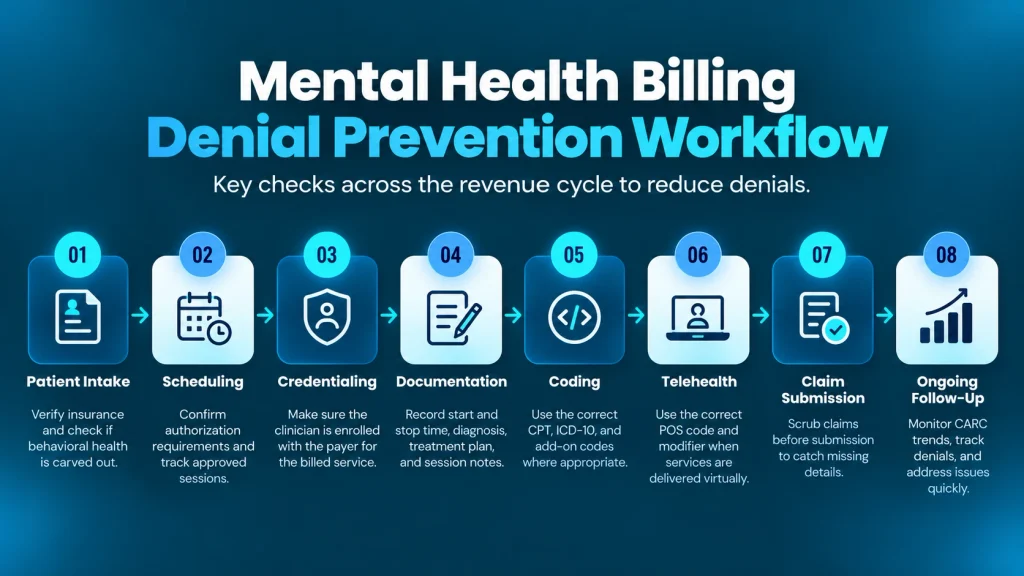
| Stage | What to Check |
|---|---|
| Intake | Behavioral health payer and any carve-out, copay, deductible, visit limits and authorization rules |
| Scheduling | Remaining authorized sessions and the next authorization date |
| Credentialing | Every clinician enrolled with every payer before their first session |
| Documentation | Start and stop times, diagnosis, treatment plan goals and progress in every note |
| Coding | Code matches documented time; add-ons have their base service; ICD-10-CM codes are specific |
| Telehealth | Correct POS (02 or 10), modifier (95 or 93) and Medicare in-person status |
| Submission | Claim scrubbed for license modifiers, timely filing and coordination of benefits |
| Follow-up | Denials tracked by CARC, payer and clinician to find repeat causes |
Behavioral Health Denial Management: How to Recover Denied Claims
Behavioral health denial management means sorting each denial by cause, fixing what can be fixed and appealing what was wrongly denied. A simple order works well:
Sort by reason code. Separate front-end errors, such as wrong payer, eligibility or modifiers, from clinical denials such as medical necessity.
Correct and resubmit errors. Fixable data errors usually need a corrected claim, not an appeal.
Appeal clinical denials with records. Send the treatment plan, progress notes, standardized measures such as PHQ-9 or GAD-7 scores and a short letter tying the service to the diagnosis and the plan’s own criteria.
Use parity where it applies. If the plan treats therapy more restrictively than comparable medical care, ask for the plan’s comparative analysis and cite it in the appeal.
Escalate on time. Track internal appeal deadlines and move to external review when the plan upholds a denial that the record supports.
When Should a Practice Outsource Mental Health Billing?
Outsourcing makes sense when clinicians are spending evenings on claims, denials sit unworked for weeks, authorizations lapse between sessions or the practice is adding clinicians and payers faster than billing can keep up. A billing partner that knows behavioral health payer rules can usually catch carve-outs, time issues and credentialing gaps before claims go out.
Frequently Asked Questions
Why are mental health claims denied so often?
Mental health claims are denied mainly because of carved-out behavioral health benefits, missing or exhausted authorizations, session times that do not support the psychotherapy code, thin medical necessity documentation and clinicians who are not credentialed with the payer. Telehealth and modifier errors add to the problem.
What are the most common mental health billing errors?
The most common errors are billing the wrong payer, missing authorization, undocumented start and stop times, add-on codes without a separate E/M, unspecified diagnosis codes, missing license-level modifiers and the wrong telehealth place of service or modifier.
How can a practice prevent mental health billing denials?
Verify the behavioral health payer and authorization rules at intake, track authorized sessions, credential every clinician before they see patients, document start and stop times and treatment plan progress, scrub claims before submission and track denials by reason code.
What is behavioral health denial management?
Behavioral health denial management is the process of reviewing denied mental health and substance use claims, correcting and resubmitting errors, appealing medical necessity denials with clinical records and fixing the root causes so the same denials stop repeating.
Is behavioral health billing the same as mental health billing?
The terms are often used interchangeably. Behavioral health billing is broader and usually includes substance use disorder treatment, while mental health billing focuses on psychiatric and psychotherapy services. The coding and payer challenges overlap heavily.
Can counselors and marriage and family therapists bill Medicare?
Yes. Since January 1, 2024, marriage and family therapists and mental health counselors can enroll in Medicare and bill for their services, including telehealth, once they meet the qualifications and complete enrollment.
Does Medicare still cover telehealth therapy in 2026?
Yes. Medicare telehealth flexibilities are extended through December 31, 2027, including the delay of the in-person visit requirement for mental health telehealth. CMS has proposed starting that requirement on January 1, 2028.
Why do payers audit CPT 90837?
CPT 90837 pays the most of the standard psychotherapy codes and requires at least 53 minutes of face-to-face time. Payers watch for practices that bill it for most sessions or document identical session lengths, so start and stop times matter.