


AR is one of the vital measures of the financial performance in medical billing because every mistake in billing could lead to delays in payments and an increased rate of denial of claims. According to industry statistics, about 5%-10% of all medical claims are denied at first, but many denials can be easily avoided due to incorrect data, wrong coding, or lack of supporting documents.
Inaccurate billing will also lengthen AR days since it takes more time for healthcare facilities to correct mistakes, contest payments, and perform additional billing follow-up. Research conducted by the Medical Group Management Association (MGMA) and Healthcare Financial Management Association (HFMA) has shown that error prevention before claim submission leads to higher acceptance rates and helps optimize revenue cycles. This article examines the major types of medical billing errors that create AR challenges and how a medical billing company in the USA can help minimize them through accurate claim management, denial prevention, and efficient revenue cycle solutions.
What Are Accounts Receivable in Medical Billing?
The definition of accounts receivable (AR) in medical billing is the total amount of money owed by a medical practitioner for their services rendered but have not been paid by the insurance firms or the patient. Once the claim is made, the amount left that has not been paid is called the accounts receivable. Proper management of the accounts receivable means maintaining a stable cash flow by avoiding any arrears.
Accounts receivable is an important aspect in revenue cycle management since it impacts the financial health of the practice. Late payments, denial of claims, and inaccurate billing may cause a delay in the payment of claims, causing high costs and low revenues. The process of accounts receivable involves accurate billing, prompt response, and denial management, among others, that facilitate fast collections and increase revenue generation. As per Bureau of the Fiscal Service, the factors that need to be considered for effective management of accounts receivable include accuracy, timely collection, compliance, and performance metrics.
The measurement of certain critical performance measures will enable healthcare providers to recognize areas where their payment processes have bottlenecks as well as enhance efficiency. Some of the measures that should be taken into consideration include days in AR, measuring the average number of days required for collecting payments, clean claim rate, measuring the number of claims that are accepted on the first attempt, claim denial rate, measuring the number of denied claims, first pass resolution rate, measuring the number of claims that are paid on first submission, and aging accounts receivable report. This report measures the number of outstanding payments in various aging categories.
How Medical Billing Errors Affect Accounts Receivable
As stated by the National Institutes of Health (NIH), the account receivable process is defined as the management of reimbursable transactions, receivable processing, collection, reconciliation, debt collection, and payments for purposes of accuracy in accounting and government accounting processes.
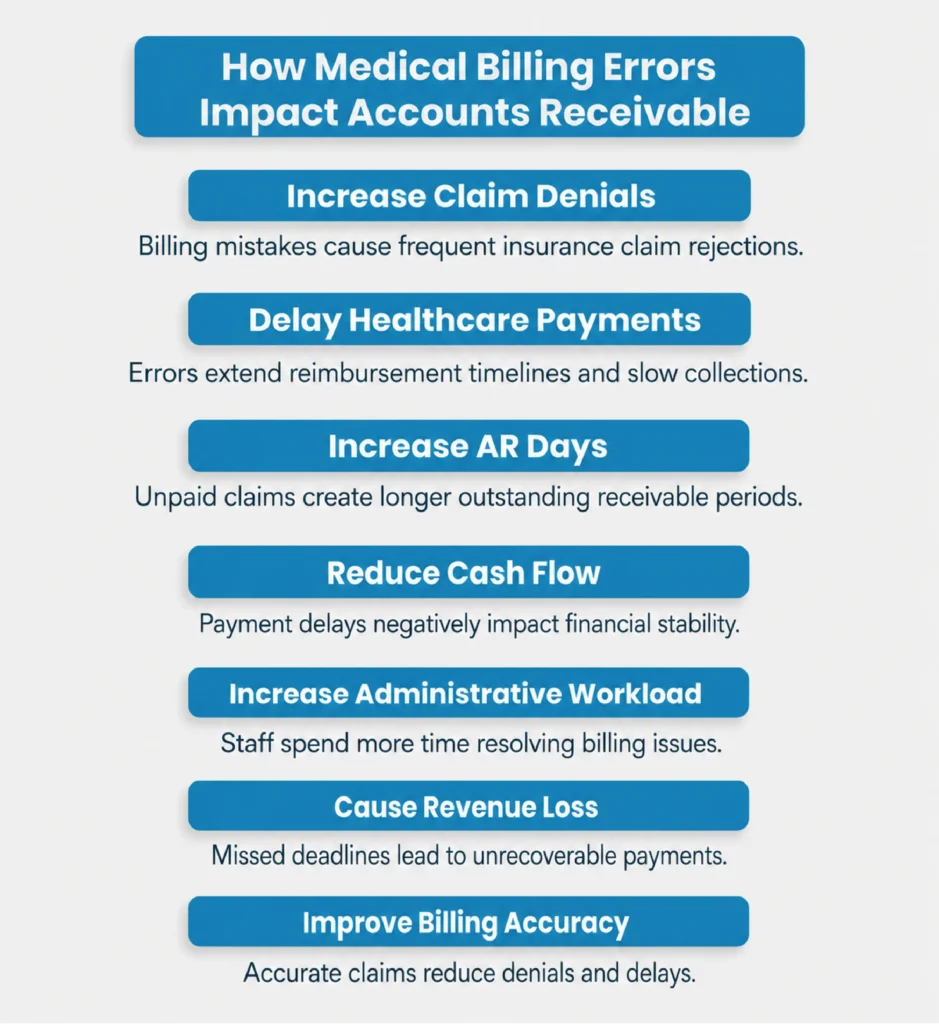
The effects of medical billing errors are clearly seen on accounts receivable through delays in payment due to claim denials and disruptions to cash flow. Errors in patient demographic information, coding issues, lack of documentation, or absence of prior authorizations usually lead to denial or rejection of claims. Rather than getting reimbursed immediately, the healthcare organization will need to make corrections and resend claims or file an appeal, thus prolonging the reimbursement process. With the rise in the number of unpaid claims, Days in Accounts Receivable rise, causing difficulty in sustaining healthy revenues and cash flow.
Apart from delayed payments, there are other difficulties that arise from billing problems. Denial or rejection of a claim implies that more effort will be needed to investigate and resolve the problem, adding to administrative cost. In some cases, the claims might take too long or fail to meet the time frame for filing claims and hence the revenue opportunity is lost forever. Improved accuracy in billing, confirming patient details and insurance, and submitting claims in the first place will help in decreasing claims denials.
Expert Advice: Implement regular billing audits and monitor denial trends to identify recurring issues early. Accurate documentation, timely claim follow-up, and efficient AR management processes can significantly reduce payment delays, lower AR days, and improve overall revenue cycle performance for healthcare organizations.
10 Common Medical Billing Errors That Cause Claim Denials
Errors that may occur in the process of medical billing can lead to denied claims and delay in payments, and in some cases, even increase the days of ARs. Being aware of such errors can assist medical institutions to ensure their claims are correct and that the revenue cycle function is maximized. Outsource medical billing services can help you to achieve all of this through proper claims management, denial management, and billing process improvements.
1. Incorrect Patient Information
Incorrect patient demographics, such as misspelled patient name, incorrect date of birth, and wrong insurance ID numbers, are some of the major causes why the claims get denied even before the processing. The front office staff is supposed to verify the records of patients as well as insurance information every time they see their patients.
2. Insurance Eligibility Verification Failures
A lack of verification for insurance coverage being active prior to delivering healthcare services can lead to claims that are denied or go unpaid. This is due to the fact that there might be an expiry date on the insurance coverage, there could be changes to the coverage plan, or incorrect billing codes might be used.
3. Medical Coding Errors
Errors in assigning ICD-10, CPT, and HCPCS codes, in addition to upcoding, downcoding, or unbundling of procedures and services, often lead to denial of claims and compliance issues. Continuous training of coders, auditing of coding practices, and availability of current coding references go a long way towards preventing coding errors in medical billing.
4. Missing or Incomplete Documentation
The insurance companies will need thorough documentation in order to justify the medical necessity of the procedure and ensure payment. The lack of doctor’s note, incomplete treatment documentation, or inadequate documentation may cause delays in reimbursement or even denial of the claims. The thorough documentation of medical information prevents common medical billing errors.
5. Duplicate Claim Submission
Resubmitting claims repeatedly will result in automatic denial since insurance companies detect duplicates through their systems or claim rejections reasons. The reason for submission of claims repeatedly happens due to lack of knowledge about the status of those claims. Keeping track of the claims avoids claim denials arising from duplicate billing.
6. Untimely Claim Filing
All insurance carriers have tight deadlines for submitting claims, which are known as timely filing limits. Claims filed beyond these deadlines are automatically declined irrespective of the necessity of the procedure. Consistent monitoring of filing dates and pending claims can help avoid denied claims in medical billing due to late filing deadlines.
7. Incorrect Modifier Usage
The modifiers offer additional information on the procedure and service, and the misuse or lack of use of the modifiers can lead to reduced payments or denial of the claims. The medical billing team must be conversant with modifier rules provided by different payers to avoid billing errors in healthcare.
8. Authorization and Referral Errors
Most of the healthcare services require the authorization or referral from the doctors prior to receiving treatment. Without approval, expiration of authorization and insufficient referral information usually lead to insurance denial for payment. Verification of the authorization requirement before receiving the services minimizes the claim denial reasons.
9. Charge Entry Errors
Incorrect charges entered, missing billable services, and conflicting billing data may all contribute to incorrect claims and delays in receiving reimbursement. Quality assurance checks and billing validation systems can help to catch problems prior to the submission of the claims, thereby minimizing medical billing mistakes.
10. Failure to Follow Up on Denied Claims
Denials should be addressed quickly because this will speed up their processing. If there is no follow up for the denials, these could become aged in the accounts receivable and might even exceed the appeal period. The accounts receivable follow up for medical billing will ensure that collections are improved and the outstanding balance decreased.
Most Common Claim Denial Reasons
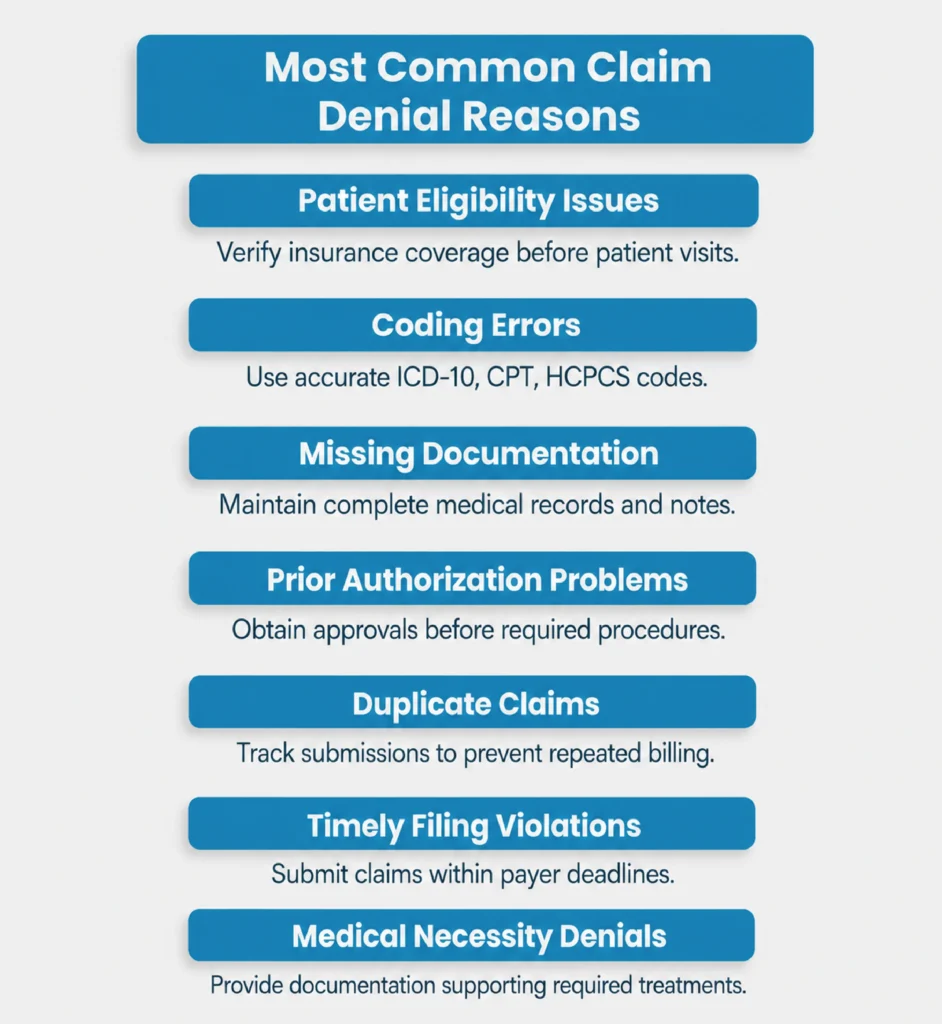
Claim denials can arise from various reasons within the healthcare sector. It is important to know the most common causes of claim denials in order to prevent mistakes, ensure claim accuracy, avoid payment delays, and improve the revenue cycle. Denial management services for healthcare professionals will assist in identifying denial trends, resolving denied claims, managing appeals, and maximizing reimbursements through denial prevention.
Patient Eligibility Issues
Issues regarding patient eligibility arise when the insurance coverage becomes invalid, inaccurate, or fails to be verified prior to offering care services. Mistakes regarding member number, type of insurance plan or other coverage information may lead to claim rejection and claim denial reasons. Eligibility verification will help in preventing claim denials due to any insurance eligibility issues.
Coding Errors
Inaccurate codes for ICD-10, CPT, and HCPCS might be a reason for denying a medical insurance claim by insurers since it will be an inaccurate portrayal of services rendered or lack of medical need. Such errors in coding will involve using incorrect codes, omission of modifiers or combining medical billing codes incorrectly.
Missing Documentation
The documentation is mandatory for insurers to verify the healthcare services and ensure medical necessity. The absence of progress notes or incomplete information may cause delays in payments or even deny payments. Keeping proper documentation is necessary to avoid denied claims in medical billing and get reimbursement from insurers.
Prior Authorization Problems
It is often necessary for some treatments to be approved in advance for coverage by many insurance policies. The failure to do so or having an expired approval may cause denials of claims. It is wise to check the payer’s requirements before any services are rendered to avoid errors in billing for healthcare.
Duplicate Claims
This happens because a certain service is filed more than once as a result of system problems, processing errors, or failure to monitor the filing process. Insurance companies usually refuse such duplicated filing as a measure against overpayments. Claim monitoring and checking the status of the filing can help reduce claim rejections.
Timely Filing Violations
There are time limits to be followed by insurance companies regarding filing of their claims, failure to file these claims within that period may automatically lead to the denial of these claims. The delays that happen in such situations could be attributed to problems in work flow and claim problems.
Medical Necessity Denials
Medical necessity rejections occur where the insurance provider finds that the documents do not prove the service, procedure, or treatment provided. Lack of clinical data or coding mistakes can be some of the causes of such rejections. Good documentation and proper coding play an important role in avoiding coding errors in medical claims.
Professional Insight: Analyze claim denial patterns regularly to identify recurring issues such as coding mistakes, eligibility failures, and documentation gaps. Implementing proactive denial prevention strategies, staff training, and effective denial management processes can help healthcare providers reduce rejections, accelerate reimbursements, and improve revenue cycle performance.
Best Practices to Reduce Accounts Receivable and Billing Errors
It is essential to implement strategies to minimize account receivable problems through a proactive strategy that involves accuracy and compliance as well as revenue cycle management. Through this strategy, healthcare organizations can effectively avoid any error, decrease denials, and facilitate faster insurance payments.
Verify Insurance Before Every Visit
Insurance verification for each visit helps avoid any problems due to coverage issues. The billing department should check whether the policy is still valid and what other aspects regarding the insurance the patient has, such as copays. This process helps eliminate mistakes made in billing due to incorrect insurance information.
Improve Medical Coding Accuracy
The process of coding is vital in making sure that the services of healthcare are accurately reflected in the claims. It is through the training of coders, compliance checks, and up-to-date knowledge on ICD-10, CPT, and HCPCS that can prevent the occurrence of erroneous coding. The professional medical coding services can even improve coding accuracy, minimize medical billing errors, facilitate compliance, and hasten the process of payment.
Conduct Regular Medical Billing Audits
A medical billing audit ensures that any problems such as mistakes or compliance issues can be detected in advance to prevent any financial problems. Some areas that need to be audited include patient data, coding, documentation, charges, and claims submission. Medical billing audit checklist is an efficient tool for conducting a medical billing audit.
Submit Clean Claims
Clean claims are those that include complete and correct information in the proper format which will enable insurance companies to process payment without further examination. Making sure that all relevant information is right and complete prior to sending the claim will make sure of its successful acceptance on the first attempt.
Monitor Clean Claim Rate
The clean claim ratio gives a clear picture about the efficiency of the billing process prior to submission of claims to the payer. An increase in the clean claim ratio means that the billing process is more efficient and error free, whereas a decrease in the clean claim ratio points out the inefficiencies in the billing process.
Train Billing Staff Regularly
Continuous training is important because it will ensure that billing personnel are up-to-date on any policy changes made by payers and other changes such as denial prevention strategies. Trained personnel will be able to spot possible problems before claims are filed and react to problems when payments are being made.
Automate Eligibility Verification
Automated eligibility verification systems enable health facilities to determine whether patients have an insurance cover prior to an appointment. Automation eliminates chances of human errors and ensures that billing staff has accurate information on the payer. Use of technology in verification prevents claim denials resulting from either inactive coverage or inaccurate insurance information.
Strengthen AR Follow-Up Procedures
A structured process to manage the follow up of the accounts receivable guarantees that all unpaid claims will be checked, fixed and settled promptly. Billing staff should always focus on aging accounts, analyze denial trends and adhere to payers’ guidelines for filing an appeal within their set timeframe.
Medical Billing Audit Checklist
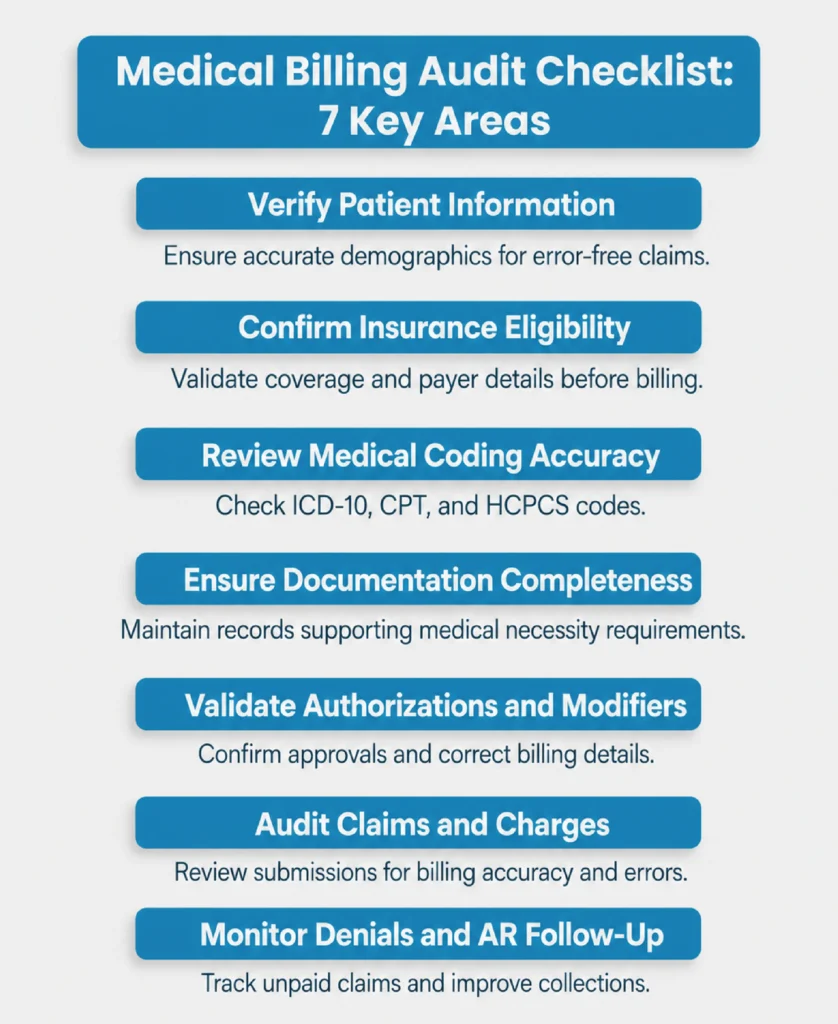
Medical billing audit provides a complete check to ensure that all the medical billing procedures stay accurate, compliant and error-free. With every part of the medical billing process being audited, health care organizations can discover problems and increase the efficiency of their revenue cycle management. Medical billing audit services by professionals helps the providers identify inconsistencies and improve their reimbursement procedures.
Verify Patient Demographics
Patient demographic data plays a very crucial role in achieving success when submitting claims. When conducting an audit, billing departments should ensure that patient demographics such as names, dates of birth, addresses, phone numbers, and insurance identification numbers are correct. This will help to avoid errors in medical billing due to registration errors.
Confirm Insurance Eligibility
Verification of insurance coverage status is essential for the patient to be on coverage and the claims being made to the right party. The auditors need to check on the date of coverage, benefits, the policy number, and the payer information. Verification of insurance will prevent denial of medical claims due to various reasons.
Review ICD-10/CPT/HCPCS Coding
Medical code audit is a crucial procedure in making sure that the code used by the physician matches the service performed or documented. Auditors are advised to verify if there is proper use of the ICD-10, CPT, and HCPCS codes. Consistent code review in medicine helps detect errors in medical coding.
Check Documentation Completeness
Documentation is essential in demonstrating the medical need for a service and also verifying the service as reported on the claim. Audits should ensure that the proper documentation and record keeping of clinical notes and treatments have been done. Poor record keeping may be a cause of denials in medical billing.
Validate Modifiers
Modifiers give extra information regarding procedures, services, and the conditions of billing. Modifiers may lead to underpayments and denials in case of mistakes, absence, and wrong application. The checking of modifiers in auditing will help in making sure that the claims reflect what was actually done.
Review Authorizations
The verification of authorizations is to confirm the fact that proper authorizations have been granted prior to offering particular medical services. In this case, the auditor should check the authorization numbers, dates, and approved services. The lack or expiration of authorizations is one of the major denial reasons for payments.
Audit Charge Entry
Charge entry audit can reveal any error in billing or charges which might be inaccurate. A review of the charge entry audit helps ensure that there is no inconsistency in the billing. Charge audits make sure that all errors in medical billing are avoided.
Track Claim Status
Keeping track of the claims will help recognize the unpaid claims, rejected claims, and delayed claims before they turn into outstanding claims. It is important for the billing team to check the process of submission of the claim, the response from the payer, and the pending process.
Analyze Denial Trends
Analysis of denial patterns assists healthcare institutions to recognize recurring billing issues and formulate relevant solutions. The denials have to be sorted according to their causes, payers, departments, and error types. This will help to understand the prevailing trends, thus formulating appropriate medical billing denial management strategies.
Follow Up on Outstanding AR
AR follow up for outstanding receivables helps to ensure that the unpaid amounts remain effectively managed until their resolution according to the payer’s deadline. The billing department is required to focus on aged claims, file appeals and correct errors as well as track payments. Effective AR follow up services in medical billing increases payment efficiency.
Expert Guidance: Conduct medical billing audits regularly to identify workflow gaps, coding inaccuracies, and compliance risks before they affect revenue. Combining audit findings with denial analysis, AR follow-up, and staff training helps healthcare organizations improve claim accuracy, reduce payment delays, and strengthen revenue cycle performance.
How to Improve Accounts Receivable Performance
The optimization of the accounts receivable is based on monitoring, proper invoicing, and follow-up. In order to decrease payments delay and maximize collections, healthcare organizations can focus on the effective management of their claims and the identification of the reasons for those delays.
Reduce Average AR Days
Shorter AR days contribute to faster payment for healthcare organizations and ensure consistent cash flow. Healthcare institutions need to concentrate on timely submission of claims, proper billing and effective follow-up process. Shorter AR days mean better collections performance and will aid in addressing issues related to AR medical billing.
Prioritize High-Value Unpaid Claims
The approach of targeting large unpaid claims would help the billing teams to earn money faster through their efforts. Large balance claims can be looked into with regard to age of the claim, payer type, and reasons for the denial. This would help reduce the financial damage caused by billing errors.
Monitor Aging Reports
The periodic review of AR aging reports enables us to detect unpaid claims from the payment time frame of either 30 days, 60 days, 90 days, or 120+ days. Such reports enable the billing department to follow up with overdue bills, solve payment problems, and ensure that there will be no problem collecting payments in the future.
Track Denial Rates
Denial rate tracking enables companies to gain insights into the extent of failures of claims and reasons for them. Denials are tracked in order to be able to come up with an effective strategy. Efficient tracking plays a critical role in efficient management of medical billing denials.
Measure Clean Claim Rate
The clean claim rate calculates the number of claims that have been accepted by the insurance companies without any corrections or further scrutiny. High clean claim rates indicate proper billing procedures and minimal errors. Measurement of the clean claim rate facilitates the identification of inefficiencies, improves claim accuracy, and minimizes common grounds for denied claims.
Use Billing Analytics
The analytics of billing offer insights on claims’ performance, payment trends, denial patterns, and revenue cycle efficiency. The healthcare industry can leverage reporting through data to pinpoint inefficiencies and make smart decisions. Analytics aid in identifying areas that need improvements in order to avoid revenue cycle management mistakes.
Implement Regular AR Reviews
AR review on a regular basis is very helpful for assessing the status of receivables and claims and initiating follow-up action on time. The AR review process must consist of aging of accounts receivables, denial management, performance of payers and collections. Regular monitoring will definitely improve the process of medical billing.
How Stream RCM Supports Accounts Receivable in Medical Billing
Stream RCM provides ways for healthcare facilities to improve their accounts receivable operations via proper claim management, denial prevention, and follow-up processes. Stream RCM will assist in the detection of billing mistakes, tracking of outstanding claims, analysis of denial trends, and management of aging accounts to help reduce AR days. Stream RCM provides revenue cycle management solutions that can enable a practice to have timely submission of claims, insurance verification, coding and payer communication to help ensure that there are no delays in payments.
FAQs
What are accounts receivable in medical billing?
AR for medical billing involves payments from insurance companies and patients for services rendered that have not yet been paid. Management of accounts receivable is all about lowering balances and making sure payments are received on time.
What causes claim denials in medical billing?
Claim denial is usually caused by inaccurate patient data, eligibility problems for insurance coverage, coding errors, inadequate documentation, non-authorizations, duplicate claims, and untimely claims. Recognizing these problems can enable healthcare institutions to avoid denial of claim and increase revenue cycle performance.
How do billing errors affect accounts receivable?
Billing mistakes lead to an increased accounts receivable due to payment delays, claim processing mistakes, and extended collection time. Errors with coding, documentation, and patient information could mean claim denials and added expenses, affecting cash flow and health care revenue management in general.
What is an acceptable clean claim rate?
Claim cleanliness is normally rated to be above 95% in order to be considered as good since this percentage may vary based on the specialty, payor mix, and process of billing. High claims cleanliness signifies efficiency in the healthcare revenue cycle management.
How often should a medical billing audit be performed?
The medical billing audit should be conducted at periodic intervals, such as quarterly or yearly. The regular conduct of the audit helps identify any errors, improve coding, prevent denials, and make sure that the entire process of billing adheres to the standard.
How can healthcare providers reduce medical claim denials?
Some of the measures that the healthcare providers can take to minimize claim denials include verifying eligibility for insurance coverage, enhancing documentation, providing billing training, reviewing codes, watching out for claim denial trends, and submitting clean claims. A proper preventive plan can improve their reimbursement rates.