

Brain imaging through MRI has become an essential part of modern diagnostics, mainly in measuring neurological abnormalities that need high-resolution internal interpretations. It is normally suggested in both emergency and routine clinical evaluations where precise brain assessment is necessary.
CPT coding for MRI brain procedures confirms that each scan is appropriately classified for billing and insurance determination purposes. Precise coding supports well-organized claim processing, minimizes administrative mistakes, and confirms compliance with healthcare reimbursement guidelines. Many healthcare organizations rely on a trusted medical billing company in the USA to streamline MRI coding, accelerate claims processing, and maximize revenue collection. This blog will explore the CPT codes for MRI brain procedures and their clinical uses.
What You Need to Know About MRI Brain Scans
According to the Centers for Medicare & Medicaid Services (CMS), Magnetic Resonance Imaging also known as MRI brain scan is a non-invasive diagnostic test which is applied for strong magnetic fields and radio waves to get a detailed visual representation of brain structures. This diagnosis detects conditions that include strokes, tumors, and neurological disorders. MRI plays an important role in modern neuro diagnostics which deliver highly precise and clear imaging results.
An MRI brain scan helps visualize soft tissues clearly without radiation which makes it a preferred process for detecting neurological conditions and abnormalities with high accuracy in medical practice. MRI scanning of the brain is done through the alignment of hydrogen molecules within the body through the use of magnetic energy that causes signals from the hydrogen atoms. Brain MRIs are commonly used in the diagnosis of diseases like stroke, tumor, infection, seizure, and structural problems within the brain.
Overview of CPT Codes in Medical Imaging
The coding for medical imaging in the form of CPT codes is a standardized numbering system to classify diagnostic testing like an MRI scan of the brain. Coding using the CPT system ensures that there is standardization of communication between physicians and health insurance agencies for documentation of medical services performed.
The use of CPT codes is extremely important in the billing process as far as healthcare claims are concerned, as it helps in processing the claim as well as getting approval for reimbursement. The importance of using accurate CPT codes cannot be understated as it facilitates smooth billing processes and healthcare management systems.
CPT Codes for MRI Brain Scans
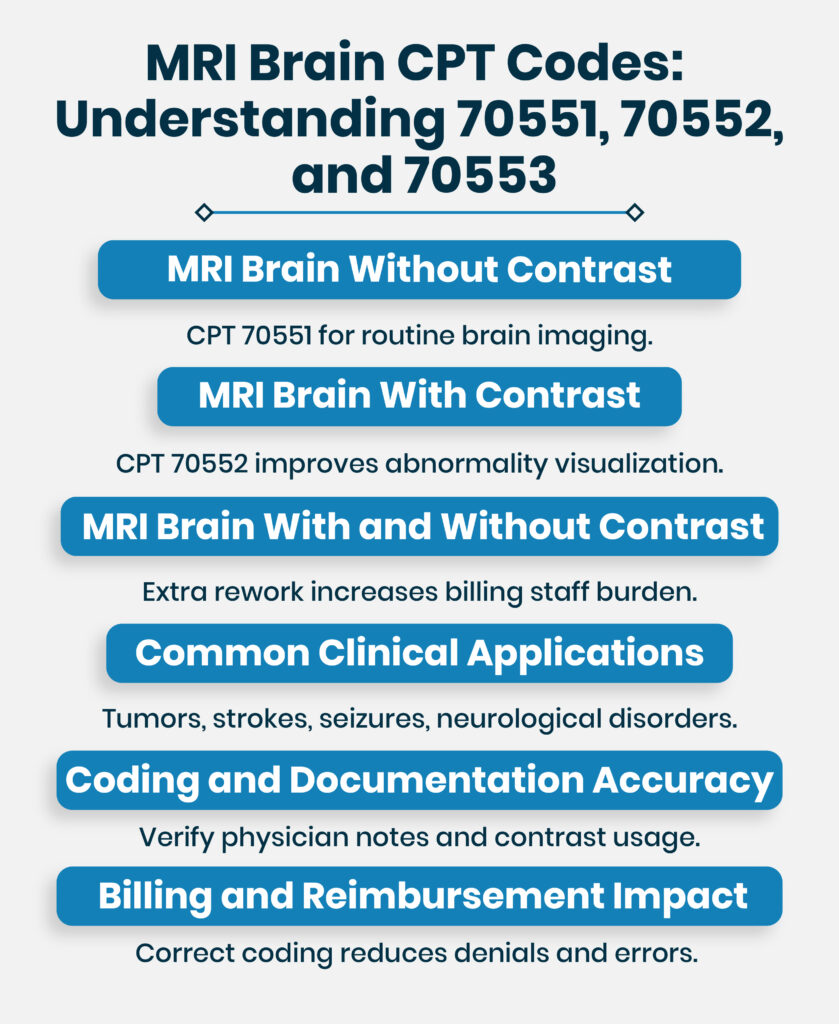
CPT codes for MRI brain scans classify procedures performed with or without contrast, ensuring accurate billing, proper clinical documentation, and timely insurance reimbursement. Healthcare providers often rely on professional medical coding services to assign the correct CPT codes, reduce claim denials, and maintain compliance with payer requirements.
MRI Brain Without Contrast
CPT code 70551 is MRI brain without contrast. This imaging is done in order to analyze the structures of the brain without using any kind of contrast medium. This type of imaging is frequently requested in patients who have symptoms such as headache, dizziness, or trauma.
MRI Brain With Contrast
The code for MRI brain with contrast is CPT 70552, which is done with a contrast material containing gadolinium that will improve the visibility of certain brain abnormalities. It may be ordered by a doctor for the presence of tumors, infections, inflammatory lesions, and abnormal blood vessels.
MRI Brain With and Without Contrast
Code CPT 70553 refers to magnetic resonance imaging (MRI) of the brain with and without contrast media. It includes two separate studies in one code. CPT 70553 can be supportive when searching for small lesions, tumors, or multiple sclerosis in patients’ brains.
Expert Tip: Ensure that the physician’s notes and information regarding contrast use are double-checked prior to coding brain MRI using the CPT code. Proper assignment of the CPT codes 70551, 70552, and 70553 will help ensure there will be no denial claims.
Difference Between CPT 70551, 70552, and 70553
CPT codes 70551, 70552, and 70553 fluctuate primarily which depend on the application of contrast during an MRI scan of the brain. CPT code 70551 is done without contrast; CPT code 70552 is contrast-only, while CPT code 70553 has both with contrast and without contrast.
Decision making in clinical settings is based on the diagnosis made, whether it is tumor, stroke, or any other neurological disease. Billing costs will differ, as 70553 is more costly compared to other codes because of the combination of images obtained. Selection of the right CPT code is necessary for proper reimbursement and avoiding medical billing errors.
Clinical Indications for Brain MRI
Brain MRI is clinically indicated for diagnosing neurological symptoms that include headaches, seizures, stroke, tumors, trauma, and brain disorders.
Headaches and Migraines
Magnetic Resonance Imaging of the Brain (MRI) is done in individuals who suffer from chronic headaches or migraine with an objective of ruling out any significant cause that includes tumor, aneurysm, and other structural problems in the brain. It assists doctors in identifying the secondary causes of headaches.
Seizures and Epilepsy
Brain MRI is important in diagnosing cases of seizures or epilepsy as it can detect any form of brain abnormality, such as scars or lesions. This helps neurologists determine the cause of the abnormality in electrical function to create an appropriate treatment plan.
Stroke Evaluation
Brain magnetic resonance imaging is very important in diagnosing strokes through its ability to identify ischemia or hemorrhage. The test assists in detecting early changes within the brain to determine the extent of damage. MRI scans assist in making prompt decisions about treatment.
Brain Tumors and Lesions
Brain MRI proves to be extremely efficient in tumor detection and lesions because it allows for obtaining high-quality images of pathological growth of tissues in the brain. The method enables doctors to define the nature, size, and location of brain tumors.
Trauma and Neurological Disorders
The MRI brain is applied in the case of traumas and neurological disorders in order to determine any damages that can occur inside the brain tissue, as well as bleeding. The test is used for the diagnosis of problems associated with such conditions as multiple sclerosis, infections, and degeneration.
Expert Insight: When recording clinical indications for brain MRI, make sure that you include symptomatology, time frame, and diagnostic results. Proper documentation will help you to ensure proper CPT code selection, secure insurance coverage, prevent denials, and streamline denial resolution.
MRI Brain with Contrast: Meaning and Purpose
Contrast MRI of the brain is performed using contrast media that are based on gadolinium and are injected into the patient’s veins to improve the visibility of brain tissues. This technique is used because it increases the visibility of blood vessels, inflammation, tumors, and tissues that may be abnormal better than the normal MRI.
Safety of MRI Brain with Contrast
MRI scan of the brain with contrast is usually regarded as safe for most individuals, where its purpose is justified. It involves the use of a gadolinium dye as a contrast. Side effects may occur rarely and may be in the form of nausea, headaches, or even allergic reactions. It is contraindicated in severe renal disorders and allergic reactions to contrast agents.
MRI Brain Procedure: What to Expect
Patients undergoing an MRI brain scan are asked to remove any metallic items prior to scanning and to let the MRI tech know of any implants, allergies, and health issues. Fasting might be necessary in certain instances when using contrast is required.
While undergoing the scan, the patient remains still within the MRI equipment as pictures are taken in series. This process can last between 20 to 30 minutes in the absence of contrast and from 30 to 60 minutes if there is any contrast. After the scan, the patient can immediately engage in their daily activities.
Billing and Coding Guidelines
Proper utilization of CPT codes for brain MRI billing ensures accurate documentation of medical procedures and appropriate insurance reimbursement. All codes must correspond directly to the type of procedure performed, including MRI scans without contrast, with contrast, and with and without contrast. Effective denial management services further support the reimbursement process by identifying coding errors, addressing claim rejections, and helping healthcare providers recover lost revenue while maintaining compliance with payer requirements.
Some errors that could occur during billing include the use of incorrect CPT codes, lack of documentation, and choosing a procedure that is not medically necessary. Approvals from the insurance company are based on medical necessity, preauthorization, and submission of correct codes. Verification of patient information can prevent claims being denied.
Can CPT Codes Be Billed Together?
Codes for the MRI brain without contrast (70551) and MRI brain with contrast (70552) are usually not submitted together in one visit because they indicate different elements of the procedure that have been included within a comprehensive service. Unbundling these codes would constitute an incorrect practice resulting in rejected claims.
Instead, the use of CPT code 70553 is required when an MRI brain examination is performed with both non-contrast and contrast enhancement during the same visit. Accurate coding of an MRI brain exam helps ensure appropriate reimbursement for services rendered, reduces claim denials, and supports compliance with payer guidelines. Many healthcare providers also utilize outsource medical billing services to update claims management, improve coding accuracy, and optimize revenue cycle performance.
Professional Advice: Do not code CPT 70551 and 70552 together for a single brain MRI study. In the event that you perform imaging with and without contrast in the same encounter, code CPT 70553. Conducting coding audits and proper documentation can go a long way in avoiding unbundling mistakes.
Cost of MRI Brain Scan
The price of having your brain scanned by using MRI technology can be affected by different variables like the location of the scanning facility, the type of technology being used, the cost of labor like the radiologists’ salary, and if contrast is needed to be administered during the process.
The cost also differs from one code to another, whereby 70553 with and without contrast is usually pricier compared to 70551 or 70552 codes. Insurance coverage will be dependent on medical need and prior authorization. Insurers normally cover MRIs of the brain partly or completely.
How Stream RCM Support with CPT Code for MRI Brain
Stream RCM, one of the prominent medical billing firms in the USA and providing Revenue Cycle Management (RCM) services, is essential in ensuring accurate billing and reimbursement processes within the health industry. In reference to coding CPT for brain MRI processes, Stream RCM makes sure that proper codes such as 70551, 70552, and 70553 are correctly chosen according to medical records in order to reduce the number of denied claims. Stream RCM coding and billing specialists will review clinical records and use proper CPT codes for brain MRI in order to comply with payer guidelines and medical necessity.
FAQs
What is the CPT code for MRI brain without contrast?
The CPT code for MRI brain without contrast is 70551. It is used when imaging is performed without any contrast agent to evaluate brain structures, detect abnormalities, headaches, trauma, or neurological conditions while providing clear anatomical details.
What does CPT code 70553 mean?
CPT code 70553 represents an MRI brain scan performed both with and without contrast. It provides comprehensive imaging for detecting tumors, multiple sclerosis, infections, and vascular issues, combining detailed baseline and enhanced views for accurate diagnosis.
When is MRI brain with contrast used?
MRI brain with contrast is used when doctors need detailed visualization of blood vessels, tumors, inflammation, or infections. The contrast agent highlights abnormal tissues, improving diagnostic accuracy for complex neurological conditions that cannot be clearly seen without enhancement.
Can CPT 70551 and 70552 be billed together?
No, CPT 70551 and 70552 should not be billed together for the same MRI brain study. Instead, CPT 70553 is used when both non-contrast and contrast-enhanced imaging are performed in one session, ensuring correct coding and compliance.
Is MRI brain with contrast safe?
MRI brain with contrast is generally safe for most patients. It uses a gadolinium-based agent to enhance images. Rare side effects include mild nausea or allergic reaction. It is avoided in severe kidney disease or known contrast allergies.
How long does an MRI brain take?
An MRI brain scan typically takes 20–30 minutes without contrast and 30–60 minutes with contrast. The duration depends on imaging requirements, patient condition, and complexity of the study performed during the diagnostic procedure.