

Back pain is among the most commonly encountered ailments within healthcare, meaning that back pain diagnoses often receive billing in the medical practice. It is critical to apply correct ICD-10 coding in order to correctly diagnose patients suffering from back pain, demonstrate medical necessity, prevent denials, and obtain prompt payment.
Selecting appropriate back pain ICD-10 codes can be problematic because of constantly changing standards, documentation requirements, and classification of back pain itself. This blog will discuss common back pain diagnosis codes, as well as tips on their use in order to help practitioners achieve better coding compliance and optimize revenue. The best medical billing company in USA like Stream RCM can further support providers by ensuring accurate coding and smoother reimbursement processes.
How Back Pain Is Coded in ICD-10-CM
Diseases associated with back pain are largely categorized within the category M54, referred to as dorsalgia, according to the ICD-10-CM classification. Dorsalgia means a condition that involves the occurrence of pain in any part of the back. Such disorders are observed at various levels of the spine such as cervical, thoracic, lumbar, and sacral spinal cord segments.
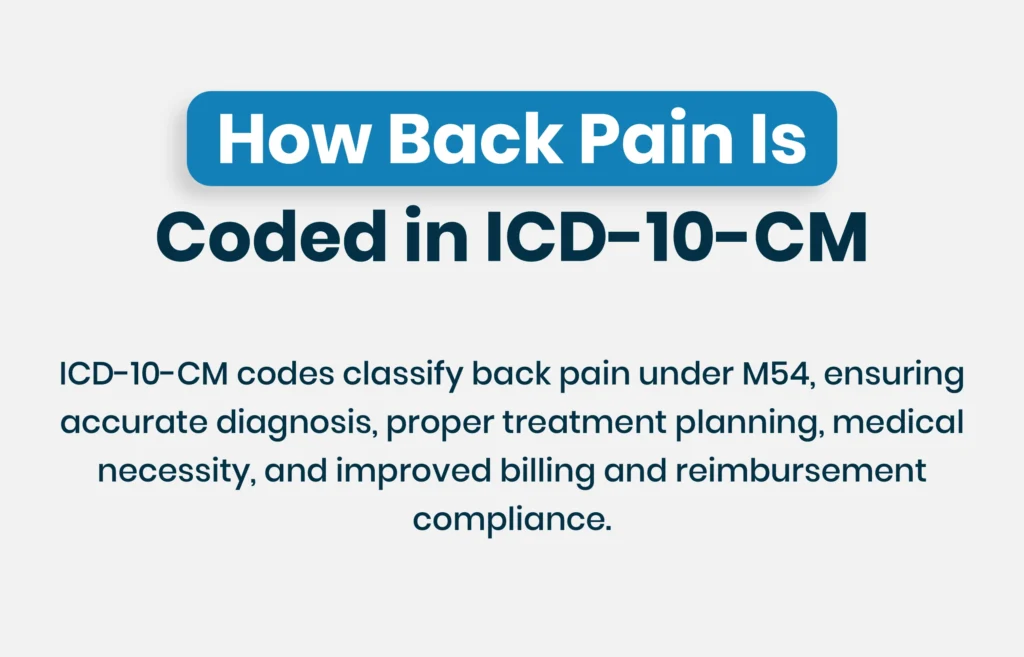
For the M54 category, there are classifications for the different types of back pain depending on the site, causative factor, and type of back pain. Codes include low back pain, spinal pain, sciatica, cervicogenic headache, and radiculopathy. The use of such specific codes ensures accurate representation of the patient’s condition and assists in treatment plans as well as communication between health practitioners and insurance companies.
It is important to know that proper coding is key in the revenue cycle. The choice of appropriate codes reduces claim denials, proves medical necessity for treatment, and speeds up payment. In addition, proper coding is key in complying with payer standards and regulations and minimizes audit risks while ensuring proper clinical and financial data management.
Expert Advice: Avoid mistakes in ICD-10 coding by adhering rigidly to documentation when selecting the appropriate diagnoses. Make sure to confirm the source, cause, and location of the pain, including any proof such as imaging.
Most Common ICD-10 Codes for Back Pain
Correct diagnosis coding starts with an insight into the commonest back pain coding types. This is because accurate diagnosis codes will help with the documentation of the condition as well as improving reimbursement outcomes.
Low Back Pain Codes
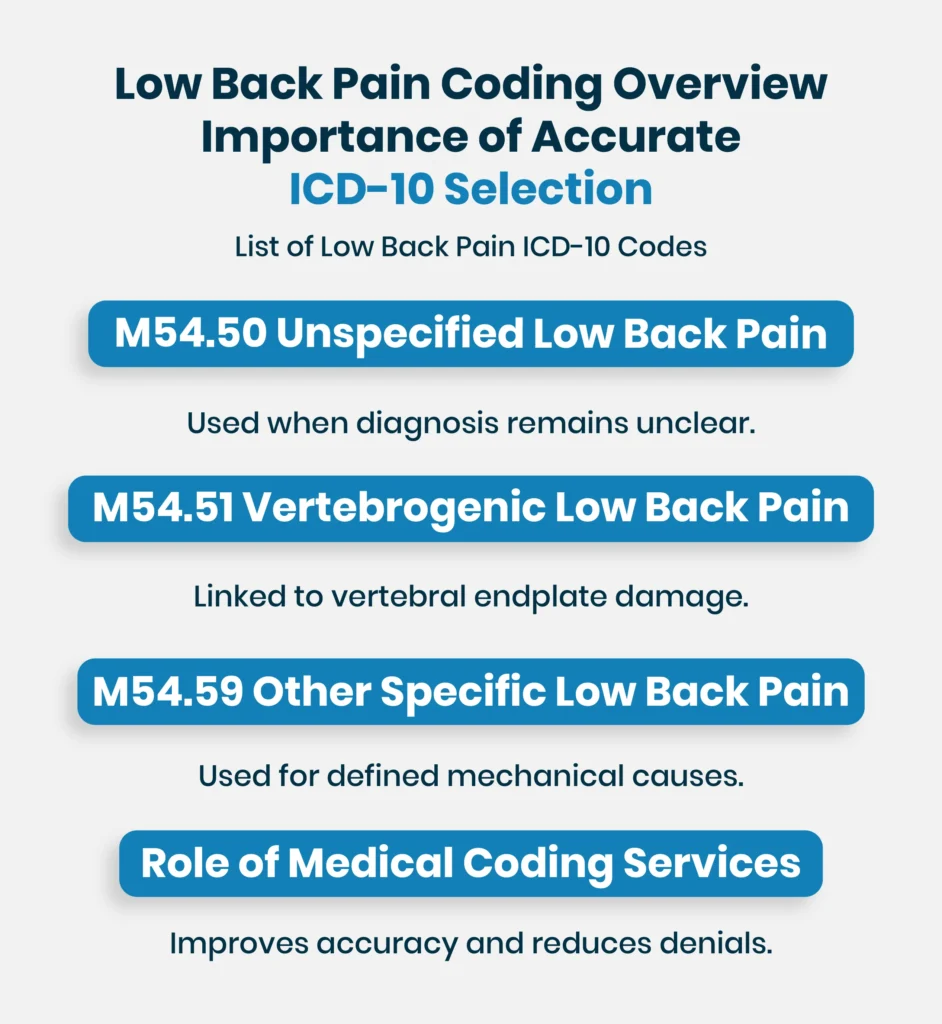
Low back pain is one of the commonest complaints involving musculoskeletal problems. The Low back pain ICD 10 code classification contains codes for M54.50, which represents unspecified low back pain; M54.51 represents vertebrogenic low back pain; while M54.59 represents other specified low back pain.
General Back Pain Codes
When the documentation fails to provide detailed information regarding anatomy, or when the condition does not fall into any particular classification, then general back pain diagnosis is given. Codes that can be applied under Back Pain ICD 10 code category include M54.9 for Unspecified Dorsalgia and M54.89 for other Dorsalgia.
Upper and Mid-Back Pain Codes
Pain that affects either the thoracic region or the cervical region needs special codes for proper documentation of the condition. The ICD 10 code for thoracic back pain is M54.6 and M54.2 for neck and upper spine pain.
Low Back Pain ICD 10 Codes: Choosing the Correct Diagnosis Code
Proper coding for low back pain is critical and needs to be done after thorough analysis of patient records. It not only ensures compliance but also helps in proper billing. The code should accurately describe the patient’s condition. Medical coding services can further assist providers in selecting precise ICD-10 codes, improving accuracy, reducing denials, and ensuring smooth reimbursement.
When to Use M54.50
The M54.50 code is applied if there is the presence of low back pain without a definitive diagnosis. It is worth noting that the ICD 10 code M54.50 is frequently employed in instances where there is still need for assessment since a diagnosis cannot be confirmed at the time.
When to Use M54.51
M54.51 is meant for cases of vertebrogenic low back pain caused by endplate lesions of vertebrae. This condition will always require some form of diagnostic imaging, including MRI evidence of Modic changes. In considering how to code back pain in ICD 10, one should make sure that documentation justifies M54.51.
When to Use M54.59
M54.59 is used for pain in the lower back from mechanical, muscular, or another specific source that does not meet the criteria for codes M54.50 or M54.51. The use of M54.59 ICD 10 code provides doctors an opportunity to report the established pain patterns without loss of specificity.
Professional Tip: Always choose the most specific ICD-10 code supported by clinical documentation. Avoid defaulting to unspecified codes when imaging, exam findings, or etiology evidently justify M54.51 or M54.59 which ensure accurate billing, minimized denials, and improved reimbursement outcomes.
Sciatica and Radiculopathy Coding
Nerve-type issues like sciatica and radiculopathy need to be coded based on symptoms since they need more detailed coding than back pain in general. Precise documentation of symptoms is key to ensuring proper coding and helps establish medical necessity.
ICD-10 Codes for Sciatica
These codes will be given if there is any pain felt running through the sciatic nerve to one leg or both legs. The codes applied under Sciatica ICD 10 are M54.30 if there is an unspecified side, M54.31 for right-side sciatica, and M54.32 for left-side sciatica.
ICD-10 Codes for Lumbago with Sciatica
If an association is noted between lower back pain and symptoms of sciatica, then the codes for lumbago with sciatica need to be applied. The Lumbago ICD 10 Codes include M54.40 (unspecified side), M54.41 (right side), and M54.42 (left side).
Lumbar Radiculopathy Codes
The Radiculopathy ICD-10 Codes are applied if the patient has any problems such as pain, numbness, tingling, or weakness caused by nerve root compression. If this condition happens at the lumbar spine, we apply the Lumbar radiculopathy ICD 10 Code M54.16. On the other hand, M54.17
Chronic vs. Acute Back Pain Coding
Distinguishing between acute and chronic back pain is key to appropriate diagnosis coding and insurance coverage. However, no specific acute pain codes are provided by ICD-10, documentation of the pain’s duration is crucial when choosing a code and filing a claim.
How ICD-10 Handles Acute Back Pain
ICD-10-CM does not offer a single diagnostic code for any particular pain, considering its acute duration alone. In other words, ICD 10 code for acute back pain will commonly be an ICD-10-CM back pain code which depends on the documentation provided by the health care provider.
Coding Chronic Back Pain Correctly
If a patient is suffering from pain that persists for many months, then the coder can assign G89.29 along with the relevant back pain codes based on the documentation provided. There are a number of benefits associated with using the Chronic back pain ICD 10 code technique.
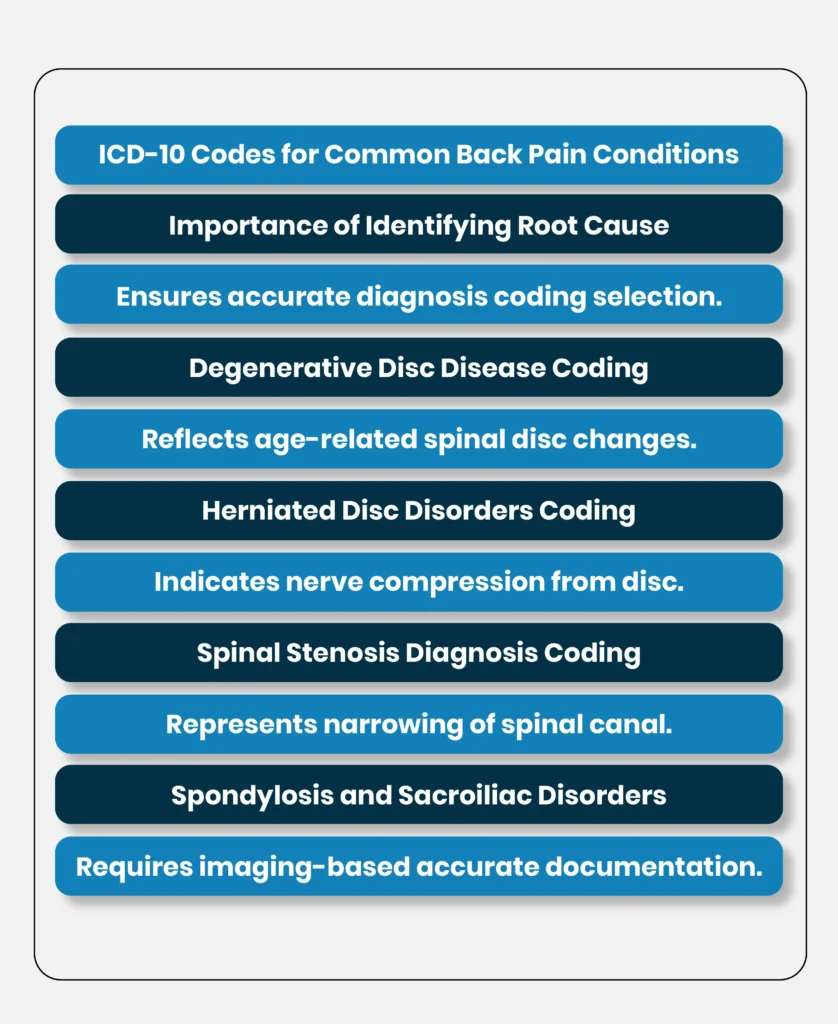
ICD-10 Codes for Common Back Pain Conditions
Most diagnoses associated with back pain involve the existence of some underlying problem other than the symptoms themselves. Knowing the exact cause of the pain helps in providing proper diagnosis codes that will allow for correct documentation as well as reimbursement.
Degenerative Disc Disease
Degenerative disc disease is often related to age-related changes in the spine that take place in the lumbar and lumbosacral areas. Once there is an image showing that the source of the symptoms is indeed disc degeneration, there may be specific diagnostic codes assigned rather than using ICD 10 for back pain.
Herniated Disc Disorders
Conditions involving herniation discs are those that are caused by pressing of the spine discs against nerve fibers in the body. The diagnosis ICD 10 code for lumbar pain can be substituted with those of disc disorders when there is evidence of disc displacement and radiculopathy.
Spinal Stenosis
Spinal stenosis is an instance where the spinal canal narrows. This may affect the nerves and other tissues in the canal. Documentation will be important during coding of the Back pain diagnosis coding guide because the imaging results usually influence the coding of the condition.
Spondylosis and Spondylolisthesis
Spondylosis is an issue related to age of the spine, whereas spondylolisthesis denotes vertebral displacement. It is important for proper diagnosis to confirm these conditions through images, and the medical professional must document the condition accordingly. Both conditions need reporting beyond the common Back pain ICD 10 code.
Sacroiliac Joint Disorders
Disorder of the sacroiliac joint can masquerade as lumbar pain and be missed when evaluating the patient. Proper diagnosis of either SI joint pain or lumbar pathology is very important to get the correct code. Understanding the question of how to code unspecified back pain begins with identifying whether symptoms originate from the spine or sacroiliac region.
Back Pain Laterality: Does Side Matter?
Laterality has significant importance in coding some back pain problems as per ICD-10 guidelines, especially those with neurological manifestations. Knowledge of the situations where laterality becomes important will assist in accurate coding as well as avoiding denials from insurance carriers.
Conditions Requiring Laterality
However, there are some conditions that mandate the documentation of symptoms either on the right or left side of the patient’s body. In the case of the diagnosis of sciatica, there are different sets of codes for the right side, left side, and unspecified.
Conditions Without Laterality
The majority of the codes used to identify back pain do not have right or left side options. For instance, the code for unspecified back pain, which is ICD 10 codes for other low back pain, and other dorsalgia codes are coded depending on symptom location, not right or left sides.
Requisite Documentation for Correct Coding
Accuracy in diagnosis coding will not be possible without proper documentation of the condition, which forms the foundation of the entire billing process. It is the responsibility of the physician to ensure that symptoms, examination findings, and the cause of the disease are clearly documented. Outsource medical billing services can further support practices by improving documentation review, enhancing coding accuracy, and reducing claim denials.
Elements That Providers Should Document
The correct documentation requires documentation of the site of the pain, onset, time, duration, limitation in activity, neurologic examination results, diagnostic tests conducted, and any persistent diagnosis. For instance, having a knowledge of the way the documentation of back pain will help in billing starts with proper documentation and coding of ICD-10 code.
A properly documented documentation shows explicitly the specific site, severity, duration, findings from the physical exam, and the diagnostic criteria of the symptoms. In contrast, a phrase like “back pain” leaves room for ambiguous coding. Guidelines on back pain coding are crucial for medical practitioners to avoid errors in their documentation.
Common Back Pain Coding Mistakes
Back pain coding errors are a leading cause of claim denials and reimbursement delays in clinical practice. Most issues arise from outdated coding habits, incomplete documentation, or misunderstanding ICD-10 guidelines. Identifying these mistakes early improves coding accuracy and strengthens revenue cycle performance.
Errors that often result in Denied Claims
These errors may include the use of obsolete ICD-10 codes, extensive use of unspecified conditions, and neglect of chronic pain modifiers where necessary. Other errors include sequence errors in coding and non-adherence to the Excludes1 instruction, among others. Knowledge of the ICD 10 code for back pain guidelines is important in avoiding these errors.
Tips on how to Avoid Coding Errors
The most effective way to avoid coding errors is through regular internal audits, continuous staff training, and access to up-to-date coding resources. Having a well-coordinated back pain coding and billing process helps reduce common mistakes and improves accuracy. Denial management services further strengthen the revenue cycle by identifying errors early, correcting claims promptly, and minimizing reimbursement delays.
Expert Tip: Prevent back pain coding denials by frequently auditing claims, updating ICD-10 knowledge, and confirming documentation supports code specificity. Always verify Excludes rules and chronic pain indicators before submission to maintain precision and maximize reimbursement effectiveness.
Changes and Updates of ICD-10 Coding for 2026
There have been many changes and updates in the ICD-10 coding system, and these will remain in the future. Staying updated with FY2026 codes is crucial because even minor changes in coding instructions can meaningfully impact medical billing accurateness and reimbursement outcomes. This applies not only to physical conditions like back pain but also to mental health diagnoses such as ICD-10 codes for depression, where precise coding is correspondingly important for compliance and proper claim processing.
Current FY2026 Coding Instructions
One of the main characteristics of FY2026 coding instructions is that greater specificity will be required for the diagnosis. In case of back pain, practitioners should be aware that it is necessary to have very specific information and to avoid vague descriptions like ICD 10 code for unspecified back pain.
Reviewing Changes to ICD-10 Codes
It is extremely important to stay up-to-date regarding new coding instructions. It means that there should be an annual review of the updates of ICD-10 and updating provider education. Following the described procedure will help use ICD 10 code for upper back pain or for other kinds of back pain.
Best Practices for Medical Billing for Back Pain
For effective medical billing related to back pain, merely using the correct ICD-10 code is not enough. The combination of accuracy in the diagnosis, quality of documentation, and requirements by the payer will result in smooth processing of the claim and timely reimbursement.
Increased Claims Acceptance
The best way to increase the acceptance rate of claims is to choose the right diagnosis on the basis of clinical documentation. Accurate medical records that help validate the coding choice make the medical practice compliant, thus improving the Back pain medical billing codes process and helping in making a case for medical necessity.
Revenue Cycle Management
The key aspects of effective revenue cycle management are reducing denial rates, speeding up claim submission processes, and staying prepared for any auditing. The consistent use of accurate Back pain coding and billing can help in achieving fast reimbursements.
How Stream RCM support with Back Pain ICD-10 Coding
Stream RCM, which is one of the leading medical billing service providers in the United States, provides support for coding back pain conditions using ICD-10 through correct diagnosis selection, documentation checkup, and decreased claim denials. Stream’s coders utilize the right codes for back pain conditions such as M54.50, M54.51, and M54.59 among other payer guidelines that enhance revenue cycle process efficiency.
FAQs
What is the ICD-10 code for back pain?
The ICD-10 code for back pain depends on location and clinical detail. Generally used codes include M54.50 for low back pain, M54.6 for thoracic pain, and M54.9 for unspecified dorsalgia. Appropriate selection relies on documentation specificity and symptom localization for correct billing and reporting.
What is the ICD-10 code for chronic low back pain?
Chronic low back pain is coded using a site-specific M54.5x code such as M54.50, M54.51, or M54.59, combined with G89.29 for chronic pain when documented. This combination reflects both pain location and chronicity which confirm accurate coding and better reimbursement outcomes for lasting conditions.
Is M54.50 a billable code?
Yes, M54.50 is a billable ICD-10-CM code applied for low back pain when no specific cause is identified. It is normally applied in initial assessments or nonspecific cases. Appropriate documentation must support its use to avoid denial and certify compliance with payer requirements.
What is the difference between M54.50 and M54.59?
M54.50 represents unspecified low back pain with no identified cause, while M54.59 indicates other specified low back pain such as mechanical or muscular types. The difference depends on documentation detail, where M54.59 requires more clinical characterization compared to nonspecific presentation in M54.50 coding.
How do you code unspecified back pain?
Unspecified back pain is coded using M54.9 when the region is not evidently documented or M54.50 when low back pain is specified without cause. Precise coding depends completely on provider documentation which makes detailed clinical notes essential for selecting the correct ICD-10 diagnosis code.
Which ICD-10 code is used for lumbar pain?
Lumbar pain is most commonly coded as M54.50 for unspecified low back pain or M54.59 for specified mechanical or muscular pain. If vertebrogenic pathology is confirmed, M54.51 may be used. Code selection depends on clinical findings, imaging results, and provider documentation accuracy.