


CPT codes are of significant importance in medical billing and help in standardizing reports and reimbursement of healthcare services. One of the most commonly used codes is the 99213 CPT code, also termed as the CPT code 99213, which is used for a routine outpatient visit of established patients. The importance of the 99213 CPT code description, documentation, and 99213 CPT code description time is significant in the claim process.
Code 99213 is an important procedure code that helps in proper compensation. It is important to understand what is 99213 CPT code and its requirements in order to implement it in an accurate manner in medical billing, as practiced by a medical billing company in USA, while taking into consideration the Medicare reimbursement for 99213 and 99213 modifier 25.
What is 99213 CPT code?
The CPT code 99213 is normally applied in the medical coding process. CPT 99213 is a communal outpatient medical code.
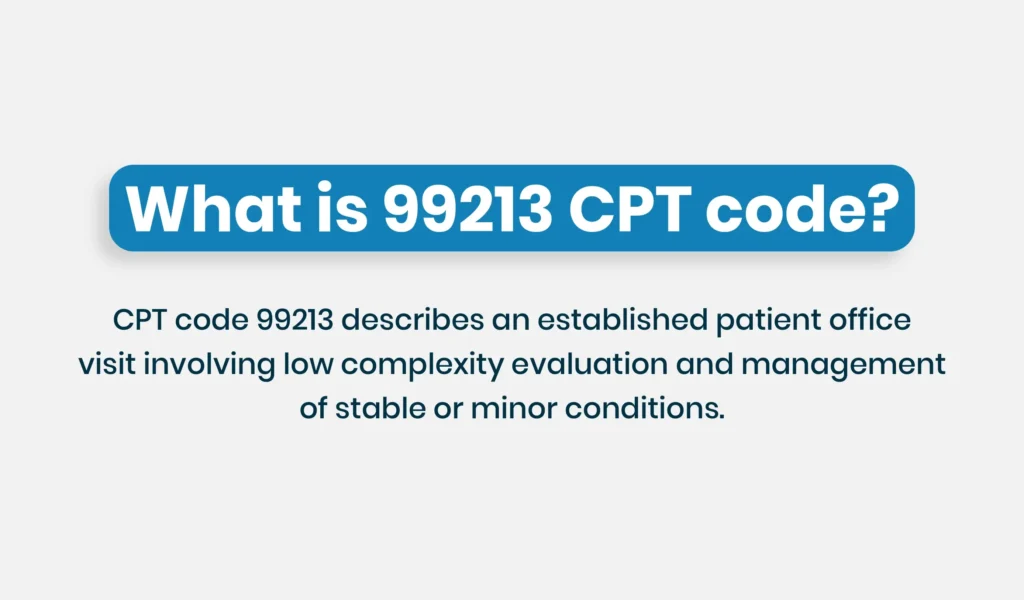
Established Patient Office Visit
The CPT code 99213 is a procedure code which is used for an office visit with an established patient. In this procedure, an individual’s health conditions are evaluated. This procedure code 99213 is considered to be of low medical decision-making.
When to Use This Code
The procedure code to be used in the management of stable chronic conditions or minor acute problems that require evaluation is 99213. Understanding the procedure code 99213 is important in the process of billing and Medicare reimbursement for the code.
The appropriate CPT code that can be used in this scenario is 99213. This code is used for patients who are already established in the clinic and require low-complexity visits such as follow-up visits for a fractured arm, diabetes checks, management of side effects of medications, interpretation of X-rays for asthma, and diagnosing and treating cold sores.
Procedure Code 99213 Description and Requirements
The procedure code 99213 covers and involves office visits for established patients that entail intensive history, restricted examination, and uncomplicated clinical judgment and decisions.
Level of Service Overview
The procedure code 99213 description is indicative of the moderate level of complexity required in the evaluation and management service visits for established patients. As per the analytics done by the American Academy of Family Physicians and the coding studies, the most common service billed is the procedure code 99213, which is indicative of low to moderate levels of decision making. As per the data available, the number of visits by family physicians for established patient office visits exceeded 38 million in the year 2016.
Of all of these, 42 percent were procedure code 99213, and 50 percent were procedure code 99214. As the difference between the two procedure codes is about $35 per visit, which is the national average for Medicare reimbursement, the distinction between the two procedure codes is significant, as the difference of 250 visits could result in a loss of almost $9,000.
Key Components
For accurate CPT code 99213 description, it is imperative that three elements are properly documented:
- History – focused review of systems and chief complaint
- Examination – limited physical examination
- Medical Decision Making – low complexity decisions for ongoing and trivial health issues
Common Clinical Scenarios
The CPT code 99213 is frequently functional for routine follow-ups, chronic condition management such as diabetes or hypertension, medication management, or minor acute complaints. Understanding what is 99213 CPT code supports in meeting documentation requirements and maximizing reimbursement for Medicare 99213.
Pro Tip: Document the focused history, partial exam, and low-complexity medical decisions evidently to meet the requirements for 99213 and to guarantee the accuracy of Medicare reimbursement.
Time-Based Billing for CPT 99213
CPT code 99213 billing is determined by time spent If care coordination or counseling drives the encounter, supporting proper billing and regulatory compliance.
Typical Time Range
For 99213 CPT code, the average time taken for an established patient can vary from 20 to 29 minutes. Research on outpatient Evaluation and Management services indicates that accurate time monitoring is significant for compliance purposes. It is essential to comprehend the 99213 CPT code description time to align with the services provided to the patients.
When Time Determines Code Selection
Time may be the factor in code selection if the service is primarily one of counseling or coordination of care. If the visit duration happens the minimum required time, the CPT code 99213 is designated based on time rather than thorough documentation. This supports correct coding to avoid undercoding or overcoding, which is indispensable for proper Medicare reimbursement.
Documentation for Time-Based Billing
Documentation of time, counseling, and care coordination is essential in time-based billing. The documentation should include clear notes on services rendered in order to justify CPT code 99213. Documentation is essential in order to comply with requirements, ensure audit readiness, maximize reimbursement, including Medicare reimbursement for 99213, while minimizing denial.
Documentation Guidelines for Compliance
Exact documentation for CPT code 99213 certifies compliance, cares for medical necessity, and minimizes audit risks while improving Medicare reimbursement.
Required Documentation Elements
Clear and accurate documentation records are important in CPT code 99213 billing. Comprehensive records of history, assessment, and medical decision-making are essential for proper care and compliance for medical practices. Documentation should reflect laboratory data, patient vitals, and planned interventions. This will authorize that the procedure code 99213 description is appropriately maintained and errors in documentation which make it easy for Medicare to pay.
Medical Necessity and Audit Considerations
Each claim for 99213 CPT code must be authenticated with medical necessity in the billing process. Clear records are significant to authenticate the purpose of the encounter or visit, intervention, and follow-up care. Well-maintained documentation is key to effective audit compliance, protection against denied claims, and adherence of legal and regulatory standards. Observance is critical in confirming precise 99213 CPT code description, billing genuineness, and compliance with Medicare reimbursement for 99213.
Pro Tip: The need for comprehensive history, examination, vital signs, laboratory, and decision-making documentation is accentuated in order to conform with CPT 99213 and avoid audit or claim denials.
Understanding Modifier 25 with CPT 99213
The 99213 modifier 25 is useful to assume separate evaluation and management services for the medical code 99213, which settles precise billing, compliance or adherence, and suitable reimbursement by Medicare.
What is Modifier 25
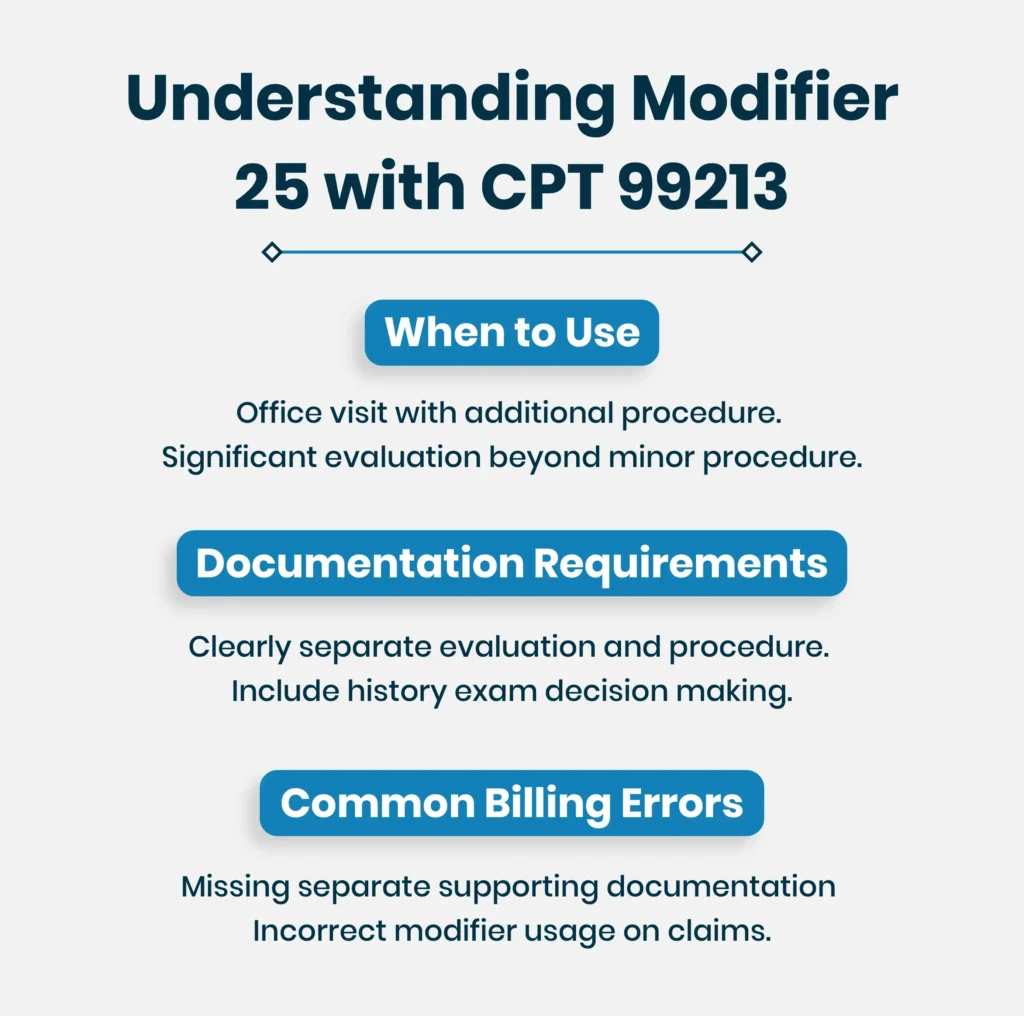
CPT code 99213 modifier 25 is used when significant and separately identifiable evaluation and management services were performed on the same day as other procedures. It is added to the CPT Code 99213 and differentiates routine evaluation from other procedures, thus guaranteeing accurate reimbursement of 99213 by Medicare.
Appropriate Usage Scenarios
One of the examples of CPT code 99213 with modifier 25 is applied in situations where there is an office visit with a separate evaluation, counseling, or management service with a minor procedure. This is vital in confirming that claims are not denied and that requirements for payers or adherence includes Medicare 99213 and other applicable coding standards.
Documentation Requirements
To support the use of modifier 25 with the CPT Code 99213, documentation of the service provided should be separate from any procedures provided. The documentation should include history, examination, medical decision making, and counseling to make sure the claim is accurate.
Common Billing Errors
Common mistakes include the improper or unsuitable use of modifier 25 without separate documentation, identical or duplicate procedures, and misunderstanding the payer procedures. Improper application of the code may trigger claim rejection, audits, or reduced reimbursement, which stress the value of following standards and accurate coding of procedure code 99213 description during outpatient visits.
Medicare Reimbursement for 99213
Medicare reimbursement 99213 is dependent on numerous factors such as RVUs, locations, and settings, with medical coding services playing a significant role in this process.
Overview of Reimbursement
The amount of medical code 99213 reimbursement is subject to variation depending on Medicare fee schedules. Commonly, 99213 is used for moderately complex levels of outpatient services. Understanding Medicare reimbursement 99213 supports medical practices and coding services advance claims to ensure correct payments, and prevent underpayment for routine established patient visits.
Factors Affecting Payment
Payment for CPT code 99213 varies depending on geographical areas, practice settings and specific standards. The difference between facility and non-facility settings is also crucial which can meaningfully affect reimbursement rate. The variables need to be understood to confirm proper Medicare reimbursement for 99213.
RVUs Clarification
The Relative Value Units describe the work value, practice expense, and mismanagement for the procedure code 99213. The proper command of RVUs is important for appropriate billing, comparing practice productivity standards, and fair reimbursement for Medicare and other payers for services provided under the 99213 CPT code.
How to Verify Current Rates
Providers can check the rate of CPT code 99213 through CMS fee schedules, payer websites, and professional resources. Partnering with medical coding companies such Stream RCM which is offering best medical coding services to providers can modernize your billing process to certify compliance and maximize claims for precise Medicare reimbursement for 99213 and industry standards.
Pro Tip: Understand the rates of CPT 99213 using fee schedules and resources from CMS, know the RVUs, the differences between facilities, and geographic adjustments, and also consider working with expert coding services to ensure accurate and compliant reimbursement from Medicare.
Billing and Coding Best Practices for CPT Code 99213
Following best practices for CPT code 99213 which ensures precise coding, avoids errors or minimize errors, supports compliance, and makes best use of Medicare reimbursement.
Accurate Code Selection
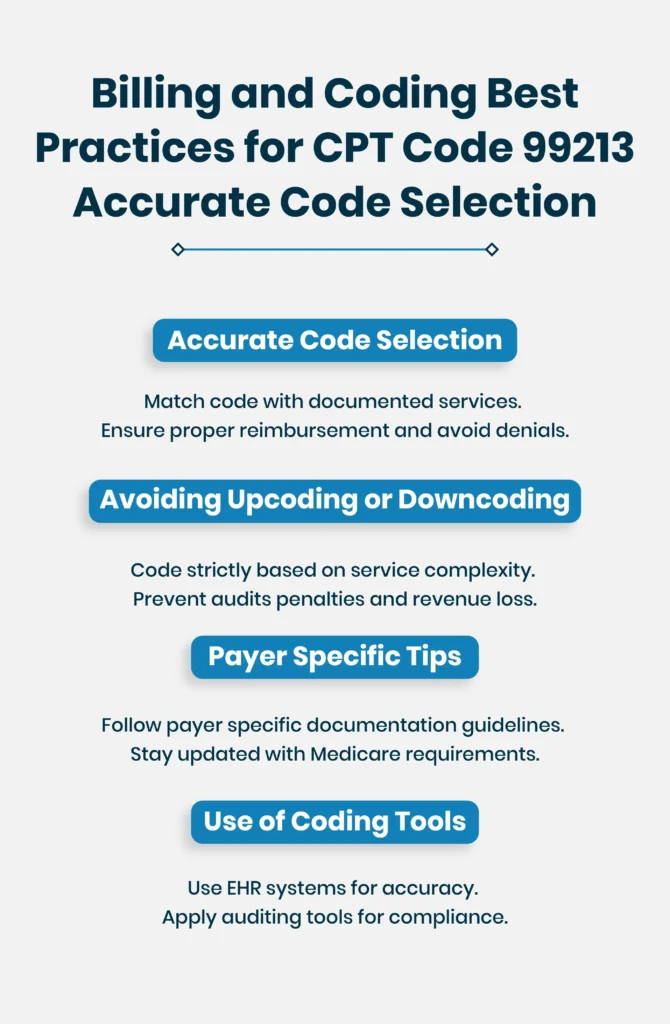
Using the right code in medical billing will ensure that the claim filed is an accurate representation of the service provided. The CPT code of 99213 should be consistent with the documented history, examination, and medical decision making. The correct use of the CPT Code in medical billing will not only prevent denials but also aid in the reimbursement of the Medicare claim for the 99213 code.
Avoiding Upcoding or Downcoding
Upcoding can lead to audits, which may result in penalties, whereas downcoding can cause revenue loss. Providers should only use the 99213 CPT code billing on the basis of service complexity. Ethical practice can be achieved by strictly adhering to accurate coding principles to maximize reimbursement opportunities for outpatient visits.
Payer-Specific Tips
Insurance payers may have specific documentation or modifier needs for procedure code 99213. Keeping abreast of each insurance payer’s rules and regulations, including Medicare which can prevent claim denials and facilitate compliance as well as proper reimbursement for services provided. Partnering with professional coding experts or denial management services providers can modernize adherence to specific payer guidelines and accurate claims submissions.
Use of Coding Tools
The electronic health record systems, coding software, and auditing tools can assist in ensuring an accurate 99213 CPT code description. These technologies can be used to their maximum potential to guarantee consistency in documentation and compliance with Medicare reimbursement 99213.
99213 vs 99214: Understanding the Difference
The code 99214 has higher levels of complexity in comparison to the code 99213. The medical decision-making process and the history and/or examination process are more complex in the code 99214. However, it is only possible with an understanding of the complexity associated with 99214 CPT code, including the requirements for the procedure, Medicare reimbursement, and the need for Modifier 25. Similarly, it is only possible with an understanding of the complexity associated with 99213 descriptions, including the requirements for the procedure and Medicare reimbursement.
The time threshold and the documentation process and the condition of the patient are the factors that make the selection of the code 99213 or the code 99214 appropriate. The inappropriate code selection may result in claim denials and audits. The appropriate code selection is possible with the compliant usage of the code modifier 25.
Common 99213 Documentation Mistakes to Avoid
Errors in CPT code 99213 documentation can lead to claims denials, audits, and lost reimbursement, reinforcing or focusing the necessity of compliance or adherence. Below are the top documentation mistakes which can removed for claims and Medicare reimbursement:
- Failing to evidently document patient history, exam, or medical decision-making correctly.
- Neglecting justification for medical necessity, which can activate claim denials.
- Using Modifier 25 inaccurately, without a distinct separate evaluation recorded.
- Copying or pasting previous notes which cause irregularities in documentation.
- Lack of time recording spent on counselling or care coordination when appropriate.
- Providing vague or unclear descriptions of symptoms and patient complaints.
- Overlooking updates in payer-specific documentation or coding requirements.
- Failing to document follow-up plans or patient instructions evidently.
- Misaligning CPT code selection with authentic service complexity and patient care.
- Missing necessary documentation or data such as diagnostic findings or lab results.
How Stream RCM Support with CPT code 99213
Stream RCM which a leading medical billing services providers in the USA, supports medical practices advance CPT code 99213 claims by certifying precise documentation, proper modifier usage, and appropriate Medicare reimbursement for 99213, minimizing denials and modernizing revenue cycles for well-organized, compliant medical billing and coding services.
FAQs
What is the difference between 99213 and 99214?
The CPT code 99213 is appropriate for low complexity evaluation of an established patient, while the CPT code 99214 is relevant for moderate complexity evaluation, which includes the expanded history, thorough exam, and high level of medical decision-making.
Why would CPT code 99213 be denied?
Denials happen when documentation is unsatisfactory, when medical necessity is not clearly established, when the use of modifier 25 is unsuitable, when the code does not reflect the visit’s complexity, and when procedures specific to the payer are not followed to support the Medicare reimbursement for the 99213.
What is the difference between CPT code 99212 and 99213?
The code 99212 is for short-term, low complexity visits or encounters with nominal history and tests. However, the code 99213 has more extensive assessment, decision making, moderate complexity, more time, and more reimbursement than the practice code 99212.
How much is the reimbursement for 99213 and 99214?
The reimbursement fluctuates liable on the location and the payers. The average reimbursement for the 99213 CPT code is less when compared to the reimbursement for the 99214 codes. The reimbursement for the 99214 code is more because it is more complicated. The Medicare reimbursement fluctuates depending on the facility and the non-facility settings.
How many times can a CPT 99213 be billed?
The CPT code 99213 under the CPT has the likelihood of being billed more than once. However, this is possible if the visits are made separately and meet the standards of ‘medical necessity.’ This is possible if the documentation is appropriate and the decision-making process is different.
What are the 5 things that Medicare does not cover?
Experimental treatments, cosmetic surgery, custodial care, routine dental care, and most hearing aids are not characteristically covered by Medicare. It only covers those medical treatments that are necessary, well documented, and consistent with federal strategies and Medicare reimbursement for 99213.