


Accurate CPT coding for the procedure of liposuction is important to ensure proper and prompt reimbursement as well as compliance with regulations. Even minor coding mistakes can activate denial, delay, audit, or loss of revenue for the providers.
Because liposuction is considered a cosmetic procedure, it is very dependent on medical necessity and documentation. Operative notes and accurate diagnosis coding are essential for justification and payment.
In this blog, we will explain liposuction CPT codes, modifiers, documentation requirements, and coverage guidelines to help providers and any medical billing company to deal better with billing confidently and reduce claim rejections.
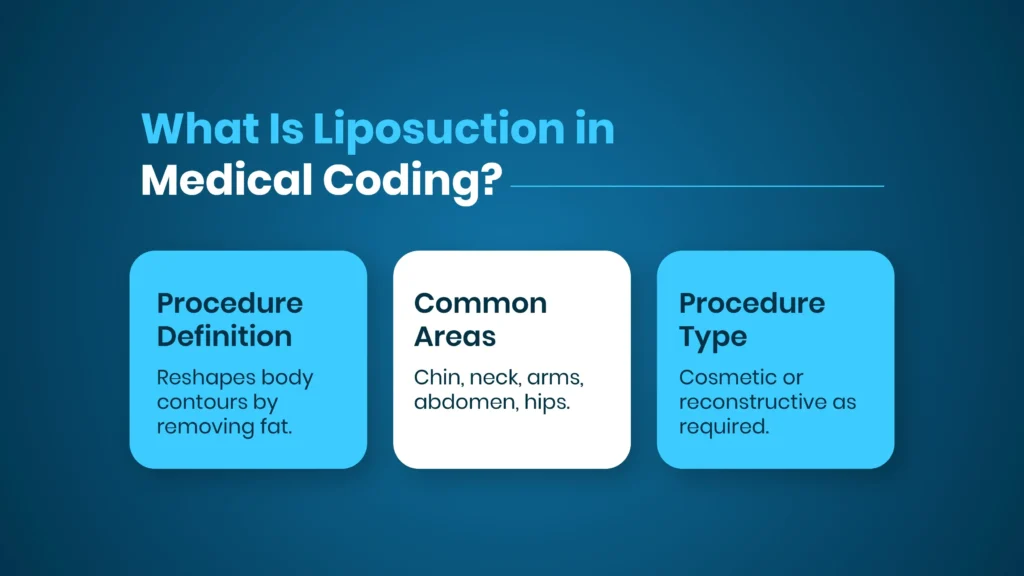
What Is Liposuction in Medical Coding?
Liposuction, also sometimes termed suction-assisted lipectomy, is a surgical technique aimed at reshaping body contours by removing localized fat deposits. According to MedlinePlus, liposuction can involve areas such as the chin, neck, arms, abdomen, hips, thighs, and calf, although this is often accompanied by surgical risk and a painful healing process. The technique is classified in the Integumentary System, in the “Other Repair (Closure)” section in the CPT manual.
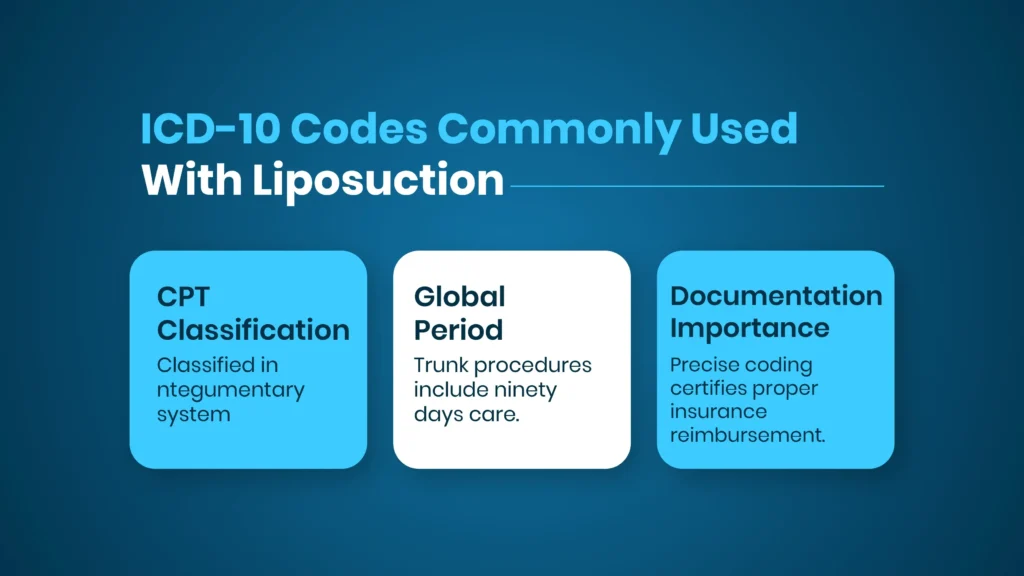
The global period for trunk procedures such as abdominal liposuction is 90 days. This means that routine postoperative care is included in the payment for the procedure, and additional visits related to the care of the patient are not separately charged. Proper coding is required for this.
It can be considered cosmetic when it is done for purely cosmetic purposes. On the other hand, it can be considered a reconstructive procedure when it is done for rectification of conditions such as lipedema, post-traumatic deformities, and functional impairments.
CPT Codes for Liposuction by Anatomical Region
The liposuction CPT codes are determined by body areas treated. The use of the correct CPT code for liposuction is important for suitable documentation and reimbursement of medical procedures.
Head and Neck – CPT Code 15876
The CPT code 15876 is for liposuction of the head and neck areas including chin, face, and neck areas. The CPT codes for liposuction are of significant position in order to ensure proper processing of claims. The correct CPT code for liposuction is important in ensuring that claims are not denied. The documentation of areas is important for reporting procedures.
Trunk (Abdomen, Flanks, Back) – CPT Code 15877
The most commonly used CPT for liposuction is CPT 15877, which covers the abdominal, flank, and back areas. The correct use of this CPT code for liposuction is vital for reimbursement. The global period for CPT 15877 is 90 days for trunk areas. The documentation and correct application of CPT code guidelines for liposuction are vital for determining medical necessity.
Upper Extremity – CPT Code 15878
CPT code 15878 is used for liposuction of the upper extremities and primarily the arms. The accurate use of the CPT code for liposuction helps ensure claims are managed without mistakes. Medical records should detail the area treated, procedure used, and fat volume removed. Accurate use of this liposuction CPT code prevents denials and supports proper claim submission.
Lower Extremity – CPT Code 15879
CPT code 15879 is used for liposuction of the lower extremities and are basically including thighs, knees, and legs. Correct reporting of this CPT for liposuction ensures appropriate documentation and reimbursement. Detailed operative notes and documentation of the treated regions are critical. Following the CPT code guidelines for liposuction helps avoid claim denials.
Pro Tip: Ensure detailed documentation for each liposuction location, specifying exact locations, techniques utilized, and amount of fat removed. Correct application of the CPT code for liposuction, along with accurate documentation, establishes medical necessity, eliminates claim denials, and optimizes reimbursement, ensuring improved compliance with medical billing and claim submission.
| Anatomical Region | CPT Code | Description | Global Period |
| Head and neck | 15876 | Liposuction of face, chin, and neck. Accurate coding ensures proper claim submission. | 90 days |
| Trunk (Abdomen, Flanks, Back) | 15877 | Most commonly billed. Covers abdomen, flanks, and back. Documentation supports medical necessity. | 90 days |
| Upper Extremity | 15878 | Liposuction of arms. Include details on fat volume removed and surgical technique. | 90 days |
| Lower Extremity | 15879 | Liposuction of thighs, knees, and legs. Proper documentation avoids denials. | 90 days |
Deep Dive: CPT 15877 – Trunk Liposuction
CPT 15877 is used for suction-assisted lipectomy of the trunk, including the abdomen, flanks, and back. The correct use of CPT code liposuction is important for proper documentation of medical claims.
The most common liposuction CPT code used in abdominal liposuction is this particular code. It is used in the removal of fat deposits to enhance body shape. It is important to use the CPT for liposuction to avoid denial of payment.
Although often cosmetic, CPT 15877 can be used as reconstructive in cases of lipedema, traumatic deformity, and functional impairment. Documentation is essential and mandatory, including the treatment site, method, and clinical justification, in order to validate the liposuction CPT code procedure.
How to Code Multiple Liposuction Areas
Report one CPT code for liposuction in each area for liposuction procedures in multiple body areas. For example, 15877 can be used for the abdominal area, and while codes 15877-59 can be used for the flank area. The use of modifier 59 is indispensable in order to avoid unbundling and to report the procedure properly.
Accurate documentation of the treated areas and surgical procedures is a necessity. Seeking professional medical coding services can ensure compliance, avoid claim denials, and facilitate accurate submission of liposuction CPT codes. Clear operative notes justify the need for each procedure, making reimbursement more efficient.
Modifiers Used with Liposuction CPT Codes
Modifiers deliver additional information about liposuction procedures to ensure accurate coding, proper reimbursement, and compliance with industry coding standards, guidelines and insurance requirements. Medical providers can refer to other comprehensive resources that provide information on coding, documentation, and reimbursement to learn more about the precise use of CPT codes in medical billing . Following are the modifiers that can be used with Liposuction CPT Codes:
Modifier 22 – Increased Procedural Services
Modifier 22 is to be used when a surgeon does a lot of work than normal in the case of liposuction. The application of this CPT code for liposuction is properly documented to maintain the claim rejection.
Modifier 50 – Bilateral Procedure
The use of modifier 50 is in case liposuction has been done on both parts of the body. The use of the liposuction CPT code is a bilateral procedure, and when used correctly, the code will indicate that the procedure is bilateral.
Modifier 51 – Multiple Procedures
Modifier 51 should be used where several procedures are carried out in the same session. This explains the billing of liposuction CPT code and avoids malpractices of unbundling in medical coding services.
Modifier 52 – Reduced Services
Modifier 52 is applied when the liposuction procedure is not completely performed or in case the procedure is reduced. The reason should be documented to justify adequate CPT code for liposuction submission.
Modifier 59 – Distinct Procedural Service
Modifier 59 marks a procedure that has been done on different locations. The following modifier is used to separate CPT code liposuction claims in more than one area of liposuction.
Modifiers 76 / 77 – Repeat Procedures
Modifier 76 is used in case of repeat procedures involving the same physician and 77 involving another physician. Reporting and compliance of liposuction CPT code should be properly documented.
Modifiers 78 / 79 – Return to OR
Modifier 78 is related procedures and 79 is the unrelated procedures throughout the global period. These modifiers endorse proper charge billing of liposuction CPT code services.
Modifiers 80 / 81 / 82 – Assistant Surgeon
These qualifiers show that assistant surgeons are involved in liposuction. The appropriate use of them guarantees proper CPT code for liposuction and reimbursement.
Modifier AS – PA/NP/CNS Assistant
The application of modifier AS is when a physician assistant, nurse practitioner, or clinical nurse specialist is involved in surgery. The liposuction CPT code should be backed up by proper documentation.
Pro Tip: It is essential to document the basis for each modifier used with liposuction CPT codes, especially the complexity of the procedure, bilateral sites, multiple sites, and/or the use of an assistant, in order to ensure accurate coding, avoid denied claims, and ensure full reimbursement for services rendered.
ICD-10 Codes Commonly Used with Liposuction
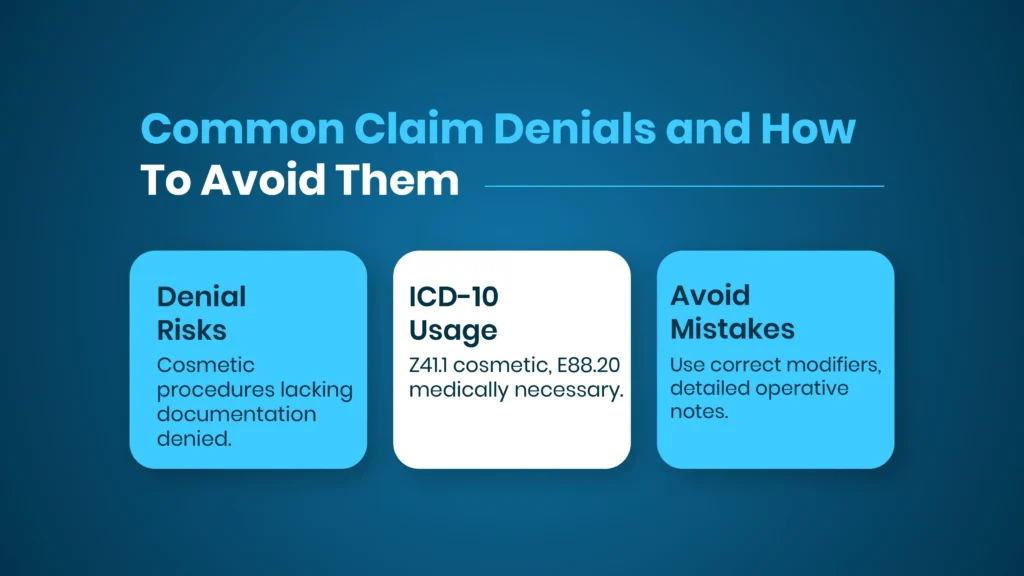
The ICD-10 code for cosmetic suction lipectomy is Z41.1. The accurateness of this procedure is central for documentation and for using the correct CPT code for liposuction as per guidelines and regulations of insurance and medical coding. The ICD-10 codes such as E88.20 and E66.9 are used for medically necessary liposuction. The accuracy of medical necessity is important for modification of the CPT for liposuction.
When Liposuction May Be Covered by Insurance
Whereas the procedure is considered cosmetic, there may be instances where insurance will pay for the procedure, such as in the case of lipedema with failed conservative treatment, functional limitations causing pain and mobility issues, recurrent infections, and trauma deformities. It is important to appropriately code the procedure with the appropriate “CPT code liposuction.”
The necessary documentation includes clinical notes, failed conservative treatments, pre-operative photos, and a comprehensive operative report. The physician also prepares a letter of medical necessity for the procedure. The precise application of the liposuction CPT code facilitates the processing of claims and ensures compliance with medical coding services.
Medicare & Private Payer Considerations
Medicare considers liposuction to be generally cosmetic, but there may be some exceptions depending on the Local Coverage Determinations (LCDs) that may be necessary. It is important to check the preauthorization, policies, and fee schedules to ensure the appropriate utilization of the appropriate CPT code liposuction.
Common Claim Denials and How to Avoid Them
The claim for liposuction code may be denied if the procedure is considered to be cosmetic, documentation is lacking, the modifiers are not appropriately used, or the procedure is performed in multiple sites but not evidently recognized. The proper utilization of the appropriate CPT code liposuction, along with the ICD-10 connection, assists in avoiding these most common mistakes to ensure successful reimbursement.
Detailed operative notes, clear documentation of treated anatomical sites, and the effective utilization of modifiers are recommended to reduce denials. Professional denial management service providers may be partnered with to guarantee the submission of claims, thus enhancing the efficiency of compliance and payment processing for liposuction CPT code procedures.
Pro Tip: Ensure documentation of anatomical sites, procedure details, and modifier use is complete and accurate. Additionally, working with professional denial management services can help prevent denials and maximize reimbursement for liposuction CPT code services.
Documentation Checklist for Liposuction Billing
It is important to have correct documentation when coding liposuction procedures. There should be records of the medical history, symptoms, and functional limitations of the patient. In case of conservatively attempted treatment, it should be mentioned. The correct application of the code of CPT liposuction has been documented and will adhere to the medical code standards.
Precise anatomical points of treatment, amount of fat excised, and the method of surgery should be given in operative details. Moreover, there is a comprehensive plan of postoperative care that justifies medical necessity, claims insurance, and allows the liposuction CPT code to be submitted correctly and receive adequate reimbursement.
How Stream RCM Support Liposuction CPT Codes
The right reimbursement and compliance of liposuction require proper use of the right CPT code. Stream RCM assists the healthcare providers to make sure they are correctly coded, using the appropriate modifiers, and thoroughly reviewing the documentation to help the healthcare practices reduce denials, automate the claims and maximize the earnings of liposuction procedures.
FAQs
What is the CPT code for liposuction?
The initial CPT code of liposuction is based on the area of the body treated: 15876 (head/neck), 15877 (trunk), 15878 (upper extremities), and 15879 (lower extremities). Coding will result in appropriate reimbursement.
When is liposuction considered medically necessary?
Liposuction may be medically necessary for conditions like lipedema, functional impairments, recurrent infections, or post-traumatic deformities. Correct use of the CPT code liposuction requires thorough documentation to justify treatment.
How do modifiers apply to liposuction CPT codes?
The binary increased work, bilateral, multiple procedures, or separate sites are represented by modifiers, i.e., 22, 50, 51, and 59. The correct CPT in liposuction billing and avoiding claim denials are achieved by using it properly.
What ICD-10 codes are used with liposuction?
Z41.1 is applied in the case of cosmetic procedures. E88.20 or E66.9 may be used in medically necessary cases. Association of such codes to right CPT code liposuction would guarantee right claims and documentation.
How can claim denials for liposuction be avoided?
Rejection can be done because of cosmetic classification, the lack of documentation or wrong modifiers. Efforts to avoid denials are best achieved through using correct CPT to perform liposuction, keeping clear operative notes and correctly assigning ICD-10.