


Medical billing and coding comprise the essential elements that make up healthcare payment. In the billing process, revenue codes are used to assign codes based on where the services are delivered in the hospital. Their application impacts transparency in claims submission, billing processes, and financial responsibility.
The revenue codes are vital in determining the remittance since they ensure that the procedures charged are according to the payers’ guidelines. Any mistakes may result in delays or claim denials. In this blog post, we will look into the meaning of revenue codes, their types, use, and Medicare guidelines. As a US medical billing services provider, we also understand how critical accurate coding is for smooth claim processing and faster reimbursements.
What Is a Revenue Code?
Revenue Codes, alternatively known as Rev Codes, are numbers that are assigned in medical billing as classification for the hospital departments where the medical services were rendered to patients. The codes point to which department or cost center provided the medical care to assist payers in determining the kind of medical service on the claim form. Revenue codes report accommodation and ancillary charges in FL 47, showing service capacity with HCPCS codes. They are maintained by NUBC and used by CMS for billing.
Revenue codes are used in healthcare claims processing to group different services under one category. For instance, revenue codes can be used to categorize room charges, lab services, or pharmacy products. It makes it easy to communicate clearly with insurance companies on what services have been provided by the healthcare facility.
Revenue codes and the CPT/HCPCS codes are not the same in terms of purpose and specificity. Where revenue codes specify the type of service provided or its location, CPT/HCPCS codes will indicate the actual procedure, treatment, or supplies that were used to provide the service in question.
As revenue codes and CPT codes are closely connected in billing workflows. You need to learn more about CPT codes in medical billing for improving documentation, billing accuracy, and healthcare reimbursement processes effectively to better understand procedure-level coding.
Why Revenue Codes Matter in Medical Billing
Revenue codes play an important role in accurate billing and reimbursement.
Role in Hospital Billing Systems
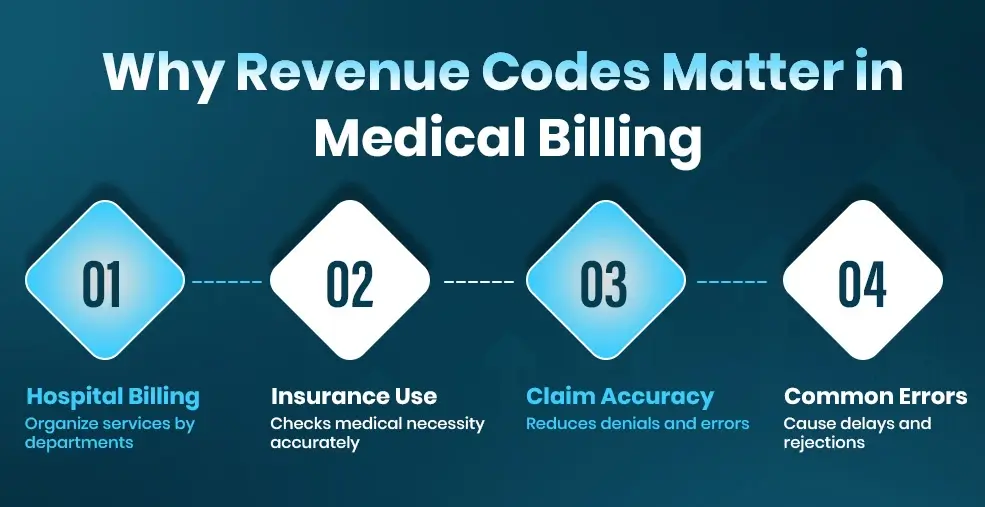
Revenue codes serve to categorize services according to departments within a hospital’s billing system. Learning about what is revenue code in medical billing will allow healthcare practitioners to appropriately categorize services, making the entire process more efficient and ensuring that all the services offered are captured properly.
How Insurance Companies Use Revenue Codes
The use of classifications is necessary for insurers when evaluating claims. It is important for insurance companies to know the revenue code because it helps in determining the category of the procedure being conducted and whether it falls within the parameters of medical necessity.
Impact on Claim Accuracy and Payment
A correct classification is crucial for successful payment because mistakes may result in denied claims or inadequate payments. A proper revenue code list helps ensure that procedures correspond to the insurance company’s standards, thus increasing the probability of receiving an approval. Correct coding increases efficiency and reduces payment differences.
Common Errors and Their Consequences
Revenue coding that contains mistakes like using the wrong revenue code or not linking to any procedure could lead to problems in claim processing. Such mistakes normally lead to claim rejections or late payment of bills. Training and auditing should be done regularly to avoid mistakes in billing processes.
Expert Insight: It is always essential to verify revenue codes against CPT/HCPCS codes before submitting any claims, adhere to latest guidelines set by payers, and undertake frequent audits for minimizing denials and quicker reimbursements.
Structure of Revenue Codes
The revenue codes are usually in the form of three-digit numbers and at times expanded into four-digit numbers for enhanced detail. The knowledge of the revenue code in medical billing as this enables one to understand its various forms and apply it properly in medical billing and medical coding services.
The codes fall under numerous numerical ranges based on specific departments within the hospital or specific services offered by the hospital. It is important to understand the hospital revenue codes to guarantee correct billing of the various services offered by the hospital, thus avoiding errors in the billing process.
For illustration, codes like 0100 for room and board, 0250 for pharmacy, and 0450 for emergency care showcase how classification is systematized. Information of revenue codes medical billing will confirm appropriate use of these sample codes, thus supporting medical providers to process claims professionally and get paid accordingly.
Categories of Revenue Codes
Revenue codes for room and board categorize payments for patient accommodation during hospitalization.
Room and Board (0100–0219)
Room and Board codes are included in a broad classification of inpatient revenue codes that relate to hospital accommodations. The codes pertain to room accommodations classified into private, semiprivate, and ward. These codes are used in order to ensure proper billing, reporting, cost accounting, and reimbursement processing in health care facilities.
Intensive Care (0200–0209)
Revenue codes for intensive care include all those services that are carried out in the Intensive Care Units or other specific units like cardiac or neonatal care units. The hospital revenue codes for intensive care show greater utilization of resources along with special monitoring and staff.
Ancillary Services
Ancillary Services Revenue Codes pertain to diagnostic, imaging, and pharmaceutical services for efficient primary patient care.
Laboratory (0300–0319)
Revenue code categories for laboratory services belong to revenue coding schemes utilized in providing diagnostic testing facilities including blood test services, urine testing facilities, and pathological tests. The purpose of using these codes is to ensure effective billing processes for clinical lab tests provided within a hospital setting.
Radiology (0320–0359)
The radiology revenue codes fall under the category of revenue codes medical billing and are used for procedures such as X-ray, CT scan, and MRI procedures. The revenue codes help the hospitals classify the imaging tests correctly. They help in ensuring proper billing by linking them to insurance companies’ billing criteria and insurance eligibility verification services.
Pharmacy (0250–0259)
Medication revenue codes describe services related to medication under the guidelines provided by the medicare revenue code system and include drug administration and intravenous drug administration. This helps in the accurate billing of medication that is dispensed in hospitals. It also makes the distinction between medication billing and other services easy.
Operating Room & Surgery (0360–0369)
Revenues codes that relate to surgeries, such as those for the operation room and surgeries, represent the codes used when charging for surgical procedures and for the utilization of anesthetics and operation rooms. The surgery revenue codes are vital for revenue coding as they are critical for ensuring proper charges for surgical services.
Emergency Room (0450–0459)
Revenue codes for ER visits refer to health services rendered in the emergency department of a hospital setting, which encompasses acute examinations, stabilization, and treatment. The hospital revenue codes play an important role in revenue coding to help differentiate between emergencies and outpatient visits in order to make correct payments.
Outpatient Services (0510–0519)
Revenue Codes for Ambulatory Care define categories for visits to the doctor’s office, outpatient consultations, and day procedures performed in an ambulatory care setting that do not necessitate any hospitalization stay. The utilization of Revenue Codes for Medical Billing enables appropriate coding for claims and helps achieve consistency in payment for such services.
Other Common Categories
Some other examples of what are revenue codes in medical billing include physical therapy services, durable medical equipment, and medical supplies. Revenue codes provide a means of categorizing various types of supportive therapies or products that can be employed during the treatment process.
Codes that classify durable medical equipment and implants related to what is rev code are vital in recording the cost of things such as wheelchairs, artificial limbs, and surgery implants. Codes on physical therapy account for services related to physiotherapy treatments. This makes it easier to code ancillary services accurately.
Quick Tip: Always confirm that the revenue code ranges are current by referring to the most recent changes in Medicare and NUBC coding, and make sure that the revenue codes match the CPT and HCPCS codes. This helps prevent errors and claim rejections.
Common Revenue Code List
Revenue codes are common types that give examples for accurate classification purposes.
0100 – General Classification (room & board)
Code 0100 includes general charges for room and board within the hospital revenue codes category. This code is meant to be applied when charging for basic inpatient accommodation costs including bed, nursing care, and general services. The correct use of code 0100 is important for proper billing and claim processing.
0250 – Pharmacy (general)
The revenue code 0250 is utilized in revenue codes medical billing in respect to general pharmacy services, which cover drug administration and dispensing. This code assists hospitals in distinguishing their pharmaceutical costs from those of other services offered. Proper use of the revenue code guarantees that hospitals adhere to regulations and avoid denial of claims.
0300 – Laboratory (general)
Code 0300 is categorized within revenue codes that pertain to general laboratory services including blood tests, urinalysis, and pathology diagnostics. The code guarantees that clinical testing procedures are appropriately classified in the billing system of hospitals. This promotes efficient claim processing for diagnostics in health care institutions.
0360 – Operating Room Services
The revenue code 0360 can be considered to represent the operating room services under the category of surgery revenue codes. These involve services rendered in surgeries as well as facility services and supporting functions for the surgical procedure. This will facilitate proper billing of the procedure and ensure accuracy of the billing process.
0450 – Emergency Room
Code 0450 covers emergency room services in hospital revenue code, which encompasses urgent care, stabilization, and instant treatment. This code makes it clear that a visit to an emergency room is not a routine visit to an outpatient facility. Proper application helps ensure proper categorization and payment for emergency health services.
0510 – Clinic Visit
Code 0510 falls under the revenue code in medical billing that is utilized for medical consultations at the clinic. This revenue code applies to all medical examinations, follow-ups, and procedures conducted without any patient admission. Appropriate coding is vital for proper outpatient billing and payment.
0636 – Drugs Requiring Detailed Coding
Code 0636 belongs to the category of medicare revenue codes used for medicines which need specific HCPCS code and documentation. The code pertains to costly or complicated medicines administered during clinical practice. Code 0636 should be used properly so that compliance and appropriate payments can be ensured.
Medicare Revenue Codes Guidelines
Medicare revenue codes help maintain standardization in billing and process Medicare claims according to federal healthcare laws.
How Medicare Uses Revenue Codes
The Medicare program makes use of the medicare revenue codes to define the departments and cost centers for the various hospital services. This will assist in defining the payment structures, categorizing the services, and eligibility for reimbursement. It helps in ensuring uniformity in the bill submission process.
Requirement to Link Revenue Codes with HCPCS/CPT codes
The Medicare program mandates that revenue codes medical billing associated with the HCPCS or CPT codes to explain specific services or procedures. The link guarantees that all claims will have all necessary information for the service rendered, avoiding denial and improving the accuracy of service determination and denial management services.
Billing Rules for Outpatient vs Inpatient Claims
Medicare has unique billing procedures when it comes to revenue coding based on whether the service provided was inpatient or outpatient. The billing process for inpatients entails the billing for packages of services while for outpatients it entails line-item billing. Revenue codes are important in identifying the type of patient being served.
Special Focus on Drug and Pharmacy Billing (e.g., Rev Code 0636)
Medicare gives special importance to what is rev code 0636 that applies to medications needing specific HCPCS codes. It helps in identifying costly medications. Proper documentation and coding are necessary for pharmacy billing in order to meet the criteria set by Medicare and to prevent claims from being rejected.
Compliance and Documentation Requirements
Correct utilization of what are revenue codes in medical billing necessitates adherence to Medicare guidelines regarding documentation. It is essential to keep good records and assign proper codes while ensuring that all services billed have medical necessity. This is vital since it helps reduce audit risks and penalties as well as guaranteeing payments on time.
Insight from Expert: It is vital to always be abreast of the Medicare revenue codes guidelines, have the right HCPCS/CPT code connections, and keep all documents up-to-date. Auditing and compliance will help avoid denials and possible penalties for incorrect billing practices.
Revenue Codes for Specific Settings
Revenue codes vary depending on the type of health care facility where these services take place.
Inpatient Revenue Codes
Revenue codes for inpatient services include those that categorize the services rendered when patients are admitted into hospitals. The revenue codes represent room expenses, nursing fees, drug expenses, and services offered by the ICU. Inpatient revenue codes facilitate accurate billing for round-the-clock care, cost accounting, and payor determination of payments.
Surgery Revenue Codes
Surgery revenue codes account for the costs associated with operating room time, surgery performed, anesthesia, and post-surgical recovery services. They also include the costs of supplies used during surgery. The codes aid in the correct billing of the surgical procedures, guaranteeing appropriate payment and differentiating surgical services from other types of hospital services.
Outpatient Revenue Codes
Outpatient revenue codes medical billing used for billing purposes and are applied in clinics, emergency room visits, and same-day procedures without admitting to the hospital. They are very useful when classifying the various services offered during an outpatient visit in order to achieve efficiency and accuracy in the claims process.
Common Mistakes in Revenue Coding
Errors in revenue codes may result in rejected or denied claims and incorrect payments in medical billing.
Incorrect Code Selection
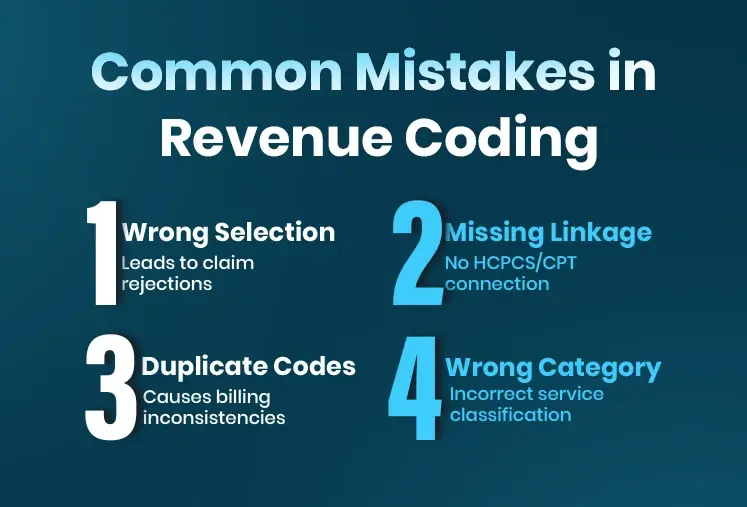
Incorrect assignment of revenue codes in medical billing happens due to incorrect allocation of services to wrong departments or categories. Such mistakes will result in rejected claims and slow down the payment process. Proper coding entails having a sound knowledge of the types of services and the departments within hospitals.
Missing HCPCS/CPT Linkage
Lack of association between what is rev code and the HCPCS/CPT code means that claims will not be complete. Both Medicare and insurance companies require procedure-based information to verify that services have been provided. In case there is no association, claims might be rejected or put on hold.
Duplicate or Mismatched Codes
Repetition or inconsistency of what is known as revenue codes in the medical billing process causes problems during the billing process. It can lead to overbilling or delay in payments. Checking and verifying the codes guarantee that each service has its unique code and corresponds with other services.
Billing Under Wrong Category
Incorrect billings due to the improper use of the revenue code list category give an inaccurate description of the kind of services delivered, for example, an outpatient versus inpatient case. The end result is inaccurate claims processing. It is very crucial to classify services in the right revenue code list category.
Best Practices for Accurate Revenue Coding
Best revenue coding practices lead to accurate coding, minimize denials, and guarantee proper health care billing processes.
Regular Training and Updates
Revenue code training on a regular basis will ensure that the billing personnel are always up-to-date with any changes in the rules and regulations associated with the process of revenue coding. Revenue code training will improve the accuracy of claims processing, reduce error rates, and increase knowledge about hospital billing processes.
Use of Billing Software and Audits
High-end billing software enables proper billing of revenue codes in medical billing through automation of charge capturing and minimization of mistakes due to manual errors. Audits reveal any discrepancies, broken links, and wrong coding. In conjunction, both processes make the process more efficient and compliant, resulting in consistent payment processing.
Staying Compliant with Medicare Guidelines
It is important to comply with the Medicare revenue codes because this will prevent denial of claims and penalties. Healthcare providers should adhere to the coding process guidelines set by Medicare. Compliance with guidelines guarantees that the organization receives the appropriate payment for services offered.
Cross-checking Claims Before Submission
Checking the hospital billing codes against one another prior to submitting the claims will aid in identifying any errors or missing codes. This is the last step that will ensure that the process is done properly and that there are no mistakes in the billing information submitted.
How Stream RCM Help with Revenue Code in Medical Billing
The Stream RCM assists in optimizing the revenue code through proper charge capturing, appropriate coding, and adherence to payer requirements in the healthcare billing process. The use of automated technology ensures efficiency, accuracy, and timely claims submission. Through efficient workflows and audits, the Stream RCM improves financial outcomes while minimizing claim denials.
FAQs
What is a revenue code in medical billing?
A medical billing revenue code is a code that indicates which department or service a person received care. It aids in grouping hospital bills to facilitate correct billing, processing claims and insurance payments as well as government healthcare programs.
What is the purpose of revenue codes?
Revenue codes classify hospital services into standard categories so that there is a clear communication between the provider and the payers. They enhance accuracy in billing, assist in validating claims, and aid in calculating the right reimbursement of services provided in healthcare facilities.
How are revenue codes different from CPT codes?
Service locations or departments are categorized by revenue code and specific medical procedures or services are outlined by CPT code. They collectively record full claim information, making sure that they are properly billed, documented and the insurance reimbursement decisions made correctly.
What are common revenue code categories?
There are categories of common revenue codes such as room and board, laboratory, radiology, pharmacy, emergency services, surgery, and outpatient care. All categories correspond to particular hospital services, which can facilitate the billing process and make the claims handling more efficient.
Why are revenue codes important in Medicare billing?
Revenue codes are used by Medicare to categorize the services and provide proper reimbursement. They should be connected with HCPCS codes to validate the claims. Proper usage prevents rejections, helps in adherence and makes payments on time.
What happens if revenue codes are incorrect?
Inappropriate revenue codes can lead to claim denial, payment delays, or auditing. These will lead to inconsistencies in billing information, which will affect the level of reimbursement. The financial and regulatory challenges in the billing process can be avoided with correct codes and proper coding review processes.