

Medical billing denial codes play an important role in identifying why insurance claims are rejected, denied or adjusted during reimbursement claim processing. Among them, the CO-22 denial code is of particular importance because it often signals coordination of benefits, duplicate claims, or contractual obligation issues that directly affect provider payments and billing accuracy.
Understanding the CO-22 denial code assists medical providers and billing departments minimize claim rejections, advance cash flow, and update revenue cycle management. This blog will explain the meaning of denial code CO-22, its common causes, insurance benefits overlap issues, how a medical billing company in USA handles claims, differences between CO-22 and PR-22, and proven strategies to fix and prevent future denials.
CO-22 Denial Code in Medical Billing
The CO-22 denial code in medical billing demonstrates that the payment adjustment is based on contractual obligations between the healthcare provider and the insurance payer. This denial is a common occurrence when a claim has already been paid, processed inaccurately, or involves coordination with another insurance plan before reimbursement can be completed.
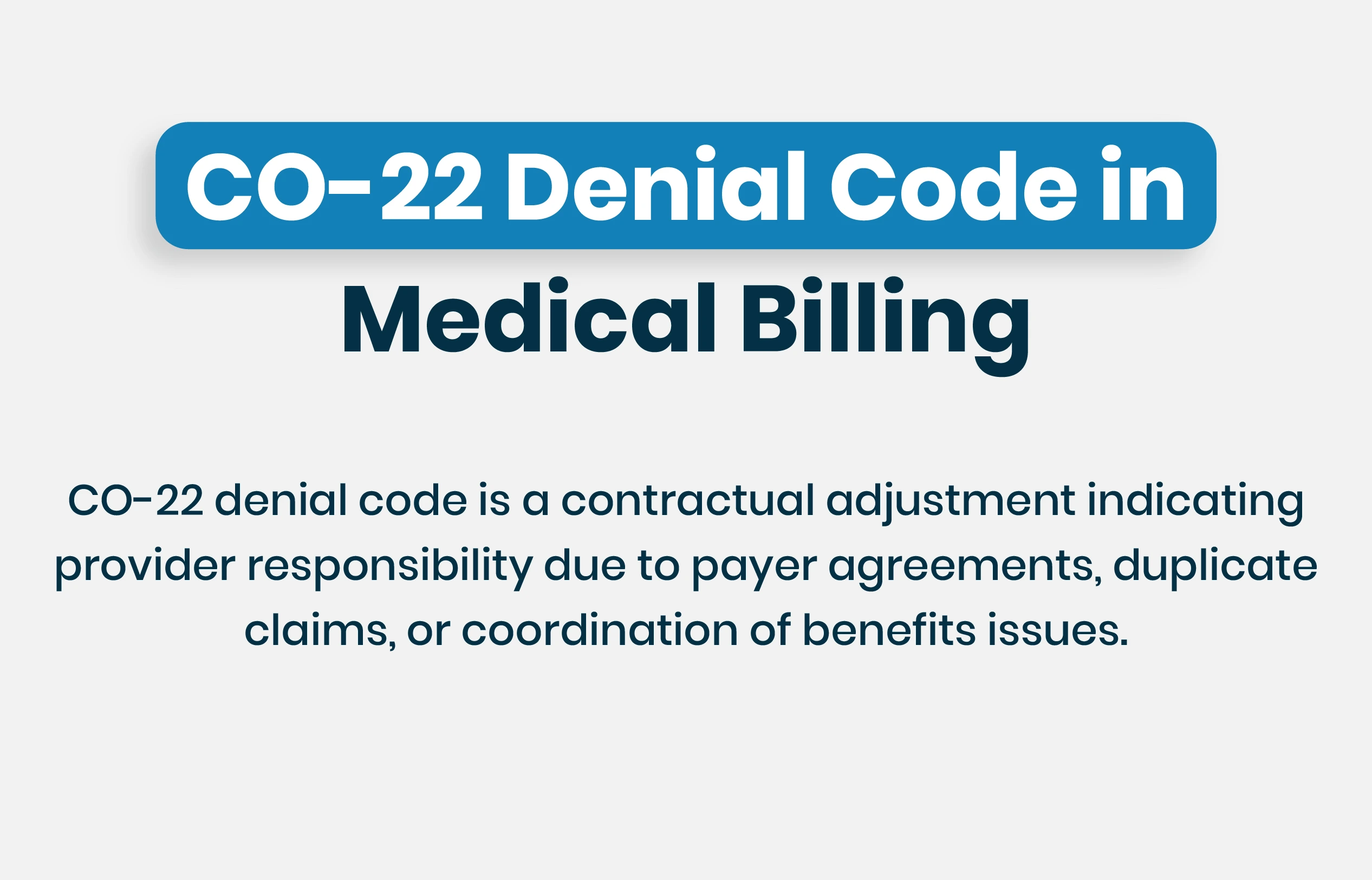
In medical billing, the term co 22 denial code description is used to designate a contractual adjustment where the provider cannot bill the patient for the denied amount. “CO” stands for Contractual Obligation which means that the provider must absorb the adjustment according to the payer agreement, dissimilar to patient-responsibility denials that shifts the financial burden to the insured individual.
Recognizing the difference between pr 22 denial code description and CO-22 is essential for precise denial management. CO codes represent provider responsibility, whereas PR codes indicate patient responsibility, and OA codes are related to other adjustments which are not assigned to either party. Correctly identifying these categories contributes to minimizing claim errors for billing teams and improving reimbursement efficiency.
Expert Guide: Always verify primary and secondary insurance details before claim submission to prevent CO-22 denials. Regularly assess payer contracts and EOBs to identify contractual adjustments and minimize reimbursement delays professionally.
Common Reasons for CO-22 Denial Code
The CO-22 denial code can happen due to billing inaccuracies, coverage conflicts, authorization problems, or payer policy violations that interrupt correct claim reimbursement and processing workflows.
Duplicate Claim Submission
One primary cause of the co-22 denial code is submitting the same claim multiple times to the insurance payer. Duplicate submissions often occur because of delayed payer responses, system errors, or manual resubmissions. Insurance companies generally reject these repeated submissions to prevent duplicate reimbursements and avoidable payment processing delays.
Incorrect Billing or Coding Errors
Code co 22 under the denial code may arise when there is any incorrect entry of CPT codes, Understanding ICD-10-CM medical diagnosis coding system, modifiers, or incorrect information about the patient. Even the smallest error in documentation can lead to claim denials. It is therefore necessary that coding should be accurate for successful claim processing.
Services Not Covered Under Payer Contract
Code CO 22 denial may have some relation to the services that fall outside of those covered by the provider’s insurance company or by virtue of their contract. When there are services that are not covered under the healthcare provider’s insurance plan, there is an adjustment made because of contractual obligation.
Missing or Incorrect Prior Authorization
The absence or non-conformity of authorization could lead to CO22 denial code explanations in insurance claims. Most payers’ demand authorization for certain types of services, diagnosis, or treatment. The lack of authorization may lead to claim denials, making it necessary for the provider to cover the cost of providing the service.
Timely Filing Issues
Co 22 denial code also occurs when there is a failure to submit claims before the filing deadline of the insurer. Each insurance firm provides timelines within which claims should be presented. Failure of providers to provide timely documents or delays due to lack of information may lead to such adjustments.
Coordination of Benefits (COB) Problems
Improper claims sequencing between insurers is another major reason behind the co 22 denial code. Coordination of Benefits issues occur during claim submission by billing staff to the wrong primary payer or fail to update secondary insurance details. Accurate insurance verification and COB management are necessary to prevent payment conflicts and claim denials.
Apply COB Rules to Identify Alternative Payers for Coverage
Coordination of Benefits rules help healthcare providers identify the correct insurance payer, minimize claim conflicts, and avoid reimbursement delays connected with CO-22 denial code errors.
What Coordination of Benefits (COB) Means in Medical Billing
Coordination of Benefits is involved in medical billing to identify which insurance provider must pay for claims first in cases where patients have more than one insurance plan. This CO-22 rejection code often arises when billers do not conduct COB validation before submitting their claims, which is why many providers rely on outsourced medical billing services to ensure accurate verification and reduce denial risks.
How COB Rules Determine Primary vs Secondary Insurance
The criteria set out by COB help determine the role of the insurance policy as either primary, secondary, or tertiary depending on whether a patient is employed, his age, dependent status, and even the policyholder. Having a good knowledge of these payer sequence policies helps prevent denial codes co 22.
Check Patient Insurance Eligibility
The verification of a patient’s eligibility prior to treatment makes sure that the insurance is still active, and there is correct information regarding the payer. The co 22 denial code description often indicates that the insurance information has expired. Checking the eligibility makes it possible for providers to verify the insurance benefits.
Verify Multiple Active Insurance Plans
It is important that the billing personnel verify whether the patient has other insurances besides the one currently being submitted for claims. Several reasons for denial codes involve inaccurate documentation of the secondary insurance information, which can cause problems regarding payment process flow and payers’ communication among others.
Review Payer Hierarchy Rules
It is necessary for a person to understand the payer hierarchy principles in determining which type of insurance will cover the claim – primary, secondary, or tertiary insurance. The denial code co 22 can be seen if there are some issues related to payer hierarchy guidelines followed by the provider.
How Incorrect COB Leads to CO-22 Denial
Inaccurate Information about Coordination of Benefits could lead to claims being denied, late reimbursement, or payment correction. The reason for denying a claim using the code CO 22 is usually incorrect coding where the primary insurance is incorrectly charged, or there is no information about the secondary insurer, often requiring professional medical coding services to ensure accurate claim submission and proper coordination of benefits.
Correcting COB Information Before Resubmitting Claims
Before submitting claims that have been denied again, it is important that the providers check the insurance information, update the payer order, and verify that the policy information is correct. COB corrections that resolve any issues associated with the co-22 denial code can enhance chances of successful submissions.
When to Bill Secondary Insurance After Primary Denial
Secondary insurance should only be charged after processing by the first insurer or rejection based on COB rules. Violation of this order may result in denial code co22 changes. The Explanation of Benefits from the first insurer should be submitted alongside the claims sent to the second insurer.
Importance of Accurate Patient Insurance Data Collection
The gathering of comprehensive and correct insurance information at the time of registration by patients is key to avoid any challenges during the process of claims settlement. Code 22 co insurance denial code description may arise because of incomplete policy numbers, expired policy information, or lack of information about the payer.
Professional Advice: Always confirm and update Coordination of Benefits (COB) details before claim submission to certify correct payer sequencing. Precise insurance data and eligibility checks support prevent CO-22 denials and improve timely reimbursement.
Impact of CO-22 Denials on Providers
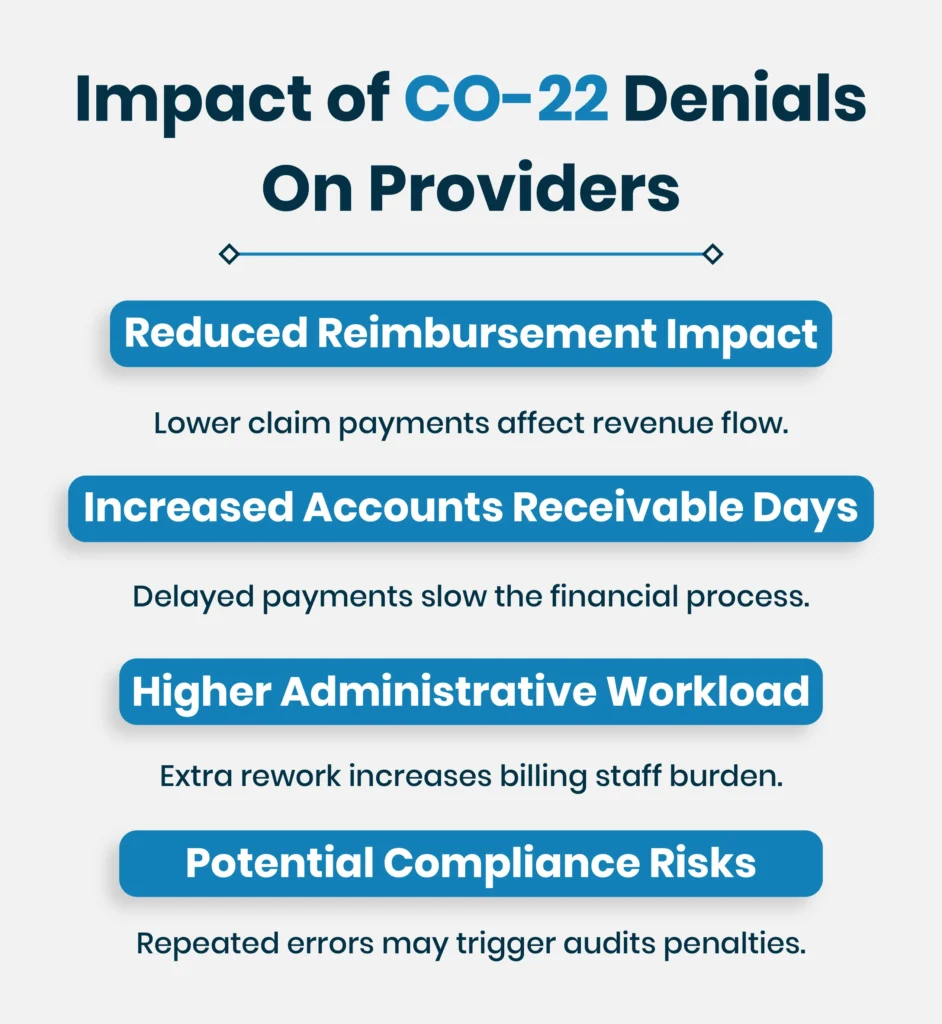
Denials of CO-22 claims may adversely impact health care institutions through delayed payments, increased costs of operation, and administrative complexities in the revenue cycle management process.
Reduced Reimbursement
The co-22 denial code has a major effect on the amount that is paid to a medical facility because of the various reasons why the claim can be rejected. The reduction in payments affects healthcare funding and its financial standing. Rejection of claims often limits the availability of funds for smooth operations.
Increased AR (Accounts Receivable) Days
The high occurrence of denied claim codes CO22 often results in higher Accounts Receivable days because the claims take a long time to be paid. The delayed payments require that the billing staff spends a lot of time monitoring the claim status, as well as communication with insurance companies.
Administrative Workload for Rework and Resubmission
The description for denial code co 22 involves more work that may arise from correcting claims, evaluating documents, and communicating with payers. The billing staff must look into the denial cause, revise the claim information, and reprocess it. This process takes up more time, hence decreasing the efficiency of the billing department.
Potential Compliance Risks
Repetition of the denial codes for co22 may place health care professionals at risk of compliance issues if the same billing mistakes, improper coding, or incorrect claim filing persists unresolved. In addition, non-compliance with payer rules and guidelines could result in audits, fines, or legal issues.
Step-by-Step Process to Fix CO-22 Denial Code
The resolution of CO-22 denials involves claim analysis, accurate correction, and good communication with payers to enhance the likelihood of successful reimbursement and prevent rejections in subsequent claims submissions.
Identify the Root Cause in EOB (Explanation of Benefits)
Before anything else, the very first thing that needs to be done to solve the CO-22 denial code issue is analyzing the Explanation of Benefits (EOB). The EOB can give you the specific reason why there was a denial. It could either be due to contract adjustment, duplicate claim, COB conflict, or lack of information.
Verify Claim Submission History
Examining the submission history can assist the provider to ascertain whether there were earlier submissions for that particular claim, whether it was denied before, and even whether there were multiple submissions. The co22 denial codes have been known to arise as a result of duplicate submissions or other computer system errors.
Correct Coding or Billing Errors
The wrong coding for CPTs, ICD-10 codes, modifiers, or the patient can be fixed right away once the denial analysis is done. The description for the denial code 22 co usually signifies a coding error that breaks the rules of the payor’s policy. Proper claim correction increases the probability of correct payment.
Attach Required Documentation (If Applicable)
The following types of documentation such as patient medical records, referrals, authorizations, and even previous Explanation of Benefit statements may be required in order to understand the co22 denial reasons. Documentation errors result in claim delays and nonpayment. It is important to provide all the correct documents in order to validate claims and get payments.
Resubmit Corrected Claim or File Appeal
Once these errors are sorted out, they must retransmit the claim or make an appeal if required. In this case, the denial code co 22 may need more information to be provided. It will help avoid further delays in payments and increase the efficiency of claim processing.
Follow Up with Payer
Follow-up by the payer is crucial in determining the status of the claim and ensuring that the corrected claim is processed efficiently. The co 22 denial code description might continue to be unclear if the providers do not follow up on the response from the payer.
Expert Insight: To resolve CO-22 denials faster, always start with EOB analysis, correct COB or coding errors, attach complete documentation, and follow up with the payer after resubmission to ensure timely claim processing and payment.
How to Prevent CO-22 Denials in the Future
Prevention of CO-22 denials entails proactive billing methods, proper documentation, and sound verification procedures to enhance acceptance of claims and ensure a smooth revenue cycle.
Implement Claim Scrubbing Before Submission
Claim scrubbing is a technique for identifying any billing mistakes, data gaps, or coding errors before the claims reach insurance carriers. It is possible to be protected from receiving the co-22 denial code by conducting an automated check of the claims to find any duplicates, erroneous codes, or incomplete information.
Use Correct CPT, ICD-10, and Modifiers
Coding for medical claims needs to be done correctly to reduce denial codes co 22. It is important that providers make sure their CPT procedure codes, ICD-10 diagnosis codes, and billing modifiers correspond to their medical procedures. Proper medical coding compliance will minimize any disputes from payers, and reduce denials.
Verify Eligibility and Coverage in Advance
Eligibility confirmation prior to service confirms that the provider identifies current insurance information, the restrictions and requirements specified in the policy, and the payor guidelines. The co 22 denial description commonly occurs as a result of using old insurance information or providing a service not covered under insurance benefits.
Ensure Prior Authorization Is Obtained
It is important to have the prior authorization before conducting some of the medical procedures because the insurance companies use the co22 denial code if this is not done. Some of the insurance companies will ask you to seek authorization before conducting specific tests and medical procedures.
Train Billing Staff Regularly
The consistent training of employees keeps the billing team aware of the policies, changes in codes, and denial processes. One example is the denial code co 22, which may be due to outdated billing or documentation issues. Continuous training will help reduce denial trends among healthcare facilities.
Use Automated Denial Management Tools
The automated system of denial management facilitates monitoring and solving the problems associated with denial trends, as well as handling any delayed payments. In order to reduce co 22 denial codes, automation can help in identifying billing problems, detecting missing information, and facilitating the correction and resubmission of the claims.
CO-22 vs PR-22 Denial Code
Understanding the difference between the co-22 denial code and PR-22 denial code is important in defining financial responsibility during claim processing. CO-22 represents a contractual obligation adjustment where the provider is financially responsible and cannot hold the patient responsible for the denied amount. In contrast, PR-22 indicates patient responsibility, meaning the patient may be required to pay the outstanding balance according to their insurance policy terms.
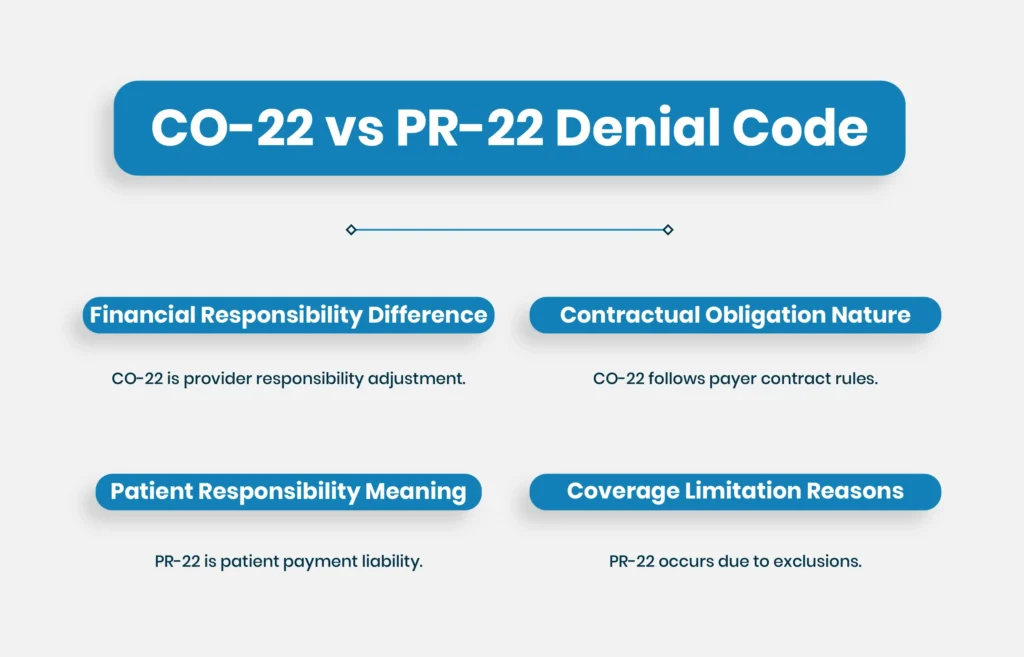
The pr 22 denial code description commonly occurs when services are not covered under the patient’s plan, deductible requirements are unmet, or limitations are specified by the policy. As an illustration, when a healthcare provider bills for a service excluded by payer contract terms, it may result in CO-22 denial. However, if the patient receives a non-covered elective service, the denial may fall under PR-22 which makes the patient financially responsible for payment.
Best Practices for Denial Management
Putting effective denial management services and strategies into practice helps healthcare providers minimize claim rejections, advance reimbursement rates, and strengthen complete revenue cycle performance. A standardized denial tracking system which allows billing teams to monitor recurring issues, recognize patterns, and resolve claim errors before they negatively impact financial operations and cash flow.
An ongoing analysis of trends in denials is vital in reducing the occurrence of co-22 denial codes and improving billing efficiency. Payer reports, coding mistakes, authorizations, and issues related to the Coordination of Benefits must be considered by medical practices when trying to find out why they experience repeat denials or double denials.
Improving communication with payers and strengthening initial eligibility verification processes can meaningfully minimize denial code co 22 manifestations. Accurate patient registration, determination of eligibility for coverage and conducting authorization checks will help avoid mistakes in claims submission. Open lines of communication between healthcare providers and insurance companies can assist providers in handling disputes effectively.
How Stream RCM support with CO-22 Denials
Stream RCM provides the healthcare industry with solutions to successfully manage the co-22 denial code with the help of their complete range of revenue cycle management services. They identify the actual reasons for denials like COB issues, duplication of claims, and lack of authorizations, which enables the claims to be corrected and resubmitted, thus reducing AR days and increasing the rates of payments.
FAQs
What does CO-22 denial code mean in medical billing?
Co-22 denial is used when there is an adjustment in contractual obligation, and the practitioner does not charge the individual patient for the rejected amount. This type of denial generally results from COB problems, duplications in billing, and billing mistakes.
Why does CO-22 denial code occur?
The denial code of co22 happens because of various reasons, such as claim duplication, wrong coding, lack of prior authorization, late submission of claims, and coordination of benefits problems. The above-listed problems force the payer to reject or modify claims according to the contract and billing policy.
Can patients be billed for CO-22 denials?
However, according to the code CO-22 denial description, this adjustment would be classified as being the responsibility of the service provider. In most cases, patients cannot be charged for any CO-22 payments since this is covered by their contract with the payer.
How is CO-22 different from PR-22?
The description of pr 22 denial code identifies the patient’s financial liability, while that of CO-22 belongs to the provider. Codes that start with CO involve any changes made under a contract, and PR involves any liability by the patient.
How can CO-22 denials be prevented?
Denial codes CO-22 can be avoided through the verification of eligibility, proper coding, obtaining authorization, and claim scrubbing techniques. Coordinating benefits and gathering accurate insurance information from patients is another measure to avoid denial codes CO-22 in the billing process.
What should be done after receiving a CO-22 denial?
After getting a co-22 denial code, the service provider needs to check the EOB, identify the errors, fix the billing or coding issues, provide required documents, and resubmit the claim. If necessary, contacting the payer is essential.